Black Diamonds ─Taiwan’s Bamboo Charcoal
Chen Chun-fang / photos Chuang Kung-ju / tr. by Geoff Hegarty and Sophia Chen
June 2016
The bamboo plant is omnipresent throughout Taiwan’s varied landscape, from plains to mountains. And the best environment for the rapid growth for which bamboo is renowned is in mid-elevation mountain areas. But while it takes only a year for bamboo to grow to full height, it takes three years for it to mature into a useful resource. As forestry products in general are becoming ever more scarce, bamboo has increased in popularity as a substitute for wood in products worldwide. Another use for bamboo in the old days was as a fuel, and today it’s again being burned—this time to produce charcoal. How is it done? Let’s take a peek at the secrets of transforming these exotic green plants into “black diamonds”—bamboo charcoal.
Taiwan has a long history of charcoal production, but the bamboo charcoal industry was launched only after the 921 earthquake in 1999. Bamboo has always been used as a strong building material and for furniture. In fact Taiwan’s fine bamboo products have been exported worldwide.
But in the 1990s, with the rise of new types of plastic products, the demand for bamboo declined sharply and Taiwan’s bamboo industry fell into depression. Then in 1999, the 921 earthquake hit Taiwan’s central region hard, affecting areas that had supported the densest of Taiwan’s bamboo groves. The earthquake sent waves through the bamboo industry and much damage was done. The prospects for the industry were fading.
In 2002, in order to revive the industry in the earthquake disaster zone, the Forestry Bureau and the Taiwan Forestry Research Institute worked with the Industrial Technology Research Institute to establish an R&D team to draw up a revitalization plan for the bamboo industry. The goal was to create new avenues for development of the industry through the production of bamboo charcoal.

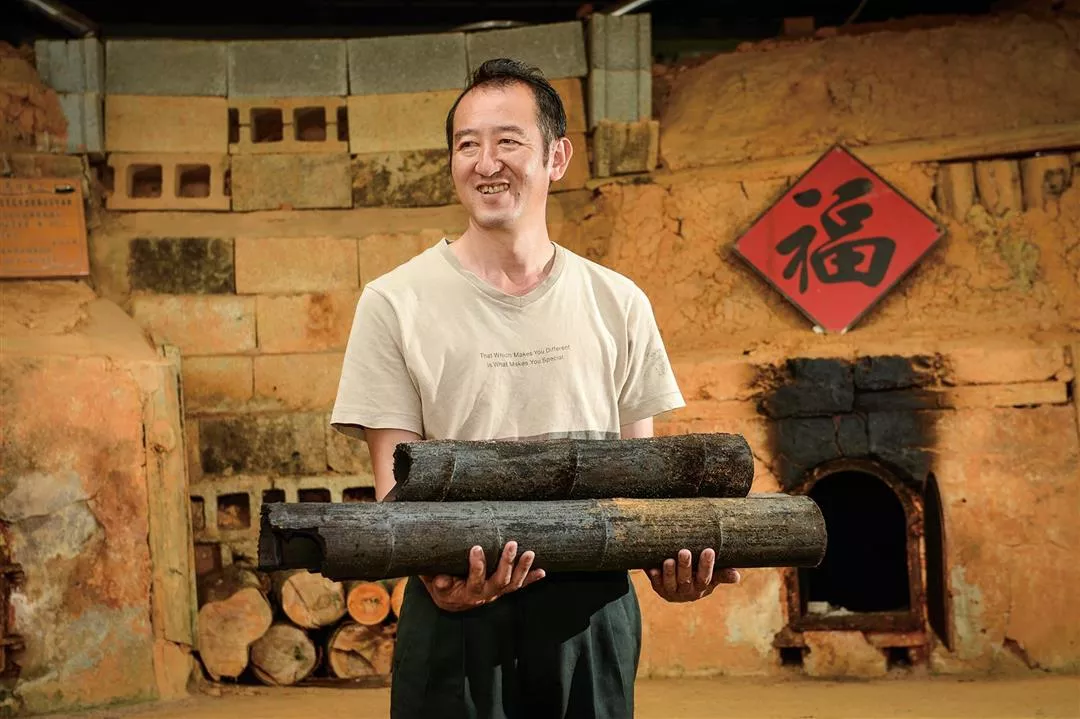
Lin Jianxun, manager of Wuxiu Bamboo Charcoal Kiln, retains the traditional kiln for making charcoal. The charcoal in his hands is the result of accumulated skill and experience.
Japan’s bamboo charcoal master
In Japan, bamboo charcoal is known and valued as “black diamonds.” With its porous structure, its ability to trap impurities and its resistance to high temperatures, charcoal can improve the quality of soil and its water retention capacity, and has been claimed to emit “far infrared rays,” with supposed health benefits. The R&D team extended a number of invitations to Japanese charcoal experts, trying to attract them to Taiwan to share the technologies of charcoal kilns and bamboo carbonization—but without success. However, one of the key researchers, Dr. Chen Wen-chi, persisted with the idea and made several trips to visit Japan’s bamboo charcoal master, Akemi Toba. Chen’s sincerity moved Toba to help, and he finally agreed to come to Taiwan. Blending modern technology with traditional techniques, the team built Taiwan’s first bamboo charcoal kiln, enhancing traditional methods of bamboo carbonization along the way to successfully produce their first batch of bamboo charcoal.

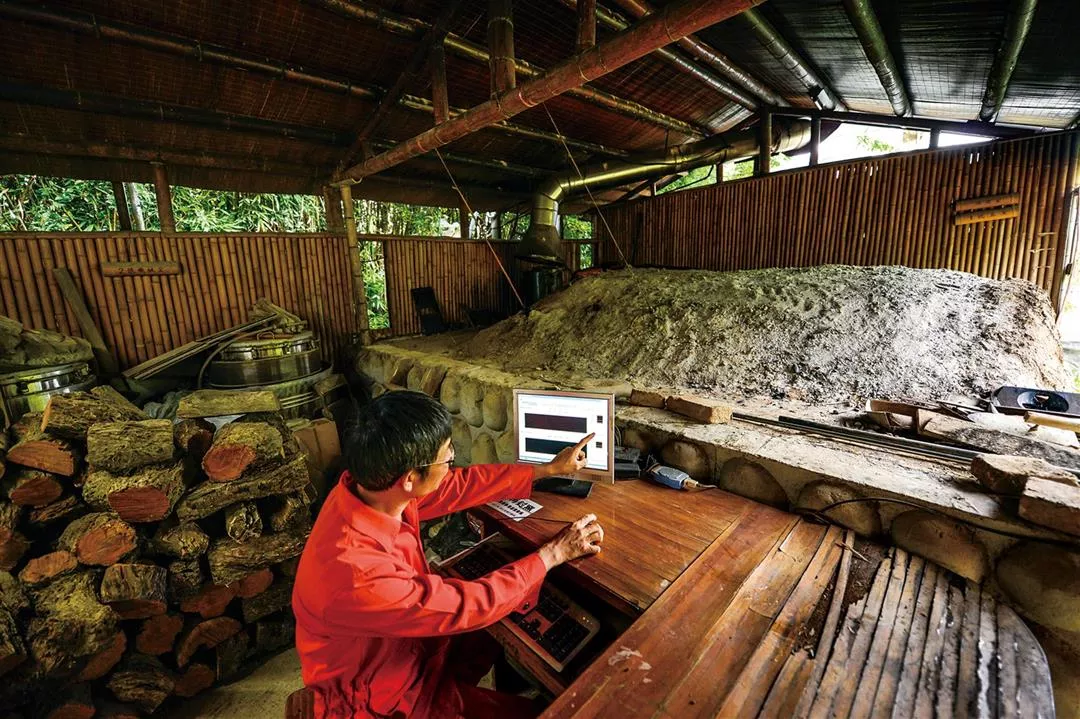
With thermocouples inside the kiln connected to a computer, ITRI is able to remotely monitor firing temperatures. The use of modern technology to manage traditional bamboo charcoal making has helped maintain high standards, and the products have been very well received.
Technology transfer
After this success, the government researchers planned to transfer the technology to bamboo farmers. The Wuxiu Bamboo Charcoal Kiln in Nantou County was one of the earliest to adopt the new ideas. They built their kiln in 2002, and now the company’s management has passed on its skills to a second generation. The current manager of the kiln, Lin Jianxun, explains the complexities of the operation: “Making bamboo charcoal may appear simple enough. After all, we acquired the technology from the government. But in fact the success of our operation is the result of many intricate processes and a lot of accumulated experience: choosing the right type of bamboo at the right time, cutting it properly, and then bundling and stacking it in the right way.”
Much of Taiwan’s bamboo, like the moso variety (Phyllostachys edulis) grown in central Taiwan, has a thick trunk which is generally suitable for making charcoal—but only plants that are more than four years old can be used. It requires a great deal of experience to know how to cut the right poles of bamboo from a dense grove without affecting the growth of other stems and shoots.
Also located in Nantou is the Bamboo Paradise Resort, which now runs two kilns, a spin-off of the work done by the R&D team. Resort manager David Chen has previous experience with bamboo art and craft design. His original involvement with bamboo for his creative work led him to a deep understanding of the material and its qualities. He hated watching the slow decline of Taiwan’s bamboo industry, so he organized bamboo farmers to establish the Bamboo Paradise Resort in 1997, hoping to continue and sustain Taiwan’s bamboo culture in some form.
They grew over 100 varieties of bamboo at the resort, which is why the R&D team invited Chen to participate in the operation to transfer technology to the farmers. As a result of this collaboration, the resort built two bamboo charcoal kilns with updated technology and management skills.
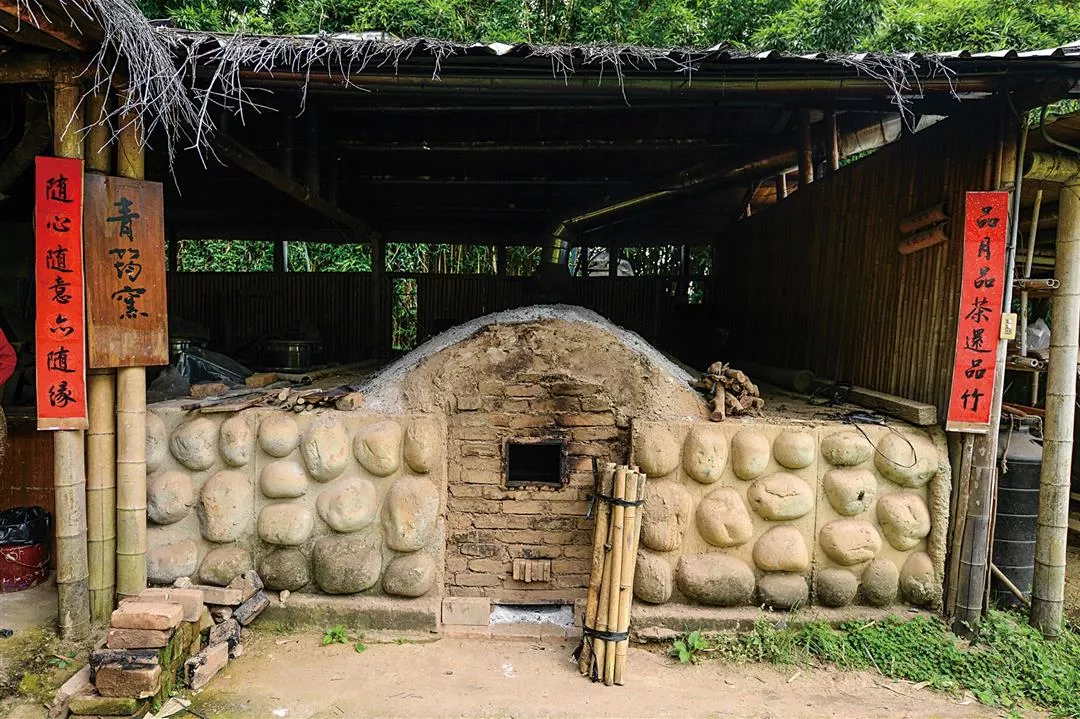
In order to preserve bamboo culture, David Chen established Bamboo Paradise Resort and built two charcoal kilns, becoming one of the pioneer bamboo charcoal producers in Taiwan.

Not as simple as it looks
In order to increase efficiency, the bamboo trunks must be cut into pieces which are then bound firmly together with cotton cord. The bundles pass through a fumigation process and air drying to reduce moisture content to 15%, which takes about three months all up. Then the bamboo is fed into the kiln to create charcoal.
Bundles of bamboo in the kiln are kept at a relatively low temperature for four to five days to build up heat. This is followed by a constant high heat for seven days, and when the temperature reaches the 600°C mark, the kiln is sealed for 14 days.

Producing bamboo charcoal may seem simple, but it is in fact a complex process. Careful selection and cutting of the right bamboo, stacking, binding, fumigating, and air drying are all steps that require skill and care.
Added value
Thermocouples inside the kiln are connected to a computer, enabling ITRI to remotely monitor the temperature for quality control purposes.
The use of modern technology to manage traditional bamboo charcoal making has helped maintain high quality standards, helping to establish Taiwan’s global reputation as a leading charcoal producer. Due to excellent scientific and technological research in the area, the Taiwan Ecocarbon Industrial Development Association was invited to attend the 2005 World Expo held in Aichi, Japan, despite the fact that Taiwan wasn’t an International Exhibitions Bureau member. A number of products derived from bamboo charcoal were displayed at the expo, including textiles and a charcoal-based desalination plant.
After this successful World Expo experience, Taiwan’s bamboo charcoal attracted attention from other countries, resulting in an invitation for a number of Taiwan’s bamboo charcoal experts to visit the US, Japan and Thailand to share their expertise.
Lin Jianxun recalls changes in the bamboo industry over the past decade. “Initially, I was only producing a small number of bamboo charcoal products, but gradually a number of universities and companies became interested in what we were doing. So the industry has expanded dramatically.” Applications today cover a wide range of products such as bamboo charcoal deodorizer, noodles, and textile yarns, and even extend to medical treatments such as kidney dialysis. As a result of collaboration between the bamboo industry, government agencies and academia, the green bamboo stalks of Taiwan’s mountains are magically turning into glittering black diamonds.

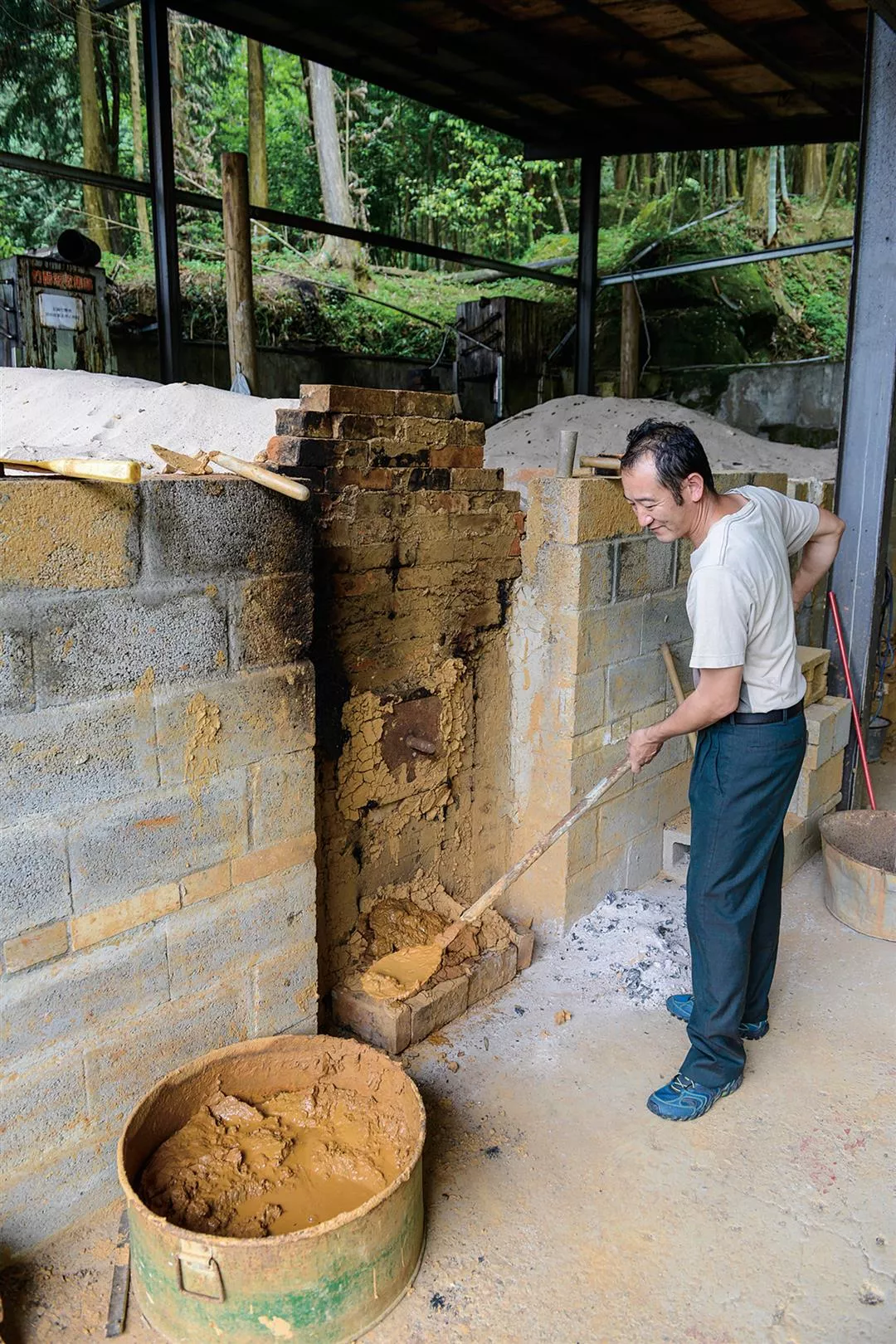
After constant heat above 600°C, the kiln is sealed with clay. It takes 14 days for the bamboo charcoal to slowly cool.

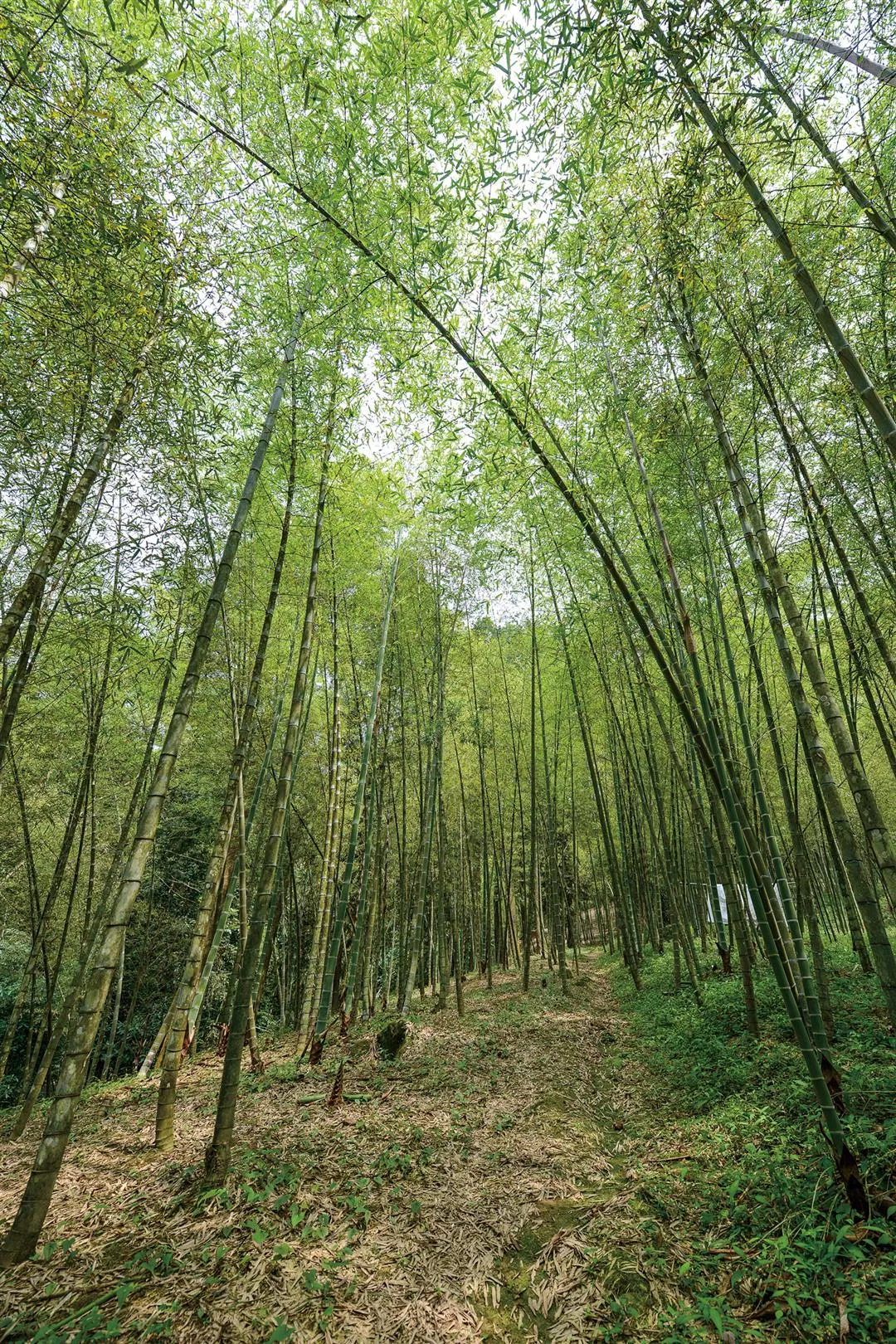
Through the efforts of many, glistening bamboo from the mountains is transformed into “black diamonds,” bringing hope for the bamboo industry.