Agents-- Giving Athletes a Sporting Chance
Vito Lee / photos Chuang Kung-ju / tr. by Christopher J. Findler
May 2007


Agents are the entrepreneurs of pro-fessional sports. The playing field or court is their market, athletes their products, and their silver tongues the tools of the trade. They represent players in negotiations with their ball clubs to get them the best in terms of contracts, pay, signing bonuses, options.... To keep clients in the public eye, they feed the media's insatiable curiosity for celebrities and search for opportunities for endorsing products and serving as spokespeople for charities.
In this the age of sports commercialization, the media is the sports agent's ultimate creator. Globalization is propelling sporting events in countries around the world to go professional and Taiwan is no exception. At this point, most agents, members of a profession that frankly hasn't been around very long, give outside observers the impression that they're more opportunists than anything, but as sports becomes increasingly big business, sports agent services are becoming increasingly professional. But how can they make players, clubs, and themselves all winners?
After the Rockies released him late last year, Tsao Chin-hui had to go job hunting. The Yankees' new champion pitcher Wang Chien-ming was preparing to talk salary. Spring was still around the corner, cities around North America were in the process of thawing out, and big-league umpires had yet to shout those soul-stirring words, "Play ball!" But across the Pacific in Taiwan, fans were already riveted to preseason activities featuring their favorite sons--two topnotch pitchers in American Major League Baseball (MLB). Whether or not tennis star Lu Yen-hsun would represent Chinese Taipei in the Davis Cup was also still a hot topic.
Would unresolved matters affect the performance of these outstanding athletes? The answer: a resounding "no." The reason: all three of them have agents that represent them in handling everything from finding new clubs and salary negotiations to whether or not they should be remunerated as a member of the national team. In the highly specialized world of professional sports, Wang and Tsao have more than enough to keep them occupied, like improving fastball speeds and strike-to-ball ratios. As for Lu, the accuracy of his serve will be critical for him this year.
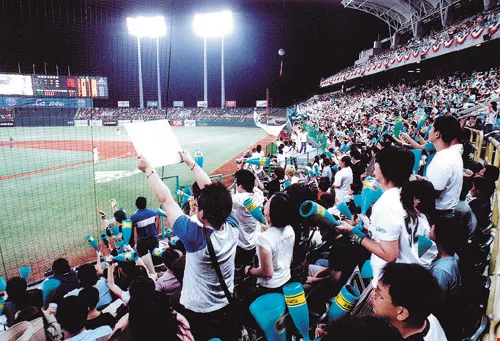
The Chinese Professional Baseball League, which previously refused to become involved in the player trading system and agents, is now changing its attitude. It is likely that a free agent system will be adopted in the near future.
The movie Jerry Maguire portrays professional sports correctly in that if you perform well, your agent will be able to "show you the money"! In America, practically the cradle of professional sports, top athletes are frequently managed by the best agents. When superstar athletes reach the top and rake in the big bucks, the agents that helped get them there are also ranked as superstars in their own right.
The most famous agent in MLB today is Scott Boras, president of Scott Boras Corporation (SBC), who has a doctorate in law and was once a ballplayer himself. With him in charge of negotiations with ball clubs, players tend to hold all the cards. Some in the industry regard him as a vampire that sucks clubs dry. They are concerned that by driving up prices and inflating player worth, Boras is adversely impacting professional baseball, possibly, some say, to the point of destruction.
Just how much influence does this superstar agent really have? Of MLB's almost 900 athletes this year, Boras' agency is in charge of 60, the majority first-string players in the primes of their careers. Twenty of his players have played in MLB all-star games and enjoy salaries averaging in excess of US$7 million (NT$220 million). According to estimates based on the average 4-6% commissions that agents (or agencies) in the industry receive, Boras' annual salary should be somewhere in the neighborhood of a cool US$10 million.
In the National Basketball Association, bloodthirsty independent agent Andy Miller is a big headache for ball clubs. His opus maximus: stunning the sports world by getting then-21-year-old Kevin Garnett an unprecedented seven-year, US$126-million contract in 1997.
So what's the draw? How do they squeeze so many big names under their wings? After years of being plagued by injuries and being shuttled from team to team, Tsao Chin-hui signed on with SBC in March of 2004. This finally gave him a taste of the kind of treatment that big agents can provide.
In 2004, Tsao was still wearing a Colorado Rockies uniform, but he wanted to pitch for Chinese Taipei in the upcoming Olympics that July. But the Rockies hesitated to permit Tsao, who was just coming back from a hand injury, to play. About this time, SBC's representative in Taiwan, Chung Mung-wen, received an overseas phone call.
"Tsao Chin-hui underwent reconstructive surgery on a ligament in his hand in 2001. It took him a year to recover and step back on the mound. So the Rockies told the Chinese Taipei Baseball Association, the organization in charge of Chinese Taipei's Olympic baseball team, that if Chinese Taipei wanted Tsao to play for them, he must abide by the Rockies' rules limiting appearances and number of pitches," Chung says. These restrictions would make it difficult for CTBA general manager Hsu Sheng-ming to arrange his rotation, so he notified the Rockies that he was considering not using Tsao.
Tsao wasn't ready to give up, though. He wanted to represent his country (and thereby also shorten his mandatory military service), and requested that Chung negotiate with the Rockies through his agency. SBC asked a sports injury specialist to examine Tsao. He concluded that "playing for Chinese Taipei would not aggravate the injury." The Rockies were notified of the doctor's findings.
"Then SBC flexed its muscles by having Boras use his personal relationship with the Rockies to show how much influence SBC had in US professional baseball. Tsao was finally allowed to go," explains an individual from the CTBA who witnessed the whole episode unfold.
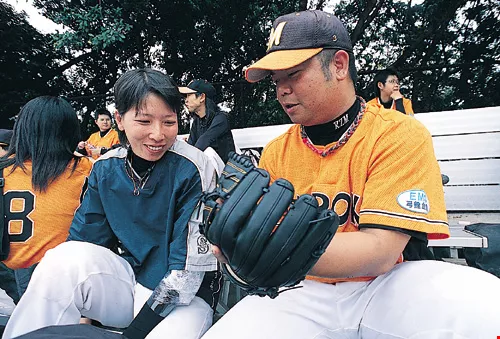
Chung Meng-wen (right) has gone from baseball player to baseball fan to baseball agent. To him, baseball is both work and play. In the photo, Chung is giving pointers at the National Women's Baseball Tournament in April.
An agent's toolbox consists of relationships, pleading their clients' cases, and when need be, muscle-flexing and saber-rattling. The game played by the sports agent is no less competitive and exciting than the one played on the field. But what exactly does a sports agent do?
Just like the agents of silver-screen celebrities, "sports agents generally make their livings off of commissions. The more their clients make, the more they make," Chung explains. The purpose of the agent is to help athletes reach their full potential both athletically and financially. "We at SBC, for instance, do all we can to handle everything 'off the field' for our clients."
"Some agents go the extra mile, taking care of all kinds of business, both official and personal, including problems with personal relationships, buying vehicles, and finding houses. They do things as trivial as obtaining game tickets for their client's friends and family and as important as managing their client's wealth. Agents, therefore, not only have to be on good terms with various teams and be familiar with the sports world, they must know the 'rules of the game' and the culture inside out," Chung continues. Their main focus, however, is still the client's professional sports career, especially salary negotiations and endorsement contracts.
Once the Olympics were over, Tsao Chin-hui returned to the Rockies and played for them on a regular basis, but just as the 2005 season was opening, it was announced that Tsao was once again injured and could not take to the field. Tsao couldn't decide whether to undergo surgery again.
SBC once again dispatched the company's contract physician. "Tsao Chin-hui was really hesitant about going under the knife again, but after the examination, the doctor more or less echoed what the Rockies' team physician recommended--have the surgery and fix the tear in the labrum of his right shoulder once and for all," Chung recalls.
Although the surgery in 2005 was successful, the long, tedious road to recovery was difficult for Taiwan's first MLB pitcher to endure. "He wanted to cut himself off from the outside world. I was his window with the world of baseball in Taiwan," Chung shares. Although they had always maintained a business relationship after Tsao signed on with MLB, it was during this time that the two gradually became close friends.
"In addition to staying in contact by phone, I made sure I visited him first whenever I went to the States," Chung confides. 2005 was the same year that Wang Chien-ming was officially brought up to MLB to play for the Yankees. Preoccupied with the "Wang Fever" that characterized the 2006 baseball season, "Very few fans actually still remembered, much less asked me about Tsao Chin-hui."
Tsao hadn't gone anywhere. Still recuperating, his life was spent going back and forth between the hospital and the team's training center. In no mood to make contact with the world outside, he even kept his trip back to Taiwan in 2006 completely under wraps. Chung was even responsible for preparing documents required for Tsao's annual US working visa. The Rockies announcement at the end of 2006 that they were canceling his contract was yet another blow for Tsao. "For a time there, Tsao was at a loss as to what to do," explains Chung, but SBC still took the initiative to evaluate the feasibility of Tsao signing with another team. In the end, after consulting with Tsao, SBC decided to sign him on with the Los Angeles Dodgers.

Following his injury, changing teams, and the long recuperation, Tsao Chin-hui performed exceptionally well this year during spring training with the Dodgers. What's more, hurting for pitchers, the Dodgers announced in mid-April that Tsao would be called up from the minors, setting another first for a pitcher from Taiwan--that of wearing uniforms for different MLB clubs.
Looking around at sports in Taiwan, however, we see that Tsao is definitely one of the lucky few to receive such support.
"Tsao Chin-hui and Wang Chien-ming have been with CSMG Sports and SBC since starting their careers. These are sound agencies of respectable size," points out Chu Yan-shuo, a Videoland Sports commentator and expert on the structure of American professional sports. But in Taiwan, whether you're talking about baseball, which has been a professional sport for 18 years, or basketball, which has never really extricated itself from its "semi-professional" status, the ball club has both the first and the final word on how much a player is actually paid. "This results in two consequences--lack of security for players and endless disputes over sports agent agreements. In the end, this prevents the establishment of professional sports ethics and rules of the game," says Chu.
The ETTV Antelopes signed on Taiwan's top hoopster Chen Hsin-an, then playing for Yulon, for a record NT$15-million, three-year contract in 2005. The day after he signed, however, Chen immediately changed his mind. The episode served to set pro basketball in Taiwan abuzz.
"Salary assessment and adjustments are one thing, but ball clubs even negotiate your endorsements and take a cut for it," Chu Yan-shuo explains. When Chen had initially tried to change teams, he had hired friends who didn't know much about the business. It's no wonder that the whole thing was bungled.
Chen had made the mistake of taking ETTV at their word following an oral agreement. It wasn't until after he'd accepted the NT$1-million signing bonus that he sat down and really studied ETTV's contract. It was only then that he discovered that the agreement stipulated that the ETTV team had the right to Chen's portrait. Furthermore, prior to signing, Chen had stipulated that if the opportunity to play ball in America presented itself, he wanted ETTV to release him unconditionally. This request was absent from the agreement. This was tantamount to shattering his dream of playing in the NBA.
Chen pulled out of the agreement before it was even dry. It goes without saying that ETTV came down hard on him. Chen had to spend all of the 2005 season on the bench due to "injury." The curtain was finally brought down on the entire contract mess when Yulon chairman Kenneth K. T. Yen, loathe to see talent wasted, stepped in and talked with ETTV. Chen apologized and returned the signing bonus.
Basketball and baseball are the two most popular sports in Taiwan. Other sporting events, such as taekwondo, billiards, tennis, and golf have seen more than their share of talented players in recent years, but the majority have had no choice but to go abroad where their sporting dreams lead them, because they have no agents in Taiwan to protect them.
"Take golf, for example. Competitions at all levels offering a wide range of prize monies exist in Japan, the US, and Europe. Fresh out of the gates, most athletes really have no idea which competitions to choose and which will benefit them the most," confides Erics Sports Marketing president Eric Shih, who recently signed on three top-notch women's golfers, including Lu Kwan-chih. Golf competitions in America offer the biggest purses, but they also attract the best players, so it's not easy to win. Competing in matches like these is not necessarily a cost-effective idea. What's more, the costs of competing abroad, including transportation, food, and lodging, are staggering. If a player has no choice but to take care of all of these himself, it's going to take its toll on him mentally and physically, which will in turn impact his game.
"Taiwan actually has its share of agents, but they tend to wait until athletes have proven themselves before handing them their business cards. Furthermore, they are generally just out for a quick buck. Then they're out of there." With no laws regulating the industry and no transparency in the market, most "agents" are retired ball players or school physical education instructors operating under the radar. They can probably be better described as "brokers." They hang out in the sports world and use various channels to come into contact with and to lobby athletes, sometimes signing secret agreements with athletes under 18, so as to lock them into contracts that offer them less than NT$10,000 per month.
"As a result, many of the best players in basketball, for example, are unable to go abroad. University scouts from overseas would like to offer players full scholarships to play for American schools. But the players can't do anything but grumble, because they have locked themselves into contracts years earlier," Chu Yan-shuo says.
In baseball, Taiwan's best sport internationally, rogue agents like these are as rife as cockroaches. When power hitter Chen Chin-feng signed a US$600,000 six-year contract with the Dodgers in 1999, the agent that set up the deal took a huge 15% chunk--much higher than the market average--as an introductory fee.
Furthermore, in the wake of the high signing bonuses given to players like Chen Chin-feng, Wang Chien-ming and Tsao Chin-hui, Taiwan has seen a drain of high-school players after they graduate in recent years. These players are "sold" into the American sports market at all levels for less than US$200,000 a pop--peanuts by US standards. CTBA secretary-general Lin Tsung-cheng relates, "It could be argued that the issue of agents is a microcosm of the globalization of professional sports. Taiwan doesn't offer much in the way of incentives to agents--competitions here are regional in nature and the market is tiny. Players are attracted to the greener grass outside of Taiwan, but few people have the means necessary to bring them into contact with the international sports world. This huge vacuum breeds 'cockroach brokers' that take advantage of athletes."
Once the "supply and demand" relationship between ball clubs and players in today's highly commercialized world of sports formed, the emergence of the "agent" was only natural. By snubbing legitimate middlemen and rejecting the rules of the game as defined by the system, Taiwan has allowed abuse by rogue brokers to become the norm.
In the US, where professional sports have been around for a long time, MLB allows athletes from North America to sign contracts only if they are 18 years old or older. This ensures that they have the opportunity to at least graduate from high school.
The lower age limit for athletes from elsewhere, however, is only 16. This serves to attract talented youngsters from Latin America, and countries south of the border have become a training ground for inexpensive players for sports clubs in North America. In contrast, "You'll never see athletes from Japan or Korea signing up to play in MLB before they're 18," Lin Tsung-cheng points out.
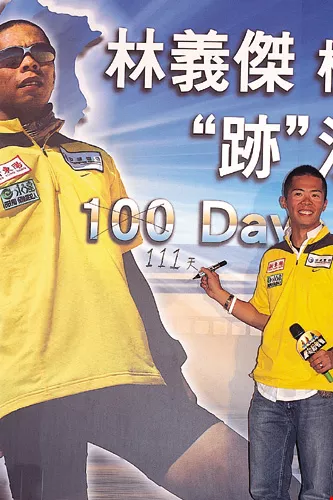
Going against the grain of agency corporatization, Kevin Lin was released from his agreement with Bros Sports last year and his girlfriend Chiang Ching-ju took over as his agent. Just how this will impact Lin's career remains to be seen.
It will be difficult to set up a system now, because the prospect of business opportunities in sports in Taiwan has uncorked the bottle, letting out the agents. While proposed Taiwanese legislation to regulate agencies remains in limbo, major international agencies that have their eyes on fine Taiwanese athletes have made their way to the island. In addition to baseball players, renowned sports agencies like IMG, CSMG, and SBC have also signed on a number of golfers and tennis players.
In recent years, Taiwan has also seen the emergence of a number of new businesses interested in cashing in on the sports agent market.
"We have signed on our first client from the world of sports," announced Summer Lin, director of China Fun Entertainment, at a press conference at the end of 2006 with Taiwan basketball sensation Tien Lei standing by her side.
Over the course of her ten-year career as an agent for entertainers, Lin has helped to launch such superstars as F4. "The players on the Dacin Tigers are well-built, good-looking, and articulate," she confides. The fusion of entertainment and sports has produced new business opportunities. Lin's bold thinking has allowed her to see the business opportunity presented by product endorsement contracts. Over the past four months, they have received a number of queries from advertising agencies, but Lin also stresses, "Our clients should focus on their playing for now. I think it best that they don't accept too many endorsements during the season."
"All you have to do is count the number of endorsements that players are getting to see that business opportunities of this sort are on the increase," relates Eric Shih, director of Erics Sports Marketing. Shih used to work for IMG, where he spent many years following up on sports agent contracts for baseball players both in Taiwan and abroad. Since hanging out his own shingle in 2004, he has signed on tennis players including Lu Yen-hsun, and recently brought female golfer Lu Kwan-chih onboard. He plans to "sponsor" her with NT$1 million a year to compete abroad. "Our current contract with her doesn't give our company any commission," he emphasizes.
No commission? Then what's in it for Erics? "I think we'll probably have to invest in her for about three years. By that time, maybe she'll be a top player and we'll be able to sign a more normal agreement with her."
In the pursuit of young talent, agents are resorting to different tactics, such as taking them under their wings and training them. This is a method to which Scott Boras also subscribes. He first provides sports equipment, personal services, and assistance off the field. He then gradually tries to persuade players to sign on with his firm. As sports in Taiwan continue to heat up, it looks like the arrival of super agents is just around the corner.
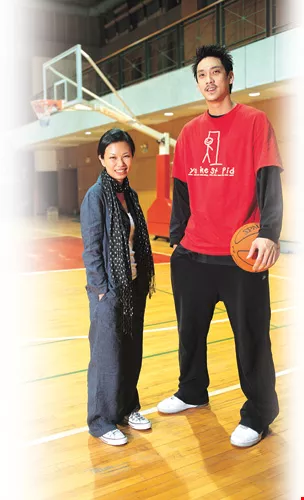
To stand behind star athletes and support their careers is the sports agent's calling. As the playoffs approach in Taiwan's Super Basketball League, agent Summer Lin takes time before a practice session to check in on Tien Lei, star center of the Dacin Tigers.
Who are their agents?
Kevin Lin--Chiang Ching-ju (Lin's girlfriend)
Chiu Tzu-kai and other US minor league players--Bros Sports
Wang Chien-ming, Tsao Chin-hui, and other US major league players--CSMG, SBC of the US
Lu Kwan-chih and other female golfers--Erics Sports Marketing (sponsorship agreement)
Dacin Tigers--China Fun Entertainment (advertising and marketing agreement)
Chen Chin-feng and other CPBL players--none
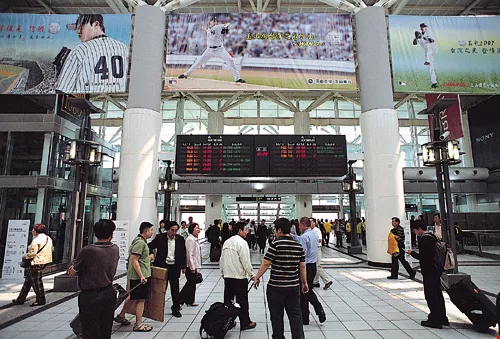
Which of Taiwan's sports stars shines the brightest? Yankees ace Wang Chien-ming has received more product endorsement opportunities than entertainment celebrities, helping make up for his relatively low salary. The photo shows a billboard featuring Wang near the Tsoying High Speed Rail Station.
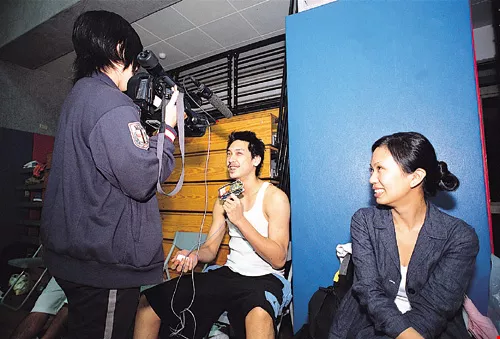
Image off the field is no less important than skill on the field. As Tien Lei is interviewed by the TV channel Videoland Sports, Summer Lin watches carefully, and from time to time reminds him how to handle the media.
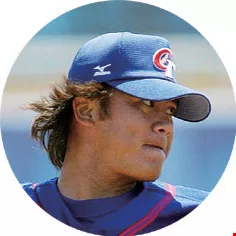
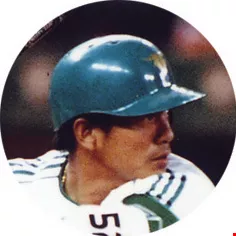

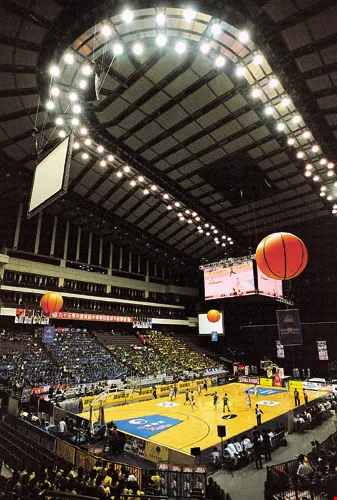
Basketball is one of the most popular sports in Taiwan. Because of physical disadvantages, few players from Taiwan have played professionally overseas, but in the last few years some Taiwanese have received scholarships to play for American universities. Eventually making it to the NBA is no longer just a dream.

@List.jpg?w=522&h=410&mode=crop&format=webp&quality=80)

@List.jpg?w=522&h=410&mode=crop&format=webp&quality=80)


