Art for All - Public Art Takes off in Taiwan
Tsai Wen-ting / photos Pu Hua-chih / tr. by Christopher MacDonald
November 2000


Paying for admission to an art museum isn't the only way to see and enjoy works of art. In today's culturally diverse Taiwan, public art has quietly become part of the scenery. It can be seen in our parks, residential lanes, downtown streets and subway stations, bringing color and humor to the bleak disarray of the city.
But what actually is public art? And what if works in this category, paid for by the taxpayer and belonging to the general public, make people feel frightened or uncomfortable? How do we tackle this unavoidable "public pollution"?
Visitors to the offices of Tainan City Government around Mid-Autumn Festival this year noticed an unusual smell as they entered the lobby. From early August, display areas to the left and right of the entrance were given over to an installation work entitled "Change" by the artist Chen Hui-mei. On one side a group of human figures made of some 2000 apples, sat at conference around a table; on the other side, more figures linked hand in hand, this time made of yams.
Arty flavor
As time went by the apples lost their pretty sheen and began to give off an increasingly fruity odor, while the coarse skin of the yams broke out in shoots. Chen Hui-mei, whose art often takes "life" as its theme, said that the smell of rotting and decay was integral to the work. Given the official setting, she purposefully chose her materials in order to draw a contrast between the resilient character of the Taiwanese people, and the corrupt heart that lurks beneath the polished exterior of the bureaucracy. It was a dig at the host authorities themselves. The rotting apples, which soon attracted flies, tested the tolerance of the city's Cultural Affairs Department and also began to draw criticism from the public. National legislators took note, and sanitation inspectors were sent to investigate the possibility of a health hazard.
Spurred by the controversy and the media interest, people began visiting specifically to see this installation, including one elderly gentleman who made a special trip just for a "whiff" of art. Eventually the artist quietly removed the decayed fruit, leaving only stained paper, so that viewers could ponder whether the rotten apples of bureaucracy had indeed disappeared.
Are rotting apples really art? Should limitations or a system of classification be imposed when provocative avant-garde work-which may shock or horrify some-makes the move from art museum to public space? And apart from temporary installations, how about the many works of public art that are permanent fixtures in the street-how to ensure that these meet the public interest and enhance the urban landscape?
Where "public" meets "art"
Strictly speaking, the briefly notorious "rotten apples" installation wasn't a work of public art. But since it was displayed at a spot through which many people have to pass, and given that city government personnel and the public had to put up with the work whether they liked it or not, it triggered wider debate on the topic.
What then is "public art"? Opinions vary and the definition is continually evolving. Broadly speaking, any creative work in a publicly accessible location, requiring no admission charge or special entrance arrangements, can be classed as public art.
The 1992 Statute on Encouraging and Rewarding Cultural and Art Enterprises requires public art expenditure to be included in the budget for public buildings and major infrastructure projects, at a value not less than one percent of total construction cost. This opened the way for the development of public art in Taiwan. Paid for by the taxpayer and selected through public tender and appraisal, these costly creations, mostly in highly public locations, have generated plenty of interest and controversy in recent years.
Since summer, the tree-lined boulevard of Taipei's Tunhwa Road has been home to nine striking new works of public art. "Droning Scenery," an installation by artist Ku Shih-yung, features six bell shapes made of resin and mounted high above the ground. Walk underneath and you hear a droning sound which blankets out the roar of the traffic.
Further south, the passer-by is startled by a bright red sculpture, an abstract work over six meters in height. This is Huang Ming-che's "Flying Across the Eastern District," and it inspires in viewers the urge to do just that. And at the pedestrian crossing where Tunhwa meets Civil Boulevard, you might notice the rear end of a zebra poised beside the road. Look more closely and you'll see that it houses the crossing lights for pedestrians. Huang Chung-yu's "Time Zebra Crossing" is so appealing to children that they forget about crossing the road.
Unexpected art encounters are even more likely in the subterranean spaces of Taipei's subway system. On the platform of NTU Hospital station for example, commuters pass a work entitled "Little Park" by Buddhist-figure sculptor Li Kuang-yu, showing a pair of hands resting palm upwards. At the next stop on the same line, CKS Memorial Hall, the wall beside the escalators is decorated with three-dimensional photography by Lin Shu-min, while a long passage leading to the Ministry of Finance is brightened by an installation of 60 illuminated light-boxes showing images of blue sky, white clouds and sunshine, designed by artists Chuang Pu and Yang An.
Back above ground, the lobby of China Medical College in Peitou is enhanced with a glass mosaic showing over 100 varieties of Taiwanese medicinal herbs, by Huang Wen-ching, who learned mosaic art in France.
These examples of recently installed public art testify to the wide range of forms and materials used, and show that public art is not limited, as many think, to sculpture. It is something you can smell, observe, touch or play with, and can even be aural in form: last Christmas Tainan's Cultural Affairs Department picked several busy locations in the city for regular broadcasts of music produced using glass and crystal.
Encounter, or collision?
Since public art appears in public spaces, often at locations used by large numbers of people, public safety issues such as how the work is installed and maintained have to be taken into account, in addition to aesthetic considerations.
In subway stations for example, the structure and position of an artwork have to be such that people rushing for their trains don't bang into it or get a shock. Last year, there was the "haunting" incident in the commercial area to the rear of Taipei main station. Sculptor Wang Hsiu-chi had installed a sculpture of a child on a bicycle at one end of a roadside arcade, with the figure of a pedestrian talking into a mobile phone while waiting to cross the road at the other end. The idea was to express the busyness and vitality of the local community. By night however, in the half-darkness, the life-size bronze effigies were mistaken for ghosts by a number of unwitting residents. After liaison among those involved the two figures were shifted to a brighter spot under a street lamp. This touching, vivid artwork, entitled "Eulogy to Life," has since become a part of local life.
Public vs. art
Wang Hsiu-chi's "Eulogy to Life" was eventually accepted by the community, but other works of public art have been unceremoniously torn down or have simply disappeared. In 1992 the sculptor Kuo Ching-Chih was commissioned to produce a monument to the seafaring founders of Taipei's Wanhua district. The artist came up with a scene representing crowds of vessels on the water, including jutting spars and masts. But local residents didn't take to the work, fearing that with all its sharp points it would puncture the fengshui of the neighborhood. As a result the NT$4 million work was forced to move, and now sits in the Institute of Applied Science and Engineering Research, Academia Sinica.
When art and the public collide in this way, should we prioritize the interests of art, or of the public? Wang Hsu-pin of Taipei's Urban Development Department feels that "art needs to be respected, but at the same time art should not exaggerate its own importance." Artists often push the boundaries, and contemporary art in particular does a valuable job illuminating the darker corners of society. But public art by its nature is open to all, and if it is disturbing or offensive, or if what it conveys is painful and hideous, then it really isn't suitable for a public space.
By the same token, the public needs to be broadminded about new art. Many creative works now considered classic were themselves spurned or mocked by the public in their own day. When America was erecting the Washington monument, local people dumped the building materials in the river in an effort to prevent construction. In Paris, the world famous Eiffel Tower was initially derided as "a heap of scrap iron," while the glass pyramid designed by architect I.M. Pei for the forecourt of the Louvre nearly led to the resignation of the culture minister who had endorsed it.
Respecting the earth
In fact, there is no need for conflict between the interests of art and the public so long as ideas are communicated and explained in advance, and demonstration models produced. One example of successful cooperation of this sort is the mosaic work at Shuanglien subway station, featuring brightly colored images designed by children from two local primary schools. In this case, the art lies in the relation between the work and the community, rather than in the form and content of the piece.
The definition of public art is constantly changing, both in Taiwan and elsewhere. The total amount of money budgeted for public art works associated with major construction projects this year is well over NT$1 billion, and given the limited availability of free space in Taiwan, even artists have been wondering if we really need so much public art. And when public art fails to pass the test of time, it represents a waste of the money spent to create it and a further drain on resources when it has to be removed.
Ultimately, public art needs to be both a dialogue with people and also a form of communication with our earth. "I hope through my work to convey an individual ideal and also to restore the ideal life of a specific environment," says Huang Wen-ching, an artist who has won a number of public art commissions. Recently Huang and his wife Chen Tzu-wen jointly produced an artwork for the plaza alongside Panchiao MRT station.
The Panchiao work uses black and pink granite laid out in the form of a maze, at the center of which is a crown made of stainless steel and colored glass. The crown doubles as a seat, where people can rest, meet and play games. The concept is "giving space back to people, rather than competing with them for space." According to Huang Chien-min, a member of the Public Art Selection Committee of the Council for Cultural Affairs and a prolific writer on the subject: "What public art in Taiwan needs is the notion of 'less,' rather than always trying for 'more'."
The construction budget for the new terminal at CKS Airport, which opened in July, included a public art allocation of NT$100 million. Deciding how to handle this huge sum proved a difficult task for the project's executive committee. Many people questioned whether public art has to be limited to the installation of permanent "works of art." If the money was instead used to set up a trust fund, the annual interest of NT$5-6 million could be spent on various arts activities. Or the money could go on a new museum or art center. Indeed in the US, where the promotion of public art dates back over half a century, the definition has long since expanded beyond the requirement for individual works of location-enhancing art. The Los Angeles Museum of Art is itself an example of public art!
Friend for life
Looking back over nearly three decades of public art in Taiwan, we see a process in which bronze statues of the national leader, mounted on high plinths, have gradually disappeared from our surroundings and been replaced by works without a "frame," placed on the ground where they can be directly approached and touched. "Public art too has changed through the eras, from the kind of objects which are looked at from a distance, to art that can be touched and lain against," says Huang Chien-min.
"A good work of public art is like part of a living body. It matures with time and leaves a continuous record of its growth, becoming a cultural asset of which the community can feel proud," writes art academic Lin Pao-Yao in his book Cultural Thinking on Public Art. Good examples of public art, both in Taiwan and overseas, are not limited to any particular era. Instead they are continually renewed with the passage of time.
When friends arrange to meet at the 228 Memorial Park in Taipei, they almost invariably rendezvous by the brass water buffalo at the main entrance. Now 65 years old, it was presented to Taiwan as a gift from Japanese-controlled "Manchuria" to commemorate the 40th anniversary of Japan's colonial rule over the island. Generations of children have since perched for pictures on back of the venerable beast-a piece of public art that figures in the photo albums of countless families and forms part of the collective memory of the citizens of Taipei.
p.84
(Top) "The apples have gone!" After a number of complaints about the rotting apples installed by Chen Hui-mei in the lobby of Tainan City Hall the artist removed most of the work, leaving a single apple as a form of question.
(Bottom) This was the installation made using over 2000 apples, that triggered a storm of controversy-when the apples began to rot-about public art. (courtesy of Chen Hui-mei)
p.86
It's a child stretching, and it's a reclining Buddha. The sight of Li Chen's "Country at Peace" gives passers-by a brief sense of repose.
p.87
Huang Ming-che's "Flying over the Eastern District" brightens up the scenery in this busy section of the city.
This pedestrian crossing light in the form of a zebra's backside, by artist Huang Chung-yu, is one of nine new works installed by Taipei City's Urban Development Department along the "Tunhwa Art Corridor."
p.89
MRT stations provide an excellent new platform for public art. This installation by artists Chuang Pu and Yang An brings a vision of blue sky and white clouds to the subterranean world.
This work by Tung Cheng-ping is intriguing no matter which angle you look at it from. The work provides a visual complement to the expanse of green outside the Taiwan Museum of Art, where residents of Taichung like to exercise in the early morning.
p.90
A pair of slender legs dangling outside an old house-quite a startling sight. During the campaign to secure protected status for the Tsai Jui-yueh China Dance Club, one artist came up with this work to symbolize the urgency of saving the studio.
This large image of two girls kissing caused a public outcry when it appeared in throbbing downtown Taipei.
p.91
There used to be lots of bronze statues of leaders and distinguished figures in our public spaces. These included memorials to heroic individuals like Kao Shih-chuan, a railway employee who died preventing a collision between a train and a bus.
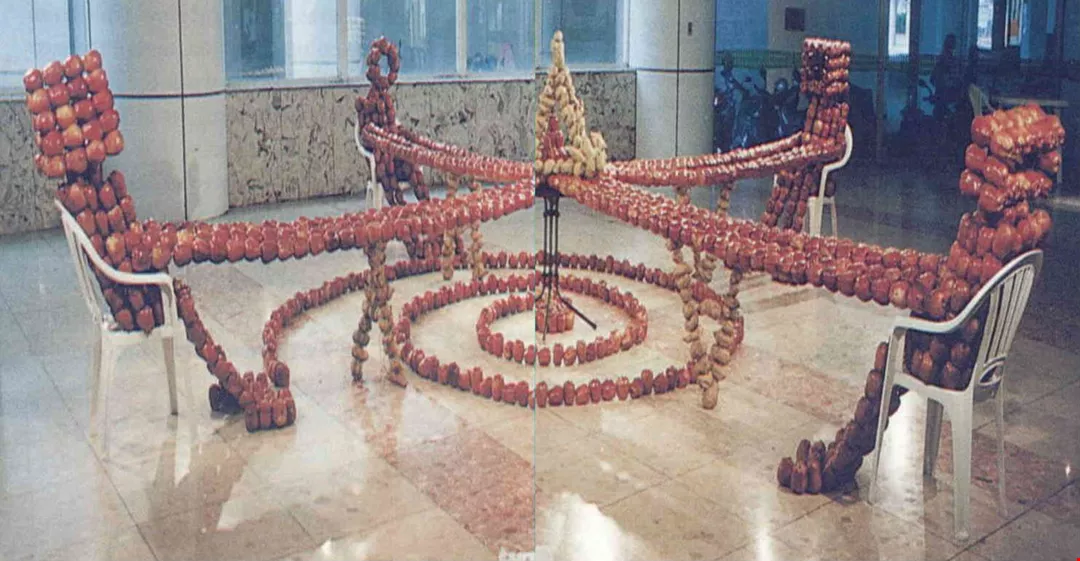
(Bottom) This was the installation made using over 2000 apples, that triggered a storm of controversy-when the apples began to rot-about public art. (courtesy of Chen Hui-mei)
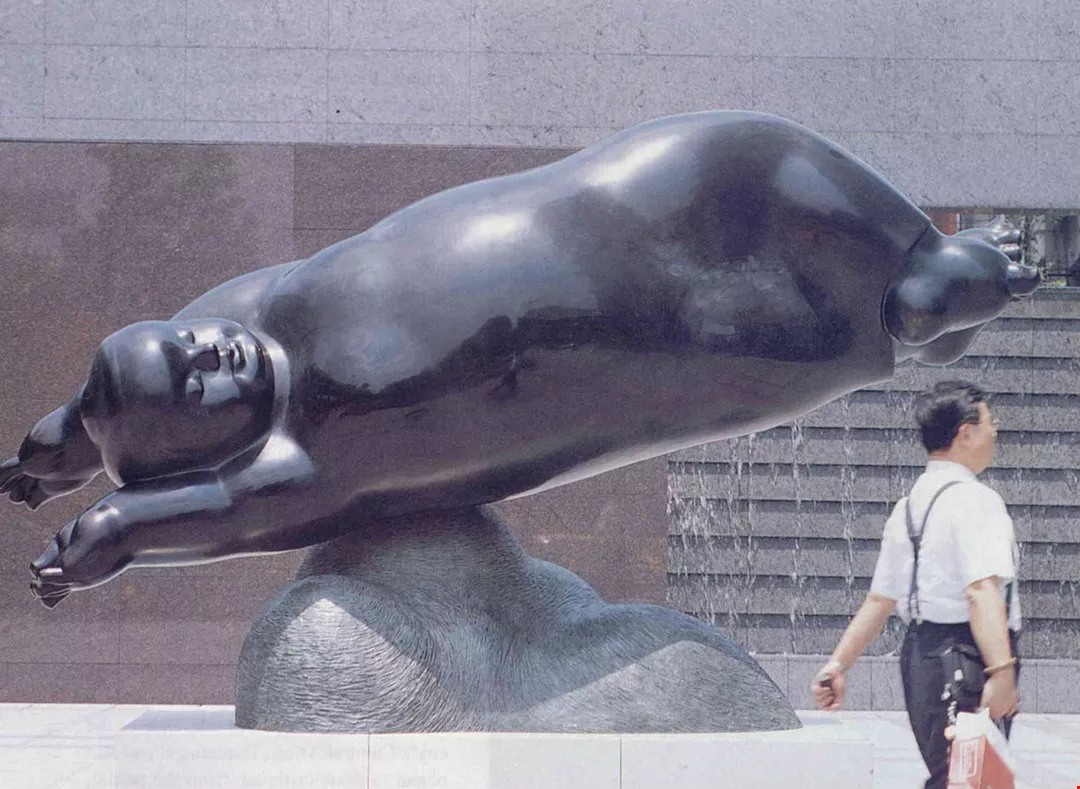
It's a child stretching, and it's a reclining Buddha. The sight of Li Chen's "Country at Peace" gives passers-by a brief sense of repose.
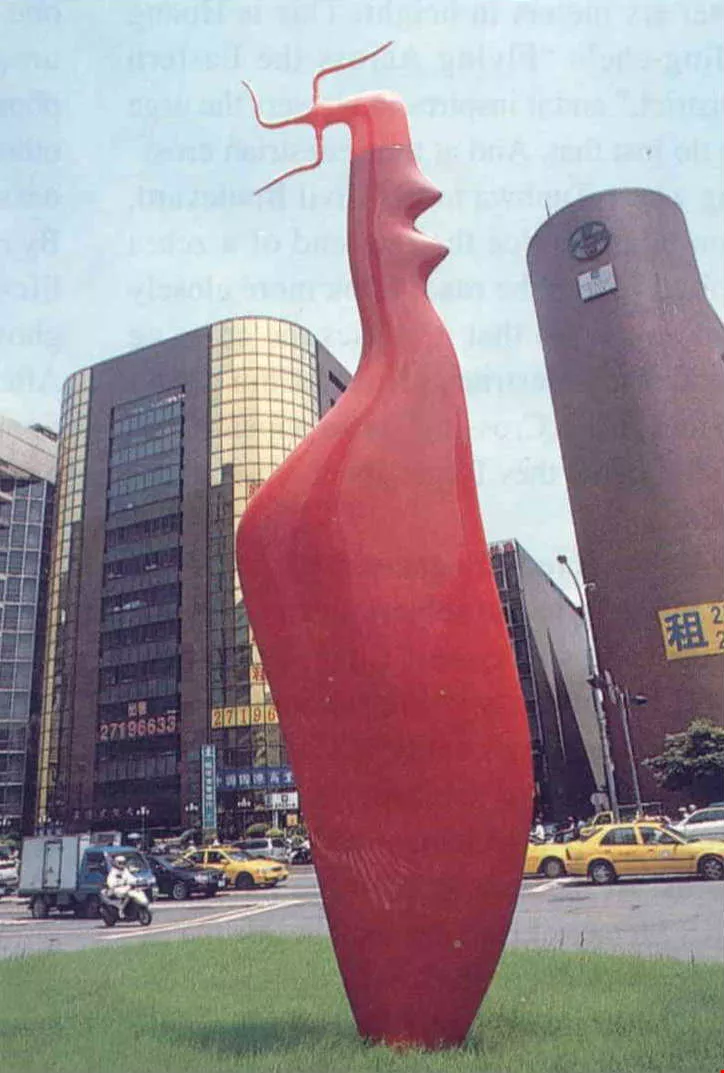
Huang Ming-che's "Flying over the Eastern District" brightens up the scenery in this busy section of the city.
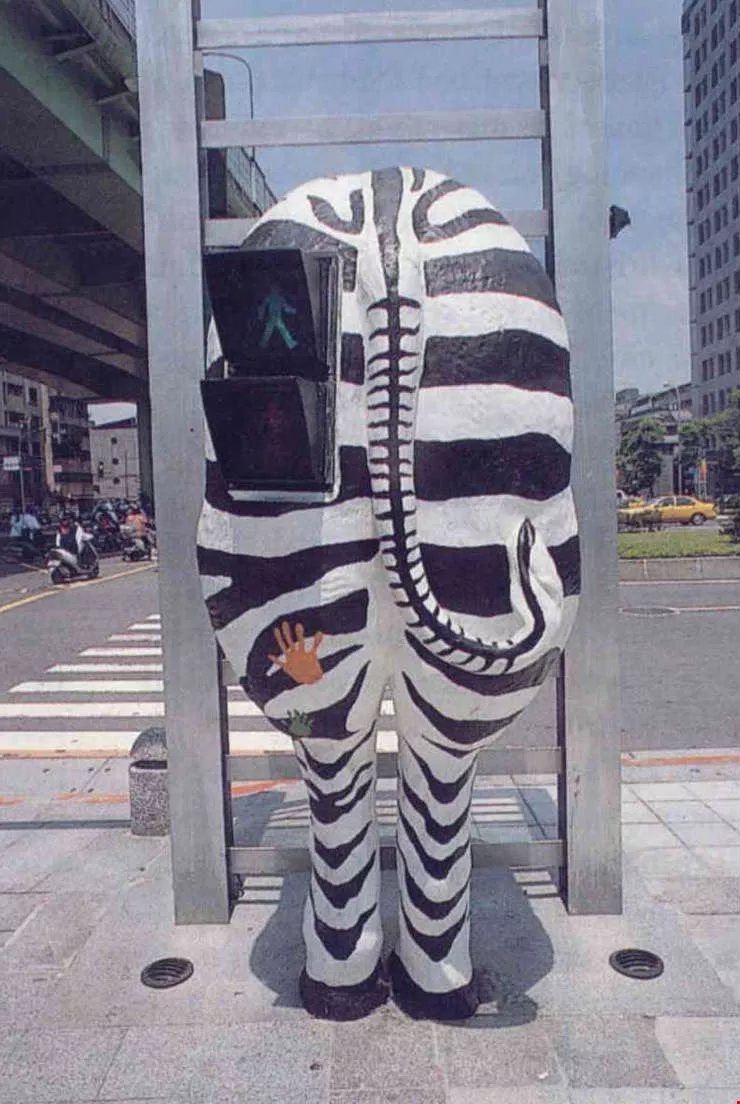
This pedestrian crossing light in the form of a zebra's backside, by artist Huang Chung-yu, is one of nine new works installed by Taipei City's Urban Development Department along the "Tunhwa Art Corridor.".
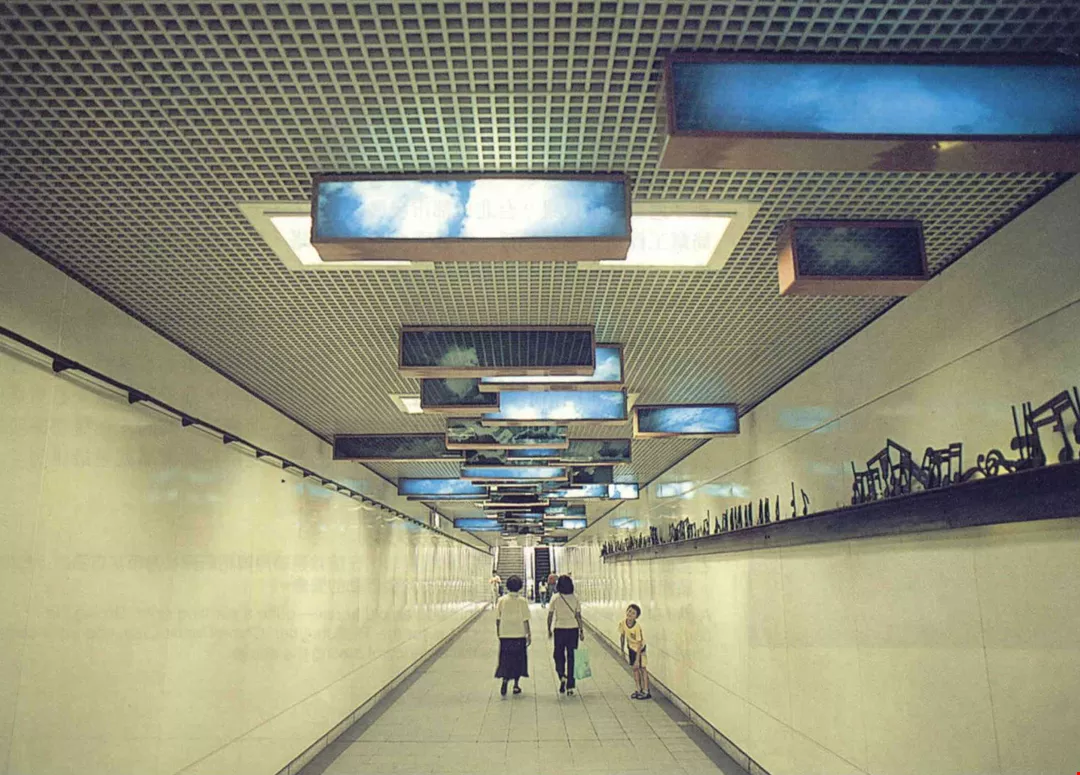
MRT stations provide an excellent new platform for public art. This installation by artists Chuang Pu and Yang An brings a vision of blue sky and white clouds to the subterranean world.
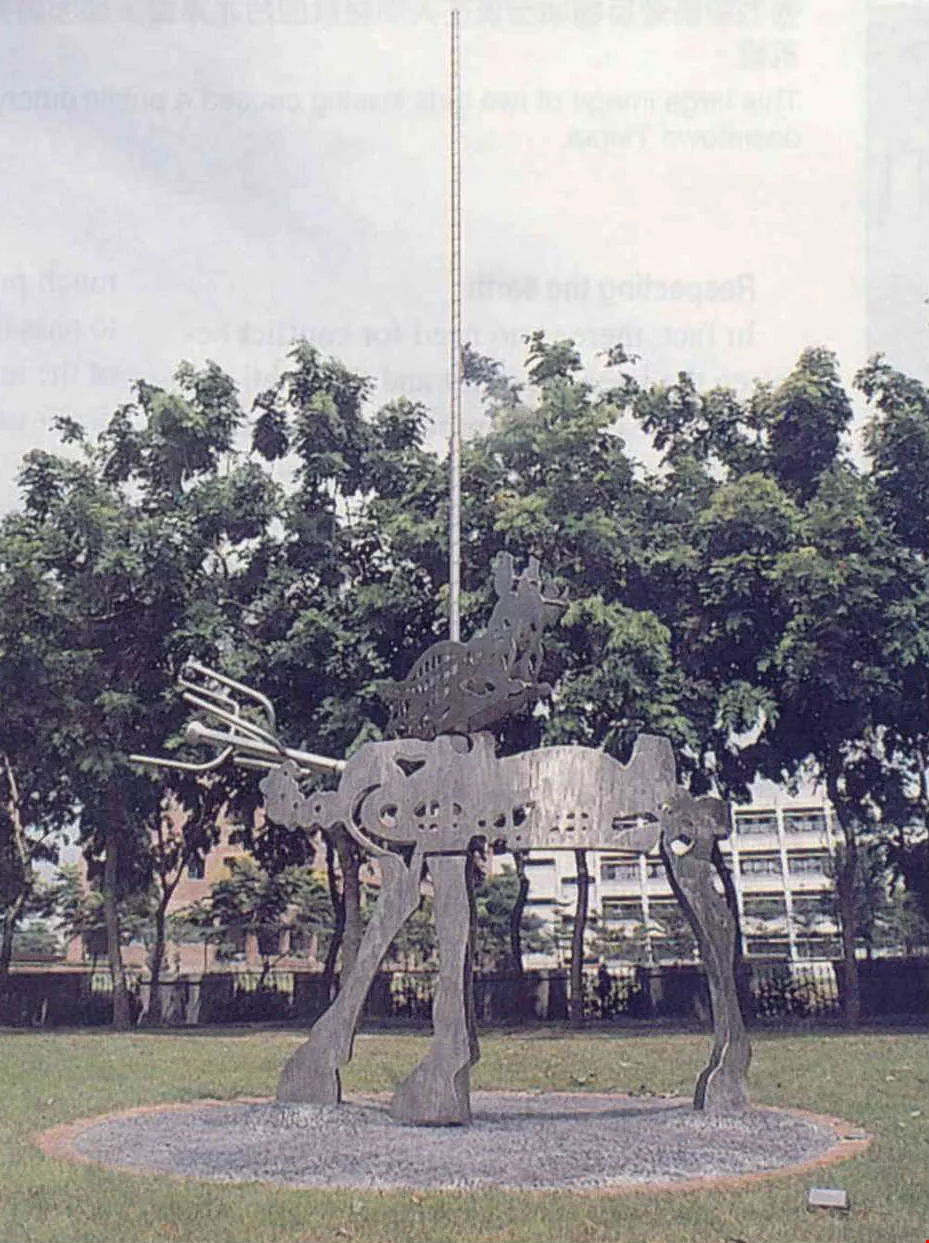
This work by Tung Cheng-ping is intriguing no matter which angle you look at it from. The work provides a visual complement to the expanse of green outside the Taiwan Museum of Art, where residents of Taichung like to exercise in the early morning.
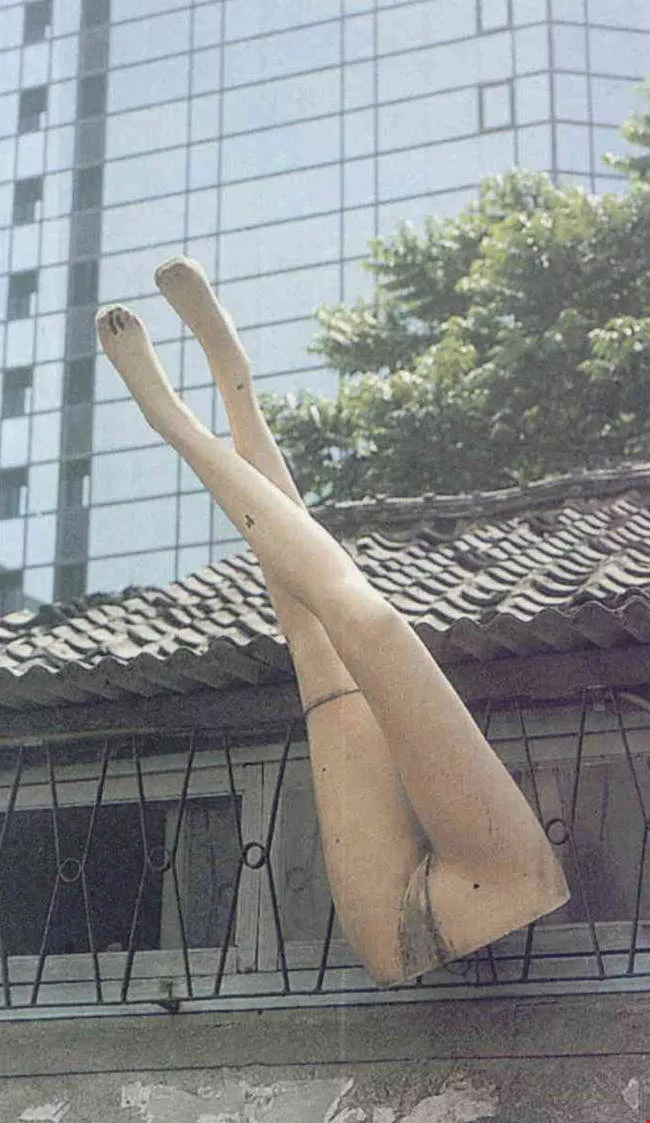
A pair of slender legs dangling outside an old house-quite a startling sight. During the campaign to secure protected status for the Tsai Jui-yueh China Dance Club, one artist came up with this work to symbolize the urgency of saving the studio.
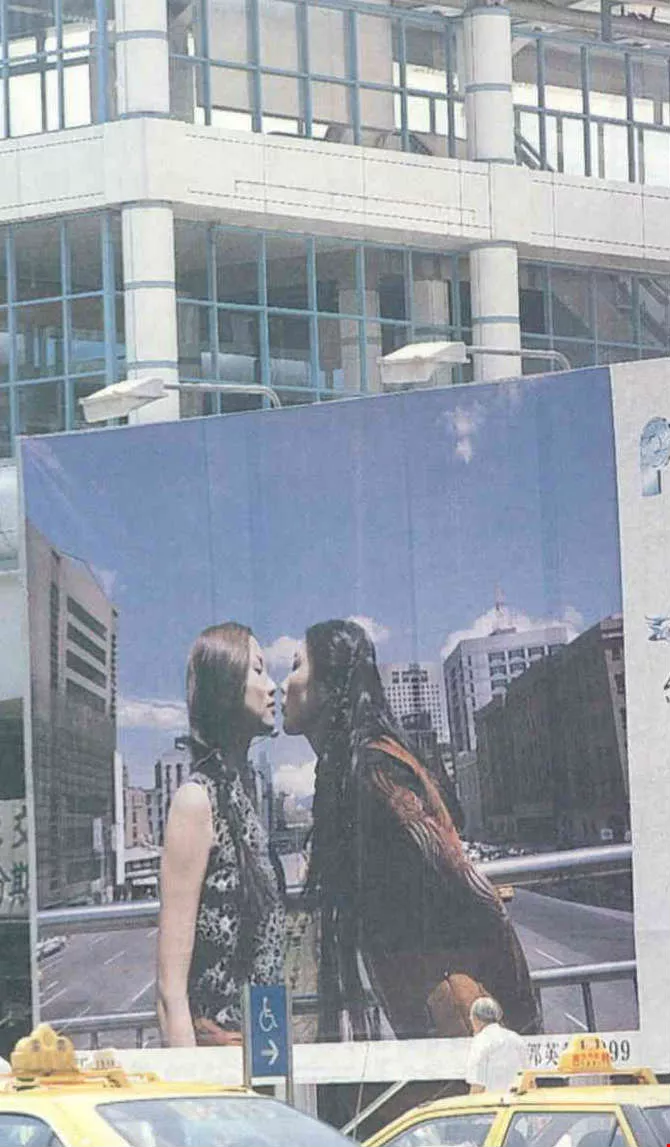
This large image of two girls kissing caused a public outcry when it appeared in throbbing downtown Taipei.
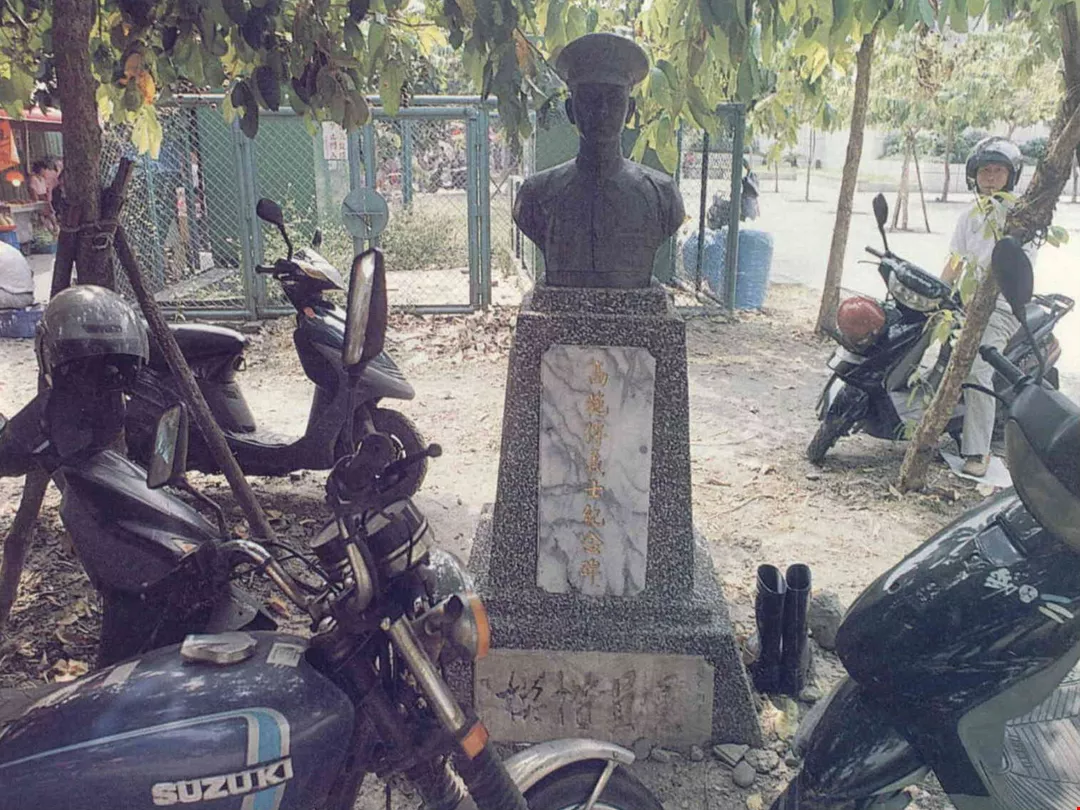
There used to be lots of bronze statues of leaders and distinguished figures in our public spaces. These included memorials to heroic individuals like Kao Shih-chuan, a railway employee who died preventing a collision between a train and a bus.

@List.jpg?w=522&h=410&mode=crop&format=webp&quality=80)


