

Another food crisis is sweeping the world!
With extreme weather experienced since mid-2010, several major food-exporting countries, including Russia, the US, mainland China, Australia, and Argentina, have suffered severe droughts and floods resulting in a continuing global shortage of food. International food prices have skyrocketed due also to human factors such as cuts in exports and the tendency to hoard food, loss of value of the US dollar, and market speculation.
According to UN statistics, world food prices have risen 25% on average over the past year. Corn has gone up by 52%, wheat by 49% and soybeans by 28%. In January 2011, agriculture ministers from 48 countries attending a conference in Berlin warned that soaring food prices could lead to social unrest and even food riots. A lack of food hits people hard. Although it will be the poorer countries who suffer the most, developed countries also need to be alert to the issue. Nobody will be immune.
The issue of self-sufficiency in food has again become the subject of local concern after Taiwan faced wild fluctuations in food prices at the end of 2010 because bulk cereal supplies (wheat, soybeans and corn) have relied on imports for decades. The government has yet to announce any long-term policy, but has called on people to consume a bit more rice every day in order to bolster rice production. However, this move shows that the government is clearly out of touch with the real issues, and will probably once again miss the opportunity for any meaningful reform.
Fortunately, a revival movement for grains other than rice, organized by private-sector and community interests and research institutions, is brewing and moving forward against the tide. For these pioneers, the resumption of significant non-rice grain cultivation in Taiwan will not only take care of the next generation's bellies, but will also reconnect human values with the environment.
According to statistics from the Council of Agriculture (COA), Taiwan's rate of food self-sufficiency has declined steadily over the recent decade; it was 35.9% in 1999 (i.e. 35.9% of calorific intake was from domestic production), but dropped to 32% in 2009. Comparing these figures with those from other Asian countries, Korea's ratio was 45% in 2008, and Japan, which has similar diet to Taiwan, rated 40%; the Japanese government has set a goal of 50% in 2020. Taiwan has a depressingly low measure of self-sufficiency in comparison.
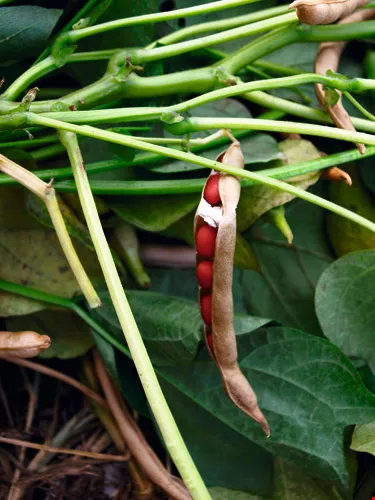
Adzuki beans grown in Wandan, Pingtung County.
One reason for these low figures is that wheat has become as important as rice as a staple for most Taiwanese. According to statistics from Wheat Associates in the US, Taiwan's total annual wheat imports from the US and Australia have blown out to about 1.1 million tons since 2002 (this is roughly equivalent to the size of domestic rice production), of which about 45% is used in the baking industry, 40% in Chinese-style pastries and noodles, and 8% in alcohol and gluten products.
Supplies of other essential grains and staples are also heavily reliant on imports. According to 2008 figures from the COA, our self-sufficiency is as follows: under the cereals category, corn is 1.7% and sorghum 2.8%; pulses and oilseeds (soybean forms the bulk of this category) rate 3.4%; and starchy roots 24% (see Tables 1 and 2).
Unfortunately, the government seems unconcerned about the issue of food self-sufficiency.
On January 12, 2011, in the National Agriculture and Agricultural Land Seminar held by the COA in response to food self-sufficiency issues raised by scholars and farming advocates, officials noted in their report that (hopefully) "self-sufficiency will rise to 34% in 2020." After revealing this target figure, many participants shook their heads, arguing that it was not nearly ambitious enough.
One of the participants in the seminar, Warren Kuo, professor at the Department of Agronomy, National Taiwan University, claims that Taiwan is likely to experience famine in the future. He is concerned that even though we may have the money, we won't be able to buy food if we don't take the necessary measures now to reverse the trend of agricultural decline. Is he being alarmist?
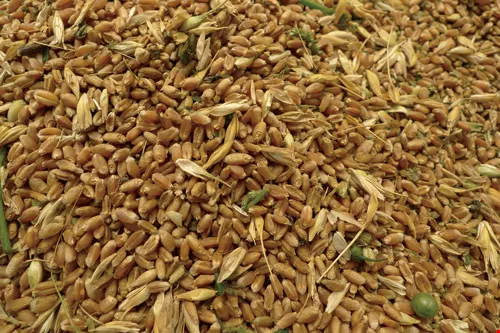
Some of the wheat produced in small quantities by farmers who have contracts with Kinmen Distillery.
According to predictions of the Organization for Economic Cooperation and Development (OECD), because of the combined effects of climate change and the oil crisis, global food prices will remain high throughout the next decade.
From experience of the food crisis in 2007/2008, it is clear that the impact on different countries will be closely related to agricultural self-sufficiency and purchasing power. In general, the impact on developing countries is going to be much greater than on the industrialized world. As a result of damage sustained through years of war, poor land policies, or the collapse of traditional farming systems due to the impact of petrochemical agriculture, developing nations are less able to maintain efficient agricultural production and are thus often forced to rely more heavily on imports.
Major industrialized countries such as the US, Canada and France boast self-sufficiency rates of more than 100%. They enjoy significant food export capacity and are therefore less vulnerable to fluctuations in international food prices.
The author of Food Rebellions!, Raj Patel, points out that the global food system from production and distribution to consumption has always been monopolized by a small number of transnational agribusinesses who tend to have the ears of politicians. They even stand to gain from food crises since they control the market. The more far-sighted governments, however, are now all working to improve food self-sufficiency rates in order to protect themselves from potential disaster.
Kuo further points out that to improve food self-sufficiency, governments must squarely face up to the three current major crises in agriculture. First, the loss of arable land: past pursuit of rapid economic development and balancing the trade deficit has meant that a lot of formerly agricultural land has been abandoned. Even today, good agricultural land is being taken for industrial and commercial use. Second, young people don't want to do farming, mainly because agricultural incomes are too low. Third, modern intensive agricultural techniques are highly dependent on the use of chemical fertilizers.
In his analysis of the decline of domestic agriculture, Kuo notes that modern fertilizers were a byproduct of the petrochemical industry, and that the green revolution of the 20th century was founded on the availability of these cheap products; however, it is estimated that in the next 15 years global oil production will decrease sharply, meeting only half of demand. Consequently, any agricultural production that depends on petrochemical products will be under serious threat in the not-too-distant future.
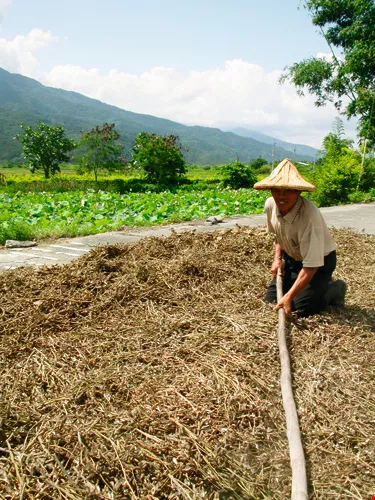
The picture shows a farmer, Asheng, who grows organic soybeans in Luoshan Village, Hualien County, using the traditional method of hitting the pods to free the beans.
However, for Taiwan, a geographically small but densely populated island, a more feasible goal to improve self-sufficiency may be to aim for 40-50%. Even in this circumstance, the government needs to develop a social consensus and demonstrate greater commitment, including, according to Kuo, "preventing future land requisitions for industrial use, rehabilitating abandoned farmland and promoting the development of organic agriculture."
Any attempt to encourage people to increase rice consumption with the goal of expanding the rice-growing industry is probably unrealistic.
Kuo suggests that growing non-rice grains will not only help to improve food self-sufficiency, but will also activate land currently set aside from agriculture (200,000 hectares of agricultural land, accounting for 25% of all arable land in Taiwan, is fallow). This would also provide an opportunity for the development of organic agriculture (the current ratio is only 0.3%).
Taiwan has the advantage of three growing periods each year, so encouraging farmers to plant a variety of grains during autumn and winter would generate additional income for them. Current obstacles to reviving non-rice grain cultivation do not include either a lack of technology or unsuitable soils. The basic problem is simply that domestic production costs cannot compete with cheap imports.
"In terms of food security and sustainable agriculture, pricing and short-term benefits should not be the only considerations," says Kuo. Although imported grains are currently relatively cheap, production tends to rely on a high proportion of petrochemical fertilizers, and transport over the long distances involved is inconsistent with carbon reduction policies.
Kuo cites soybeans as an example. There are more than 2 million vegetarians in Taiwan, and their primary source of protein is legumes. The bulk of this is provided by imported genetically modified (GM) soybeans, which raises a number of health concerns. But because beans are available in an enormous variety of species and flavors, the Asian Vegetable Research and Development Center, partly funded by the ROC government and headquartered in Tainan, has collected a large number of bean varieties. "Why not encourage the local cultivation of a range of beans? This would benefit people's health and also provide a source of seeds for future growth."
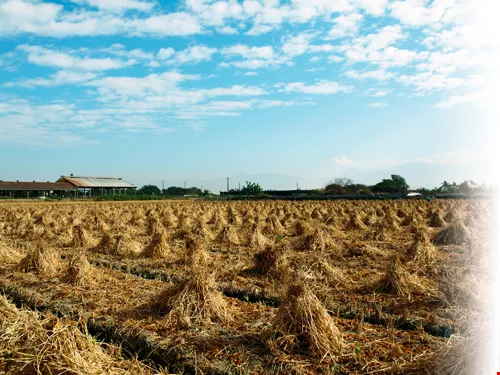
Shen Fulai in Pingtung follows traditional harvest techniques by pulling up bunches of adzuki beans by hand and setting them to dry in the sun. The beans are easier to free from the pod after they have absorbed intensive sunlight. The only thing you have to worry about is rain, so you just pray for fine weather!
A major proportion of the grains used to supply the domestic livestock industry are imported. If cheap corn and soybeans were not brought in from overseas, could the domestic market provide alternative feed sources, and would they be cost effective?
There is an area of 300 hectares of organic farmland at Kending at the southernmost tip of Taiwan. This farm, at the Heng-chun Branch of the COA's Livestock Research Institute (LRI)-formerly the Stallion Ranch of the Taiwan Governor-General's Office during the period of Japanese rule-holds the promise of becoming an experimental supply base for domestic organic feed crops.
A team there led by agronomist Dr. Chen Chia-sheng is actively promoting the cultivation of local organic pasture and feeds. According to Chen, a wide range of feed crops are suitable for cultivation in Taiwan in addition to the traditional large-scale crops of corn and soybeans. Sweet potatoes, sorghum, rice, pearl barley, buckwheat, oilseed rape, sesame, peanuts, adzuki beans and mung beans can also be used as livestock feed.
But before 2008, the livestock industry had become accustomed to the use of imported grains or formula feeds for several decades. At that time, however, when the food crisis hit Taiwan, the Dairy Farmers Association gained a government subsidy to improve the production of local corn fodder, opening a new door for the revival of domestically grown feed. Since 2004 the LRI Heng-chun Branch has operated an organic pasture, and since 2010 has experimented with planting multipurpose organic feed grains on five to 10-hectare plots.
Multipurpose crops, those that can be used as green fertilizer, livestock feed or human food, can provide financial advantages, as well as reducing risk and avoiding the need for chemical fertilizers.
Animal breeders benefit from the availability of fresh, nutritious feeds. Chen says that although at present domestic feed is not as easy to buy as imported feed, "there are examples where people who have tried domestically produced feed have saved millions of NT dollars."
While organic livestock production is in its infancy, this industry and organic farming, especially with the revival of grain production, can benefit each other enormously. Chen looks optimistically to the future: "If Taiwan could maintain 1% organic livestock production, more than 10,000 hectares of organic grains would be necessary to provide feed; perhaps one day the livestock industry will help expand domestic organic agriculture!"
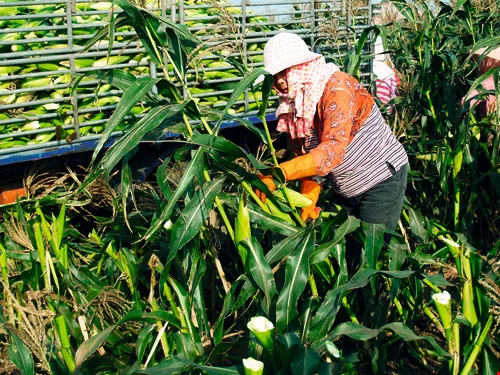
The Farmer's Association of Puzi, Chiayi County has actively assisted farmers to grow organic corn in recent years. The hard-working village women make up the main labor force.
In fact, one of the simplest ways to reduce the lack of self-sufficiency is through the power of consumers to directly link up with and encourage local producers to grow more grain through collective buying techniques.
About 10 years ago in Taiwan, a group of housewives were looking for rice that people could eat without any health concerns. The group gradually expanded and established Taiwan's first bulk buying organization-the Homemakers Union Consumers Co-op (HUCC). Their chairwoman, Chen Hsiu-chih, says that over the years the principle for selecting products has been to support both local agriculture and environmentally friendly producers. Imported products are considered only if there are no or insufficient local products available.
However, local non-rice grain products have always been in short supply. Most wheat and soybeans certainly are imported. Other grains including black soybeans, mung beans, adzuki beans, red pearl barley and corn are all purchased by the co-op's product specialists who scour the nation for local products, creating strong partnerships with producers in the process.
Chang Ya-yun, editor-in-chief of HUCC's publications, discusses some of the common difficulties faced by small-scale non-rice grain farmers in Taiwan.
First is the high cost of labor. Because non-rice grain cultivation has declined and ready-made agricultural machinery is hard to find, farmers have to do a lot of the work manually. For example, the adzuki beans the co-op purchased were produced by Shen Fulai, an old farmer of over 70 summers from Wandan, Pingtung County, who still uses traditional methods of harvesting. He pulls up whole bunches of adzuki beans and piles them in the sun. After the pods dry out, he uses a machine to free the beans. Then, his wife has to pick out the lower-quality beans to make sure the produce conforms to quality standards.
Second, because the food industry stresses economies of scale, it's not easy to have the tiny quantities of grain produced by small-scale farmers processed at a large mill. And because small-scale farmers lack drying or preserving equipment, millers are unwilling to assist them because of a lack of consistency in product size and quality.
Third, marketing difficulties: many farmers who undertake non-rice grain growing as a part of their crop rotation are often elderly and work alone, and while they are capable of doing the farming work, they find it hard to do the packaging, marketing and accounting. Furthermore, the current organic food accreditation system tends to disadvantage small-scale farmers with expensive accreditation fees, and actually excludes farmers who don't own their own land. So some farmers who have adopted an environmentally friendly approach and are producing high-quality domestic products cannot get access to organic marketing channels.
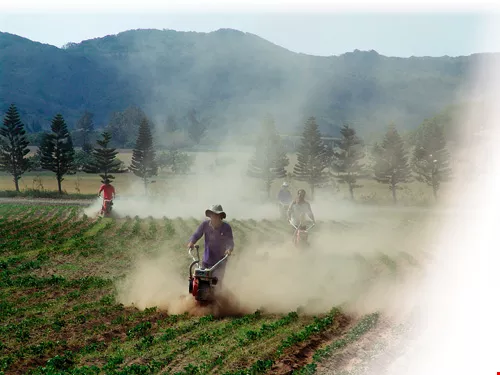
In Kending, staff at the Hengchun Branch of the Council of Agriculture's Livestock Research Institute have overcome the difficulties of drought and strong winds to successfully grow organic soybeans in winter. Soybeans are not only one of the most important sources of protein for humans and livestock, but can also fix nitrogen in the soil
The good news is that when HUCC went looking for grain producers, they found some local farmers' associations that were keen to promote organic grains. Puzi Farmers' Association in Chiayi County, for example, has been promoting organic rice in recent years, and has brought together a group of farmers interested in growing organic corn, assisting them to apply for group organic accreditation. Products such as black soybeans, red pearl barley and mung beans sold by the co-op are purchased through the Puzi Farmers' Association under its contracts with farmers.
"In terms of self-sufficiency, we have just started. Encouraging our 30,000 members and the wider community to appreciate the value of the land and environment is our ultimate goal." Chen says that HUCC has become more radical on agricultural issues in the last two years, including standing up against the Rural Regeneration Act and supporting the farmers of Wanbao in Miaoli County who were protesting against the building of a science park. "This is our learning period, exploring the food self-sufficiency issue, and we are happy that more and more partners have been able to join us in this journey."
The private sector has in fact been more active in the quest for self-sufficiency than the government. In addition to encouraging individual awareness and the need for concrete action, they also need to monitor the government to ensure that it maintains its determination and fulfils its responsibility to face major challenges, such as the deterioration of agricultural land and the loss of rural populations, eventually rebuilding the reputation of grain as an essential national asset. Although the non-rice grain revival is only in its infancy, one day it may blossom in full!
| Products | 2000 | 2008 |
| 1.Cereals | 28.7 | 24.0 |
| (1)Rise | 106.1 | 89.5 |
| (2)Wheat | 0.0 | 0.0 |
| (3)Corn (maize) | 2.4 | 1.7 |
| (4)Sorghum | 41.0 | 2.8 |
| (5)Other | 0.4 | 0.5 |
| 2.Starchy roots | 20.4 | 24.0 |
| (1)Sweet potato | 100.0 | 99.9 |
| (2)Cassava | 0.1 | 0.1 |
| (3)Potato | 15.8 | 23.1 |
| (4)Other(mainly yam) | 359.2 | 184.5 |
| 3.Pulses and oilseeds | 4.0 | 3.4 |
| (1)Soybeans | 0.0 | 0.0 |
| (2)Peanuts | 94.5 | 85.4 |
| (3)Sesame | 2.2 | 2.2 |
| (4)Other | 2.2 | 4.9 |
unit:%
Note: Figures show percentage of calories.
source: ROC Agriculture and Food Agency, Food Supply and Utilization Annual Report
| Feed corn | Edible corn | Sweet potato | Peanuts | Sorghum | Adzuki beans | Soy | Sesame | Other* | |
| Area planted(hectares) | 9,446 | 11,924 | 10,692 | 21,761 | 190 | 3,785 | 123 | 107 | 996 |
| Output(metric tons | 45,98 | 87,579 | 229,038 | 56,941 | 719 | 8,550 | 220 | 56 | 1,975 |
| Major production areas | Chiayi, Tainan | Yunlin, Chiayi, Tainan | Yunlin, Changhua, Taichung | Yunlin, Changhua | Chiayi | Pingtung | Pingtung, Kao-hsiung | Tainan | -- |
Note: "Other" includes proso millet, barley, buckwheat, wheat, millet, mung beans, kidney beans, black-eyed beans and broad beans.
source: ROC Agriculture and Food Agency, Yearly Report of Taiwan Agriculture
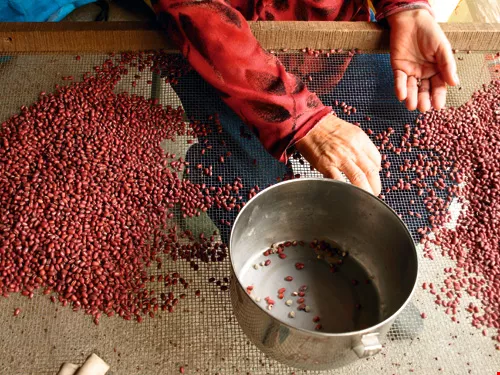
Small-scale grain producers often work alone, so processing and packaging is hard work, especially for older farmers.
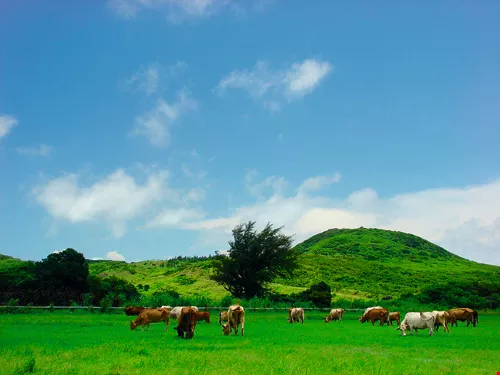
As Taiwan's organic livestock industry is just getting started, the Livestock Research Institute in Hengchun is attempting to grow organic non-rice grains, playing an important pioneering role in the field.