

A variety of methods can be employed to over see the parliament. But oversight merely addresses the symptoms. To really cure the illness requires educating the voters and improving the system. "Whatever the level of your voters, that's the standard of parliament you get," is the way Democratic Progressive Party legislator Chen Shuipien puts it.
As for overseeing the parliament, the more pluralized the better. As I see it, generally speaking there are seven major categories.
Seven major approaches, each with advantages and disadvantages: The first type is systematic oversight. For example, "sun shine laws," which open up government action to greater public scrutiny, are of this type. But "laws don't enforce themselves." If you just pass a law but don't thoroughly put it into practice, you will end up destroying respect for the dignity of the law. For example, it is stipulated in the "Law on Election and Recall of Public Officials" that campaign expenditures must be reported, and cannot exceed a certain level (I think about NT$7 million for Taipei City [from where Chen was elected to the Legislative Yuan]). But the truth is that it is virtually impossible to run an election campaign within these limits. And some candidates just come right out and say without hesitation that they've prepared hundreds of millions of NT dollars for their campaigns. Yet you never see the implementing agencies for this law warn them or punish them, which certainly is disappointing.
The second is oversight by the parliament itself. For example, the legislature should keep accurate records on the attendance situation, what is said in the Yuan, attitudes to voting on given issues, and so on, and provide these to the public for reference. It is also necessary to thoroughly implement the internal rules of the parliament. Some people argue that "self-cleansing" or "self-discipline" groups should be established among the legislators them selves, in order to clarify things for the voters, but there are still difficulties with this right now.
The third way is oversight by the media and the attentive public. In particular, all the media reporters work side by side with the legislators from dawn to dusk, and they are very clear about their character and deportment from long-term and continuous con tact. So you could say they are the best overseers. If reporters dare to escape from the pressures of friendship and appeals to their sentiments, and report the facts, and the media will let them have their say, the capacity of this oversight would really startle people. You shouldn't think the one being criticized will not take any notice. If someone is criticized by the media and doesn't seem to care, in fact write for a week straight, and see who won't give in first! I'm just afraid that the media share mutual interests with the legislators, or perhaps are like a swarm of bees who buzz about something for awhile and then don't follow up. Then there will be loopholes in this type of oversight.
You too can keep watch on the parliament!: The fourth way is political party oversight. Currently, under the condition of party politics, it is hard for independents who belong to no party to survive. Thus the vast majority of candidates must adhere to some party. As for how a party can exercise control over weak legislators, they can ex press their attitude by refusing nominations, or can nominate someone but not give him any real support in the campaign. If you want to clean up politics, the most fundamental way is for each political party to reject nominating those wealthy businessmen or local factional elites just for the sake of winning. This is what is really meant by fulfilling the party's responsibility to oversee things.
The fifth way is public oversight. This can be divided into private groups and the electorate. Private groups include the current Parliament Monitor Foundation, the old New Era Foundation, as well as women's groups, labor groups, and so on. If they can only remain fair and objective, they can all be excellent stewards. Of course, the most basic method is for voters to use their ballots--don't vote for any weak candidate just because he happens to have given you a little more money.
The sixth way is balance from the executive branch officers. If legislators want to arrange some special privileges or do some back-door lobbying on behalf of some campaign contributor, they absolutely couldn't do it without help from executive officials. If any civil servants who come under un due pressure from legislators will have the courage to stand up and refuse, this will guard the door for the people. I'm just afraid that executive departments, interested in getting the budgets for their pro grams passed smoothly, will not dare or will find it too inconvenient to offend legislators. Or perhaps some bureaucrats themselves will act inappropriate ly, and when their errors are discovered by others they will not dare to not do whatever they are told. This is really frustrating.
The last technique--which is always the over sight of last resort -- is self-oversight. No matter how many external forms of oversight there are, each has a number of loopholes and gaps. The only thing that can never be deceived is one's own conscience. If those interested in politics destroy their consciences, then there's really nothing more to be said.
Of course, besides "oversight," in fact you can not overlook the whole election system and the in appropriate expectations of the electorate toward their legislators. Often these become reasons why legislators are willing to adopt any method to win, or why they cannot concentrate on actually participating in the policy process.
Think about it. If a person has to spend tens of millions every three years in the election, it would be simple deception to try to say that they wouldn't try to "recoup costs" during their term. Thus if you want to clean up elections and to achieve the ideal of "professional lawmakers," then "publicly funded elections" should be attempted, where the government provides the money for voter service centers during and after elections and for legislative assistants and hardware. This means legislators will not have to worry about finances, and only then can they keep their "capital" of in corruptibility. If this can't be done at present, at the least the voters can be educated not to accept bribes, so that vote-buyers will spend a great deal of money but will find they can't be elected. This is the only way people will stop thinking that to compete will require ever-increasing amounts of money.
Further, the voters should respect the fact that legislators are national level representatives, and must be responsible to the people of the whole nation, and not ask their legislators to waste their money and energy going to local social gatherings or attending weddings and funerals and the like [as local officials routinely do], nor select legislators on the basis of localism or the narrow concerns of some special interest group. This is the only way to give legislators more room to attend to the policy process. Rectifying the overall system and attitudes is even more important than oversight.
[Picture Caption]
Democratic Progressive Party legislator Chen Shui- pien has his say about various phenomena in the parliament.(photo by Wang Wen-ping)
Parliamentary reporters work "cheek to jowl" with legislators for long periods; they should thus be the best "overseers" of the assembly. (photo by Tsai Wen-hsiang)
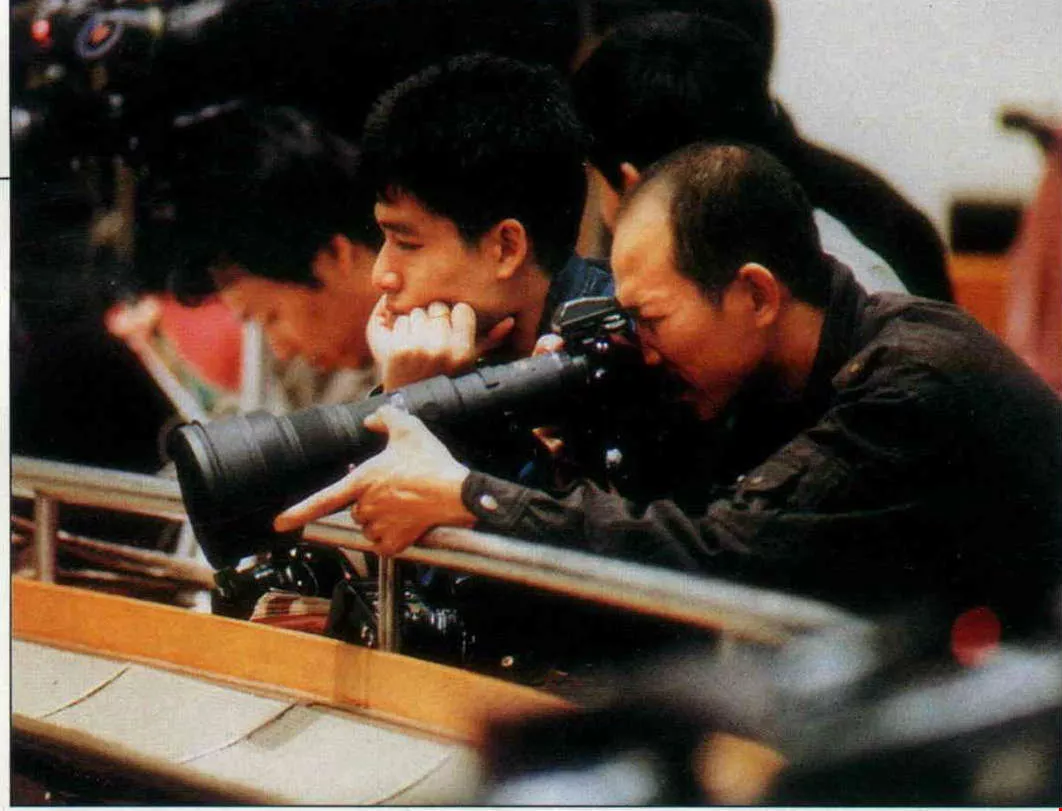
Parliamentary reporters work "cheek to jowl" with legislators for long periods; they should thus be the best "overseers" of the assembly. (photo by Tsai Wen-hsiang)


