

In fall 2006, the baseball field is still as hot as in summer.
Chinese Taipei defeated Japan to take third in the Intercontinental Cup, which came to a close on 19 November.
This is the first time that the tournament, inaugurated in 1973, was held in Taiwan. With this grand occasion in mind, the Taichung City Government allocated funds to build a new stadium and asked Yankee superstar Wang Chien-ming, who snatched 19 wins while pitching in US Major League Baseball this year, to act as a spokesman for the tournament. The late autumn was marked by nothing less than baseball fever.
Chinese Taipei not only tied its tournament record, this was the first time in the history of the games that the national team was able to turn the tables on Japan after having suffered defeat at its glove 11 times straight.
Earlier, when the La New Bears went to Japan in early November to do battle with Asia's best professional teams, they did Taiwan proud. In this, the second Konami Cup Asia Series, the Bears pummeled the PRC and plucked off South Korea to beat their third place record from last year, winning them the right to go toe to toe with Japan's Ham Fighters. Despite lackluster batting and gloomy predictions from the Japanese press, La New managed to stay neck and neck with the Ham Fighters throughout the championship game, forcing countries around Asia to take a second look at Taiwan baseball. Next up, the Asian Games, to be held in December in Doha, Qatar, are expected to whip up yet another frenzy.
In sharp contrast to on-the-field conquests, events off the field this fall have been nothing short of disastrous. A series of blows, including the La New club owner crying that he "can't hold on much longer," November's bombshell scandal that the underworld is coercing players to throw games, and Nippon Professional Baseball scouting for Taiwanese players, have rocked the confidence of Taiwan fans in their teams.
Glory and shame aside, the question on everybody's mind is: Will this year's belated baseball fervor serve to boost professional baseball on the island?
On the night of 25 October, the Bears, a fledgling team of only three years, wrestled the championship out of the paws of the President Lions with a 7:3 victory, winning four straight in the best out of seven series.
In contrast to the regular season, which saw a 30% drop in attendance due to such factors as Wang Chien-ming, Chinese Professional Baseball League postseason play saw an upsurge in interest. This is especially true of the first two games of the championship series between the Lions and the Bears, both of which were decided with homeruns in the bottom of the ninth with walk-off runs. These nailbiters whacked TV ratings out of the park, topping even the defeat of Wang Chien-ming and the Yankees in the League Champion series.
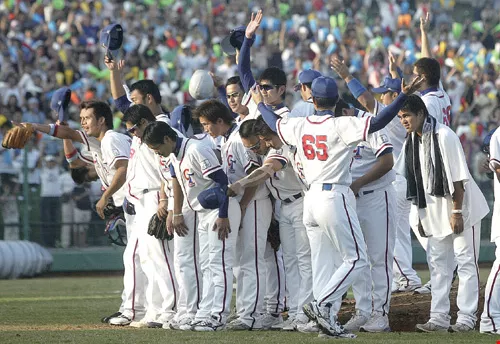
On November 19th, Chinese Taipei beat Japan with a score of 4:0 to win third place in the Intercontinental Cup held in Taichung. This was also the first time that Chinese Taipei outclassed Japan in the series. After the last out, Chinese Taipei swarmed onto the pitcher's mound to the cheers of the crowd.
If it's not one thing...
Professional sports are performances, and are meant to reach exhilarating climaxes at season's end. But the excitement this year didn't end with the Bears' realizing their championship dream. Many things that occurred later outside the ballpark turned out to be more important than any that occurred within.
The day after his team's victory, La New owner Peter Liu tossed out the first shocker, stating that if La New continues to stack up financial losses, the team might have no choice but to call it a day. He explained that in the three years that he has owned the Bears, he has lost NT$250 million. Team expenditures for the 2006 season alone amounted to about NT$200 million. After deducting fees for broadcasting rights, ticket sales, and peripheral product profits, the deficit stood at some NT$80 million. That's not chump change for a medium-sized enterprise like La New. He went on to suggest that the government offer tax incentives to businesses that own professional baseball teams.
Liu's heartfelt statement was a little bit too much reality for still-celebrating fans, but his bad news would be just the start.
In early November, TVBS got hold of an optical disc showing Bears' pitching coach Lin Kuang-hung meeting with suspicious characters. In the video recording, Lin took a bribe and was ordered by the other party to throw the championship "or else." After the disc was made public, Lin, accompanied by the league's legal team, denied at a press conference allegations of trying to throw the series, but the Bears still placed him on temporary suspension until results of the investigation come back.
The 2005 season was also rocked by scandals involving underworld characters colluding with players to throw games. Bears players also "starred" in that scandal. In July of 2006, Tsai Feng-an, a popular member of the Brother Elephants, saw his contract ripped up. No reason was ever given, leading to widespread speculation.
Perhaps the Bears are just too unstoppable, however. The scandal was splashed across the newspapers several days in a row, but as league champions, the Bears had won the right to represent Taiwan in the Konami Cup Asia Series in Japan and as they boarded their flight, they did so to the cheers of their fellow countrymen and women. In Tokyo, the Bears first trammeled the PRC, then trounced Korean champions the Samsung Lions, winning a slot in the finals. Despite a 0:1 loss to Japan's Ham Fighters, the Bears won praise from the Korean and Japanese media as well as from fellow Taiwanese.
When it rains...
Their strong showing at the Konami Cup didn't keep the Bears happy for long. As the Taichung Intercontinental Cup got under way, Nippon Professional Baseball launched new efforts to recruit talent.
The CPBL and Nippon Professional Baseball signed an agreement in 2004 in which they agreed to keep their mitts off of each other's players, but the CPBL continues to be drained of good players. In 2005 and 2006, Lin Ying-chieh and Lin En-yu, both Macoto Cobras, began playing for Japan's Tohoku Rakuten Golden Eagles and Japanese scouts seem to swoop down whenever good players, like Yang Chien-fu or Pan Wei-lun, materialize in the CPBL.
The CPBL does the training, but Nippon Professional Baseball reaps the benefits. The situation is even worse with amateurs. Since Tsou Chin-hui, Wang Chien-ming and Kuo Hung-chih were picked up by MLB teams, junior-high and high-school athletes have been leaving Taiwan in a mass exodus. In contrast to signing fees of "almost US$1 million" for players like Kuo Hung-chih, a few hundred grand from ball clubs seems to do the trick as younger players are drawn to the US. A number of players fresh out of junior high school have been brought to Japan to play and study simultaneously.
While professional baseball in Taiwan is experiencing a slump, the island's pool of amateur talent is being siphoned off. With nobody stemming the flow in Taiwan, many are using the back door labeled "study abroad" to find their future elsewhere, raising widespread concern that baseball in Taiwan will go the way of its counterparts in Latin America--that is, exporting ballplayers (to the MLB and Nippon Professional Baseball) and "importing games"--as it serves merely as a training ground for professional baseball leagues in Japan and the US.
At a time when its teams have been racking up some impressive stats, professional baseball in Taiwan is ailing and faced with unprecedented challenges. For the sake of baseball's future in Taiwan, it is imperative that complete stock be taken of the system and the cancer be thoroughly rooted out.


