

Under the Kuomintang (KMT), many media outlets known for frequent criticism of the ruling party were not at all bashful about rallying behind the KMT whenever it came time for elections. This tendency was especially pronounced with the three big non-cable television stations, and the practice drew a lot of criticism. Now that the Democratic Progressive Party (DPP) has come to power, will the media play the same old game with the new boss? The issue is an especially pressing one at China Television Company, where the KMT is the biggest shareholder. What must the media do to maintain impartiality and put professionalism first?
During the months leading up to the presidential election in March, non-cable TV stations China Television Company (CTV), Taiwan Television (TTV), and China Television System (CTS) were roundly criticized for biased and unbalanced reporting. There were reports that a senior executive at one of these stations actually issued an order to go all out in support of the ruling party. He reportedly said, "For the next three months, we don't want you paying any attention to the ratings." Now that the KMT is out of power, however, there will inevitably be some changes in the way the media reports the news.
With regard to the shift in news reporting that has taken place since Chen Shui-bian won the election, DPP legislator Lin Chuo-shui notes that since the ban on new media organizations was lifted in the late 1980s, anyone with enough money has been able to jump into the field. In Lin's opinion, it is perfectly natural for a newspaper to have a political orientation, but the three big non-cable TV networks deserve criticism for excessive bias. Most of the stock in all of these networks is owned by either the KMT or various government organs, and Lin argues that these networks, which broadcast an overwhelming majority of over-the-air television programming in Taiwan, need to take a serious look at how they report the news now that Taiwan has a new government.
Of the three networks, CTV is in the most delicate political position, for over 42% of its stock is held by the KMT. Tang Chien-ming, head of CTV's news department, offers the following explanation of the way his company covered the presidential election. According to Tang, the news department divided political news during the election into two categories; one focused on coverage of top government officials, while the other focused on election news. Each candidate received equal amounts of election coverage, but "a lot of people thought we were favoring the KMT," says Tang, "because we devoted a lot of non-election political coverage to what the government was doing. The KMT was the ruling party, so it held the advantage that naturally goes to the incumbent. Lien Chan engaged in a lot of activities in his capacity as vice president, so there was no way any of the other presidential candidates could possibly have received as much media exposure as Lien did. Besides, the KMT had bought up most of our advertising time." Now that the DPP is the ruling party, says Tang, it will benefit from its position the same way the KMT did before, so it is only natural that the DPP will receive more coverage henceforth.
Chung Chin, the new director of the Government Information Office, has some very specific ideas about the regulation of the non-cable TV networks in the future. In her opinion, a media organization is not to be criticized for having a political orientation of one stripe or another, but news coverage must be distributed fairly across the political spectrum. She is considering the possibility of implementing a "point system" to monitor incidents of unfair news reporting by the non-cable TV network. Under such a system, a TV network that accumulates too many points could find its license in jeopardy the next time it comes due for renewal.
Would a point system really resolve anything, though? Tang Chien-ming points out that the non-cable TV networks are commercial operations and must therefore take the ratings into account at times. The government could forbid TV networks outright from surveying viewership of news programs, of course, but assuming that the government won't go to such lengths, says Tang, there's not a lot that can be done. "There are lots of approaches to the problem, but there is no way to totally eliminate outside interference."
Many are calling for drastic reform of the non-cable TV networks. Legislator Li Ching-an, for example, has recently established an ad-hoc legislative group to promote the passage of legislation aimed at eliminating the involvement of political parties, governmental organs, and the military in the running of broadcast television companies.
The group has drafted an amendment to the Broadcasting and Television Law, collected the required number of signatures, and forwarded the draft amendment to the Legislative Yuan's committee on education. If the amendment legislation gets through committee and is enacted into law, political parties, government organs, and the military will have one year to sell off any stock they own in the non-cable TV networks. Says Li, "The only way to completely ensure the professional independence of the news media is to bar the involvement of political forces in the management of media organizations." But the TV stations make for extremely inviting targets. The effort to root out political influence may very well set off a major political tussle in the Legislative Yuan and beyond.
p.16
It's a new era and a new government, and society must adapt and grow. The media, at the forefront of public opinion, must also make adjustments. (photo by Hsueh Chi-kuang)
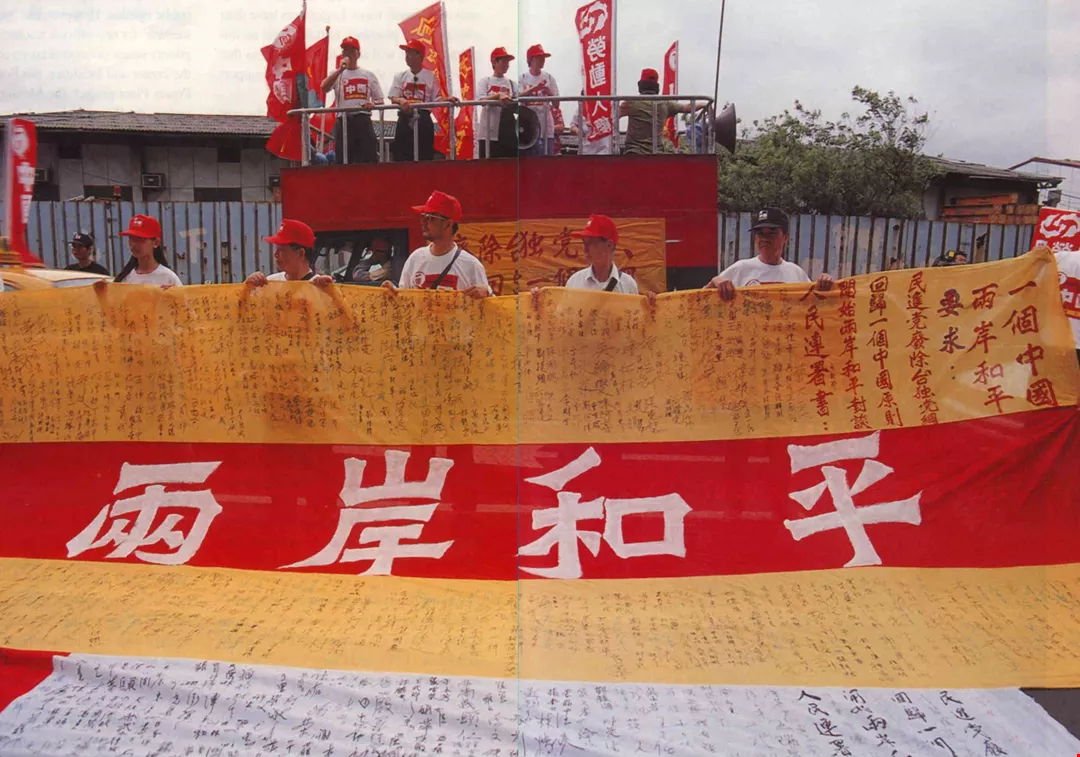
Everyone hopes to maintain peace in the Taiwan Strait. If the PRC does not attack Taiwan, Taiwan will not declare independence. The photo shows a demonstration by the Workers Party demanding that the DPP remove the Taiwan independence plank from its platform. (photo by Jimmy Lin)


@List.jpg?w=522&h=410&mode=crop&format=webp&quality=80)


