Projecting Taiwan’s Image Abroad
the editors / photos courtesy of the GIO / tr. by Phil Newell
May 2012


The Republic of China: Area, 36,000 square kilometers. Population, 23 million. Foreign reserves, US$430 billion, fourth highest in the world. According to WTO statistics, Taiwan is the world’s 16th-largest exporting nation and 17th-largest importer.
The ROC is a global high-tech industrial powerhouse, but because it is not a member of the United Nations, it is unable to participate in international organizations, and has few regular avenues through which to express its opinion. What can be done to create a “brand image” for our country so that others sit up and take notice of us? This problem has always been at the core of the government’s efforts to get information about Taiwan out the world, and these efforts will carry on even after the Government Information Office has passed into history.
“Like a butterfly emerging from a cocoon and stretching its wings, the Republic of China on Taiwan is starting to show its colors.”
This quote comes from an advertisement placed in major US media outlets back in 1993. The accompanying image shows an elaborately costumed model spreading her arms out in imitation of a butterfly, a metaphor for Taiwan’s transformation over the previous four decades. Some Americans who saw the ad were so impressed by its aesthetics that they wrote to the GIO seeking to buy a poster version!
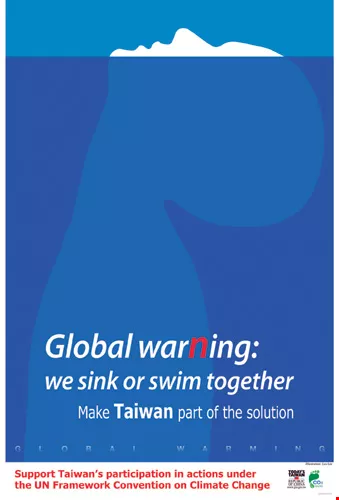
As nations have become ever more intertwined in the 21st century, problems like global warming now require collective solutions. The GIO’s 2011 ad “Global Warning” stressed Taiwan’s willingness to make its own contribution.
There’s nothing unusual about making up advertisements for a product, but a country? How on earth do you go about marketing a country?
“Actually, all countries engage in public relations and propaganda,” says Cheng Tzu-leong, a professor in the Department of Advertising at National Chengchi University, who has written extensively on the use of marketing and media techniques by nation states to create “brand images” for themselves. “Most countries not only use broadcast media, but their symbolism also appears in pictures, on clothing, and in works of art. Even the US, which has enormous substantive strength, does this kind of thing. International radio broadcasts from the Voice of America have been around for a long time, as have official publications, promoting the image of the US as a country of democracy, freedom, and wealth.” Cheng adds that even Hollywood gets in on the act, making countless films whose plots are imbued with images of the “American dream” and portray the US as a “melting pot” and “land of opportunity.”
The history of international political advertising by the GIO here in Taiwan can be traced back to 1973, when 12 text-only ads were inserted in The New York Times under the rubric “The Case of Free China.”
Behind the ads lay an important historical development. In 1971, the General Assembly of the United Nations adopted Resolution 2758, transferring China’s seat at the UN to the People’s Republic of China. Before the motion even went to a vote, then minister of foreign affairs Chow Shu-kai announced that the ROC would withdraw from the UN. This was one of the most traumatic events in our country’s diplomatic history.
Thereafter the ROC government embarked on a campaign to draw the attention of the US’ informed public to the Taiwan issue, and in 1973, building on the theme of the 60th anniversary of the founding of the ROC, began work to influence how US citizens perceive us.
Over the course of four decades of public relations work since then, several clear trends have emerged. The content of advertisements has shifted away from text toward visual images; political terminology has shifted from “China” to “Taiwan”; marketing that highlights Taiwan’s economic success has shifted its focus from “trade” to “technology”; and the main axis of promotional work has gone from “image” to “issues.”
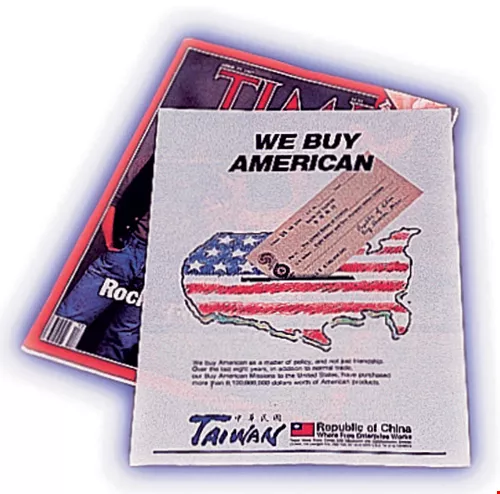
The 1987 ad “We Buy American” was the earliest issue-oriented advertisement produced by the GIO. A response to American pressures to reduce the ROC trade surplus with the States, it emphasized that Taiwan was even then already buying a lot of US goods.
Using advertising to promote a general image, and using it to address specific issues, are in fact very different strategies. A lot of considerations go into deciding which approach to take.
For example, image-based PR campaigns have included the butterfly metaphor mentioned earlier, as well as a “high-jump” theme, symbolizing the “quiet revolution” of Taiwan’s development toward democracy. There was also a series on the theme of Taiwan’s vitality and creativity, using Ju Ming’s sculptures, the Cloud Gate Dance Theatre, and Taipei 101 as iconic representations of Taiwan.
However, argues Cheng Tzu-leong, successful branding is not easy. For one thing, it has been difficult to achieve a consensus on what kind of image best represents Taiwan. You can’t just navel-gaze and come up with whatever you like, without considering the views of others. Moreover, an identity cannot be created just by clever advertising. The idea that people in Taiwan have of the US, for example, doesn’t come from reading US government PR materials, but from films, TV, travel, and study abroad. It is a broad picture composed of countless individual pixels. Hence the decision to move in the direction of issue-oriented PR is a correct one, Cheng concludes.
The 1987 campaign on the theme “We Buy American” produced especially strong resonance.
At that time there was a rising tide of trade protectionism in the US, and Taiwan’s annual US$10 billion trade surplus with the States became a prominent target for complaints. From the US came wave after wave of calls to open up Taiwan’s market, lower tariff barriers, and balance two-way trade.
The GIO took the lead in striking back. They consulted with Wang Nien-tzu, a legendary figure in Taiwan’s advertising community, and began brainstorming. In a swirl of collective creativity and cooperation, they completed a series of six adverts. One showed a check from the Bank of Taiwan, in the amount of US$8.1 billion, being deposited into a slot in a stars-and-stripes-colored map of the US. Another turned around an old English adage to declare that money does indeed grow on trees, and highlighted the high returns achieved by foreign firms investing in Taiwan. The ads made direct, clear-cut statements, had a clear focus, were accompanied by complementary representations, and—released on a schedule of one new ad per week—packed a long-term punch. Even today people talk about how masterful this campaign was.
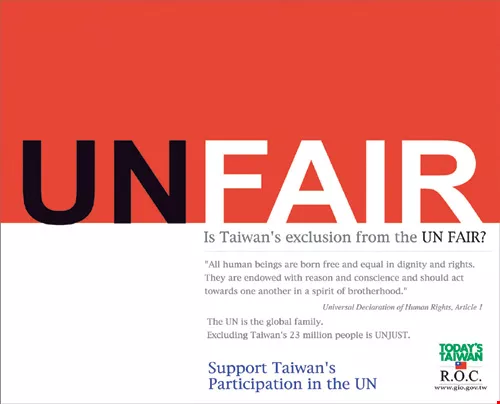
The extended-tandem-bicycle ad of 1993 was the first to appeal for admission of Taiwan to the United Nations. The “UNFAIR” and “WHO Cares” ads of 2004 likewise appealed for support for Taiwan’s admission to international organizations, citing the ROC’s economic wealth, achievements in health care, and robust charitable and aid sector.
Meanwhile, as consciousness of the Taiwan issue rose in Taiwanese society, citizens began to call for re-entry into the United Nations.
In 1993 the GIO launched a series of ads on the issue of participation in the UN. For example, one ad in that year was built around the concept of an elongated tandem bicycle. The seats are occupied by figures representing countries and cultures around the world, except for one that is empty. The ad reads, “Without a Full Team, It’s Uphill for the UN.” The clear message is that it would be a lot easier for the UN to reach its goals if Taiwan were there to lend a helping hand. In 1995, on the occasion of the UN’s 50th anniversary, another ad was produced in which the symbol for the UN was depicted as a jigsaw puzzle with one of the pieces missing. It called on countries around the world to support our country’s entry into that organization.
In 2004, deciding that the best defense is a good offense, the GIO set aside the genteel, low-key approach of previous adverts and bluntly asserted that it was unjust for the 23 million people of Taiwan to be excluded from the “global family” that is the UN. The English heading of the ad, reading simply “UNFAIR,” was a clever play on words calling on the “UN” to be “FAIR.”
Niu Tse-hsun, an associate professor of advertising at Chinese Culture University, has written that the axis of this series of ads was to express Taiwan’s concern about international issues, as well as the country’s ability and willingness to help solve them. It appealed to readers on both rational and emotional levels. While aggressive ads of this kind are not common, its appeal to law, reason, and sympathy, and its clear statement about Taiwan’s own suitability for UN participation, hit home with many people around the world. Niu even concluded that once the ROC adopted the role of challenging the status quo at the UN, it should have upped the ante by raising the intensity of criticism. In his opinion this would have produced even better results.
In 2004 came the campaign focusing on Taiwan’s desire to enter the World Health Organization, starting with an ad headed “WHO Cares?” Melding both image-centered and issue-centered strategies, it called on the international community to support Taiwan’s entry into the WHO.
Given the close interconnections of today’s global village, problems like epidemic diseases and climate change require more international cooperation than ever before. When the parties to the UN Framework Convention on Climate Change met in South Africa in 2011, the GIO produced an ad on the issue of global warming. Noting that climate change was causing glaciers to melt and sea levels to rise, thereby threatening the very existence of mankind, Taiwan declared that even if not allowed to sign the UNFCCC it would still contribute ideas and resources to the collective search for solutions to climate-related problems.
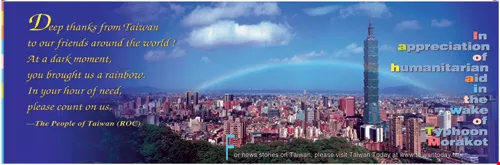
After the September 21, 1999 earthquake, the GIO produced the ad shown at left to thank the international community for its support. The ad at right was issued after Typhoon Morakot.
International public relations work is the bridge between the government of one country and the citizens of foreign lands. Virtually all countries rack their brains to come up with ways to improve their international reputation and pursue their interests.
The US invasion of Iraq back in 2003 worsened friction with Islamic civilization and also sparked a wave of resistance to the US even in the West. Despite the US’ display of overwhelming military superiority, its image was badly tarnished in the struggle for international public opinion.
When Barack Obama took office as US president in 2009, he was determined to rebuild America’s international image. He invited Joseph Nye, a Harvard professor renowned for his theory of “soft power,” to organize a foreign policy advisory team and reassess US public relations strategy.
Nye’s theory is that attractiveness to others is a source of “soft” power. In the course of international negotiations, appealing emotionally and rationally to one’s counterpart can be an important complement to the traditional approach of the carrot (economic benefits) and the stick (military threats).
Given Taiwan’s limited resources, bringing soft power—which is relatively cheap—into play is certainly an option that should always be on the table.
This may of course not be as easy as it sounds. Take for example the very practical problem of getting advertising programs up and running. Cheng Tzu-leong relates: “Because government procurement law requires all contracts, including those for public relations, to be awarded individually by a bidding process, with the ads given out piecemeal year by year, it is hard to get consistency and quality of message. But advertising relies on cumulative long-term impact, so even if the government is reorganized, it would be a bad idea to terminate the whole program.” He feels that the government should step more into the background, and the focus should be less on abstract image building for the nation state and more on cooperation with non-governmental groups to tell the story of our people and society.
“People are always interested in personalities and in stories. For example, rather than talking abstractly about Taiwan’s willingness to play a proactive and helpful role as a member of international society, you could talk about the global charitable work of the Tzu Chi Buddhist Foundation, the international medical aid teams staffed by young people doing public service as an alternative to military service, or the ordinary people who do good deeds without fanfare on a daily basis. The message will be clear that international society should not shun such kind-hearted people,” says Cheng.

The extended-tandem-bicycle ad of 1993 was the first to appeal for admission of Taiwan to the United Nations. The “UNFAIR” and “WHO Cares” ads of 2004 likewise appealed for support for Taiwan’s admission to international organizations, citing the ROC’s economic wealth, achievements in health care, and robust charitable and aid sector.
A case in point: Chen Shu-chu. It was several years ago when the domestic media first got on to the story of Chen, a 50-something grocery vendor in Taitung. Living extremely frugally herself, she saved almost all the money she made each day. She ended up donating several million NT dollars to build a library for a primary school in Taitung, and then set her sights on creating a fund of NT$10 million to help poor people.
After numerous local reports, Chen eventually caught the eye of the international media. In March of 2010 she was selected as one of Asia’s “48 Heroes of Philanthropy” by Forbes magazine, and in the same year was named one of Time magazine’s 100 most influential people on the planet because of the enormous impact she has had on the world around her.
National image is a “soft power” asset, but the iron law of the advertising industry is, “If you want advertising that works, you have to start with a good product.” When you consider how much attention Chen Shu-chu’s appearance in the international media drew to Taiwan, you can see that, although the government cannot shirk its responsibility to promote the national “brand name,” when it comes down to brass tacks, the best possible spokespeople for Taiwan are me and you.
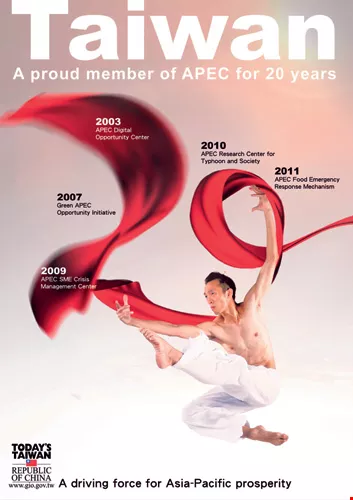
Taiwan has been a member of the Asia Pacific Economic Cooperation forum for 20 years and a driving force in regional economic development. This ad incorporated the cultural symbolism of a leaping dancer from the Cloud Gate Dance Theatre.
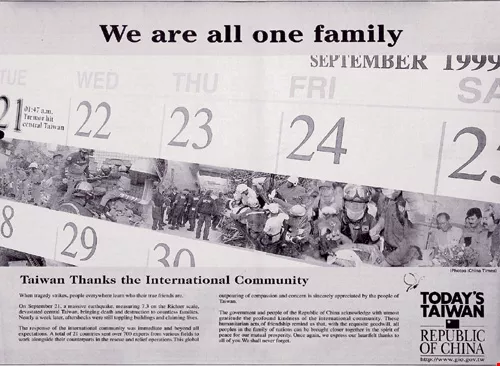
After the September 21, 1999 earthquake, the GIO produced the ad shown at left to thank the international community for its support. The ad at right was issued after Typhoon Morakot.
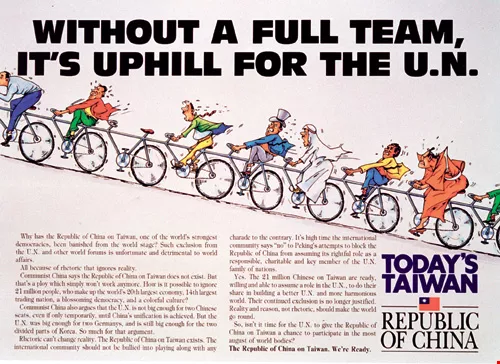
The extended-tandem-bicycle ad of 1993 was the first to appeal for admission of Taiwan to the United Nations. The “UNFAIR” and “WHO Cares” ads of 2004 likewise appealed for support for Taiwan’s admission to international organizations, citing the ROC’s economic wealth, achievements in health care, and robust charitable and aid sector.