Tracking First Peoples--The Shihsanhang Museum of Archeology
Teng Sue-feng / photos Jimmy Lin and courtesy of Shihsanhang Museum / tr. by Jon Babcock
July 2003


The Shihsanhang Museum of Arche-ology officially opened its doors on April 24. Located in Pali Rural Township, Taipei County, it offers protection to archeological sites and historical artifacts that shed light on the life of Taiwan's early ancestors some 1800 years ago. The building itself is likely to become a new attraction for the left bank of the Tanshui with its postmodern style and avant-garde architecture.
Before emptying into the sea, the leisurely Tanshui River makes a big curve producing scenic Tanshui on the right bank and Pali on the left. The image of poetic and picturesque Tanshui town caught in the remnant rays of an evening sun is known to all. But now Pali, too, is enjoying its day in the sun thanks to the historical treasury that it possesses. The Shihsanhang Museum of Archeology is northern Taiwan's first museum of archeology. It occupies an area of nearly 12,000 square meters, and cost NT$380 million to build. The idea for its design came from the historical vicissitudes of the archeological discoveries, and from the first peoples who crossed the sea in boats to come to Taiwan.
The museum is built in three disparate architectural styles, representing the connection between mountains and sea, between past and present. The arched steel-framed structure symbolizes the sea, with the structural layout employing outward radiating lines to indicate the ocean. The gently sloping roof is reminiscent of a sand dune in the environment of the ancient Shihsanhang or perhaps a whale's humped back as it emerges from the sea. Visitors will find an exterior stairway which will take them up to the roof where they are treated to exhilarating panoramic views. The three-story all-concrete construction symbolizes a mountain. The high walls on both sides draw one's attention outward to the Tapenkeng site at the foot of Mt. Kuanyin, hinting at the close connection in time between the Shihsanhang and Tapenkeng cultures.
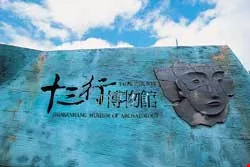
Its avant-garde style has made the brand new Shihsanhang Museum building a landmark in Pali Rural Township, Taipei County.
Surveying the left bank scenery
By following the course through the museum, the change in spatial bearings makes one aware of the long time-span of history. But it must be said that even the architectural uniqueness of the Shihsanhang Museum does not spare it from clashing severely with the holding tanks of the nearby Pali wastewater treatment plant. Fortunately, the architects have mitigated this by the happy connection between the wide staircase and the roof which draws one upward to a point from which sky and sea are seen as one and a feeling of vast visual space is created. The "out-of-kilter" construction hints at the destroyed ruins, at an ancient reality so hard to access.
After having enjoyed the view outside, you will go down the gently descending stairs or follow the path down the slope and enter the museum itself feeling as if you are entering the underground treasure vault of an archeological dig. In the reception area in front of the treasure trove the first thing that occurs to many visitors is, "Why is it called thirteen (shihsan) hang?'"
It is a long-standing custom among archeologists to name prehistoric sites after the current name of the place where the site was discovered. The Shihsanhang site took its name from "Shihsanhang Village," the alternative name of Tingku Village in Pali Rural Township, Taipei County, which was an important trading port during the Qing dynasty. The name "Shisanhang" refers to the thirteen trading houses or "hang" that set up an open market in this village. In later years, as the old Mengchia (now Wanhua) and Tataocheng (Tihua Street) areas of Taipei grew in importance, "Thirteen Hang Market" declined into a small fishing village.
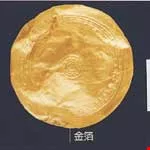
Gold foil
History reawakens
Just as ancient artifacts, which cannot speak, reveal one impenetrable mystery after another, the discovery of the Shihsanhang site is a remarkable tale in itself.
In 1955, Air Force Major Pan Ke-yung was flying the skies over Mt. Kuanyin in Pali Rural Township when the compass suddenly started to jump erratically, obviously due to some kind of magnetic abberation. He suspected there was an ore deposit under the ground surface below. Two years later, with the help of geologist Lin Chao-chi and a mineral exploration company, Pan Ke-yung went to Tingku Village in Pali to take a look. Lin Chao-chi discovered numerous fragments of iron ore slag, remnants of primitive iron smelting. Because there was no record of metal making in that area by either Han Chinese or Japanese, Lin concluded that this was probably a prehistoric iron smelting site.
Two years after the Shihsanhang site was discovered, archeologist Shih Chang-ju led a team of archeologists from Taiwan National University to carry out a brief dig at the site. They found a rich variety of prehistoric artifacts, including pottery, stone vessels, iron vessels, and cultural items made of glass and other substances, together with graves. They postulated a close connection between the people of the Shihsanhang culture and the Ketagalan, a Pingpu (plains) Aboriginal tribe. From this point onward, the name of the Shihsanhang archeological site become well known and was included in the prehistory section of the Taipei County Prehistory Gazette. Henceforth, scholars would often came here to investigate and gather data. In 1988, thanks to a National Science Council plan entitled, "A Plan for Archeological Research into Taiwan's Earliest Han Chinese and Pingpu Settlements," Tsang Chen-hwa, Liu I-chang and other researchers at the Archeology Group of the Academia Sinica Institute of History and Philology formally began exploration of the Shihsanhang site.
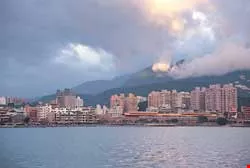
The distant bank of the Tanshui River and the town of Tanshui as seen from Pali. photo by Diago Chiu)
Protecting the site
Just as the Shihsanhang culture was receiving serious attention from scholars, the former Taiwan Province Housing and Urban Development Bureau included the site and a large chunk of the surrounding area in their land use plan for the Pali wastewater treatment plant. Construction of the plant began in 1989. It looked as if the Shihsanhang site was doomed to imminent destruction through its transformation into sediment pools, sedimentation tanks, holding tanks, and other sewage treatment facilities.
"The Shihsanhang site is about to be buried under heavy construction," read the news. But once it was exposed in this way, it caught the attention of various segments of society and evoked calls for help. The movement to protect the site and preserve its cultural artifacts had begun.
After two years of protests by cultural and academic groups, in November, 1991 the Ministry of the Interior designated Shihsanhang a Class 2 historical site. The protected area is 3161 square meters and measures approximately 144 meters by 22 meters. In 1995, the relevant agencies of the central government agreed to set aside land for a "Shihsanhang Archeological Site Exhibition Hall" next to the wastewater treatment plant. The name was changed to "Shihsanhang Museum of Archeology" in 1998 when work started on building the museum.
One man in particular, Liu I-chang, a research fellow at the Institute of History and Philology, invested a great deal of effort in saving the site. At the press conference preceding the opening, he declared that although he hoped for nothing but the best for the "new life" stemming from this piece of ground, he still harbored much concern.
He worried that because construction of the Pali wastewater treatment plant made it impossible to build the museum on top of the site, the site would be lost. Aside from this persistent concern, Liu I-chang expressed high hopes that the Shihsanhang Museum would exist and prosper together with all the ethnic groups that are intertwined with Taiwan's land, history, and society. "The Museum should blend seamlessly with the lifestyle along the left bank of the Tanshui River mouth. It should play a cultural role right alongside Chihyenshan, Yuanshan, the Dutch, the Spanish, the Han people, and so on. It should allow us to learn more about and to build the history of Taiwan."
Whither from, whither to?
If the site is visual evidence of former peoples' opening new land, then what do the cultural artifacts unearthed and preserved at Shihsanhang tell us?
Tsang Chen-hwa, a research fellow at the History and Philology Institute, had this to say: "The Shihsanhang culture is associated with the iron age in northern Taiwan, starting roughly 2300 years ago and continuing until the advent of the Han people in this area." Shihsanhang represents Taiwan's prehistoric culture.
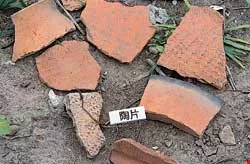
The main feature of Shihsanhang culture is that stone tools are few; there are hollowed-out stones, stone mallets, etc., but no cutting tools. Such things as iron slag, iron ore, and charcoal unearthed at the site show that the people of that time already knew how to smelt iron. Aside from stone and iron implements, there are numerous ceramic items, mainly reddish brown sand-and-clay pottery that is distinguished by being hand-thrown, containing fine sand, being fired at a high temperature, and by its strength and hardness. This is usually found in the form of small-mouthed big-bellied round-bottomed jars, and circular-based jars with abrupt spouts in the rim. Besides these there were also pinch-mouthed and wide-rimmed basins, often decorated from the neck down with various design motifs that vary greatly, although square criss-cross patterns and slanting criss-cross patterns predominate. In addition, there are a few impressed circles and dotted designs. Usually such ornamentation is found on the exterior surface and above the lips of the pots.
Among all the pottery, there are not many examples of the light brown earthenware type, but it has a rough rope marking decoration rarely seen on the other objects. Pots made from blackish ash-colored clay are also few in number, but they too have some special characteristics. The jars and vases have small mouths and big bellies. The material is of very fine quality and the exterior surfaces have undergone smoothing and polishing. There are broken lines and circles on the exterior surfaces of the "shoulder" portion, and these decorative line patterns normally encircle the outside of the vessel.
Besides these implements of everyday use, Shihsanhang culture has a great number of agate marbles, glass bracelets, glass earrings, glass marbles, and marbles of other materials. Also discovered at the site are gold ornaments, gold pendants, bronze bowls, silver tube ornaments, copper knife handles, copper bowls, copper bells, copper coins, and other rarely seen artifacts that most likely came in through trade with foreign regions.
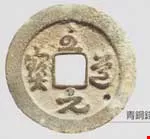
Coins discovered at the site show that Shihsanhang people traded with the Han people.
Relics talk
The rich cultural artifacts of the Shihsanhang dig have much to say.
As the studies of archeologists over the past ten years have shown, at least three different groups of people have lived at the Shihsanhang site at various times. The earliest were the people of the Yuanshan culture who settled here roughly 2000 years ago, during the late Neolithic. Since few artifacts remain from this period, it is possible that their stay was relatively brief. Close to the nearby northwestern foot of Mt. Kuanyin is the Tapenkeng site where remains from the Yuanshan culture have also been found. Living only a kilometer from the Shihsanhang site, it is possible that the people of the Yuanshan culture found life too difficult on the bleak and windy seacoast, and moved away to settle at the foot of Mt. Kuanyin.
Next, around 1800 years ago, another group of people moved into Shihsanhang. This is what archeologists call "the Shihsanhang culture," and they are most likely the ancestors of the Ketagalan tribe of Pingpu Aboriginals. This group lived at Shihsanhang for a long time, at least until as recently as 800 years ago, in other words for more than a thousand years. In addition to leaving behind a rich set of traces and artifacts, they left behind a huge number of graves. Most of the artifacts unearthed at the site were left by this group of people. Finally, last to arrive were the Han immigrants who came over from Fujian during the Qing Dynasty and set up a village here.
Sketching the prehistorical picture
The discovery of the Shihsanhang site is doubtless a major event in Taiwan's history as it goes a long way toward clarifying the prehistorical background of these islands.
From the evidence unearthed by archeology we can get an idea of the everyday life of the Shihsanhang people, living in intimate contact with nature, more than a thousand years ago. For example, their main food was rice and besides the cultivation of this staple, they hunted in the mountains, caught fish, lobsters and shrimp, and gathered shellfish in and alongside the Tanshui River. In other words, they fully utilized the abundant resources available in the big river mouth and in the mountains and forests. They would throw away what they didn't eat at specific spots. These form what archeologists refer to as "kjokkenmodding" or "kitchen middens."
From the discovery of pottery vessels decorated with weaving patterns it can be assumed that the prehistoric people of Shihsanhang people were able to use simple tools to make clothing. The clothing itself has disintegrated in the graves and there is no way of knowing what colors or styles were used. The people lived in houses built on posts high above ground to avoid getting wet and as a protection against animal interlopers. These are referred to as "stilt houses" by scholars, and houses of this type of construction could once be seen in the villages of all Taiwan's Aboriginal peoples.
Because the Shihsanhang people traveled to and from the southeast China coast and to various places in the South Pacific, imported pottery, bronze artifacts, Han coins, glass marbles, etc., are also to be found at the site. Furthermore, craft techniques were well developed. Not only were they able to smelt iron and use it to make a variety of items for use in everyday life, but they acquired items from other groups through trade. They were also able to produce high-quality and finely decorated ceramic pots, and bowls. And they had the leisure time to create ceramic figurines of humans and animals.
The graves show that the Shihsanhang people buried their dead lying on their side, knees bent. The body was usually positioned with the head to the southwest, perhaps for cultural or religious reasons. Pottery, pearl ornaments, and gold objects accompanied the body in the grave. Based on studies of the skeletal remains, it seems clear that the Shihsanhang people were the direct ancestors of the native peoples of Taiwan. They, too, liked to chew betel nuts and tobacco leaves, and to chat and eat while squatting.
Although the cultural artifacts unearthed so far have revealed a good deal of information, still many mysteries remain. For example, why did the Shihsanhang people suddenly disappear after living here for a thousand years or more? But from the arrangement of the graves, and the close connection between pottery type and customs, scholars postulate an extremely close relationship between the people of Shihsanhang and the Ketagalan, and consider them most likely to be the ancestors of the Ketagalan. But the definitive answer here will have to await a DNA analysis of the unearthed human bones.
So at land's end, where the great Tanshui River enters the sea, in Pali on the river's left bank stands the Shihsanhang Museum of Archeology. Here, from the eight-sided "out-of-kilter" pavilion with walls that stand 17 degrees away from the vertical, we can climb the whale back-shaped radiating steel platform and enjoy the cool breezes. To the one side we can take in the distant indigo Tanshui River mouth, and on the other, we contemplate the lush blue-greens of Mt. Kuanyin and the archeological sites. We think back to the early people here-sweating, smelting iron, with the know-how to carry out high-temperature pottery firing, and one page in the thousand-year story of these prehistoric people gradually opens to our understanding.
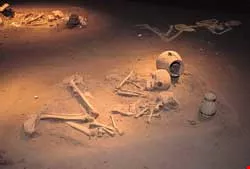
(far left) Nearly 200 complete graves have been found at the Shihsanhang site.
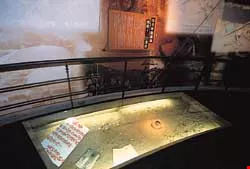
(center) By displaying actual artifacts the museum helps visitors visualize the lifestyle of the Shihsanhang people.
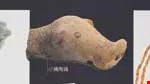
Ceramic pig
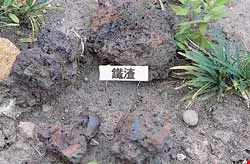
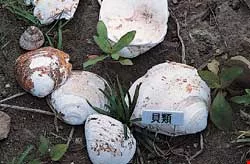
Iron slag, pottery shards, shells and other artifacts are still to be found at the site, located between the Shihsanhang Museum and the Pali Wastewater Treatment Plant.
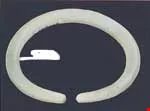
This glass earring from one of the graves was probably imported from China's southeast coast or from South Asia, according to experts.
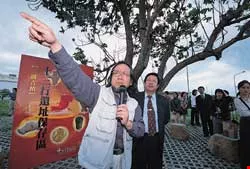
History and Philology succeeded in partially saving the Shihsanhang site.

@List.jpg?w=522&h=410&mode=crop&format=webp&quality=80)


