Techno Art Storyteller, Huang Hsin-chien
Vito Lee / photos courtesy of Huang Hsin-chien / tr. by David Smith
January 2011


Storytelling is his stock in trade. High-tech gadgetry-including sensors, LED displays, interactive installations, and video game consoles-do the talking.
He tells his own stories, but also enjoys bring others in on the telling, be they professional dancers, stage directors, or companies trying to sell real estate, clothing, or mobile phones. With today's blurring of the boundaries between art and commerce, some of the stories he tells are quite artistic, while others are thoroughly commercial.
He says a good story should have its ending written by the audi-ence, be the setting Taipei, San Francisco, or Shanghai. Whether on the 88th floor of Taipei 101 or at the recently opened Taipei International Flora Exposition, his stories always leave the door open for the audience to step in and affect the outcome.
He is Huang Hsin-chien, a multi-talented crossover digital artist who personally gets involved in both drawing designs and writing computer programs, moving easily back and forth between the worlds of technology and art.
Discussions of symbiosis in the natural world focus quite often on the process of pollination, in which insects feeding on flowers spread pollen from stamens to pistils, thus fertilizing the flowers. In so doing, the insects prolong their own lives while helping plants procreate. Though hand pollination is now a common practice, natural pollination by insects remains the mainstay in farming.
The Taipei Flora Expo, which puts equal stress on the beauty of flowers and the fascination of artful display, naturally has an exhibit that zeroes in on the topic of species propagation. The problem, however, in today's high-tech world is how to present beauty while at the same time giving visitors a vivid experience of the process of pollination.
In 2009, with the opening of the expo still a year off, the director of the expo's Pavilion of Dreams, Yuan Nai-juan, turned to Huang for assistance: "We wanted for the Pavilion of Dreams to tell a story using both technology and art, and Mr. Huang knows more about that than anyone else in Taiwan."
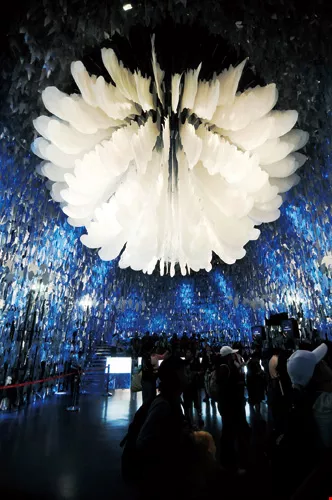
The most popular pavilion at the Taipei International Flora Exposition is the Pavilion of Dreams, which features interactive art that showcases Taiwan's cutting-edge technologies. The displays there are especially notable for their 3D animation, real-time interactivity, miniaturized dimensions, and highly sensitive reaction to visitors. Visitors wearing RFID bracelets, for example, can make flowers move about in the display. Visitors are in for a special treat when a brilliantly illuminated mechanical flower measuring six meters across blossoms in the main hall of the pavilion.
With the Flora Expo now into its second month, the Pavilion of Dreams remains the most popular of the expo's 14 pavilions, and the lines of people waiting to get in are longer than anywhere else. Once in Hall 2 of the pavilion, the visitor's entrance into the "metamorphosis area" activates a host of animated insects, which begin crawling all over the flowers there. Proceeding forward through stamens, visitors moves toward the heart of the flower, then pass through a wall of petals made of Lycra fabric, where grains of pollen drift slowly downward toward avatars representing the visitors. The avatars take the form of insects, and the pollen "sticks" to them. In the center of the huge "techno" flower is its ovary. When the pollen-laden visitors reach out and touch an ovule, they complete the pollination.
The instant pollination is achieved, the ovule throws off dazzling beams of light. The visitors gasp in delight.
Ms. Yuan explains that "the Industrial Technology Research Institute [ITRI] manufactured the ovule and the surrounding LCD glass, but it was Mr. Huang who came up with the core concept." The ovule is made of glass and hangs down fully two meters meters from the ceiling.
With experimentation in the mixed use of different media all the rage these days, technology has indeed opened up limitless possibilities for art. At Hall 2, the LCD glass from ITRI is the main "prop" used by Huang to create a dream-like flower world, but for the surrounding flower petals he relies on soft Lycra fabric laid over a simple metal framework to offset the cold tone of the glass. The petals add a note of warmth and create a more richly pleasing visual effect.
LCD glass is most often used for interior partition walls or in the windows of tall buildings to control the passage of light or to make space feel more airy or interesting. Conventional LCD glass can only be used for a flat surface because curvature of the glass makes it impossible for the liquid crystal structure to control the passage of light, but the ITRI made use of a cutting-edge polymer-dispersed liquid crystal film for Hall 2, resulting in an LCD display that works properly even with curved glass.
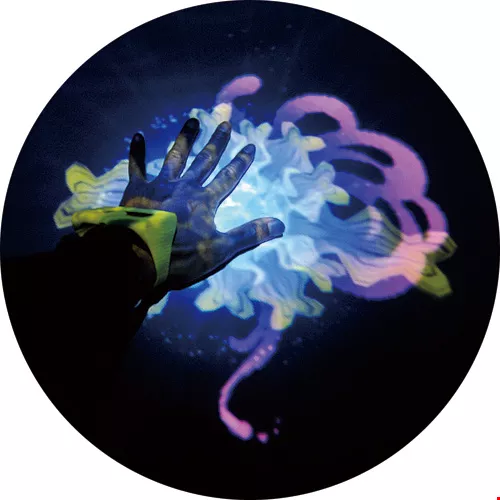
The most popular pavilion at the Taipei International Flora Exposition is the Pavilion of Dreams, which features interactive art that showcases Taiwan's cutting-edge technologies. The displays there are especially notable for their 3D animation, real-time interactivity, miniaturized dimensions, and highly sensitive reaction to visitors. Visitors wearing RFID bracelets, for example, can make flowers move about in the display. Visitors are in for a special treat when a brilliantly illuminated mechanical flower measuring six meters across blossoms in the main hall of the pavilion.
His work with high-tech firms has afforded Huang the opportunity to keep abreast of the latest technologies. This is crucial, since a high-tech artist uses technology as a tool for creating works of art.
The melding of art and technology in the beginning was a simple matter of drawing with computers, but has now moved on to a stunning array of 3D visuals, special stage effects, and all sorts of interactive installations. Huang, who was born in 1966, grew up in an artistic home and first came in contact with art through the traditional media-lead pencils, watercolors, and crayons. His mother was a painter, and his older sister a ceramicist. "My mother taught at the Affiliated High School of National Taiwan Normal University, and never demanded that I draw specifically this or that. The stuff I did at the beginning was nothing more than doodling."
"I like to look at things, observe. I like fine textures and mechanical structures." Sitting unshaven in his office in a wrinkled T-shirt, Huang recalls that he has always been drawn to unspectacular things like rusty metal and lichens. He is mesmerized in some cases by things that others would find ugly.
Huang's wife, Tsau Saiau-yue, recalls that it took her quite a while to understand his fascination with tiny things: "Back when we were dating, when we would go out for a stroll or something he'd always have to photograph all these things he was seeing. Sometimes I'd already be walking on ahead before realizing that he was still back somewhere musing over some tiny thing." The things he was photographing would eventually become the subject matter of his artistic endeavors.
However, one of Huang's eyes has been "on the blink" since childhood. At age four, he suffered a cornea injury that left him visually impaired for life in the right eye. Since that time, he has had to make do with just the left eye. "For a while, I wasn't able to accurately judge distances. Now I rely on touch to gauge the size and distance of things."
But impaired eyesight never kept him from reading or drawing. He gradually got used to using one eye to view the world. When working out the idea for a piece of art, he always starts by doing a preliminary drawing in his sketchbook. However, he does acknowledge that the eye injury has had some impact on his character, and feels it is perhaps the reason why he has never been very physically active or talkative. "As a kid, I was sort of living in my own world." Huang recalls: "Because of the cornea injury, I came to understand that when you sustain a physical or psychological injury, you become stronger in another area. It's like something else will emerge to compensate for the lost eyesight, whether it's hearing or one of the other senses."
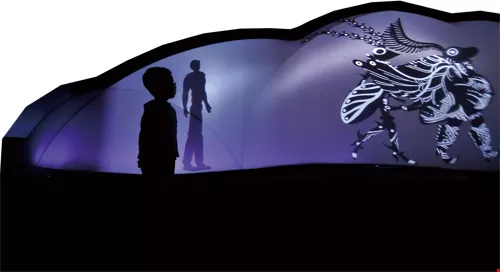
(left) In Hall 2 at the Pavilion of Dreams the visitors are transformed into insects that putter about in a maze of flower petals. When the insects pass beneath a flower pistil, their pollen-laden bodies complete the process of procreation. This entire exhibit was designed by Huang Hsin-chien.
After graduating from the Department of Mechanical Engineering at National Taiwan University, he received a full scholarship to the Illinois Institute of Technology's Institute of Design, successor to the renowned New Bauhaus School of Design. There he completed his master's degree.
While in school, the introverted young Huang originally thought he would become a mechanical engineer, or perhaps a product designer. Later, after taking up work as a creator of computer games, he thought for a time that he would stick to that path for the rest of his career. But while he was pursuing his doctorate in the United States, his advisor contracted a serious illness, which prompted Huang to leave academia for the work world. "Because of that, I had the opportunity to work with the avant-garde musician Laurie Anderson, and it was then I discovered a deep-seated desire to create. It was as if it had been there all along, since childhood."
Almost 20 years older than Huang, Laurie Anderson first achieved note in New York in the early 1980s with her offbeat experimental music performances. In addition to music, she also made films, and employed a wide array of gadgetry in her work, including synthesizers, filming equipment, computer-aided design, and various electronic gizmos of her own design. In 1994, she hired Huang to help make an interactive musical piece. "In Laurie I saw the verve and idealism of an artist, and the power of an artist to influence others." After that, he worked in the gaming machine divisions of Sony and Sega for a total of seven years. This work would have a big impact on how he went about his work once he took up art.
Coming from an artistic family, and having accumulated work experience in digital art, computer programming, and computer game development, by 2001 Huang had matured into a young artist adept in a wide range of multimedia specialties. He returned that year to Taiwan and opened his own atelier, Storynest Corporation.
In just a few short years, Huang managed to find clients among a long list of Taiwan's entertainment-world heavyweights. He had made a name for himself. The singer Summer Lei hired him to produce a series of CD jackets and music videos. She also had him produce her website and an interactive video entitled The Poetronic Little Prince. When pop superstar Jay Chou went on his Incomparable world tour in 2004, he hired Huang to produce a big 3D animated stage set. In 2006, Huang collaborated with choreographer Ku Ming-shen on Memory Puzzles, praised as a pioneering work of modern dance that combines with digital animation to achieve something utterly original. Huang's contribution was photos of Tai-pei cityscapes projected onto the stage set. Huang's wizardry enabled each movement of the dancers to push and pull the projected images about the stage, and as the performance unfolded, the dancers gradually transformed from rambunctious youngsters into deliberate and measured old folks.

A graduate of the Department of Mechanical Engineering at National Taiwan University, Huang Hsin-chien has a special fondness for mechanical parts. Sound in Stasis (2009) communicates the memory of growing up through a series of what appear to be gear wheels.
As one who straddles the worlds of technology and art, Huang moves back and forth comfortably between the two, both in the nature of his work and in the list of his clients. He is used to working in teams, and after meeting with his collaborators to discuss a project, he works out a project plan that will run to several dozen pages at the very least, and in some cases will stretch to hundreds of pages. His project plans are very much like the product manufacturing specifications used in industry. In addition to writing out a prose description of his artistic concepts, he also provides detailed specs for the equipment he will use, the venue, and much more.
The project plan for Hall 2 in the Flora Expo's Pavilion of Dreams, for example, states as follows: "The 'pollen grains' produced by the projector will be 'round or elliptical,' and will float slowly down from above at a fixed speed but following unique paths."
As for the interactive mechanism, after the pollen grains start floating down from above, RFID bracelets handed out to the visitors enable a computer to pinpoint the visitors' locations and cause the pollen grains to congregate around them. As the grains bunch together, they collide and merge into larger grains.
In working at the concept stage, Huang must consider the limits of what is technically possible, because once the proposal is finished he will have to convert his ideas into reality.
With the help of computers and other high-tech gadgetry, an interactive art work can be made to "perform" for 24 hours a day, and one can even decide, depending on the circumstances, the size of the work at any given time. For this reason, in addition to purely artistic venues, there are also a lot of commercial establishments and events that like to make use of interactive works.
One example is the virtual fitting room that Huang designed in 2005 for Macy's Department Store in San Francisco, where the store equipped a fitting room with a webcam. Once the camera captures a store visitor's image, the person can use a touch screen to see what he or she would look like in different outfits, without the hassle of actually having to try them on. Besides saving time, the virtual approach also saves women the worry of messing up their hairdo or makeup. The touch screen can even be used to "try on" different glasses, belts, and other accessories, and one can check the price of each item and see where it is stocked in the store. The whole process of trying things on and buying them is made a whole lot easier.
Another highly successful commercial project of Huang's is his work at the Taipei 101 skyscraper. Ever since the building was completed, the observatory on 88th floor has been a magnet for visitors to Taipei, so the building management decided to hire Huang to design an interactive installation that would put the crowning touch on an already popular destination. The result, Walk above Clouds, was completed in 2008. As visitors walk through a corridor about six meters long, images of clouds projected on the floor part beneath their feet to reveal images of Taipei City seemingly far below. With Walk above Clouds garnering rave reviews, Taipei 101 was able to raise the price of admission from NT$350 to NT$400. Walk above Clouds brings in an estimated 150,000 monthly visitors, so the attraction of interactive installations is not hard to appreciate.
Huang has also made a mark in mainland China, most notably at the Shang-hai Art Museum with his 2008 work Shall we Dance, Shanghai? Huang started with 3,000 photos of buildings around Shanghai and selected the most distinctive of them to create the installation, in which images of imposing skyscrapers are converted into lithe "beings" that dance in synch with the movements of museum visitors.
"They're going gaga on construction in the mainland, and the big buildings just tower over people," says Tsau Saiau-yue, who explains that the work seeks to communicate in a bit of a humorous way that people can make buildings dance and determine the course of urban development.

Shall we Dance, Shanghai? was installed at the Shanghai Art Museum in 2008. When a visitor stands with his or her feet in the indicated positions, images of buildings move in synch with the visitor's body movements.
With digital art becoming ever more firmly established in Taiwan, colleges and universities have identified it as the wave of the future and begun actively seeking to turn out graduates in related fields. Even polytech schools like National Chiao Tung University and National Taipei University of Technology have interactive media programs.
"A lot of people ask me whether interactive art is commercial or -artistic, but artists have in fact always served commerce. The royal courts of Europe were once the biggest patrons- of the arts," says Huang, for whom the most important thing is that, when an artist is at work, he or she should not be thinking solely about sales. Otherwise, the work will not be pure. He argues that an artist should keep in mind who the audience is, and what sort of impact he or she is trying to achieve.
In fact, experimental mixing of technology and art has always had its critics. In the opinion of Hsu Po-yun, founder of the locally famed New Aspect- Cultural and Educational Foundation: "Some young artists, in particular, seeing that technology can put pizzazz in stage lighting, end up diving headlong into 'crossover art.' That kind of stuff is not at all interesting."
MIT Media Lab was the first research body in the United States to conduct research on interactive art. In 1996 the lab's Tod Machover, a leading light in the world of interactive art, wowed the world with his Brain Opera, which premiered at the Lincoln Center and created a big stir. During the performance, members of the audience were able to control the sounds of electronic instruments either on the spot or via the Internet. Some in the art world, however, felt the show was an unmitigated disaster. Many critics bluntly stated that Brain Opera was nothing but a joke parading in the guise of interactive art.
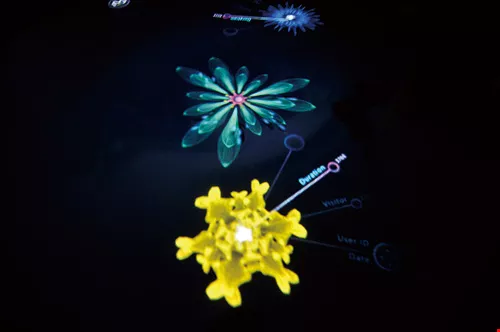
With digital music still in the experimental stage, the interactive aspect is quite attention-grabbing, but there has been no lack of total flops in the genre. "Those who would create an interactive work must first ask themselves what sort of art even needs to be interactive," says Huang. He argues that audiences used to be more like spectators, but now the interesting thing about interactive works is that they turn the tables, so that users and audiences themselves have a say in the outcome of a story.
"Sometimes I lurk around to see how people are reacting to my works," says Huang, who laughingly admits that he has on occasion tweaked an exhibit based on how people were reacting.
No matter what the artistic form, time will eventually separate the wheat from the chaff, and time is on the side of a marriage between technology and art.
"Technology has a story to tell. Some feel it's cold, but technology was invented by humans, and has the characteristics of humans. It's up to us to use it as we see fit. That's what makes it interesting."
Huang's office is strewn with robots, remote controls, and computer jacks. A visitor might think it's in a mess, but this is the dream factory where homebody Huang spends an average of 14 hours every day. Here he has traded in the pencil for a mouse to use in pushing at the limits of multimedia expression. He acknowledges that technology may at times fall short, but continues hoping for the day when he can use it to compose the most beautiful art ever seen.
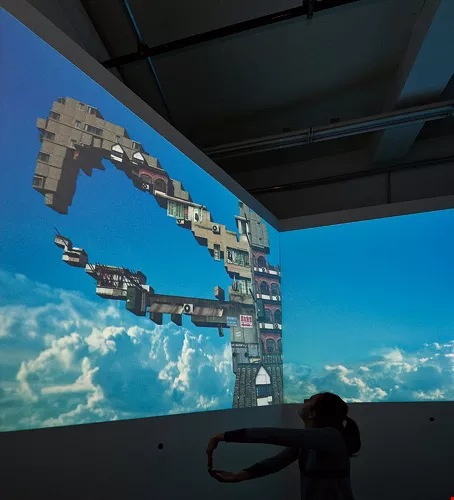
Shall we Dance, Shanghai? was installed at the Shanghai Art Museum in 2008. When a visitor stands with his or her feet in the indicated positions, images of buildings move in synch with the visitor's body movements.
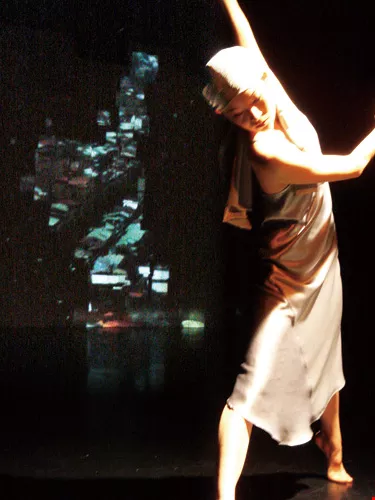
Huang Hsin-chien and choreographer Ku Ming-shen collaborated on Memory Puzzles, a dance performance in which the cityscape depicted in the stage set changes in response to the movements of the dancers.
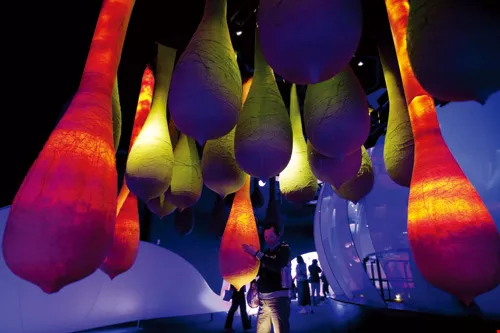
(left) In Hall 2 at the Pavilion of Dreams the visitors are transformed into insects that putter about in a maze of flower petals. When the insects pass beneath a flower pistil, their pollen-laden bodies complete the process of procreation. This entire exhibit was designed by Huang Hsin-chien.
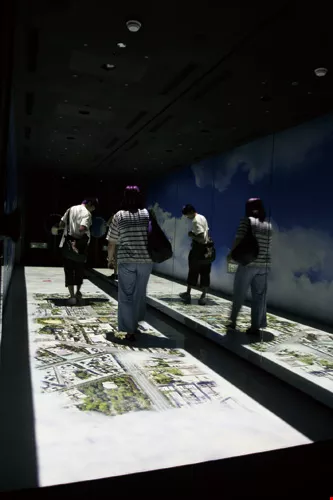
Walk above Clouds, a work executed on the 88th floor at the Taipei 101 skyscraper, is the highest piece of installation art in Taiwan.
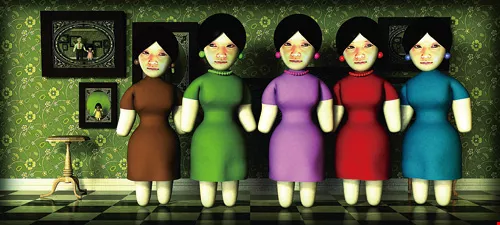
With Huang Hsing-chien's Gaze, when a person stands before the display screen, a computer captures an image of his or her face and then multiplies it to create a composite "family" photo in the style of those that families had taken many years ago.
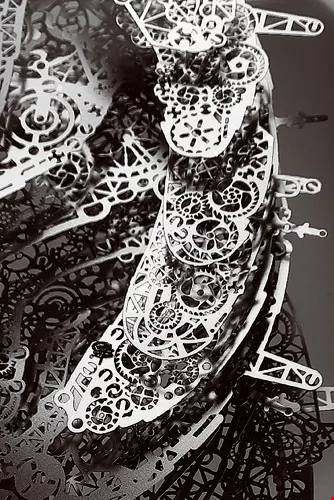
A graduate of the Department of Mechanical Engineering at National Taiwan University, Huang Hsin-chien has a special fondness for mechanical parts. Sound in Stasis (2009) communicates the memory of growing up through a series of what appear to be gear wheels.
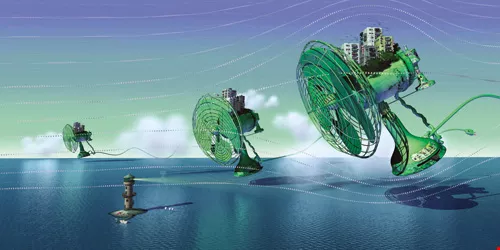
Not long after returning from America and discovering that the cityscapes of old Taiwan were no longer to be found, Huang Hsin-chien created a digital woodblock print called Exported City to express his nostalgia. The work features an image of a product from his childhood-electric fans made by Tatung-being exported to Southeast Asia.


