Writing Blossoms on a Withered Tree-Interview with author Shih Shu-ching
interview by Anna Wang / tr. by Christopher MacDonald
November 2000


The author Shih Shu-ching writes with the same nuanced delicacy as the late Eileen Chang but without the latter's air of detachment, using language in a way that is both vivid and refined. After completing her novel Weixun Caizhuang ("Tipsy with Make-up") she was invited by Buddhist Master Sheng Yen to write his biography. Blossoms on a Withered Tree, as the book is entitled, has been in the stores for three months and is selling well.
How did Shih, who as a novelist is more used to describing scenes and emotions, put aside her habitual sense of self and enter into the inner life of a spiritual leader? And how did she translate the profundities of Buddhism into intelligible terms? In the following interview, Shih (of whom her old friend Lin Hwai-min has said: "She has set aside the sentimental attachments of youth and arrived at the wisdom of middle age") talks about how she approached and felt about writing this biography.
Q: You have had a prolific output in the past 30 years, from your early works Job's Descendants and Porcelain Kuanyin, to the recent Hong Kong Trilogy, and have covered a variety of styles. Your latest offering, Blossoms on a Withered Tree, seems to be a complete departure for you. Let's start by talking about what it was that inspired you to write this book, and what your approach was.
A: Lin Hwai-min said he was surprised that I should start working in a new literary form in middle age. In fact it came about naturally. I was deeply moved by the Master's life of quiet but committed religious endeavor, and simply recorded and described his experience in book form.
Of course, I don't deny that writing this book was extremely difficult, and that the schedule was very tight. This was mainly because Sheng Yen is a writer himself, and reading through the many articles he has written is itself an enormous undertaking. Then there was the fact that Sheng Yen had already authored his own memoirs, and plenty of others had written about him too, so it was not easy to come up with an original approach. Also, despite having written over 30 books, this was my first biography. And with my still limited grasp of Buddhist teachings I felt a mild sense of panic throughout, worried that I wouldn't do a good job.
Before beginning to write I closely examined the reference material to gain a thorough picture of the Master's background. I thought over and over about how, in the few years that I have studied Chan under Master Sheng Yen, his words and deeds, though always unassuming, have contained so much that was precious. He treats others with generosity but is strict on himself, and his success has been achieved through unrelenting hard work. Although very easygoing, he is clear about his goal of studying and promoting Buddhist teachings, and resolute in his faith, and this is why he has been able to accomplish what he has. I therefore took the idea of a "statement of resolution" as the keynote for the book, describing and interpreting the events of the Master's life from this perspective. I didn't attempt to overstep my brief, or pass judgement. I simply presented the story of a clever boy from an impoverished background, who grew up and experienced awakening against the backdrop of a turbulent era and then, from his own experience of life, went on to expound on the compassion and wisdom of Buddha, eventually earning widespread recognition.
Q: How did the opportunity to write this biography come your way, and how did you set about the task?
A: In 1995 I came back to settle in Taiwan, and was converted to Buddhism under Master Sheng Yen in March of that year. The Master always knew that I was a novelist but never spoke about it.
The year before last, when the Master was 68 years old, he proposed to me the idea of writing his biography, and said that ideally he would like to see it in print in time for his 70th birthday. I was writing Weixun Caizhuang at the time, so I didn't start on the biography just then. Only when Weixun Caizhuang was finished, last year, did I begin to compose myself in preparation for work on the biography.
Gathering together the parts
Life is an accumulation of successive stages, and the same goes for writing. Though we often don't realize it at the time, every stage is a form of preparation for the one that follows. In my case, if I hadn't first produced a roman-fleuve like Hong Kong Trilogy, I most likely wouldn't have been able to manage the task of depicting the Master's peripatetic, extraordinarily full life. So long is the period it has covered, so epochal the changes that have occurred during that period, and so extensively has the Master traveled, that there were a million-and-one different threads to follow. I hardly knew where to begin.
Eventually I opted to start with the 921 Earthquake-which occurred around that time-and how it affected Master Sheng Yen. The sight of the Master's gaunt figure moving among the rubble, and his grieved expression, made me think about how he had grown up in a time of war and chaos, amid scenes of ruin and desolation. This gave me an intense feeling of how unfathomable life is, and how much effort the Master puts into the task of delivering his teachings. So the story begins with the earthquake, and then goes back to the time of the Master's childhood.
Q: How long did the whole process take? Were you gathering material and writing at the same time, or was the book drafted in one fell swoop at the end? Did Master Sheng Yen give you regular interviews and check the manuscript?
A: This was a massive undertaking. It couldn't possibly have been done in one fell swoop. I used the Master's own memoirs along with stories written about him by others to provide a framework, setting out the events and achievements of his lifetime up to the present day. Then I went to visit each of the places where the Master spent time studying and promoting Buddhism. Effectively, I was both a journalist doing interviews and an academic carrying out field work. I took lots of notes and eventually gathered together the different parts into a single whole. As to the writing, I am a very self-regulated person. I write every morning, whereas the afternoon is for reading, interviews, and other matters. During the writing process Master Sheng Yen didn't see the manuscript, and I only asked him to check it when the final draft was ready. I also requested the Master's opinion when it came to selecting a title. He looked out on the autumnal streets of New York City and offhandedly said: "Blossoms on a Withered Tree." It's a phrase that is rich in the spirit of Chan, and I feel that it also encapsulates the Master's life. He has endured a life of privations and lived the equivalent of four different identities, even changing his name four times, but whenever he was in dire straits he was always able to find a way out in the end, sticking to his beliefs. Like a withered tree sprouting blossoms, he gives people a sense of wonderment and of epiphany.
Q: This book adheres strictly to the form of biography, in total contrast to the free-flowing energy of a novel. Did it constrain your writing, the fact that you couldn't employ your talent for creative description?
A: I actually feel that this was good thing. In fact, when I was writing the book I purposefully strove for a state of composure so as to bring myself closer to the thinking of a spiritual person. I meditated and read sutras morning and night, every day, and also sat in on Buddhist art classes, so that my mind would be pure and lucid. Many people have remarked on the unaffected, limpid style of the book, which shows, I think, that I was successful, because that's just the feeling I wanted when I was writing it.
Q: Although your works in the past have demonstrated a range of styles, a feeling of excitement always comes through in the writing, and one can feel that you are someone with a passion for life. Writing this book, did you have the same kind of passion?
A: It's very hard to change a person's character. It's true that I'm someone with intense emotions, a woman who basically has a very full, happy life. But as I said before, when writing this book I deliberately calmed my mood. I particularly noticed that I had to step back, that I couldn't project myself into the characters as I often do in a novel.
However, that is not to say that I wrote without feeling. When I was writing about the difficulties and setbacks that the Master experienced, I often became deeply moved. Like writing about the time he was wandering around New York in the winter without a place to stay. On many occasions I was moved to tears. Writing about how he dragged himself from place to place when he was sick, day after day, to teach his followers, I couldn't help feeling my respect for him grow, and I think that too is a kind of passion.
Lifelong example
Q: Some think that as a disciple yourself, you can't write objectively about your Master. Was there a risk of hagiography?
A: It's a charge that makes me quite offended. Everything in the book was written on the basis of reference materials, plus interviews with his colleagues, believers and disciples. I traveled to Meinung where the Master shut himself away for six years, to Japan where he studied so painstakingly for his doctoral degree, and to the US where he has worked to promote Buddhism and establish temples. Everyone I spoke to had the highest regard for his example. What grounds could I possibly have for criticizing him?
What's more, the reaction in Buddhist circles in Taiwan when he first went to Japan to study, and the resistance he encountered when he went to the US to promote Buddhism, all showed how little solidarity there is within the Buddhist community. In the book I write unreservedly about negative issues like this, so how can anyone accuse me of flattery?
Q: In fact that concern is unwarranted. For you, which sections of the book are the most moving, and what kind of enlightenment do you hope readers can obtain from the book?
A: Many places in the book are moving to me. The stories of the Master's ten-year military career, and of the two times that he became a monk, leave a particularly deep impression. Also the spirit that drove him in mid-life to move to Japan to study, and in later life to go to the West to promote Buddhism. Sometimes I would be writing away and find my eyes brimming with tears, thinking about how he is such a great man. I also admired the way that he didn't wish to say much about the process of his spiritual awakening and the point at which it occurred.
Particularly in this day and age, when many people lay claim to divine powers and mystical revelation, Master Sheng Yen was remarkable for stressing his own ordinariness, and he used that to encourage everyone else. This is the kind of spirit that I hope readers will pick up from the book. Even in the face of adversity there is no need to despair about life. You have to seek ideals, pursue them to the end, and walk your own road.
p.119
For novelist Shih Shu-ching, writing Blossoms on a Withered Tree was a process of spiritual rediscovery. (photo by Pu Hua-chih)
p.120
Master Sheng Yen, who holds a doctoral degree in Japanese literature, is a man of culture and refinement, with the exemplary bearing of a Confucian scholar. (photo by Hsueh chi-kuang)
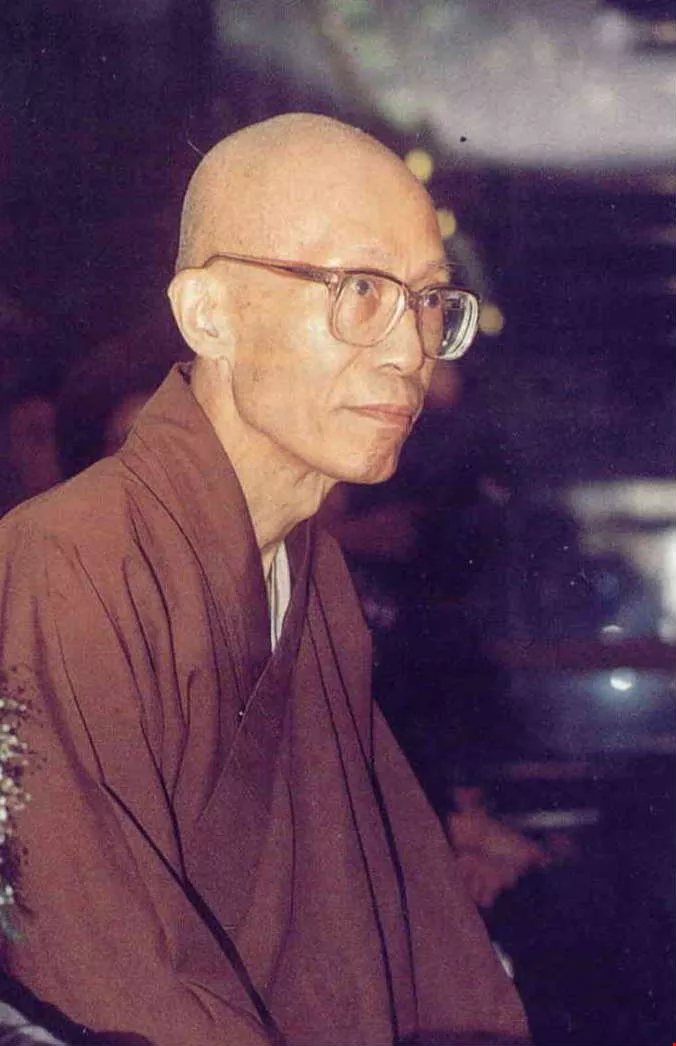
Master Sheng Yen, who holds a doctoral degree in Japanese literature, is a man of culture and refinement, with the exemplary bearing of a Confucian scholar. (photo by Hsueh chi-kuang)

@List.jpg?w=522&h=410&mode=crop&format=webp&quality=80)


