Happiness vs. Competitiveness-Has School Become Any Less Stressful?
Chang Chiung-fang / photos Hsueh Chi-kuang / tr. by Robert Taylor
April 2003
Some people say, childhood only comes once, so you should let children play to their hearts' content, and learn joyfully.
Others say, adversity spurs vitality, while comfort breeds sloth. Compared with young people in mainland China, where assiduous study is all the rage, the next generation growing up in prosperous Taiwan are gradually losing their ability to compete.
Should childhood years be spent in happy play, or in diligent learning? Who can give guidance to parents, and answers to children?
It is a Wednesday, and like other primary school pupils in Taiwan, Yang Hsiang has the afternoon free from school. This fifth-grader at Taipei City's Heti Elementary sits at home in front of his computer, playing games with complete concentration. He says that Mummy only lets him watch TV and play computer games one hour each a day, and he has to be in bed with the lights out by half past nine. But how he spends the rest of his time is up to him. His younger sister, second-grader Yang Jung, has finished her homework and is on the balcony, playing on her swing and chatting to the dog. Only their elder brother Yang Shang, who is in his first year at junior high school, is not yet home from school.
None of the three Yang children has ever gone for extra tuition at a cram school, even though Yang Hsiang gets failing grades in English tests at school, and even though when Yang Shang began junior high school he initially had some difficulty adjusting and got failing grades in English and maths, despite having been top of his class in maths and excellent at science in elementary school, where before graduating he made sketches of all his classmates which were printed as a book for each of them. "It was their evaluation methods, using nothing but pencil-and-paper tests, that beat Yang Shang," says his mother Liu Min, who believes that school assessments only tell part of the story, and one shouldn't set too much store by them. She just tells her children that they have to find their own ways to adapt to this system.
"What matters to me is whether the children live well-ordered lives, have good manners, and are able to look after themselves," says Liu Min. In her view, academic attainment is illusory, for paper qualifications do not mean that somebody will be a capable worker. What will give children the ability to compete in the future? Liu Min believes the answer is not grades, but self-confidence.

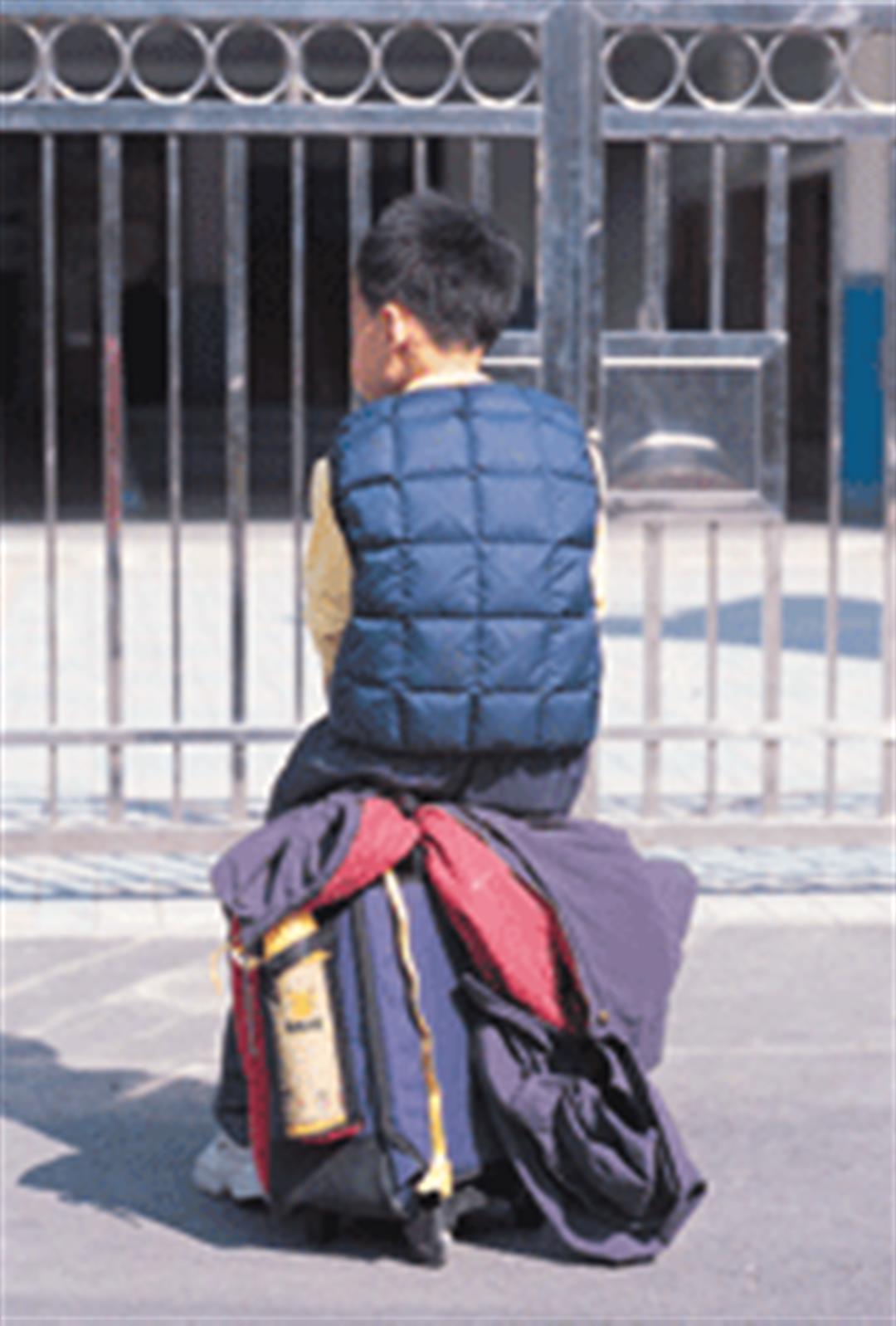
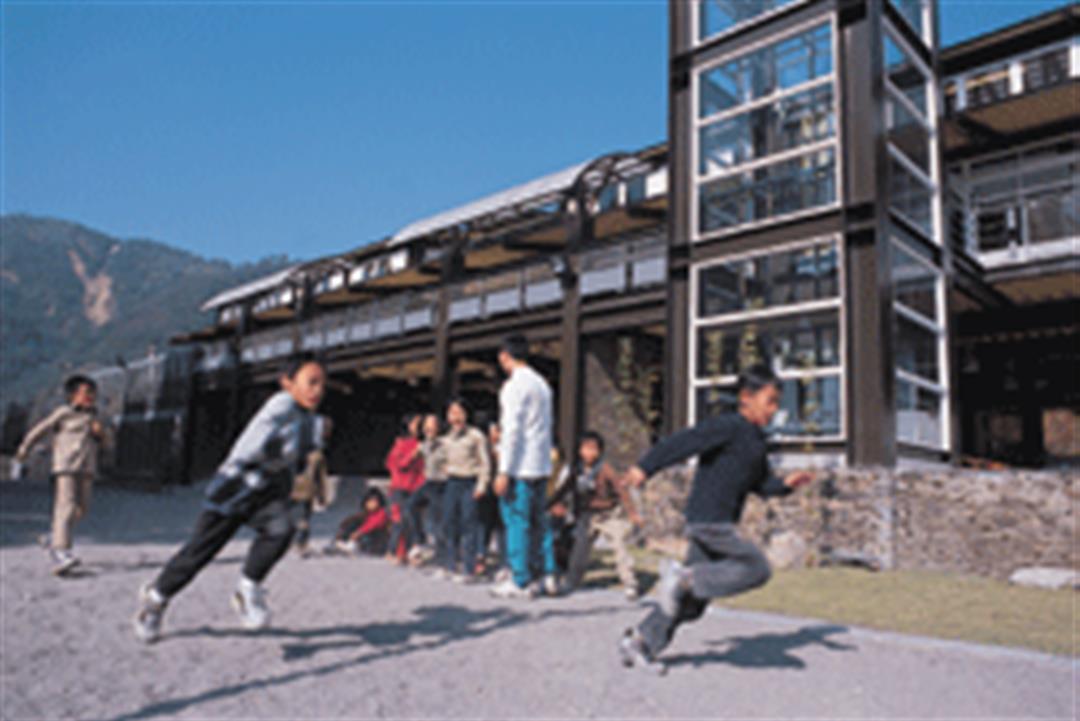
(facing page) From the president down to parents, teachers and children, everyone hopes their "satchels can be lighter." But why is it taking so long?
Holiday forest school
On school-free days, when other children are busy with extra English classes or piano lessons, the Yangs take their children off on camping trips all over Taiwan, which Liu Min calls their "holiday Forest Elementary School." The places they often visit include Kuanhsi Township and Chienshih Rural Township in Hsinchu County, Leli Elementary School in Taipei County, and Aohua Elementary School in Ilan County, where the children often play with the local aboriginal children.
As well as getting close to nature with her children, Liu Min also leads them in family book appreciation sessions, in which they all sit together and share their thoughts about books they have read.
In an age when grades are valued above everything and most children attend cram schools on top of regular school, doesn't Liu Min struggle with her conscience? Doesn't she have doubts? "I see things very clearly, and I'll never give in on this!" She says: "At age 40, I still get nightmares about exams, and I don't want that to happen to my children!"

Let's hope that the children studying so hard in the classrooms will one day be able to spread their wings and fly.
Harvard bound
Eight-year-old Huang Chun-chieh also lives in Taipei City, but he has a very different life.
Chun-chieh attends the private Hsinmin Elementary School. Right from the first year, the school has all-day classes. Chun-chieh gets up at 6:45 each morning to catch the school bus at 7:20, and his classes finish at 4:30 p.m. But when he gets out of school it is time for more studying to begin, for from 5 to 7 p.m. on Mondays, Tuesdays and Thursdays his mother has a British tutor give him extra English lessons at home, and on Wednesday and Friday afternoons from 4:30 to 5:30, another teacher comes to give him French lessons.
On days when Chun-chieh doesn't have to go to public school, he is not idle either. On Saturdays he goes to an abacus and mental arithmetic class from 8:30 a.m. till noon, and to maths classes at a different school from 2:30 to 4 p.m. Sunday is his only day of rest. When Huang Chun-chieh was just one-and-a-half, his mother Lin Shu-hui started taking him to Orff Music World for children's music sessions, and then for "creativity development" classes from age two. From two years and seven months old she sent him to an all-English kindergarten, and at age four he began going to maths classes. Lin Shu-hui says proudly that ever since Chun-chieh was little he has been a perfectionist, and he has a strong thirst for knowledge.
Huang Chun-chieh "speaks English like a native," and the goal he is striving for is to "study at Harvard some day." He writes a diary in English every day, and his standard of English has already reached the Cambridge intermediate level, equivalent to the fourth year of primary school in Britain. To build Huang Chun-chieh's future ability to compete, Lin Shu-hui plans to have him begin studying Japanese in his third and fourth years of school, and German in his fifth and sixth years. "Apart from languages, I also hope to let him come into contact with things like medicine and economics early on," says Lin.
What does he want to do when he's grown up? While other children his age may hum and haw before answering "a teacher," "a painter," or perhaps "an entomologist," eight-year-old Huang Chun-chieh says with assurance: "I can't decide yet, because you have to have a global view and keep up with the latest trends in society!"
Though at opposite ends of the spectrum, kids like Huang Chun-chieh and the Yang children may both be in the minority. But amid calls on the one hand for more relaxed attitudes and greater diversity in education, while on the other hand the pace of globalization is quickening and the pressure of international competition reaches down into almost every household, more and more families are moving toward one or other of the two extremes of "happy learning" or "greater competitiveness."

Competition in society is inevitable, but what is competitive ability? How can one become competitive? And as children build their future competitiveness, will they lose their happy childhood?
Hares waiting for tortoises
Early this year, Taiwan's Business Weekly magazine devoted much space to reports on the relative competitiveness of students on either side of the Taiwan Strait. The magazine called on people in Taiwan to wake up to the fact that they were in "a battle for survival between diligence and laziness."
"Taiwan no longer holds the advantage in cross-strait competition," says Taipei City education director Wu Ching-chi. He recounts that two years ago, when he visited an elementary school attached to East China Normal University in Shanghai, he saw mainland teachers teaching lessons in English; and at Tianyi Middle School near Wuxi in Jiangsu Province he saw teachers and students of a third-year gifted children's class conversing entirely in English.
During the Taipei International Book Exhibition, Japanese cartoonist Kenshi Hirokane opined that despite the clamor for the development of the knowledge economy, the prospects for making knowledge the basis for Japan's future prosperity are worryingly poor, because Japanese education nowadays is too undemanding. For example, Japanese educators recently discussed simplifying the value of pi from 3.1416 to 3.
Some university maths professors in Taiwan feel that we are a step ahead of Japan in this regard: they criticize the maths courses taught in Taiwanese schools in recent years as being so shallow that for elementary school students here, pi has already been simplified to 3. After several years of educational reform, the children who were used as the first guinea pigs are now in seventh grade (the first year of junior high school), and their maths ability has been decried by some as "worthless." This state of affairs has become a focus of legislators' interpellations in this session of the legislature, and the new maths promoted as part of the educational reforms has also become the butt of universal criticism. Professor Chen Yi-liang of National Taiwan University's mathematics department observes that the maths teaching materials introduced under the new nine-year integrated curriculum are overly simplistic and shallow, so that students' level lags one to two years behind the old textbooks used in Taiwan, and those currently used in the US.
Looking at the progress of education in countries around Asia, the situation in Taiwan causes many people to worry, but some teachers take a different view. Ding Gih-jen, head of the Jendo Education Society, says that making teaching materials simpler does not necessarily cause students' ability to regress. If children are failing to learn, the problem may lie in the teaching methods, rather than the textbooks being too simple. Scholars should not look at elementary- and high-school mathematics merely from the point of view of elite education. Ding observes that in the past, maths textbooks were too difficult, and two-thirds of children were doing no more than "sitting in" on classes. Now that the textbooks have been simplified, people complain about "the hares having to wait for the tortoises." But from another perspective, in the past people ignored the very existence of the "tortoises." Today at least the tortoises are moving forward!
Another telling example is English teaching. In recent years, the age at which children in Taiwan start learning English has been constantly falling. Many counties and cities have even "jumped the gun" by disregarding the Ministry of Education's requirement that English teaching should start in the fifth year of elementary school, and have begun to teach it from the first year. But many scholars observe that studying several languages too early only confuses children, and the end result may be that they don't learn even their mother tongue properly. Thus such an approach may be counterproductive.
Recently, President Chen Shui-bian wrote in his e-newspaper that he hoped children could have "fewer tests, lighter satchels, and more sleep." From this we can see that although "happy learning" is a goal that education reformers have been pursuing for many years, it remains tantalizingly out of reach, and today, with the threat of cross-strait and international competition, the idea of taking a little of the pressure off children is once again arousing much doubt and opposition.

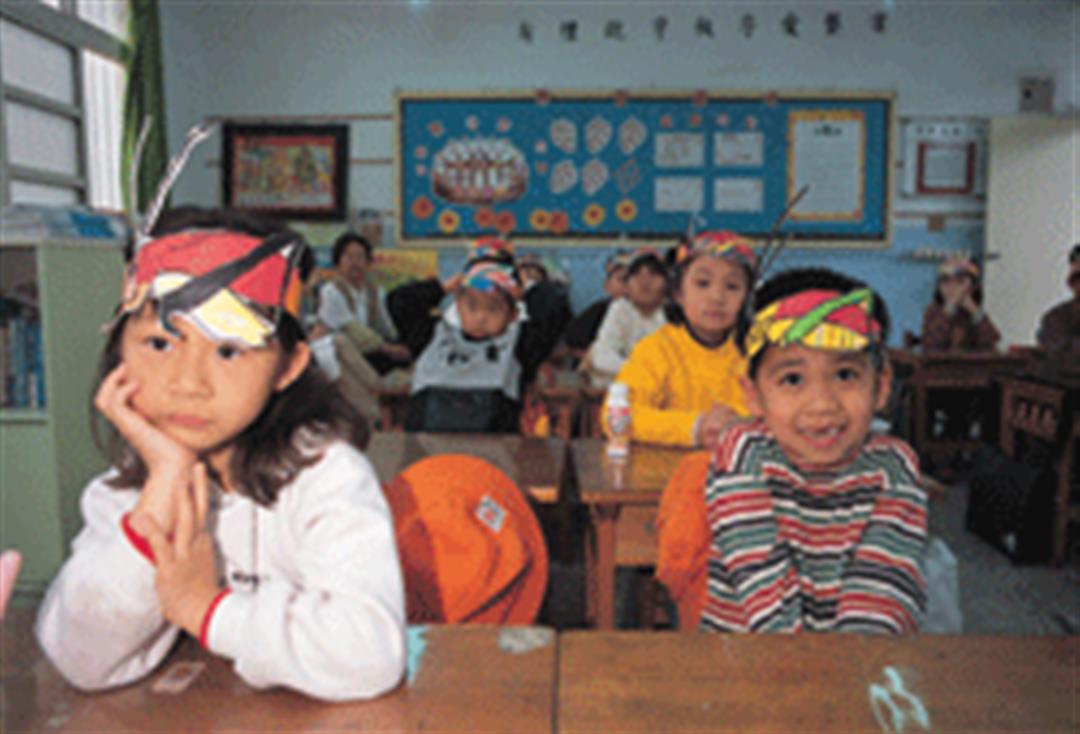
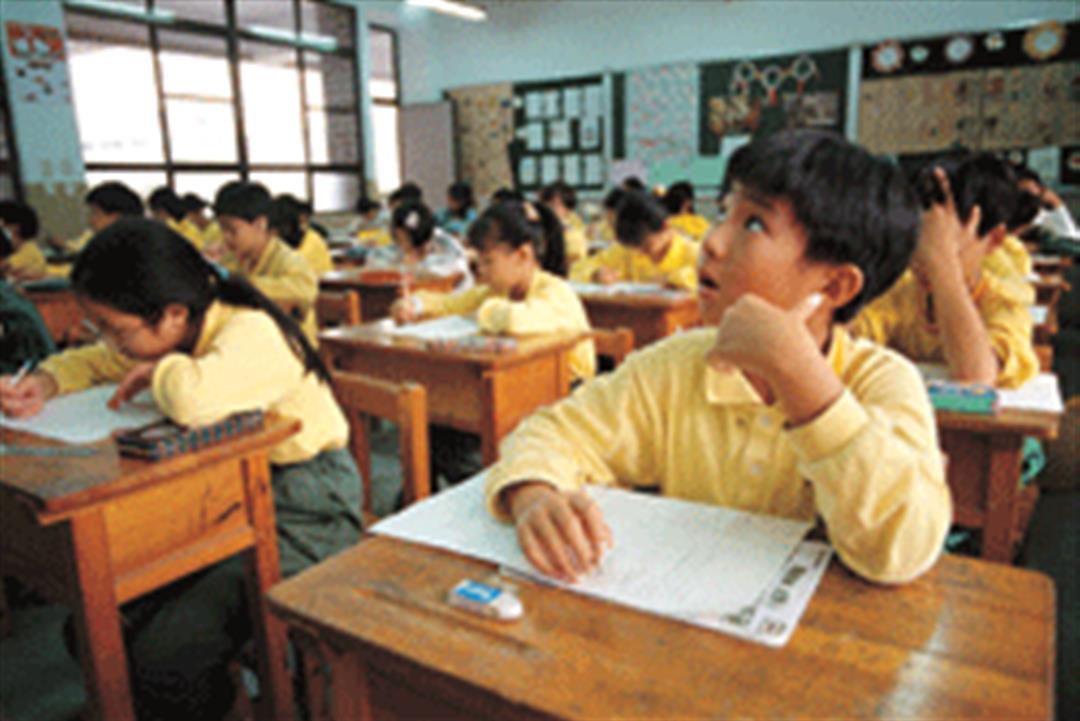
Does it always have to be at exam time that you find out that you learned the wrong things? Tests have long been children's biggest source of anxiety.
The best that money can buy
Which is the right choice-happy learning, or enhancing children's competitive abilities? No one can say. But with no answers forthcoming, parents are anxious and confused. As they waver back and forth in their thoughts and actions, their choices are leading to a polarization in the way children grow up.
"The taller you grow, the higher we'll stack the money!" This is something Mrs. Lin often says to Lin Chia-hsun.
Lin Chia-hsun is in the fifth year at the private Wego Elementary School in Taipei City. Thanks to her mother's careful planning, from an early age she has studied violin, computers, abacus and mental arithmetic, and has had extra tuition in the maths, English, biology and even table tennis. Chia-hsun's performance has not disappointed her mother, for she has won a scholarship every term.
Mrs. Lin says that her daughter doesn't like to be outdone, so she uses "peer power" to encourage her, taking the trouble to arrange for children from different classes who are top of their class to have tuition together with Chia-hsun. For instance, while in third grade Chia-hsun began studying high-school-level English. Mrs. Lin says that her aim in having her daughter study things early is not to have her skip a year, but just to let her be "in at the front."
Mrs. Lin says that very few children are self-motivated, so parents have to take the trouble to get involved in their children's education. "I acted as my daughter's 'book carrier' for three years," says Mrs. Lin.
As a result of educational reform, children today are no longer ranked in strict order of their test marks. Instead, their attainment is reflected by broader grades-A, B, C and so on. Also, the principle of more equal emphasis on five major aspects of education is gradually being implemented. Today intellectual education accounts for only 60% of overall grades, while physical education accounts for 20%, and moral and social education each account for 10%. But this does not mean that parents no longer care about their children's rankings, and children are still pushed to treat schoolwork as a life-and-death struggle. Some parents cannot tolerate their children doing badly in any subject at all, and when there is little difference between children's academic grades, then sports grades become crucial to success. This is why Mrs. Lin pays a coach to give Lin Chia-hsun "extra tuition" in table tennis.
Mrs. Lin originally planned to have Chia-hsun complete her undergraduate studies in Taiwan before going on to do advanced studies overseas. "But now, with education policies chopping and changing, I'm worried that she will lose her international competitiveness, so perhaps we'll send her to study overseas earlier," says Mrs. Lin.

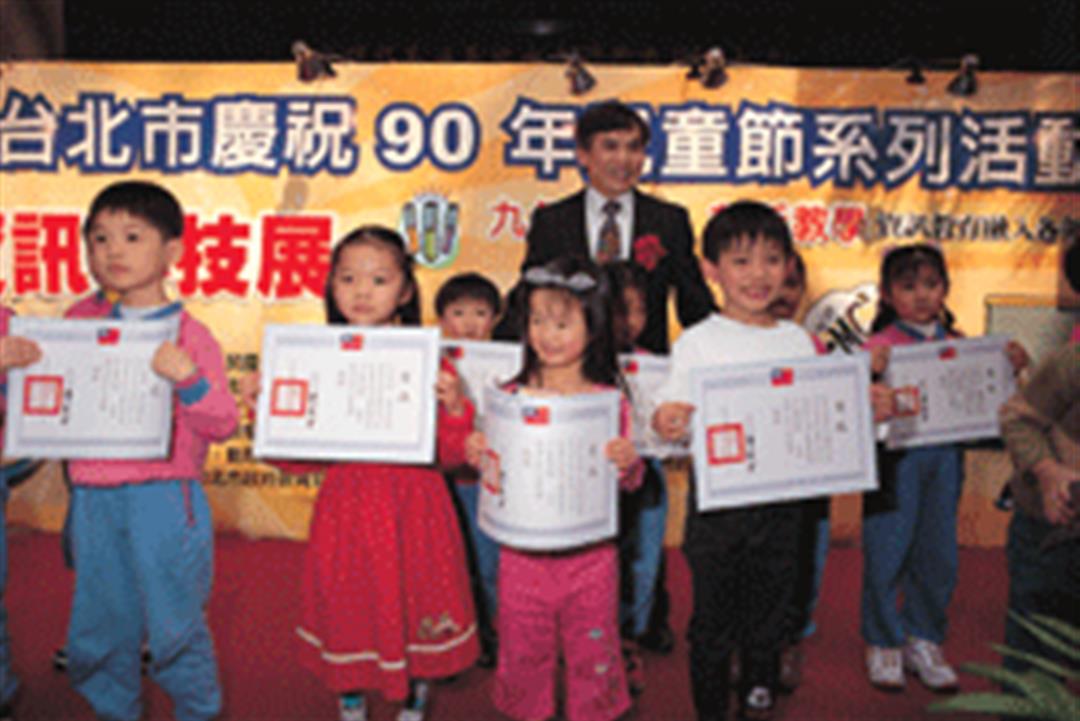
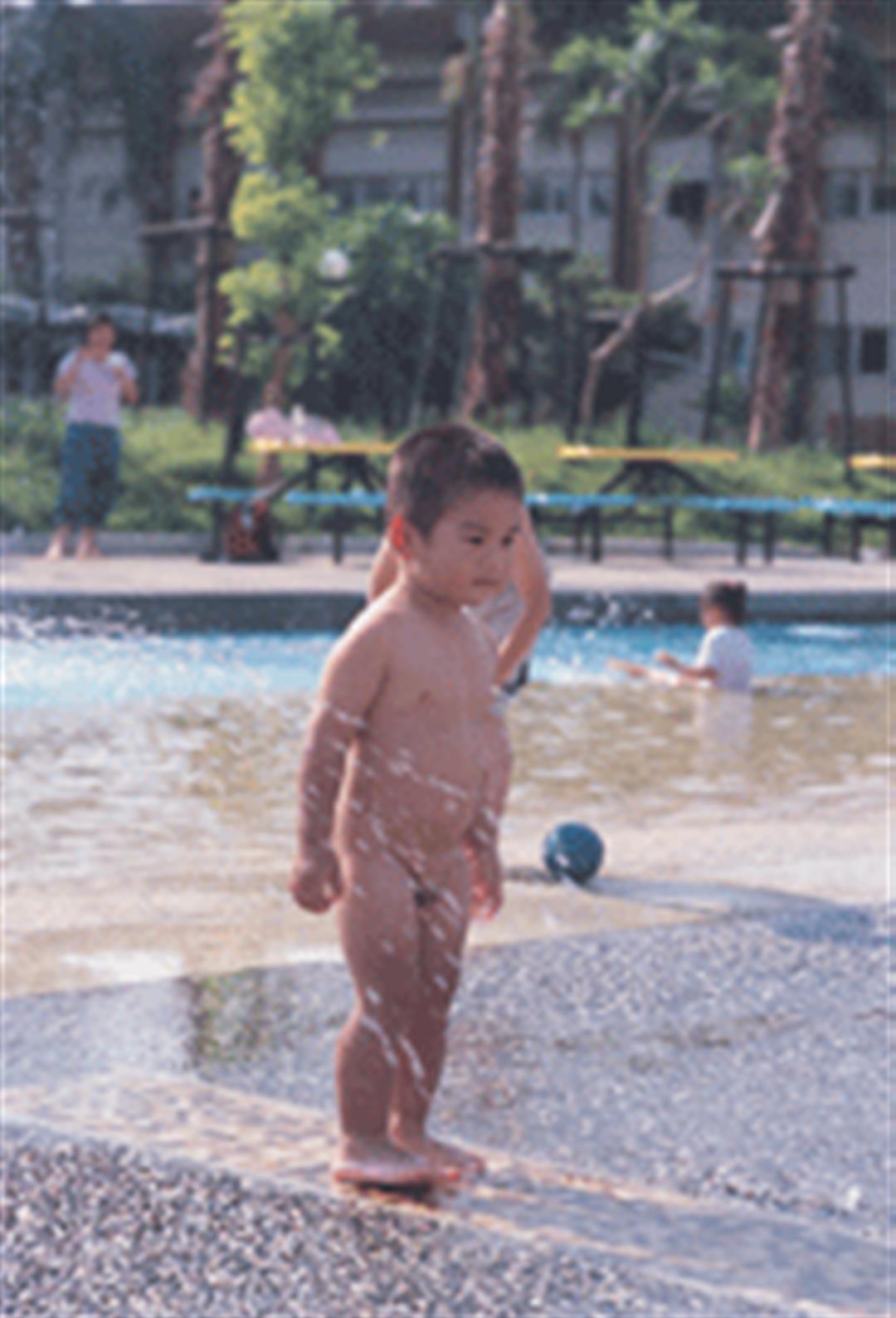
When else will they have time for fun? Childhood only comes once.
Difficult choices
Some people do their best to give their children a happy childhood, while others put all their effort into building their children's competitiveness. But parents with such clearly defined goals and a firm resolve, on whichever side of the argument, are surely in the minority. More parents seesaw between the two extremes, uncertain what is for the best. On the one hand they cannot fully accept the idea of happy learning, for fear that their children really will lag behind others. But on the other hand they haven't the heart to completely sacrifice their kids' childhood happiness for the sake of building their competitiveness.
"If you want a happy childhood, you might end up with a tragic adolescence," Su Tsu-hua often "warns" her son Chang Yi-chien, who is now in his fifth year at elementary school.
"If they are too happy, they won't make the effort to study," says Chen Shu-ying, whose son is in sixth grade, as she struggles to make sense of a morass of conflicting ideas. For the child born with a silver spoon in its mouth, whose parents can provide it with a special environment, things may be different. But for the rest of us, if you impose no discipline at all on your children, and only care about not putting them under any pressure, they really will lack the ability to compete. And poor grades can also affect a child's mood. "If they aren't doing well at school, how can they learn happily?"
"If you don't care, then the child won't make the effort," says Chen. She believes that the scale one applies is very important. "Ten to 20% of leisure is enough!"
"If they can't have fun while they're in elementary school, when can they have fun?" In the past, Chen Li-chen did not put any pressure on her children over schoolwork. But when her son Te-wei reached his third year of elementary school, and in his first science test scored 70 points, which ranked him between 20th and 30th in the class, she began having him do a dry-run test at home before each test at school. Sure enough, she reports, "It makes a difference if you breathe down their necks. In his second test he got over 95 points, and came third."
All parents want the best for their children, but for parents today it is more difficult than ever. One career woman sighs that to give a child a happy childhood takes far more effort today than in the past.
For instance, in Taipei City, even if parents would like to let their children play to their hearts' content every day, there is nowhere for children to run about, and few other children for them to play with, so they only get to play with machines. But the more time children spend with machines, the less contact they have with human beings, and this affects their emotional development, producing effects such as not valuing friendship, or expecting other people to obey their will just as machines do.

Many parents fear that their children will "lose on the starting line." But they forget that health and self-confidence are the basis for competitiveness.
Happy childhood-just a dream?
Confused parents can only take things one step at a time, as they try to respond to the conflicting demands of an environment that expects them to make their children happy, but also able to compete. But if we take a look at the real "sufferers"-children themselves-it seems that the slogans about happy learning that have been bandied around in the education debate for the last few years have not had much effect.
A survey on "children's and adolescents' daily life and emotional status," carried out in June and July last year by the John Tung Foundation, showed that one in five of today's seventh-graders (12-year-olds) was depressive to an extent that merited further professional evaluation. The three top factors behind their malaise were: exams (44.4%), school performance (37.9%), and money (26.8%).
Another survey, on "anxiety indicators in children in urban areas in Taiwan," which was conducted last year by the Child Welfare League Foundation, also revealed anxiety in almost 75% of children. Their main sources of worry were, in order: poor school performance, boredom in daily life, parents being too strict, societal problems, being unpopular with classmates, dissatisfaction with their own appearance, and not feeling safe on the streets.
Different surveys, same results: tests and grades remain the number one worry that plagues children.
But Professor Li Chia-tung of the computer science department at National Chi Nan University, who has long been interested in education issues, believes that as long as the pressure to compete for places in higher education exists, children can never be happy. Especially today, with the economy flagging and jobs hard to come by, parents demand even more of their children academically, for fear that otherwise they may be unable to find a good job and will join the ranks of the unemployed. Thus the pressure on children only increases.
"The issue of education reform is linked to the economy," says Li: when the economy is going well, people can find opportunities to succeed in all walks of life, so they are less driven; but when the economy fares badly, people have a greater desire to study in order to better themselves.
"Integrated curriculum? Not only the textbooks aren't integrated, not even parents' attitudes are integrated," says Su Tsu-hua. She says that while children are still at elementary school they don't feel the pressure of competition for university places, and parents take pity on them, so one can talk about happy learning. But as soon as parents think about the fact that community senior high schools are not yet a reality, that most other parents still believe you have to bust a gut to get into a good senior high school and university, and that when children start junior high they will be subjected to lots of tests and perhaps also corporal punishment, which they may have difficulty adjusting to if they are used to freedom, then the parents cannot feel relaxed about "happy learning," but think it is better to build children's "fighting ability" as early as possible, in order to avoid them being unable to keep up with other children later, and ending up even more dispirited.
Because of this, except for families that are so economically disadvantaged that they cannot think about paying for extra tuition, the pressure is still there for many children. Particularly in better-off families, even if there is no pressure from schoolwork, there is still pressure to study artistic pursuits.
One first-grader's mother wakes him every morning at 6:30 to practice the piano. But when the little boy took part in a "free improvisation" performance, no matter how he played all that came out was the notes he had learned from sheet music, and he was quite unable to improvise anything for himself.
Associate Professor Liang Pei-yung, director of the psychological counseling center at National Taipei Teachers College, once counseled a case involving a fourth-grader. His mother had arranged for him to take all kinds of artistic courses, and he was often so tired that he would fall asleep on the bus. The child said to Liang: "When my dad does overtime he gets very tired and Mummy always tells us he's tired. So why doesn't she know that doing extra classes after school is overtime, and I get very tired too?"

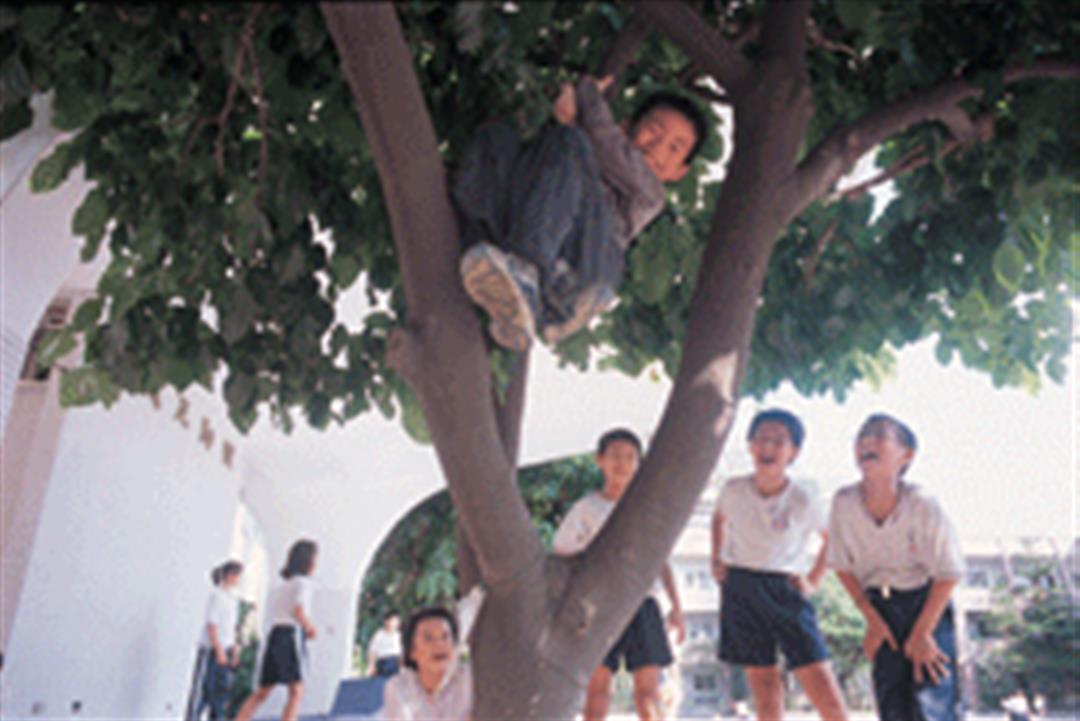
Urbanization leaves today's parents unable to let their children play as they please, for where can they go to play? And how many computer-playing children can still climb a tree?
Crazy parents
Seeing a long road of competition stretching away in front of their children, parents are anxious to prepare them for this future, and some try to do so by sending them "into battle" before they have even reached school age.
One kindergarten that displays the slogan "all-round, all-English" touts its ability to instill children with "leadership qualities, artistic gifts, and outstanding English." It also stresses that its teaching system can satisfy parents' and society's demand for pre-school education to be "diverse, international, scientific, and refined." Similar all-English kindergartens have recently been springing up like weeds. But how many people can really be "gifted, outstanding leaders"?
Before the Chinese New Year, a third-year student at Taipei's Chienkuo Junior High School-a gifted child who excelled at maths and physics-ran away to Hualien and committed suicide. This news rekindled critical discussion in education circles, and came as a stark warning to many parents.
Gifted education expert Wu Wu-tien, who is dean of the college of education at National Taiwan Normal University, observes that in Taiwan, education for gifted children overemphasizes knowledge at the expense of emotional education. This, combined with society's and families' high expectations, leads to gifted children having a high IQ but a low EQ, and a poor ability to deal with setbacks. They are also unused to seeking help from others, and this is what finally leads some to take their own lives. "This is the result of adults' ignorance," says Li Chia-tung, who avers that parents with any sense would never tell their child, "You're gifted." Natural talent is not something that can be taught, but many Taiwanese parents try to play God by "cultivating" gifted children.
If the overall scholastic environment does not change, and competition remains an inevitable trend, then of course children will be put under so much pressure that they can barely catch their breath. But is competitive ability necessarily related to studiousness? Do good grades and the ability to pass tests mean that someone will be able to compete?
"You can imagine what kind of person you want your child to be, but you can't plan it. You can provide a diverse environment, but don't try too hard to mould your child." Lin Ku-fang, director of the graduate institute of arts at Fo Guang University, who has two mischievous sons of his own, says that you only have to look around and see how many people work in jobs unrelated to what they studied, and how many study subjects that do not match their interests, to know that there are many things in life that can't be planned in advance. This is why building a child's competitiveness does not mean giving him or her specific skills, but the ability to adapt to a rapidly changing environment.
You can't compete unless you're happy
Liang Pei-yung says that in an age of division of labor and specialization, it is teamwork and interpersonal relationships that are all-important. Therefore in addition to specialist skills, being able to co-operate with other people, express oneself, deal with one's own emotions and cope with stress are skill of perhaps greater value. "I'm not against parents' building their children's future competitive ability, but please let your children live in the present!" begs Liang.
Lin Ku-fang observes that people's obsession with competitiveness is in fact a reflection of mass anxiety about Taiwan's national future.
Liang Pei-yung says that although competition will be unavoidable in future society, what is more important is how to face and deal with the stress that competition creates. He reminds parents that "speaking" and "playing" are two effective means by which children can deal with negative emotions. But it can be very difficult for them speak their minds, because so many adults are not capable of listening to what children have to say.
According to the Child Welfare League Foundation's survey, more than 40% of children choose to bottle up their worries, because they "don't want to talk about it," because "talking is no use," or even because they "don't know who to tell." In view of this, in April of last year the CWLF set up a children's helpline called "Ow! Hey! Oh!" to give children a channel by which to "get things off their chest," and thereby satisfy their need for emotional support.
CWLF vice-executive director Alicia Wang states that since the helpline was set up it has received an average of 28 calls a day from children, more than 80% of them girls. More than half the problems that children phone in with are difficulties with their peers at school. Many also use the line as a channel to relieve the stress of schoolwork, or to seek ways to relieve that stress. "It is noteworthy that even children in the early years of school are showing obvious signs of study-related stress," says Wang.
Play is another way for children to relieve stress. In fact, if parents understand how to give their children a free rein when appropriate, this not only reduces the pressure on them, but is also a way to help them stay emotionally balanced and enhance their ability to cope with problems.
For instance, during term time Chen Shu-ying keeps a close watch over her son's schoolwork, but during the winter and summer holidays she makes it a point to not send him to a day-care center, nor to arrange any classes for him. "I want my son to know what holidays are. If he can't relax even in the holidays, how will he have the energy to start the next term?"
In fact, every child has a different temperament, so the stresses of studying affect them in different ways, and one cannot generalize. In other words, a child who studies may not be unhappy, and a child who plays all day is not necessarily growing up happily. There is no one-size-fits-all approach to bringing up children, and each one's education has to be tailored to his or her character and abilities.
Modern parents are nervously racking their brains as they grapple with the practicalities of trying to give their children a happy childhood, yet build their future competitive abilities. But we should also spare a thought for the children who are the center of all this attention. What does the future hold for them?