

Behind this year's stand-out Taiwanese film Island Etude is the story of a chance encounter between a director with a dream and a major American film company, which gave this labor of love a previously undreamed of chance to reach mainstream cinemas. This small film has since become the breakout domestic film of 2007 and spurred a growing fad for round-the-island cycle trips.
What drove the husband-and-wife team of En Chen, the so-called "oldest of the new directors," and producer Yang Li-yin to make Island Etude despite having neither a big-name cast nor spectacular special effects? What twists and turns did they go through on their journey to box-office success? And how does one tell the tale of a film that has become the toast of the local cinema industry while simultaneously shining a light on the dire state of that same industry?
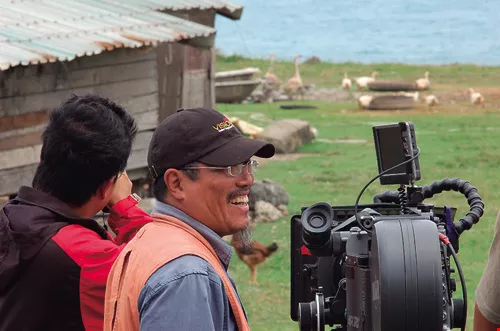
The scene opens as the day's first rays of sun strike Taiwan at Taimali Township, Taitung. For director En Chen--a long-time collaborator with famed director Hou Hsiao-hsien and whose cinematography for Hou's film City of Sadness earned him a Golden Horse nomination--this marks his first steps into feature film direction.
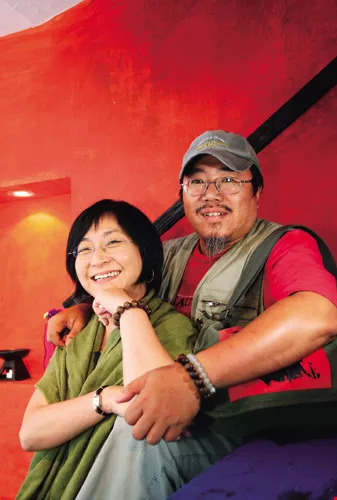
One made his name as Hou Hsiao-hsien's cinematographer, the other made her name as an award-winning television actress. Now, after 20 years of marriage, En Chen and Yang Li-yin have worked together on their first film, Island Etude, with Chen making his directorial debut and Yang "forced" into the role of producer for the first time.
Now or never
"People have taken to calling me 'Mr. Yang,'" jokes En Chen, who despite 22 years in cinema and having earned international renown as a cinematographer is still less famous than his Golden-Bell-winning actress wife Yang Li-yin. Within the industry, though, it is well known that Chen was the man responsible for the long shots and moving shots that so eloquently contributed to many of Hou Hsiao-hsien's films, including City of Sadness; Daughter of the Nile; Good Men, Good Women; and Goodbye South, Goodbye.
Born in 1959, Chen has seen first-hand the ups and downs of Taiwan's movie industry. A graduate in printing from Shih Hsin University, he has worked as an assistant director, lighting technician, art director, cinematographer, and producer, working through the 1980s--Taiwanese cinema's golden age--and the 1990s, when VHS tapes ruled and Hollywood films took the throne. Now, when locally made films account for less than 1% of the market, Chen has finally decided to make his directorial debut with Island Etude.
Island Etude was conceived in 2004, when Chen was heading to a filming location and bumped into a student from Kun Shan University called A-tsai. A-tsai was traveling around Taiwan on his bicycle, his guitar strapped to his back. Chen asked why he was doing it, and A-tsai responded, "There are some things you have to do now, or you'll never get to them." It was this simple yet powerful statement that inspired Chen to make Island Etude.
With Taiwan's film market so small, Chen had been forced to turn his talents to making commercials. After eight years of being little more than a commodity, Chen was shocked out of his complacency by that simple comment.
From that day, Chen began thinking about how he was already in his middle age, and wondering what things he would never get to if he didn't do them now.
Having worked in film for 22 years to substantial success but still never having sat in the director's chair, Chen realized that this was something he wanted to accomplish, and that he wanted to contribute a film of his own to the cinema world. His final decision was simple--to film a story like A-tsai's.
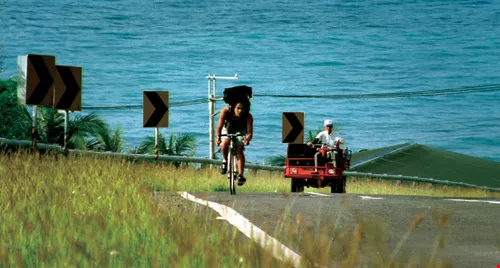
Island Etude is a road movie that takes the audience on a trip around the beautiful coastline of Taiwan in the space of 100 minutes.
Island Etude's "five noes"
Chen first went about deciding the genre through a process of elimination. He decided to forego Taiwan's more common social realist films, along with the horror films and homosexual tales that have been popular in recent years. Ultimately he decided to make his film a road movie.
Bearing in mind the news media's penchant for sensationalism and the general tone of society, Chen laid down a "five noes" policy of his own for Island Etude: No violence, no crime, no sexual themes or scenes, no smoking, and no "bad guys." Eschewing conflict, Chen hoped to use seemingly unconnected plots and visual means to create a movie for the whole family.
And so shooting began, with 47-year-old Chen finding inspiration and an escape from the doldrums of middle age in the words of a young man he barely knew.
"2006 was an environmentally important time to document Taiwan." When things started in July 2005, Chen inspected locations and found that some of the places he'd hoped to shoot at had been completely wiped out. Thanks to typhoons and natural erosion, in just one short year Taiwan had been completely changed. This served to drive Chen even harder: not only did he want to realize his dream, seeing these alarm bells warning of the "sickness" of the land around him added to the significance of what he was doing.
Another point he considered was that his choices of landscape should have some special meaning for the movie. For example, by starting in Kaohsiung, heading through Pingtung, and then into Taitung, he could work in a tale from Japanese-era Taiwan called "Sayon's Bell," telling of an Aboriginal girl who drowned helping a Japanese man leave Ilan to serve in the Sino-Japanese War; she was later honored as a "patriot." Chen could also include a coal-fired power plant in northern Taiwan, the ecological issues facing the west coast, and so on. Such issues, which seem serious for a road movie, were in fact just a mask for Chen's determination to get his audience thinking about the history of the island, its environment, and contemporary social issues.
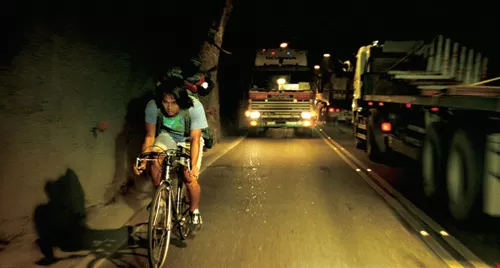
Island Etude is a road movie that takes the audience on a trip around the beautiful coastline of Taiwan in the space of 100 minutes.
The hard part
What no-one realizes is that Island Etude, which has become the talk of the Taiwanese cinema community, was a difficult film to bring to the big screen.
"I wanted to realize my own dream, but I had to be careful and go through precise calculations. Film is probably the most costly of artistic endeavors; my movie needed to be about 90 minutes long and on 35-mm film, and something like that can cost tens of millions of NT dollars. If I wasn't careful, I could've ended up spending the rest of my life paying off the expenses on this one film," says Chen.
Even with a NT$5 million grant from the Government Information Office, a loan on his house, and sponsorship of about NT$10 million from cellphone maker Dopod and bicycle maker Giant, his shooting costs were barely covered.
After the film was finished, it was panned by the audience at a trial screening, sending the usually upbeat Chen into a dim mood.
"After watching the film, the scholars said they thought since it lacked the usual conflict and tension of a feature film, it wouldn't sell," Chen recalls. Even after placing sixth in the 2006 Golden Horse Film Festival's "Made in Taiwan" selection, with none of the top five being feature films, the film still couldn't win the respect of the cinematic intelligentsia.
Having started off wanting to make a film for the whole family, Chen began to give up hope and tell himself that maybe the experts were right. If he just got a production subsidy from the government to help him tie up the loose ends and then gave his debut film a few free screenings to repay the locals, he would have at least done a good deed.
Meanwhile, with little left in their budget, Chen and his wife Yang Li-yin decided to spend NT$2.4 million on making prints of their film and getting it out to three theaters, never even considering renting a theatre or doing any promotional work.
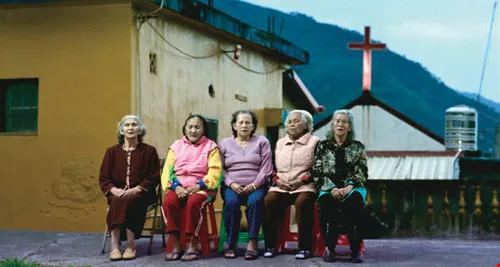
Island Etude is a road movie that takes the audience on a trip around the beautiful coastline of Taiwan in the space of 100 minutes.
Building on word of mouth
Before the film's official premiere on April 27, Chen, still bearing in mind his idea of "doing a good deed," took the film on a circuit of festivals, including the Yilan Green International Film Festival, the Golden Horse Film Festival, and Taichung's Movie for Young Minds festival. By the end, over 4000 people had seen the film for free, and unbeknown to the busy crew, those 4000 had already started spreading the word.
Happening across their "patron," Eric Shih of Warner Brothers Taiwan, proved to be the helping hand Chen needed to spur him along the last, uphill section of his trek. When Island Etude producer Wang Keng-yu heard that Warner, which rarely released Chinese-language films, was willing to offer two free trial screenings to Taiwanese films that were in search of a distributor, Chen leapt at the opportunity and met with Shih.
After watching Island Etude, Shih asked Chen, "And who did you want watching this film?" "I've called it an 'ode to Taiwan,' so I'd want anyone who has a connection with the island to see it. The distribution should be broad so as not to betray that original intent."
Having the right marketing angle is vital to a movie's success, and Warner chose to focus on emphasizing Island Etude's being a local film. This film was "one everyone would love," so they felt comfortable backing it wholeheartedly. From the moment that decision was made, Island Etude went from being a "wish fulfillment" project and a "good deed" screened only in three cinemas to being shown in 16 cinemas nationwide with the professional marketing support of Warner Brothers, turning it into a film that captivated Taiwan.
After the film went wide, the marketing model they used differed from that used for most independent Taiwanese films. Trailers were screened, posters were displayed in cinemas, "watch and win" promotions were organized... all kinds of marketing usually reserved for mainstream films was put in place. Meanwhile, a promotional blog was set up on local website Wretch, and positive word of mouth was spreading from those original 4000, already reaching levels of hype much greater than other local film releases. The siren song of Island Etude was drawing in people who had given up entirely on local cinema.
Island Etude is a road movie that takes the audience on a trip around the beautiful coastline of Taiwan in the space of 100 minutes.
Work in progress
Between its premiere on April 27 and early July, the time of writing, Island Etude has become a blockbuster by local film standards, becoming the most screened and longest running Taiwanese film, and looks to have a shot at being this year's top locally made box-office earner, with approximately NT$17 million to its name so far. But of course, where there are supporters, there are inevitably critics.
Bloggers have accused the film of being too light on tension and having sub-par moving shots, amongst other things. Some have leveled such criticisms as "What is this, the 2007 Tourism Bureau video?" To these, Chen laughingly responds, "Thank you for the comments. Film is a very personal form of creativity, but once it's done, every filmmaker has to hand their baby over to the audience. I appreciate any and all opinions."
"From the beginning I wanted to capture Taiwan's best side, so I chose to include scenes that are part of the common memory and sentiment of all Taiwanese. Just like braised pork rice, it might be simple, it might be cheap, but it reminds you of home, and can be a moving experience in itself." This is how Chen, who is clearly a man on a mission regarding Taiwanese film, describes his intended foundation for Island Etude, and how he addresses the doubts of some of the audience.
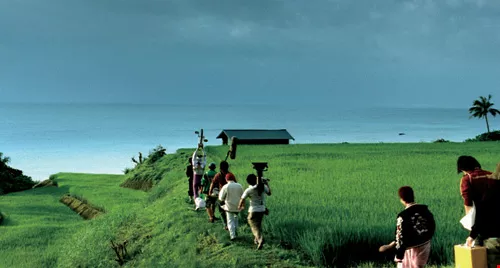
Over the 40-day shooting schedule for Island Etude, the cast and crew traveled almost 160,000 kilometers, with the vehicular crew traveling 16,000 km. In total, everyone traveled far enough to circumnavigate Taiwan 16 times. You can imagine how hard this was on them. And it was more than just the distance; the expense was also huge, and at the end it seemed there would be no way of paying off their debts, making the effort somewhat of an unfinished symphony, and leaving Chen and Yang with another problem--handling the changes in their lives the film would make, financially and career-wise.
"Now that I've made my debut as a director, who's going to want me as a cinematographer?" says Chen somewhat bitterly. But will there be a second part to his directorial dream? Chen answers with a sigh, "I hope so!"
For those who watch Island Etude, by the time local singer Kimbo Hu's melancholic end theme plays both ordinary moviegoers and moviemakers alike have been inspired to reflect and consider how to bring more people into Taiwanese films.
Island Etude is a road movie that takes the audience on a trip around the beautiful coastline of Taiwan in the space of 100 minutes.

@List.jpg?w=522&h=410&mode=crop&format=webp&quality=80)


