Getting the Jump on the Competition in an Uncertain Job Market
Liu Yingfeng / photos Jimmy Lin / tr. by Phil Newell
July 2013
With graduation marches ringing in their ears, about 300,000 members of the Class of 2013 are transitioning into society. At a crossroads in their lives, many are experiencing feelings of confusion and uncertainty. For most of them, the working world and its challenges are a complete mystery.
However, an increasing number of young people have now realized that you can’t wait until the moment you graduate to begin thinking about your future and searching for yourself—the earlier you start, the better. To find the right stage for themselves, they have plunged into the corporate world, working hard to develop practical skills and figure out the rules of the workplace game. These young people have acted to get out of the starting blocks in the job market earlier than their competition.
Inside the Agricultural Exhibition Hall at National Taiwan University (NTU), there’s a lot going on here in late April. More than 40 start-up companies from the worlds of cloud computing, the Internet, and new media are here for an internship fair organized by the NTU Entrepreneurs Association. Nearly 200 people have crowded in.
Ray Chen, a graduate of the Institute of Biomedical Engineering at NTU and founder of the Long Good company, has been coming to the fair for three straight years since first getting involved in the development of a motion sensing device for health maintenance in 2011. He notes that over the last two years the economy has been in a bad state, and many students have been trying to get a jump on their career planning by taking internships to try to figure out which direction they want to go in the future.
On your mark, get set….
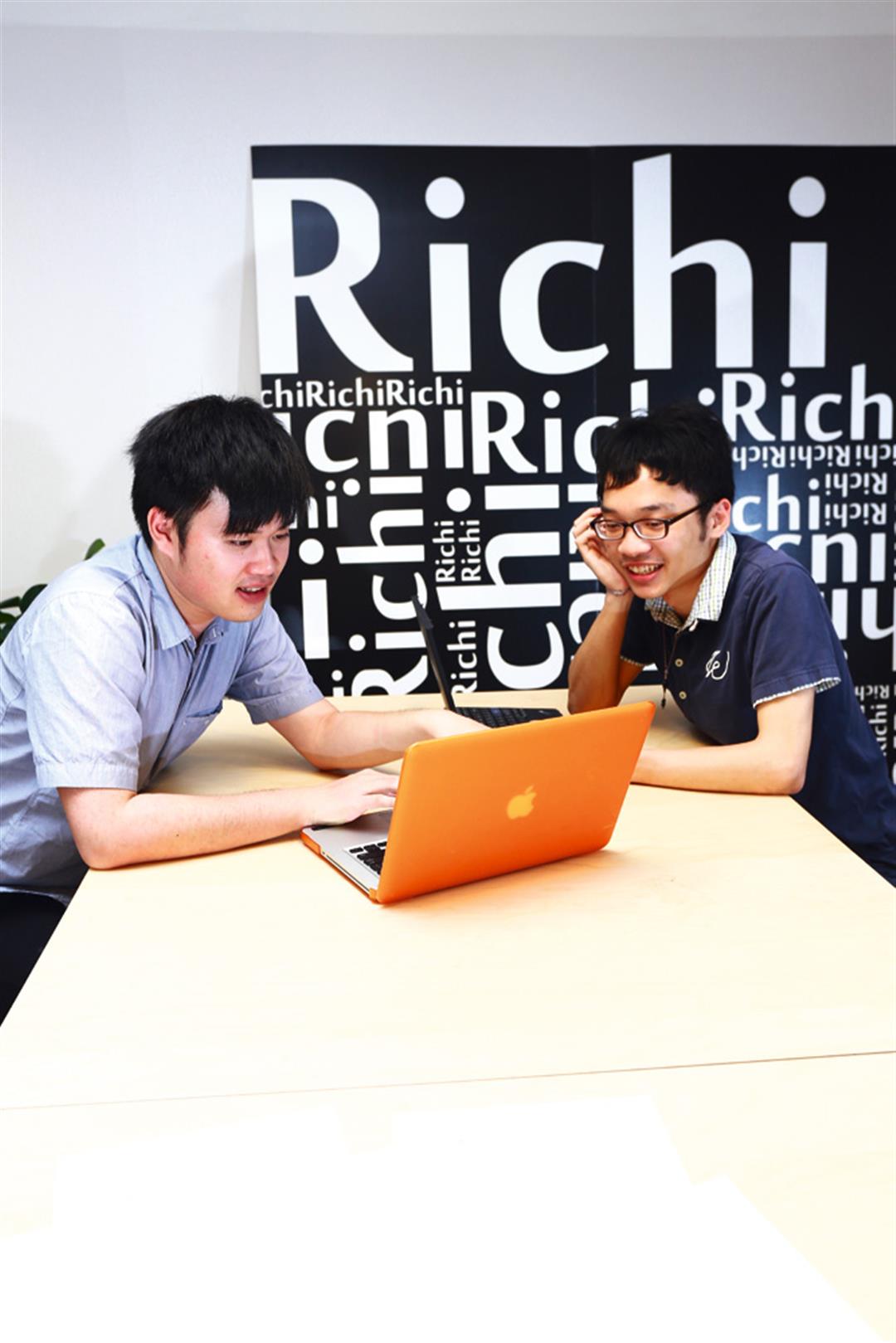
One of the companies here is the Taiwanese Internet firm Richi, which was named as one of the “Global 100” technology firms to watch by Red Herring magazine, the bible of Silicon Valley venture capitalism. Co-founder and chief operating officer Shen Beiyi says that compared to big corporations, start-ups offer a number of attractive features. They are smaller and less hierarchical, and you can easily see the company grow and go through the stages of transformation from small to large. They have greater potential for explosive growth, and job assignments are more flexible than in large firms, so interns can be exposed to a wider variety of experiences. Since announcing openings for interns, Richi has received nearly 50 résumés, of which many are from people who already have worked as interns elsewhere, a sign of how proactive many young people are being these days.
Yang Bojun, a student in the Department of International Business at NTU, worked as an intern at the e-commerce firm PayEasy during the summer after his sophomore year. He was tasked with organizing activities on university campuses to promote new brands. This year he decided to intern at Richi because he wanted to be able to observe up close how a start-up company rises above the competition and handles operational challenges, in preparation for the day when he will found his own company.
There are good reasons why young people still in school feel trepidation about the job market they will face in the immediate future. Recently the Council of Labor Affairs announced that workers newly entering the workforce are getting an average salary of NT$25,036 per month, an increase of only NT$381 over the previous year. With more and more bad news going round about the stagnant economy and uninviting pay scales, students know that most of them will be facing an uphill struggle.
The employment difficulties faced by the younger generation can be seen all over the world. The report Global Employment Trends for Youth 2013, released by the UN’s International Labor Organization in May of this year, says that the unemployment rate for people aged 15–24 is expected to increase from last year’s 12.4% to 12.8% in 2018.

It’s graduation season again, and students are looking for work while firms are trying to find talented people. Closing the industry–academia gap will be essential to increase employability of young people.
Many university students are unwilling to just leave their future career plans in the “imagination” stage, and it has become common for young people to compete for internships during summer vacations.
A recent survey, conducted by the 1111 Job Bank, of “willingness to do summer internships,” shows that nearly 50% of queried students would be willing to do an internship in a company. Given a selection of “reasons why,” respondents most often said they wanted to “get some working experience in the relevant field,” and “get some experience in society and learn more about workplace culture.” 1111 Job Bank PR director Daniel Lee says that the number of internship opportunities posted on their website has been growing by about 20% a year, and there are currently about 600 unfilled internships on the site, with the largest number being in consumer services and information technology.
104 Job Bank senior vice president Ricky Hong has made similar observations. In 2012, their website had only 1389 people trying to get internships, but in March of this year that figure was 3535, or 2.5 times higher. He says that the younger generation is in a worse position than their elders in terms of finding jobs. If you make a mistake in choosing a career path, there is a very high risk that the mistake will cost you heavily in time and money. Thus many students hope, through internships, to narrow the gap between their academic knowledge and their practical skills, and therefore are being very proactive.

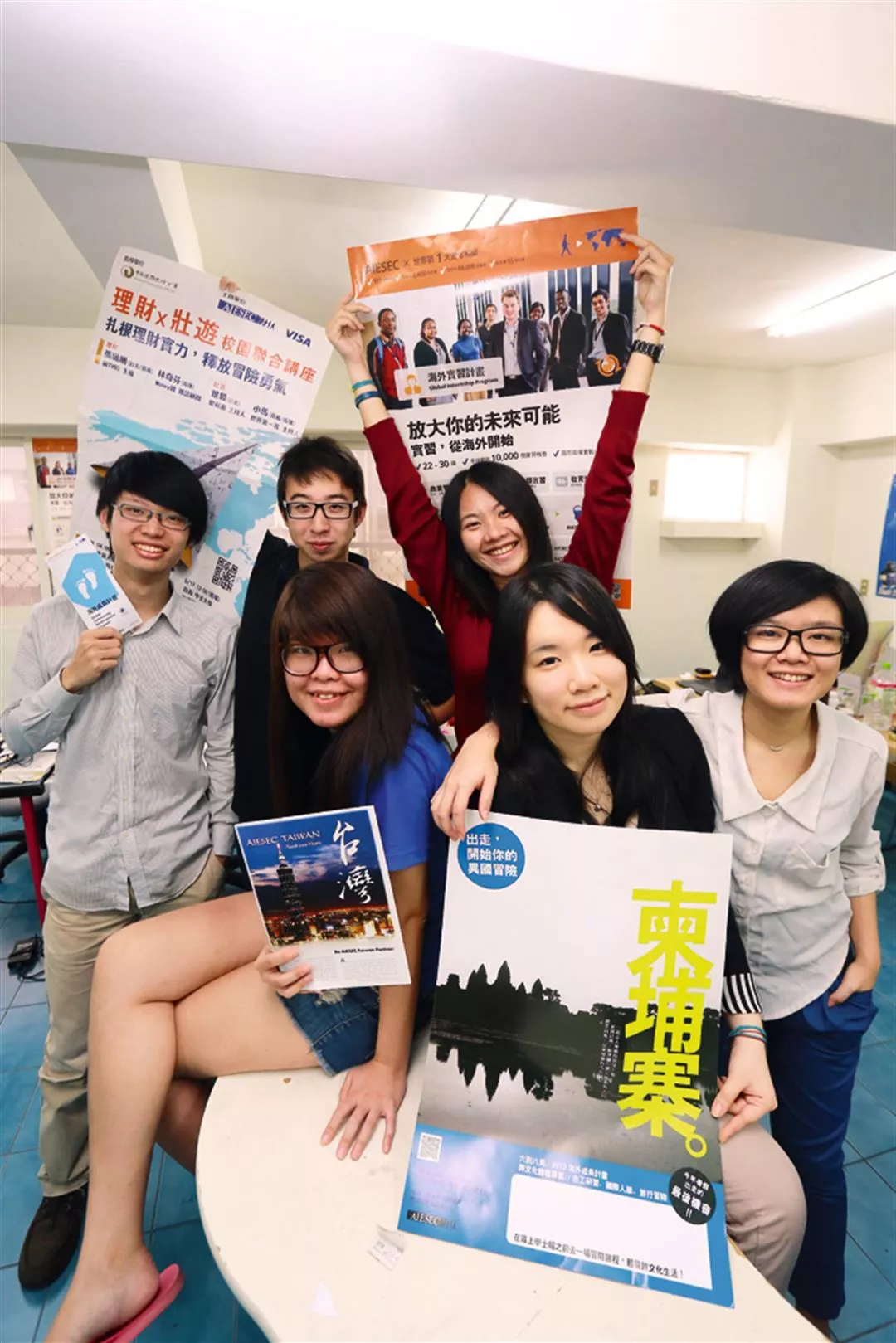
The global student organization AIESEC advertises nearly 10,000 international internship opportunities each year, giving students the chance to broaden their perspective. The lower photo is of the team at the national office of AIESEC Taiwan. Selena Huang (right photo, courtesy of Selena Huang), now 27, did a one year internship in India, greatly boosting her adaptability in the workplace.
Foreign corporations are generally the preferred choice for internships, because they usually have more comprehensive personnel training and development systems. The Taiwan branch of advertising behemoth Oglivy and Mather, for example, in addition to its regular internships that are offered each year, has since 2008 been running a special internship program known as “Project Team Terence.”
O&M Taiwan vice president F.Y. Lu says that the program was founded to commemorate their colleague Terence Lin, who was appointed the Beijing advertising sales director but suddenly passed away while working there. Amidst their grief, the people at O&M decided to launch an internship program to search for a rising star who could embody the same sense of passion that Lin brought to the advertising profession.
Project Team Terence has, over the last five years, taken only the crème de la crème. Each year they receive nearly 500 applications, but choose only 10 interns. O&M sees the program not merely as an opportunity for young people to get some practical experience, but as a source of uniquely talented people. Applicants must pass through a rigorous selection process in order to win a spot.
For the initial hurdle, O&M asks applicants to submit a self-introduction/résumé. They get some very creative submissions. For example, Ellie Chen, a 24-year-old graduate of the Department of Public Finance at National Chengchi University, laid out her résumé (including three consecutive years participating in the university singer-songwriter competition, and experience as a campus radio station DJ) in a magazine-type format. And to emphasize her devotion for advertising, she described herself as a xidufan—which means not merely “addict,” but an addict in the same “outlaw” sense as a convicted drug abuser.
York Tsai, who attended three different high schools and three different universities, chose the tack of putting all his weaknesses on display—literally. He asked friends to come up with terms that would describe him, positive or negative, and then printed these on a poster. The descriptions include “silly,” “empty-headed,” and “inarticulate.” At the bottom the poster reads: “I have many shortcomings, but I’m not afraid of criticism. This is the real York Tsai.”
These two unique “résumés” easily passed the first phase of the screening process.
The final collective interview for candidates includes a variety of bizarre questions and puzzlers. F.Y. Lu explains that the whimsical questions are designed to test whether the students have the right character—genuine enthusiasm and quick minds.
The O&M internship program lasts eight weeks. Before leaving the program each intern must, just like a full-time employee, complete a proposal for an advertising campaign, and they are under no less pressure than professional ad-men. Each year the firm screens out the top one or two proposals, and their authors are invited to join the O&M team.
Lu emphasizes that the point of Project Team Terence is to discover fresh new talent for the industry. He laments that there is a widespread impression that the advertising business demands long hours and imposes high stress levels, so fewer and fewer students want to enter the field. Students who go through the trials of an O&M internship are in a good position to know whether they are really suited to a long-term career in advertising.

It’s graduation season again, and students are looking for work while firms are trying to find talented people. Closing the industry–academia gap will be essential to increase employability of young people.
You have to jump through a lot of hoops to get an internship at a major corporation, but some young people take on an even bigger challenge, seeking internships overseas. It makes you think twice about the widely held belief that kids today “are afraid of pressure.”
Selena Huang, 27, a graduate of the Department of International Trade at National Chengchi University (NCCU), working through the global student organization AIESEC, got an internship in India back in 2010, gaining valuable experience working in a different cultural context.
Huang had just reached her senior year in 2008 when the global financial tsunami hit. Every day there were stories in the news about companies laying off workers. Even in the classroom, worried professors were telling their students that they would “have to be psychologically prepared for a long war of attrition” in pursuing their careers.
In February of the following year, even as Huang was submitting her résumé to local companies, she also began working through AIESEC (of which she was a member of the NCCU branch) to look for an overseas corporate internship.
After graduating, Huang got offered a sales job at a company in Taiwan making surveillance equipment, starting at NT$50,000 a month. As a result she put her plans for an internship on the shelf. But she soon became bored with the daily routine of filling out product orders and adding up columns of figures, and she decided to leave the job and make her dream of an overseas internship a reality.
In the summer of 2010, she was notified that she had gotten an interview with the Indian firm Crimson Interactive, which provides online English editing services.
Huang set off in July of 2010 to Mumbai, where she set to work helping Crimson Interactive develop a market for Chinese language services. As the only employee in the company who understood Chinese, Huang was charged with editing the company’s Chinese language interface. When she started, she was dumbstruck at how much needed to be done. Not only were there huge numbers of mistakes in the Chinese, even the basic design of the webpage failed to meet the standards of ease-of-use and concision that Chinese Internet users take for granted.
After taking on the task, she not only had to redo the website virtually word by word, she got assigned other duties as well: She became the communications node between the headquarters in India and the subsidiary in Taiwan, and sometimes also had to do customer service for speakers of Chinese. Eight months later, as her internship approached its end, Crimson had doubled the number of its Chinese-language clients, and because of her outstanding performance the company offered to keep her on. This overseas experience really opened her eyes to a wider perspective on the world.
After returning to Taiwan, Huang quickly found a job in international sales with WUS Printed Circuit Company in Kaohsiung. “Maybe if I had gone to do an overseas internship right from the start, I wouldn’t have had so much trouble adapting to my first job.”

The global student organization AIESEC advertises nearly 10,000 international internship opportunities each year, giving students the chance to broaden their perspective. The lower photo is of the team at the national office of AIESEC Taiwan. Selena Huang (right photo, courtesy of Selena Huang), now 27, did a one year internship in India, greatly boosting her adaptability in the workplace.
Given the harsh conditions on today’s employment battlefield, not only have students become more proactive and companies begun to rethink internship possibilities, but even schools have started to reevaluate their own role.
For example, Taiwan’s many universities that specialize in the training of teachers have—because of falling birthrates and reduced demand for new teachers—had to help their students explore other career options. In late June, the College of Management at National Taiwan Normal University, the nation’s premier teacher training institution, signed contracts with over 20 companies and ruled that, for students in the program for a BA in business administration, a corporate internship would be a “required course” (with academic credits) during the summer after a student’s junior year.
In 2011, the NTU College of Management got its own internship pilot program started, called TIP (the Taida Internship Program). Lee Ji-ren, associate dean at the college, says that few companies take the initiative to seek interns, so after being asked repeatedly by students about internship opportunities, he figured he might as well just go ahead and start a program from scratch. The College of Management recruits the firms, and the 104 Job Bank provides the platform. The first year the program enlisted 30-plus enterprises including high-tech, manufacturing, and services firms, with more than 150 openings.
The creation of a systematic internship platform was a historic first for both students and companies. Lee persuaded business leaders to enroll their firms in the program, and also invited the human resources director from Johnson & Johnson Medical Taiwan, Alice Liang, who has had extensive experience with interns, to give a seminar for HR directors at other companies. Over the past three years, corporate leaders have been increasingly enthusiastic about accepting student interns, and the “survey of willingness” that TIP sends out to companies has been getting a positive response rate of 70–80%.
An educator for more than two decades, Lee Ji-ren has observed that, given that advancement in the school system has been based largely on test scores that are in turn based exclusively on book learning, Taiwan students rarely have much exposure to the non-campus world before they get to university, so they don’t really have much practical focus when it comes to choosing courses. By the eve of graduation, quite a large number of students still are confused and uncertain about their future. Students also often are under a lot of peer pressure when it comes time to choose a career, in response to which they submerge their own inclinations. In the end the best they can hope for is a job they “hate less than the others.”
But if a student can get an internship in a company and make some contacts, then when the time comes to make a choice, they can escape from the conformist biases of classmates and parents, and can be more psychologically prepared for their leap into the working world.

It’s graduation season again, and students are looking for work while firms are trying to find talented people. Closing the industry–academia gap will be essential to increase employability of young people.
Having followed the issue of youth employment over many years, Lio Mon-chi, dean of academic affairs at National Sun Yat-sen University, says that students in Taiwan suffer almost universally from “late maturity” in thinking about their careers. The result is that “unsatisfying employment” is even more of a problem than “unemployment.”
While a lot of students are ill prepared for their own futures as a result of parents pushing them in directions they are not enthusiastic about, or simply because there are fewer good choices during an economic downturn, the students are also victims of stultified curricula.
The argument over whether institutions of higher education should be “halls of knowledge” or “professional training schools” has been going on for a long time, says Lio, but in fact higher education can incorporate both industry and academics. There is no need for a zero-sum struggle between “a broad liberal education” and “technical education.” For the moment, the most urgent task in closing the “industry” vs. “academia” gap is curriculum design, with the aim being to find an equilibrium point between book knowledge and practical skills.
Lio says that a lot can be learned from the AQF, the “Qualifications Framework” designed by the Australian government. In addition to the basics, the curriculum incorporates recommendations from national-level industrial unions, giving students the option of taking eight to 10 courses linked to industry development during their four years of university. The curriculum is reviewed and revised every three years to ensure that it remains up to date on changes in industry.
Of course universities in Taiwan have by no means failed to notice the transformation of our industrial structure and society. For example, schools like Feng Chia University and National Sun Yat-sen University have started asking students to do special projects—such as an extended report or an internship—that will demonstrate the practical skills that they have learned during their four years in school.
In order to maximize employability of young people, businesses, schools, and students themselves will have to all work together. During the current stage, when things are changing but nobody really knows for sure what will happen next, one thing is nonetheless certain: students are the decision-makers for their own futures. As they contemplate eventually entering a highly competitive job market, a growing number of students are preparing earlier, accumulating experience, and testing themselves. Only in this way will they be able to shine as brightly as possible in the next stage in life.
The International Association of Students in Economic and Commercial Sciences (AIESEC), founded by European students in 1948, now boasts 86,000 members from 117 countries and territories. Each year AIESEC offers nearly 10,000 overseas professional internship opportunities in the fields of business administration, education, and technology—including positions with such renowned corporations as IBM and Oracle—for students and recent graduates between the ages of 18 and 31.
Building on the idea of foreign exchange programs, AIESEC’s Taiwan branch, founded in 1964, has in recent years become an important channel through which students can access overseas internships.
Janet Wang, vice president of AIESEC Taiwan’s national office, states that student inquiries about AIESEC overseas internships have increased significantly since last year. For this year’s orientation, for instance, online applications alone numbered 1,500, an increase of 25% over last year.
Peggy Pan, president of AIESEC Taiwan’s national office, says that India, Brazil and mainland China are the three chief regions in which AIESEC provides internship opportunities, and about 38% of successful Taiwanese applicants opt for India. Companies willing to offer internships in Europe or North America are relatively rare.
Pan explains that currently 80% of applicants are business school students, but the internship opportunities available in Western countries are mostly in science and technology; moreover, due to geographical considerations, they prefer to accept students from nearby countries.
Due to stiff competition, each applicant needs to pay an administrative fee of NT$4,000. AIESEC Taiwan forms a committee to review applicants’ résumés and conduct all-English interviews to test their language skills. Because they intend to work overseas, major screening criteria include the ability to cope with stress, and to accept other cultures.
In previous years, screening committees were made up of businesspeople, academics, and students returning from overseas internships. But this year, AIESEC Taiwan changed its screening model: representatives from the national office, and representatives selected by the national office from the 16 university and regional offices, jointly formed a national screening committee. Out of nearly 200 applicants, 130 candidates were selected to go forward to the worldwide screening process, competing with applicants from other countries.
At this second stage of screening, overseas companies arrange to interview candidates who meet their criteria, asking them about their motivations and expected salaries, and determining whether they have the right specialist skills. After jumping through all these hoops, the proportion of Taiwanese applicants successfully obtaining internship work each year through AIESEC is only 40%.
As Taiwanese students’ interest in internships rises, overseas internships that both broaden students’ international vision and enrich their employment history have become an alternative to backpack travel in the eyes of the younger generation.
Is an internship a job, or education? Should interns get paid? These issues come up for discussion every summer.
New York Times columnist Thomas Friedman recently pointed out that university education is often unsuited to what corporate leaders want, so from a company’s point of view, experience outweighs education. Unfortunately, it is increasingly difficult to find any internship opportunities that pay even minimum wage. For the summer of 2013, Goldman Sachs received more than 17,000 applications for only 350 paid intern positions.
Earlier, the New York Times reported that in 2008 more than half of all university students in the US had experience as interns, but it was estimated that between a quarter and half of these had not received a penny of compensation. The view of the US Department of Labor is that unpaid internships must meet strict criteria set out in 1947 that prove the internship benefits the intern more than the company, that the intern is getting an educational experience similar to vocational training, and that the intern is not taking a job away from a full-time employee. Otherwise the internship would be technically illegal, though the courts remain divided on how strictly to interpret these criteria.
Looking at Taiwan, in July of 2009 the “yes123” job search website surveyed 521 firms and 80% of them said that they would pay interns, with 4.6% even saying that they would pay interns the same amounts paid to full-time employees. But nearly 20% replied that they would not pay interns, because they felt that interns were coming to the company to learn, and the company was already absorbing the costs of managing them and teaching them, which were more than what it would have cost to pay the interns directly.
Under Taiwan’s Labor Standards Act, there are no clear provisions governing whether interns should get paid, so this is a legal gray area.
Meanwhile the Act on Cooperative Education in Senior High Schools and the Protection of Participating Students’ Rights requires that living expenses paid to senior high and vocational school students receiving vocational training in businesses or other institutions contractually partnered with their schools must not be less than the statutory minimum wage.
But in the case of off-campus internships for students in tertiary education, the Ministry of Education considers them to be a “non-hiring relationship,” under which the companies are providing training and practical experience. Therefore the MOE has only “soft” norms, suggesting that companies sign contracts with interns that clearly specify the rights and interests of both parties.
Although internships are valuable in helping people gain experience, if you find an internship open you would be well advised to first get everything clear with the company to avoid any disputes after the fact.

Wang Yuhan, who studied in the Department of Computer Science and Information Engineering at National Taiwan University of Science and Technology, spent her summer vacation doing an internship at WeatherRisk, a risk management firm focusing on climate, to help her learn more about what she might want to do for her future career.

It’s graduation season again, and students are looking for work while firms are trying to find talented people. Closing the industry–academia gap will be essential to increase employability of young people.

Unflinching in the face of the hardships of the future, young people stand in the starting blocks of the race for employment, determined to come out ahead.
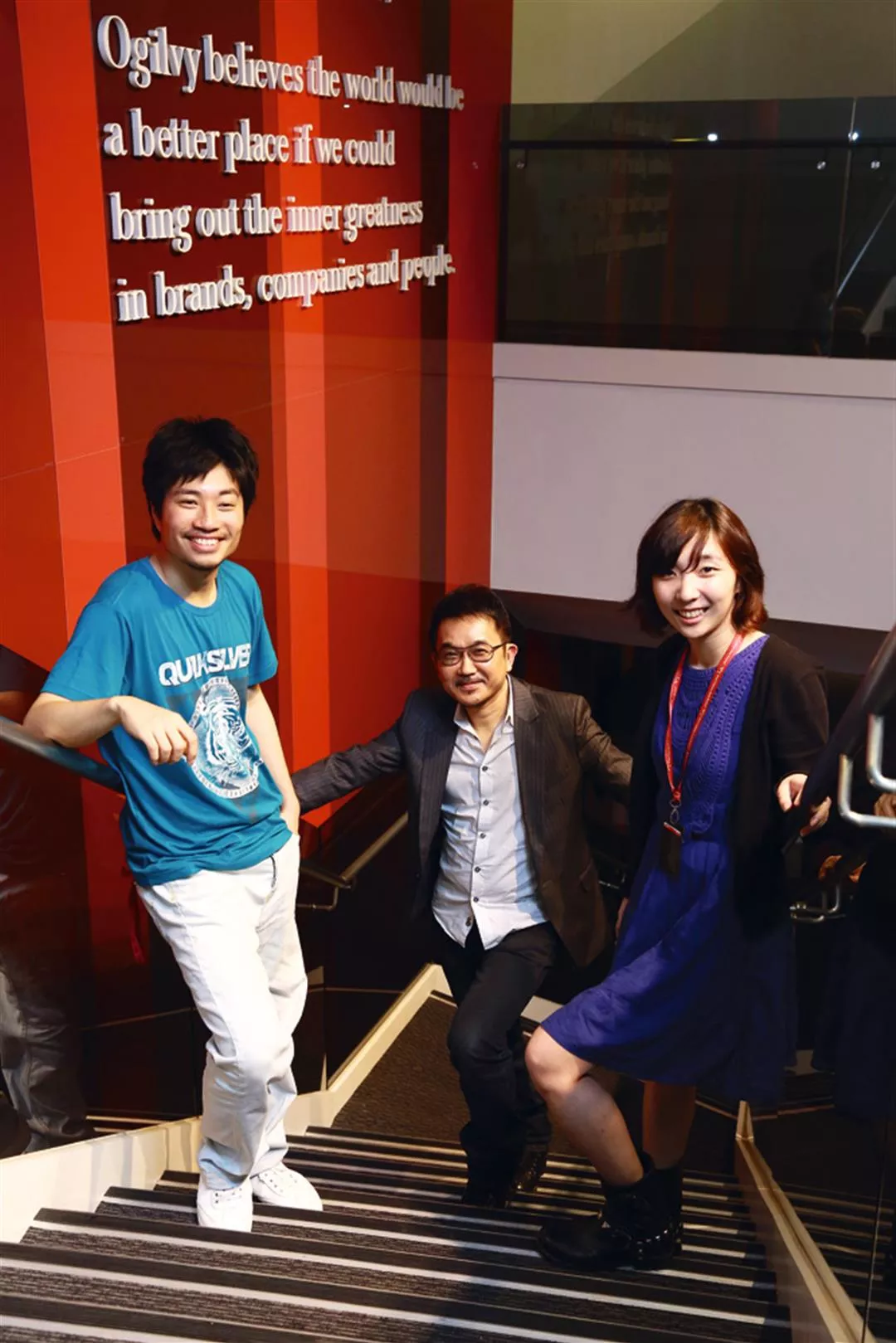
Oglivy and Mather Taiwan’s “Project Team Terence” is an internship program that aims to discover creative young people with a passion for advertising. Three years ago Ellie Chen (right), a graduate of the Department of Public Finance at National Chengchi University, and York Tsai (left), from the Department of Advertising at Chinese Culture University, performed so well in their internships that they were hired on full-time.