Taiwan Tourism Takes Off--Rail Leads the Way
Eric Lin / photos Jimmy Lin / tr. by Butler Waugh
August 2003


"Remembrance is as long as a railway line," writes the poet Yu Kuang-chung in a poignant line describing the essence of his travel memories.
For many Taiwanese, railroads are one of the enduring memories of growing up, and they have played an exceptionally important role in Taiwan's social development. However, for many people, though the memories are precious, the railroads had become only that: memories. But over the past few years Taiwan railroads have suddenly experienced a retro revival and have become quite the fashion. Colorful tourist trains started running during the Millennium Year, and all at once there was a complete change in style as the Neiwan, Chichi and Pinghsi branch lines and Alishan Forestry Railway became hot tourist attractions. Train tickets from the auspiciously named "Eternal Peace and Vigor" route have sold in the tens of thousands. Convenience stores began selling boxed lunch prepared just the way they used to be served on trains. Many other business opportunities have been created as well.
Rail travel's new-found popularity is actually due to the promotion of railway culture by railroad enthusiasts. With help from the Taiwan Railway Administration (TRA), travelers, and local governments, we are really seeing the "new blossoming of an old tree." What makes Taiwan rail travel so appealing? Read on...
It is summer vacation in July and at 7:00 a.m. platform number three in the Taipei train station is packed with people waiting to board. Look closely and you'll notice the mood of this group is special. Although it will still be a three-hour trip before they get to Hualien, many people are already dressed for the beach. "Our beach vacation begins at the Taipei train station," says Ms. Lin, who is wearing hot pants and sandals.
As you board the train, the trappings of the railcars also seem different. The first three business class railcars are equipped with the wide and comfortable swivel seats you might normally find in the first class section of an airliner, with only three seats per row. Between the business class and economy class cars there is a restaurant car where you can have a cup of coffee, watch the scenery flash by, and imagine you are one of the romantic characters in a novel by Chiung Yao.
Children are having fun running about the train. There's excitement in the air and nobody is complaining that it's too noisy. A stewardess wearing an updated Amis tribal costume and smiling sweetly has started serving breakfast in the car. She brings to mind the popular stewardesses who worked on the fast Chukuang trains in years gone by.

The train takes us into the unknown future, and is often a playground for our dreams. The photo shows coastal scenery in Hualien County.
Can't help but smile
This is the "Hot Springs Princess" line, a tourist train that leaves Taipei every morning at 7:20 a.m. and travels to the Chihpen hot springs resort in Taitung. The only stops it makes are Hualien, Kuanshan, and Taitung, and it passes by some of the most beautiful scenery of Taiwan's east coast, such as Kueishan Island. The Hot Springs Princess stewardess introduces and describes the scenery to passengers in a warm silky voice. The Railway Joint Operations Center and the Hualien Tourist Association have both assigned specialists who are available on the train to provide travel information. "The vibe really is different. Every time I'm assigned to duty on the tourist train, I can't help but break out into a big spontaneous smile," says conductor Cheng Ching-yuan.
Today over 60 employees from the Hai Yu Advertising Agency have filled the first two business class cars. There are children playing throughout the cars, and young singles have turned the seats to face each other and play a game of bridge. The person who planned this trip is the general manager's secretary, Ms. Liu Kuang-jun. She says that the 3-day 2-night Hualien luxury tour only costs a little more that NT$10,000 per person, which is much cheaper than an overseas tour. The children can also relax and play in the railcars. "Our boss likes this type of 'all the eggs in one basket' safe mode of travel. He's already decided on our company trips for next year and the year after; we'll take a tourist train to the destinations of Taitung and Kenting.
Each day the Hot Springs Princess line carries at most a couple of hundred passengers, yet the advertising it brings to the Taiwan Railway Administration (TRA) and the Hualien area is invaluable. Mr. Cheng Chin-fa, president of the Huatung Travel Agency, which specializes in tourist train tours, says that the tourist-train business is stable and tends toward the educational. There are many groups that usually do not take tours such as the Firefly Watchers (a group of nature-lovers) that will put together groups in April and May. This has a positive effect on the depth and breadth of the local tourism industry.
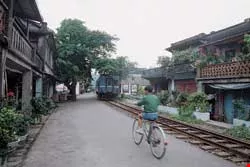
The railway helped create prosperity in Pinghsi once upon a time; old buildings are, unusually, built facing the tracks, and the area retains the flavor of an old mining town. (photo by Pu Hua-chih)
Railway ventures
Currently there are two tourist train lines-the "Hot Springs Princess" and the "Kenting Star"-that run to three major stops, Hualien, Taitung and Kenting. In the second half of this year a new round-the-island train will begin operation. Special features of all three of these trains include no standing tickets (i.e. all passengers have reserved seats), few stops, business-class railcars, and tickets only sold as part of package tours through designated travel agencies. They are operated by a consortium of thirty travel agencies, called the "Round-the-Island Rail Travel Joint Venture Center," who lease the trains from the TRA. Executive director Tien Chih-cheng says that average loadings in non-peak periods are 70% for the Hot Springs Princess and 50% for the Kenting Star.
"The packaging, marketing, and promotion of the tourist trains are left entirely up to the operators. The professionalism of their operating methods will establish public awareness in a short amount of time," says Tien. Promotional items for the initial phase include boxed lunches, cell phone bangles, and Aboriginal costumes, and in the future they hope to market these items separately.
Market-minded business people are always more responsive than government officials. The tourist trains offer two types of boxed lunches, the traditional steel container lunchbox, as well as a pottery lunchbox from the well-known Shuilishih kiln. The lunchbox sizes and colors often change, and during tuna season the Kenting Star even offers blue fin tuna sushi from Tungkang Harbor in Pingtung.
Rail travel has become fashionable again, and group tours are the mainstay of the Taiwan rail travel packages offered by the participating travel agencies. "The chief reason rail travel is succeeding today is because of the profound and unparalleled role of the railway in Taiwan's culture and history," says Tien, pointing out the essence of the railway's charm.
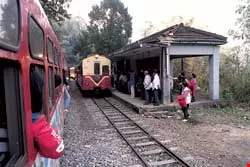
The Alishan Forestry Railway is a national treasure that holds an important place in the hearts and minds of Taiwanese. (photo by Diago Chiu)
Branch lines bloom
Liu Ming-chuan started building Taiwan's first rail line in 1887, and the rail network has gone through many changes over the course of the Japanese colonial era, the early years after the resumption of Chinese rule, the reform era, and the current revamping of the TRA. To fully exploit Taiwan's natural resources, the Japanese built rail lines with the same gauge tracks as those in Japan. They also built forestry lines to serve the lumber industry, as well as little trains (taken over and made famous by Taiwan Sugar Corporation) to transport sugar cane. They also engineered a line through the precipitous mountains of southern Taiwan. While not all of these are still in operation, you can still see traces of railway history in every corner of Taiwan. The impact of railroads has been so broad and deep that just researching the railroad's development would result in a complete history of modern Taiwan. The railways also explore all the aspects of variety of Taiwan's geography, from the mountains to the sea.
"Presently, tourists comprise over 30% of TRA's passengers. The winter and summer vacations are without a doubt the peak seasons," says senior specialist Chang Hsi-mei, who is responsible for TRA transport operations. In the future this tourism function will become even more obvious. In the past few years the TRA has brought back steam trains, and have used methods such as colorfully painted trains to make an impression on consumers and to preserve a significant railway culture.
Due to the growing convenience of aviation and highway transport in recent years many TRA branch lines have closed. The remaining rail lines inspire nostalgia for the early 20th century, which assure that they will be treasured. Currently, the surviving three branch lines-the Pinghsi, Neiwan, and Chichi lines-all have local tourism festivals that promote the railway's "experiential travel," and spur the development and nurturing of the local culture. On most weekends there are large numbers of tourists, which is really gratifying.
Chang Hsi-mei mentions the Neiwan Line as an example. The Hsinchu government incorporated in the line into its "Tung Blossom Festival," and in only two or three years "the line has been completely transformed." Not only has it been possible to save many sights, such as the old streets of Neiwan, the Neiwan theater, and the Neiwan suspension bridge, but local restaurants and teahouses have come up with unique local approaches and offerings. As a result, last year the number of passengers on the Neiwan rail line increased 38% over the year before.
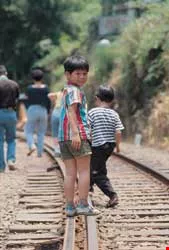
Riding one of Taiwan's small railways is a journey back into memory.... and the making of another beautiful memory in itself. (Sinorama file photo)
Eternal peace and vigor
With the TRA facing future competition from the high-speed railway, tourism provides an opportunity for the TRA to transform itself. Yet, because of the very great differences between passenger traffic during peak and opposed to non-peak periods, the three branch lines are all running in the red. The TRA does not have the resources to do more packaging or marketing. However, with the success of travel industry cooperation, such as in the tour trains discussed earlier, the TRA has found it can cooperate with local governments and the private sector in marketing and operations.
"For instance, if local governments or the private sector help support the colorfully painted tourist trains, the TRA can offer them reduced-rate or even free train advertising on branch lines," says Chang Hsi-mei.
The TRA is limited in its ability to develop its tourism capabilities. However, it has enthusiastically developed sales of railway cultural mementos, souvenirs, and food over the past few years. This line of business has become a new "cash cow." Last year the Taiwan Railway Catering Service Department earned nearly NT$1.7 billion in yearly revenue, and railway lunchboxes alone earned close to NT$300 million.
"The Taiwan Railway Catering Service Department has an entire team that is responsible for product development," says Chen Ching-biao, general manager of the department. For the railway there is no dearth of commercial products, which range from a low-priced aluminum lunchbox, to commemorative train tickets, to old railcar signs, to a rail spike bottle opener, to an NT$20,000 antique pocket watch, and up to and including the NT$35,000 "Flying Cloud" model steam engine. The TRA has only to offer a product and people will purchase it.
Mr. Chen says that the most profitable item is without a doubt tickets on the local train from Yungkuang (meaning "eternal vigor") station to Paoan (meaning "keeping peace") station in southern Tainan; the Chinese characters imply that it is a ticket to "eternal peace and vigor." To date the Eternal Vigor station has sold over 100,000 tickets. Another version that has been specially packaged and is available in the larger stations has sold almost 80,000 tickets. "It's hard to believe that just printing tickets could be so profitable," says Chen.
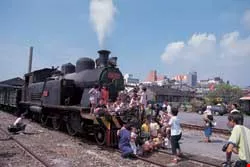
The CK101 steam engine's antiquated style provides maximum interest to both railroad buffs and casual travelers.
Last stop around the world
The significance behind "Eternal Peace and Vigor" may be difficult for foreign travelers to comprehend, but the attraction of Taiwan's railway tourism knows no borders. Japanese railway culture expert Masaru Ushikochi points out that Taiwan's railways provide endless fascination to Japanese railway enthusiasts, and even to ordinary travelers.
"The railway gives people a sense of nostalgia. The rail lines in Taiwan are the same gauge standard as Japan's railways. Even the model numbers of some railcars are the same. If the motivation for travel is a longing to see a place that, while far away and remote, is familiar in a dream-like way, then Taiwan's railroad has the special ability to give Japanese a wonderful feeling that combines the strange with the familiar," says Ushikochi. He has traveled on the railways of 40 different countries, yet he keeps coming back to travel Taiwan's railway again and again. The next trip he has in mind is to bring his new bride for a honeymoon trip on the Hot Springs Princess.
Another Japanese railway traveler is author Koichi Kazama. As a student, a railroad journey across Taiwan opened his eyes to the wider world, so much so that years later he decided to take a tour around the world. "At first I was only interested in traveling on Japan's railway, but I was deeply affected by the captivating views of Taiwan's coastal rail line. The world holds heart-stirring secrets that are not found in Japan," says Kazama. He is still taking his world tour and his last stop is Taiwan. Good friends he made in Taiwan many years ago have been eagerly anticipating his arrival.
"In Japan rail travel is the mainstream. If this project is promoted to the Japanese market, it is bound to create a stir," says Stephen Wu, president of Zion Tours. The Taiwan travel industry has already invested in promotion in Japan; and when the word gets around, the Hong Kong, Korea, US and European international travel markets are also looking good.
Ushikochi says that the South Link Railway has made the deepest impression on him in his more than ten trips to Taiwan. "After slowly slipping over the Kaohsiung and Pingtung plateau and traversing a long tunnel, it suddenly brightened and we arrived on the east coast. It was like something straight out of Yasunari Kawabata's Snow ountry."
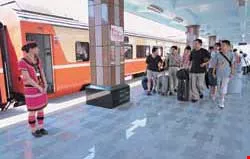
Smiling sincerely, the Hot Springs Princess' train conductor and staff serve passengers as they bask in the warm Pacific sunlight. The photo on the opposite page shows the Hot Springs Princess from the outside.
Pinghsi Line
The Pinghsi Line has the most beautiful scen-ery of the just three branch rail lines that remain in Taiwan. In recent years, Pinghsi has become known home and abroad for the "sky lanterns" released on Lantern Festival and many films and television programs have been shot against the backdrop of the town's historic street. Pinghsi as it appears on the screen has conquered the hearts of countless viewers, and now visitors flock to the area on weekends and holidays.
The Pinghsi Line was originally a coal-hauling railway, built in 1918 by the Taiyo Mining Corporation. Starting at the Santiaoling Station in Ilan County, its terminus is at Chingtung Station, giving it a length of 12.9 kilometers. In 1929 the Japanese colonial authorities brought the line under government authority, and began passenger service. The tracks wind through the Keelung River Valley; the journey features beautiful verdant mountains, the Shihfen Waterfall, the Lingchiao Waterfall, the Tahua "Teapot" Cave, and other sights. As relics of the long-gone glory days of the mining industry glide by the train's window, the sound of chugging wheels is complemented by the gurgle of flowing water, making for a lovely effect.
Pinghsi Rural Township is home to 13 former mining sites. Chingtung, the terminus of the railway, was once a flourishing mining settlement. The long, narrow buildings are, unusually, built facing the tracks. Abandoned coal storage bins, coal-car tracks, and Japanese-style workers' dormitories still stand intact. The structures on Shihti Street, below the Shihti Bridge, are constructed from Japanese cypress; now occupied by restaurants and shops, they are a favorite tourist destination.
Between the rail line, mining sites, waterfalls, and sky lanterns, the Pinghsi Line offers the greatest diversity of things to see of any of Taiwan's branch lines.
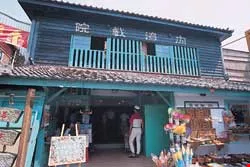
The Neiwan Theater is an intact example of Japanese colonial era architecture; such historic sites add human interest to the Neiwan Line railway.
Neiwan Line
The scenery along the Neiwan Line is the most unadorned and natural of all Taiwan's branch lines. It also has the steadiest traffic, because it is still used for transporting goods. Recently, because the Hsinchu County government has incorporated the railroad into its "Tung Flower Season" event, this railway has taken the edge in popularity among day-trippers over the Pinghsi or Chichi lines.
This line was built to serve the Chutung Industrial Park. The section from Hsinchu to Chutung, known as the Chutung Line, was opened in 1947. In 1950, the line was extended to Hohsing for the benefit of the limestone quarrying industry. It was further extended to Neiwan in 1951 to serve the lumber and mining industries around Mt. Chienshih, giving the line its current total length of 27.9 kilometers.
While riding the line passengers can see plains, industrial zones, and mountain forest, making for great variety. A ride on this train gives one the feeling of being lost in another age. The Hohsing Station is of particular note among the stops along the line, because it is the only "switchback station" in all of Taiwan. The land on which the station lies is very steep. While the track along the station platform is flat, trains must travel along a slope of 25 degrees to get there. Trains entering the station must drive past the platform, and then back in. There are also similar level turnoffs where one train can back in to allow another going in the opposite direction to pass. (There is only one set of tracks on this line.) Even non-railroad-buffs are sure to find it interesting.
The terminus, Neiwan Village, was originally a shipment point for timber coming from the Youluo River, and enjoyed a brief period of prosperity. In 1950, during the glory days of lumbering and mining in Taiwan, it had a Japanese-style theater, which still stands today. Scenes from many well-known films have been shot in Neiwan, so it is a popular spot among fans of the silver screen. The Hakka restaurants along the historic old street are another reason why people keep coming back.
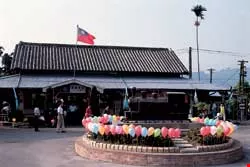
The Chichi Station, pictured here, was severely damaged in the September 21, 1999 earthquake. It has since been rebuilt. (photo by Diago Chiu)
Chichi Line
The Chichi Line is a railroad with a turbulent life. There was great controversy over a decision to halt traffic on the line in 1986, and in 1999 came the September 21 earthquake. Today, the fact that it is again possible to enjoy a ride on the Chichi Line brings with it a feeling of just how precious life really is.
The Japanese colonial regime began construction of the Chichi Line in 1921 in the course of the project to build a hydroelectric power station at Sun Moon Lake. The railway, today 29.7 kilometers long, is the only one in Nantou County. The Chichi Line not only runs past beautiful natural scenery, but there are many sights adding cultural and historic interest: Chichi Station. Minghsing School (a traditional Chinese academy), Kuangsheng Temple, Mutsai and Shuilishih kilns, the "Pioneer" stone memorial stele....
The "green tunnel" is the most characteristic feature of the Chichi Line. Taiwan Provincial Highway 16, which runs parallel to the tracks from Mingchien Rural Township to Chichi Township, is lined on both sides by camphor trees which cover it in dense foliage. giving the appearance of a tunnel. How romantic it feels to ride the train along here on a summer afternoon with sunshine and a cool breeze pouring in through the windows.
The September 21, 1999 earthquake caused enormous damage to the Chichi Line, including the collapse of Chichi Station, adding another chapter to the legend of this railway. Even today, tourism to Nantou has not seen a full return to the pre-temblor boom, which has naturally affected operations on the line, and you can still see sites where damage remains as yet unrepaired. Taking a trip on the Chichi Line these days is not only doing your bit for reconstruction in the area, but also is a reminder to appreciate life-after seeing the tremendous problems of reconstructing the line, travelers will surely come away with a new way of looking at things.
Alishan Forestry Railway
The Alishan Forestry Line was born the same year as the Republic of China (1912); it is one of the three most important mountain railways in the world. Unique among Taiwan's rail lines, this one is managed by the Forestry Bureau.
There are countless references to Alishan (Mt. Ali) in Taiwan's folk and popular music. The children's ditty "One, two, three, we go to Taiwan / Taiwan has Mt. Ali / Mt. Ali has its sacred tree..." is known even beyond the shores of Taiwan, and is still a reminder of home for many people who have moved far away. Any adult today who grew up in Taiwan knew well the path upward through Alishan's tropical, temperate, and cold-climate tree belts, and the fact that you had to take the Alishan Forestry Railway to see it.
Sadly, widespread planting of betelnut trees, tea plants, and mustard plants has destroyed the old appearance of the forest, and the most famous sight along the route up-the "sacred ancient tree"-was knocked down on July 1, 1997. The destruction caused by human activity on Mt. Ali is tragic, but fortunately the railway is holding its own, and many tourists are still thrilled by the "screw-thread" and "zig-zag" sections of the line.
The steepest segment of the railway reaches a gradient of 62.4 per thousand. The tracks first wind around like the thread of a screw, then, as the steepest parts approach, begin to zig-zag back and forth in a series of switchbacks, suddenly changing direction just when it seems you are going to run straight into a sheer cliff face. Some say that if you've never experienced this feeling, then you are not a real Taiwanese.
Early in 2003, human error led to a serious accident on the Alishan Forestry Railway. The line is still closed while safety is being upgraded. We look forward to the reopening of the line in the future, and to traveling on it with 100% safety.
(Eric Lin/tr. by Phil Newell)


