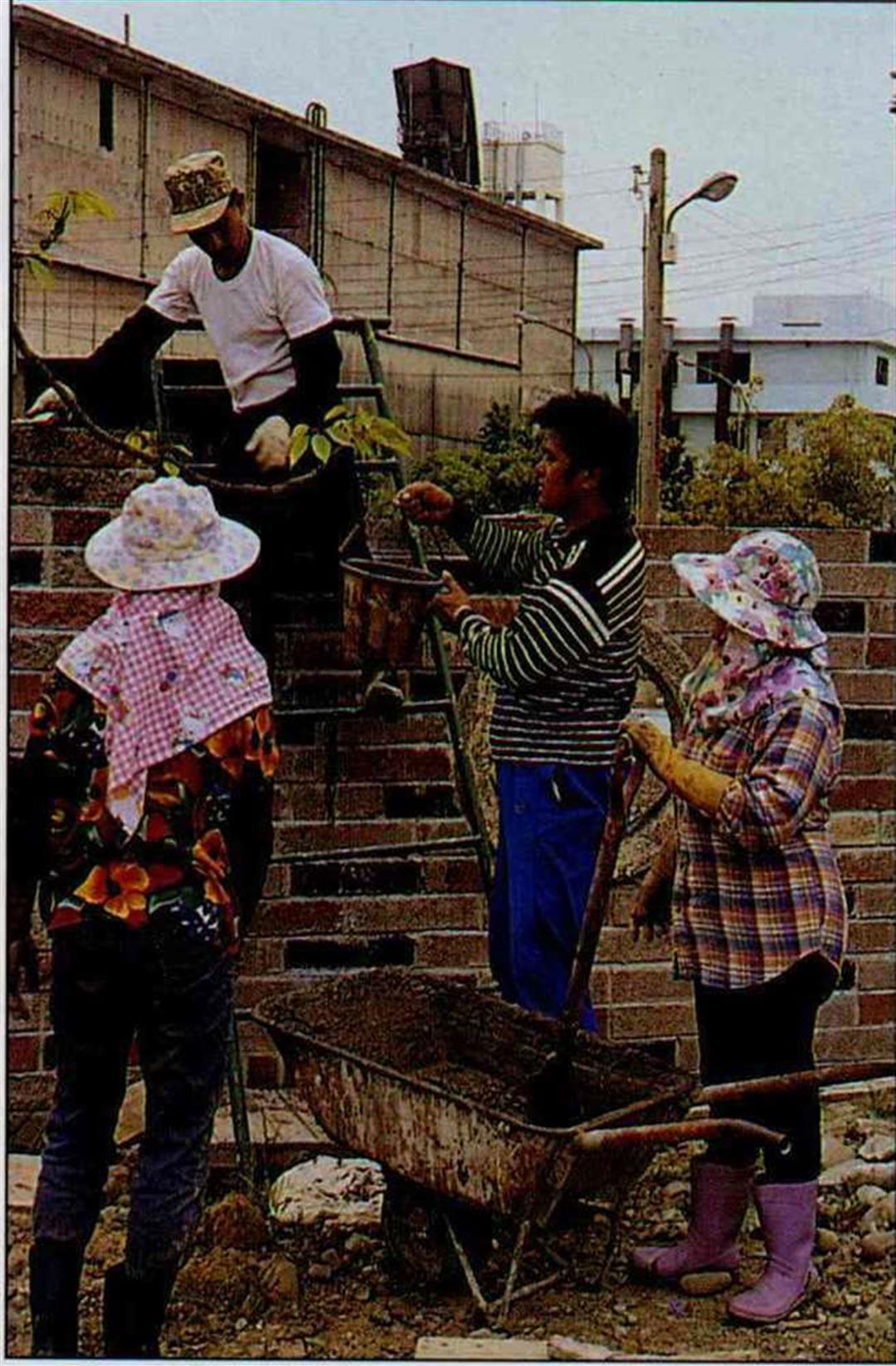
Do young intellectuals have a monopoly on preserving the cultural traditions of indigenous peoples? Of course not. Working in construction--which is anything but academic-- hasn't prevented Wu Te-kuei and his wife Huang Su-mei, both Amis, from doing their bit to promote traditional aboriginal dance.
In Miaoli County, along the banks of the Chungkang River in May, the tung trees are in bloom, giving the impression that snow is blanketing the hillsides. Where a suspension bridge spans the canyon, a narrow path winds up the steep slope from the entryway of the Tunghe Elementary School in Nanchuang Rural Township.
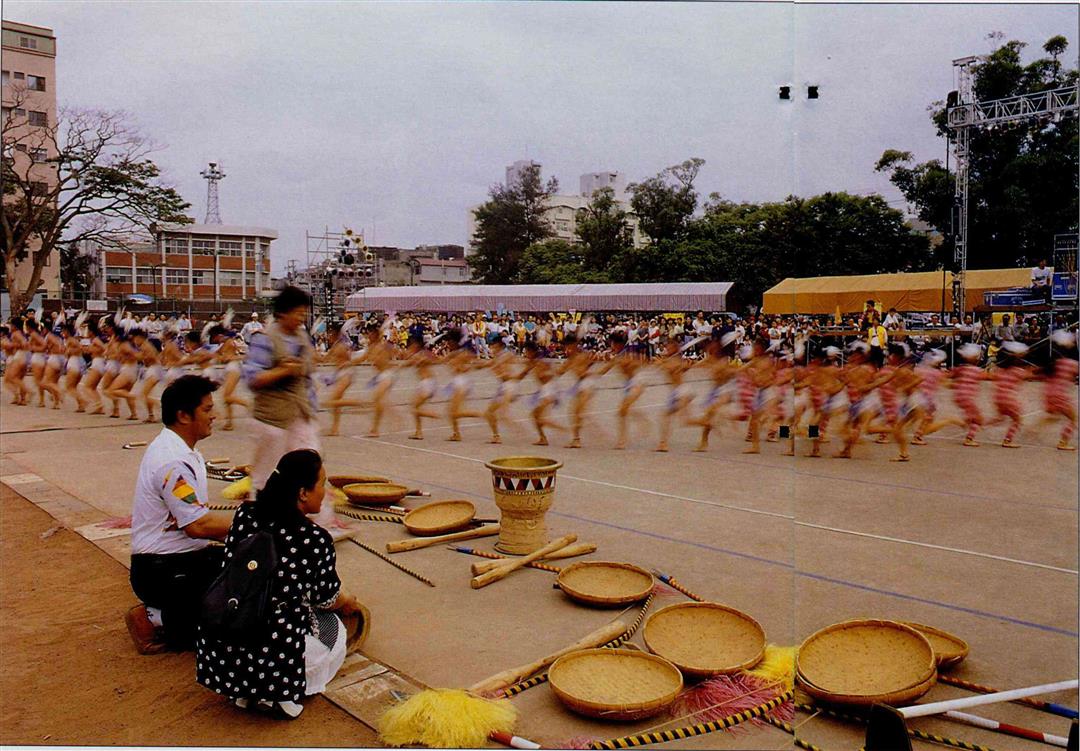
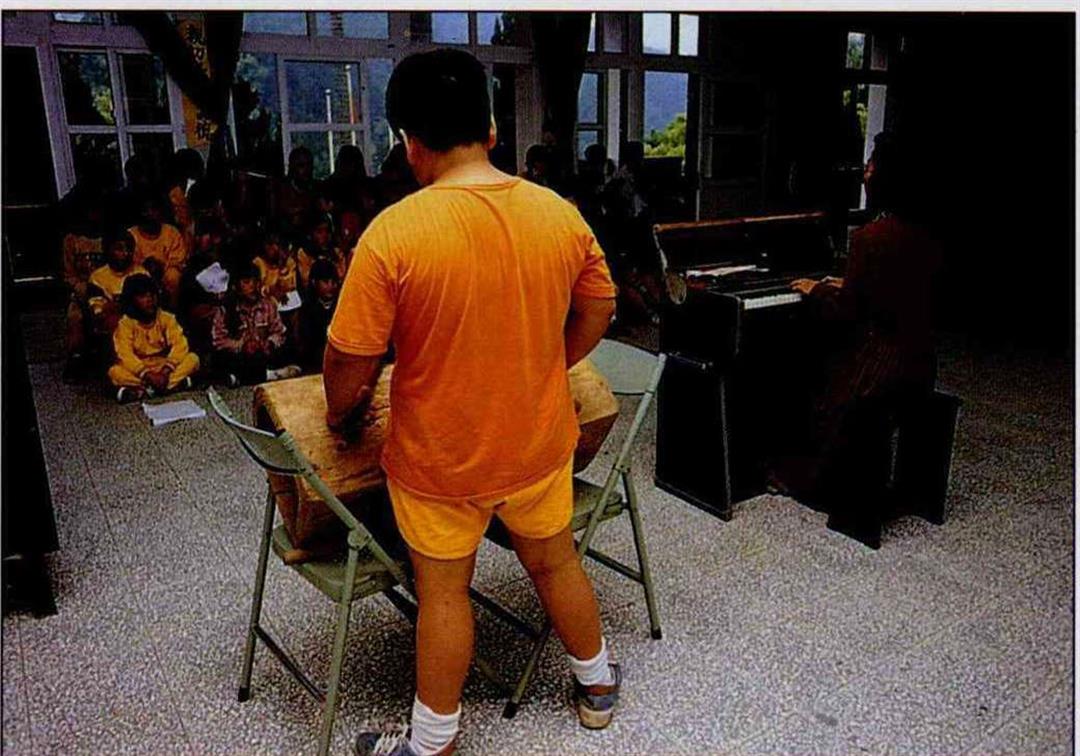
On this day, the school's 82 students in grades two to six are out in the schoolyard practicing "The Tribal Love of the Sons and Daughters of Tunghe." As the beat is tapped out with a stick, the predominantly Saisiyat children shake their hips, swing their arms and crane their heads. Their steps are firmly footed, as if they want to open the ground beneath them, and their singing voices are clear and carry well, as if they want to shake the mountain tops.

Children blessed by the mountain spirits.
A coach of champions
This year is the first that Tunghe has participated in the aboriginal dancing competition for elementary schools. It took top honors in the folk dance group at the county competition and won honorable mention at the provincial finals. The children's teachers were Wu Te-kuei and his wife Huang Su-mei, both Amis from Chi-an Rural Township in Hualien County.
In the six years since 1989, they have taught tribal dance (largely Ami dance) at four schools in Miaoli County: the Tapu, Haikou and Tunghe elementary schools and Nanchuang Junior High. All but Tunghe are frequent provincial champions.
People are surprised that the couple work in construction and aren't professional dance instructors. They accept just a small, symbolic fee, and take time off from their work during the day to run around and teach in the schools. Then they work at night so as not to fall behind in their construction schedules.
Wu Te-kuei's skin has been turned black and red by the sun. His baby face is round, his eyes set deep in their sockets, and his nose up-turned. When he smiles, he's all eyes and mouth. There is a shyness about him that suggests the candor of innocence. His wife Huang Su-mei stands only 150 centimeters to his 180. Yet strangely, side by side they seem to make a good match--perhaps because they have similar demeanors.
Huang Su-mei says that they do virtually everything together, and teaching dance is no exception. With the dancing, however, she plays only a supporting role. The meaning behind the dances, their structure and choreography are all determined by her husband. When asked about his motivation for teaching dance, Wu Te-kuei pauses for a moment to think before saying with great earnestness, "I didn't realize the importance of one's own culture until leaving my hometown."

Wu Te-kuei and Huang Su-mei earn their bread by running a construction business. Teaching dance is their avocation, and a concrete display of their deep love for indigenous culture.
Getting the grounding at home
Born in 1951, Wu lived in his Ami tribal village until he went north to perform his military service after graduating from the architecture department of Kuokuang Vocational School. Living at home over his entire childhood meant that he received the complete training given to Ami boys aged 13 to 18. When talk turns to his boyhood and the coming of age ceremony, Wu's eyes light up.
The coming of age ceremony used to take an entire week. During the first five days, the elders would impart knowledge and give instruction in dance. And in the last two days the boys would fast and practice catching birds with their bare hands. Groups of boys would wait along the banks of the river and be off in pursuit when a bird flew from its nest. When the bird got tired, it would stop somewhere to rest, and after three or four such excursions it would be exhausted. Then they could catch it. Of course, the boys would end up so tired that they couldn't stand up themselves.
If you weren't careful and killed the bird, then on the final day's marathon it would certainly get "darker the longer you ran" (meaning you would become light-headed). When the tribespeople along the course detected that something was amiss, they would use green ginger leaves to whip your back, wanting you to shout, "give me a bright road!" Then the fatigue would pass, and you could finish the course. Afterwards, everyone sang and danced until daybreak. This is how Wu Te-kuei laid the foundations for his dancing.
Coming north to do his stint in the army, he came across his cousin and childhood playmate Huang Su-mei, and when they returned to the village they married. Then they went together to Chu-nan, and in the wink of an eye two decades had passed.
For the first 17 years in Chu-nan, Wu Te-kuei worked in the office of an architect, mastering all the various skills of the profession from design, drafting and cost assessment to construction. Walking along the streets of Chu-nan, Huang can point out the buildings and walls that her husband built. But the result of all this hard work was that his boss gave him a salary that wasn't enough to support three children. Many friends urged him to go out on his own, but Wu just couldn't gather the gumption to leave.
Finally, when Wu's parents died within 14 days of each other, his boss groused about Wu's taking a month off to observe the proper funeral rites and period of mourning. Mad that his boss didn't respect his tribal customs, Wu overturned a table and left. That's how he got started on his own.
"For indigenous people, with no family connections and no financial resources, it was very difficult," Wu and Huang explain. The jobs they get now are mostly with government units with which they have dealt in the past. These require less capital but also bring thinner profit margins.
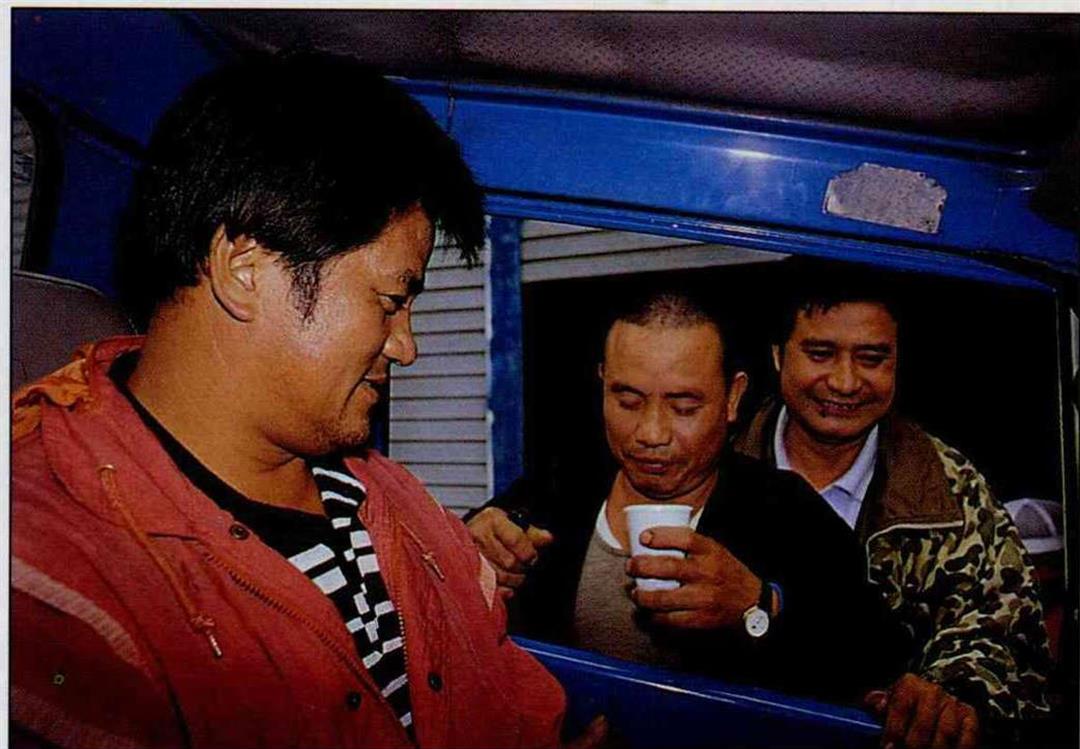
Wu frequently chats with parents to get a better understanding of Saisiyat life and culture.

Everything is tough at the beginning
Wu would return to his village for new year's celebrations and other festivals. Seeing everyone dancing at the harvest festival sparked emotional memories in him and the wish that he could dance at normal times. After all, Wu's brother Wu Te-sheng led a dance troupe at Yichang Junior High which frequently won competitions.
"If kids in Hualien could dance well, why not kids in Miaoli?" Wu got his chance to find out in 1989. When he was doing a construction job at Miaoli's Tapu Elementary School, Principal Tseng Hua-ching mentioned that he wanted to start a dance program at the school but couldn't find a teacher. Laughing, Wu pointed at himself and said, "Your dance teacher is right in front of you!"
The first year was the hardest. The couple created "Joy Forever," adapting some of the faster dances from the harvest and new year's festivals of the Hualien tribes. The rhythms were fast, which made it easier for the dancers to keep in step and gave the impression of more energy. In preparing for the competitions, for which they used musical instruments and more choreography, they asked Wu's brother, with all his abundant experience, to come and give them some guidance.
Tien Chun-chih, director of Taipei's Mountain Dance Troupe, says that the most valuable aspect of indigenous dancing is that the emotions of the dancing rise with the emotions of the singing, and so only with everyone singing and dancing together will the proper feeling and spirit come out. The Wus understand this, and thus have the children sing while dancing. But they were worried that the children would sing off key or lose the beat during the contest, and so they taped a practice in the month preceding it. They then replayed the tape during the contest and had the children sing along loudly. Still, most of the children at Tapu were Han Chinese, and Wu felt that their pronunciation was never quite right.
Be that as it may, the first time Tapu participated in the county and provincial competitions, it took first place, and it would go on to win three years running. In the fourth year, Wu began teaching at the Haikou Elementary School as well. The result was that his teams ended up competing with each other, and Haikou beat Tapu. Since then, Wu has stuck to teaching at only one school at a time.
In 1993 he came to teach at Nanchuang Junior High, where he began to throw some Saisiyat dancing into the mix, since many of the school's students came from that tribe. "Yet perhaps because these students were older, they weren't willing to let themselves go, planting a desire within him to find an elementary school with indigenous children.

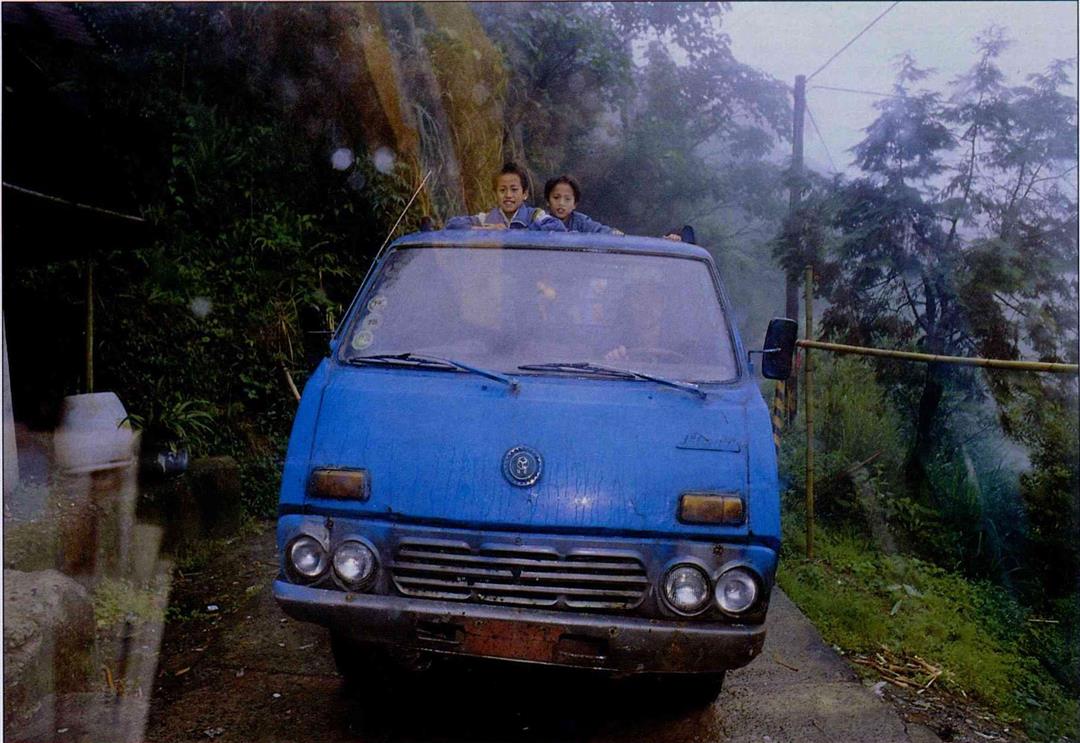
Children who live by Sky Lake often hitch a ride for the long trip back from school.
The short spirit ceremony
Wu learned by chance that the Tunghe Elementary school had indigenous students. And when he met the school's principal Chen Chao-chih, he found out that Chen was very interested in establishing a model school for indigenous children. Things clicked between them right away.
Upon arriving at the school, all of the old problems were quickly resolved. Hsiao Hsiu-yun, a second-year homeroom teacher who helps Wu critique the kids' movements, was president of the student dance club at National Hsinchu Teacher's College. She says that indigenous children--as a general rule--have a better sense of rhythm and more perseverance, and they don't mind working hard when practicing. The children felt honored to have this chance. At times, when the changing formations of the dances required a few children to be excluded for some numbers, the children would all make their best efforts, so that the teacher wouldn't know whom to use and whom to leave out.
But there were some problems here as well. In order to accommodate the living habits of the village's Saisiyat residents, Wu thought of incorporating the short spirit ceremony into the dance, and with that in mind in 1994 he specially attended the biannual ceremony at Sky Lake, where he taped the entire thing. He also spent time off from work to visit with Saisiyat elders and the parents of the students in order to get a firm grip on the meaning behind the ceremony.
Because there is a taboo against singing these songs at normal times, Wu at first thought that they would dance but not sing. Then a teacher suggested that they could hoot the tune instead of sing the lyrics, and in this way they resolved the problem. Because the school isn't flush with cash, the children's costumes were made one at a time by retired teacher Feng Te-hui's wife. Wu and Huang provided such props as sickles, spears, bows and arrows, and the loom which is used as an instrument. For the feathers in the head dress of the kid playing the tribal chief, the Wus made a special trip back to their tribal village. And Wu Lan-ying, the school's director of studies, figured out how the props would be used.
The Wus made the hour-long drive from Chu-nan once or twice a week and taught for a full morning or afternoon. When construction got delayed as a result and they couldn't hire workmen at night, they'd often work themselves until 11:00 and then get up the next morning at 6:00.

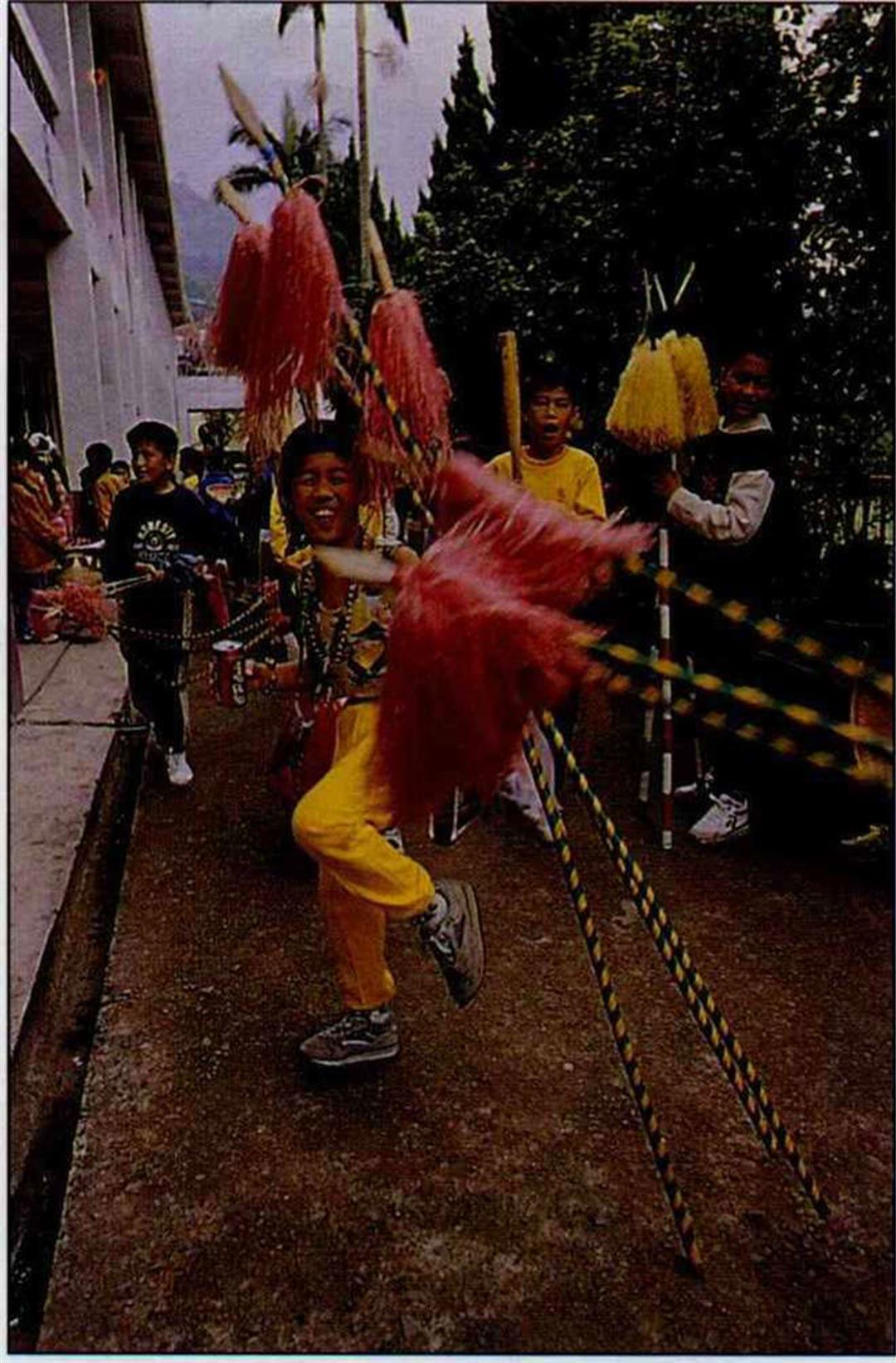
Regardless of what expectations adults have about the dancing, the kids often just think of it as a fun game.
Parents join in
But the hard work had its reward. Everyone's efforts brought spectacular results. Even Chu Yi-te, director of the dance troop from the Taoshan Elementary school and a Saisiyat, was bowled over by their performance. "Where I can go to hide and cry? I never imagined that they could dance so well!"
The Wus' efforts at Tunghe finally attracted the attention of the Saisiyat people. On May 9, the children participated in a choral contest and sang Saisiyat folk songs. The few tribesmen of the village who can still remember the traditional songs are a precious resource, and it was a member of the school's parents association who provided the songs for this performance. Even if the lyrics were in Ami(to avoid breaking taboo), it was at least a step in the right direction.
Ever since the troupe from Tunghe made such a good showing at the provincial competition, it has been getting invitations to perform from all over. Sometimes when teachers are resting on vacation days, the troupe ends up short-handed and the parents step up to take up the slack. More and more among them are recognizing their ethnic identity and showing a willingness to throw themselves into the work of carrying on Saisiyat culture. Previously the school wanted to offer classes in the mother tongue and invited parents to help put on a class. The response was tepid. Now parents teach Saisiyat in every grade.
But in the world of dance, some are curious why Wu Te-kuei, an Ami, would select a Saisiyat village in which to teach. They also have their doubts about mixing songs and dances of the two tribes, wondering if this will not pose an obstacle to promoting the indigenous culture since these performances are not "pure."

Children are practicing for a choral music contest. It will be the first time they perform Saisiyat folk songs.
Everyone is indigenous
Wu just laughs and says everyone is indigenous, and that it's best not to make such distinctions. Furthermore, he points out that Ami and Saisiyat culture have many points in common. The pronunciation for such words as hair, skin and charcoal are the same, and the Ami also have a legend about a short spirit. Now when Wu meets with his Saisiyat friends, they'll joke with each other and say that the other's tribe is a lost branch of their own!
Nevertheless, the Wus are well aware of the problem of "purity," and they hope they to delve deeper into Saisiyat life and ceremonies and put on a "Hero Dance" that is purely Saisiyat next year. They shouldn't be lonely, as more and more Saisiyats themselves seem willing to join the ranks of those working to pass on their legacy.
[Picture Caption]
p.110
The children of Tunghe Elementary school move to Wu Te-kuei's beat. Their song and dance are rooted in the vitality of indigenous life.
p.112
Children blessed by the mountain spirits.
p.113
Wu Te-kuei and Huang Su-mei earn their bread by running a construction business. Teaching dance is their avocation, and a concrete display of their deep love for indigenous culture.
p.113
Wu frequently chats with parents to get a better understanding of Saisiyat life and culture.

p.114
Children who live by Sky Lake often hitch a ride for the long trip back from school.
p.115
Regardless of what expectations adults have about the dancing, the kids often just think of it as a fun game.
p.115
Children are practicing for a choral music contest. It will be the first time they perform Saisiyat folk songs.
p.116
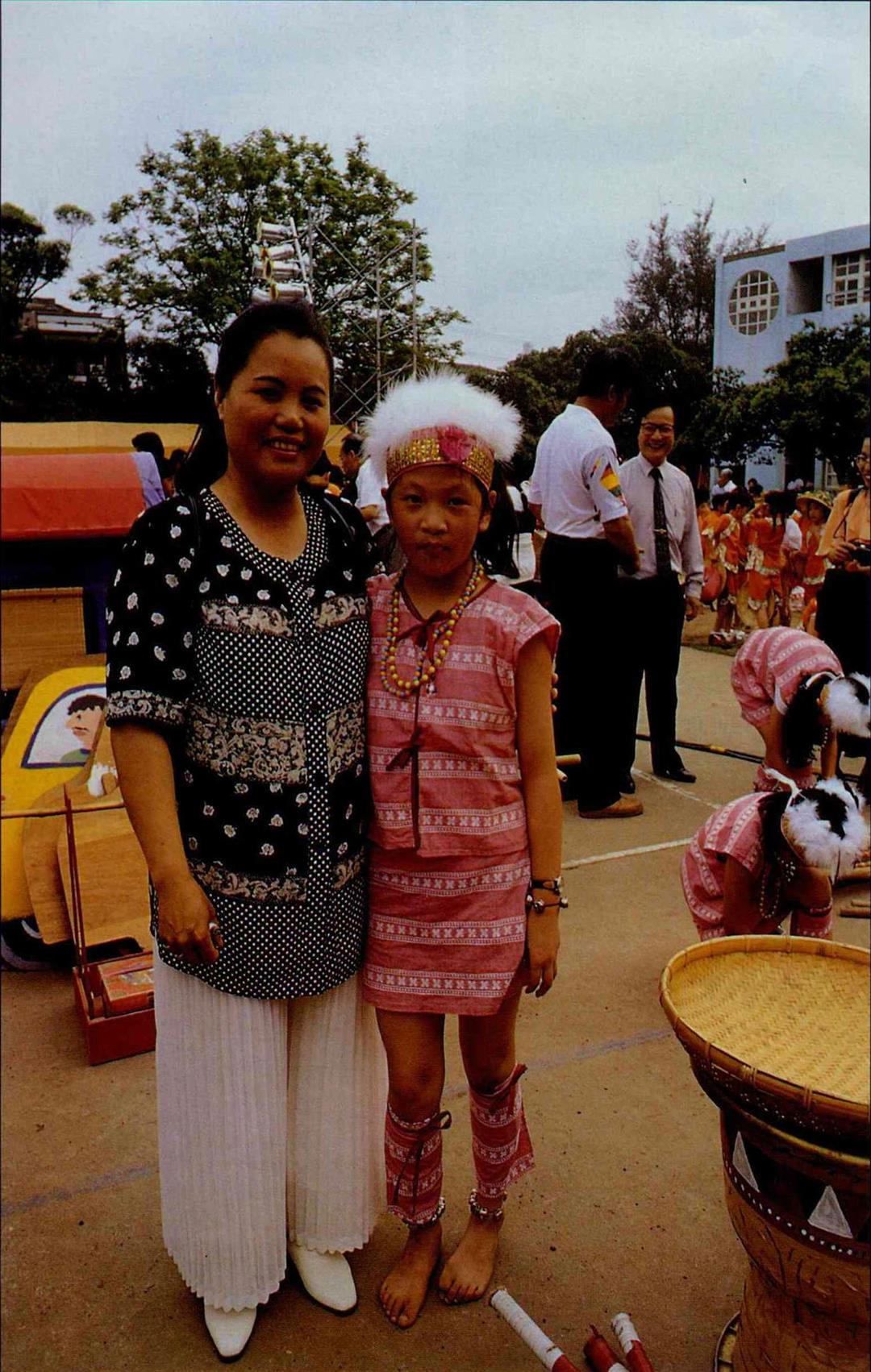
At Tunghe, besides helping the dance troupe win awards, Huang Su-mei has also "adopted" a daughter.

At Tunghe, besides helping the dance troupe win awards, Huang Su-mei has also "adopted" a daughter.