The Power of Aggregation: Contributor-Driven News Sites Take Flight
Eric Lin / tr. by Scott Williams
January 2014


The ways in which we transmit information are changing. With the print media in decline and readers moving online, the world’s news media are going digital in a big way. Meanwhile, citizen journalists are taking to the Internet in large numbers, gathering and sifting diverse perspectives to reveal the truth. Editors who once worked behind the scenes are moving into the limelight, wielding their integrative expertise to weave complex threads of information into simple, cohesive charts and stories.
This eruption of new reading habits and writing skills has given rise to a new kind of online destination, the curated, contributor-driven news website. If the creators of such sites have vision and the ability to attract people, they can establish a journalistic brand that draws on the insights of numerous writers to become a force for social change.
In the US, the Huffington Post has surpassed The New York Times as the news website with the highest browse rate in the world. It has also earned journalism’s highest honor, the Pulitzer Prize. Here in Taiwan, the two most popular sites of this kind, The News Lens and News&Market, are in the process of redefining our ideas about journalism and communications.
Winter is awards season for Taiwan’s journalists, and 2013 was a year for online independent media and citizen-journalists to shine.
At the Excellent Journalism Awards, News&Market won the prize for investigative reporting, Coolloud founder Sun Chiung-li for commentary, and the PeoPo Citizen Journalism Platform for social utility. PeoPo also won the award for audio-visual reporting.
In the past, referring to something as “citizen journalism” suggested that it was little more than amateurish venting on issues, but nowadays online journalism is beginning to challenge the dominance of traditional media.

News&Market is tightly focused on food safety and has won accolades from the public for its treatment of issues ranging from where to find pesticide-free vegetables to “rice-less rice noodles” and drugs used to create leaner meats.
Taiwan’s platforms for independent journalism have a history that dates back to Coolloud’s 1997 founding. However, their current period of explosive growth and evolution didn’t begin until 2010, and it owes much to Facebook’s rapid expansion and readers’ newfound enthusiasm for sharing articles and information.
According to a 2013 Shih Hsin University study on Taiwan’s mass media, the Internet is our second most important vector for news. In fact, its 74.9% usage rate far outstrips that of print media and is second only to that of television.
The now popular contributor-driven news sites link five functions: reporting, news editing, blogging, microblogging, and sharing. Even the traditional media are pouring money and manpower into the trend, extending their battle for readers into the online space.
The founders of contributor-driven news sites fall into basically two categories. The first run their media operations as social enterprises, are focused on citizen activism, and are effectively non-profits that seek only to break even. News&Market is a case in point.
The News Lens exemplifies the second type, which deploy a Huffington Post-style model of citizen journalism in an effort to build large for-profit media entities that can counterbalance the traditional mainstream media.
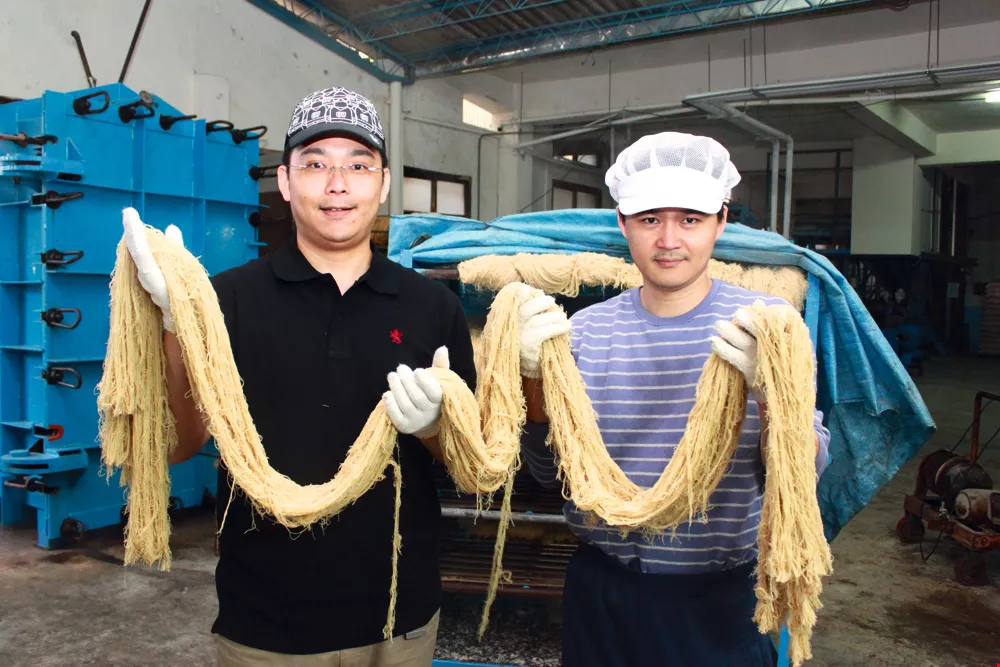
News&Market is tightly focused on food safety and has won accolades from the public for its treatment of issues ranging from where to find pesticide-free vegetables to “rice-less rice noodles” and drugs used to create leaner meats.
News&Market’s September 2011 launch was very tightly focused on the use of in-depth reporting to draw attention to issues related to land, agriculture, and food. During the two-plus years since its establishment, the company has seen in excess of 1 million visits to its website in a single month, and received 80,000 Facebook likes. The website has a high degree of “stickiness” for its readers, and has also become influential. In fact, its online reports on food safety issues, including its series on elementary school lunches, “rice-less” rice noodles, and the dangers of the drugs used to create leaner meats, have spawned similar stories in the mainstream media and influenced government policy.
News&Market’s Mandarin name (literally, “upstream/downstream, news, markets”) incorporates three concepts that offer insight into its mission.
The company intends “upstream/downstream” to suggest the relationship between the media and its readers, as well as between food producers and consumers. The “news” refers to offering top-quality news that serves as a communications medium fostering greater understanding between upstream and downstream, repairing the confidence lost as a result of food safety crises, and enabling action. The “market” part of the name is a reference to the site’s online market, which provides consumers with the means to buy healthy organic produce, and helps farmers stick to their ideals by providing them with a no-fuss means to distribute their produce.
The three ideas might seem an odd mix, but the website is so well designed that visitors grasp the connections immediately. News&Market places the news front and center and its market functions in a more secondary position. The news itself consists of in-depth reports by its three in-house writers and its editor, as well as articles by more than 600 freelance contributors. Since many of its freelancers are also small farmers, the numbers of articles posted on the site vary with the seasons.
“Most of the pieces by farmers focus on their land and their growing experience. Consequently, they produce loads of articles after harvest time and hardly any when they’re busy planting and tilling,” explains Ahon Shaw, one of the company’s founders and the person in charge of its website planning.
While most websites place ads along the sides of the page, News&Market fills those sidebars with pictures of small farmers’ produce, providing site visitors with links enabling them to purchase organic produce and NewsMarket’s own branded products. Homemakers currently comprise the bulk of the company’s customers, and make regular, frequent purchases. These sales provide the majority of the revenues necessary to keep News&Market running.
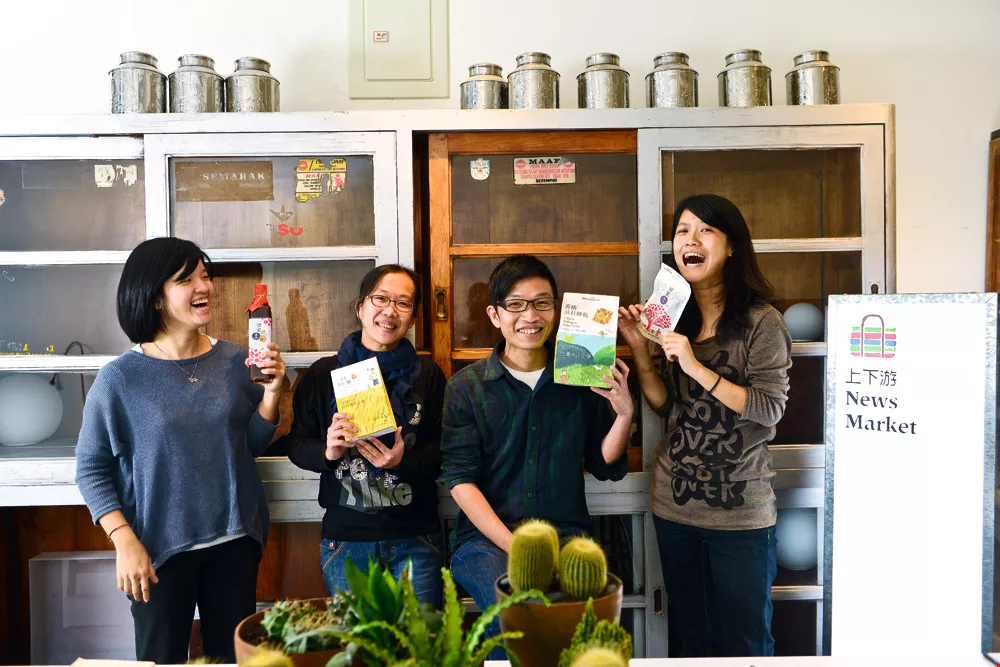
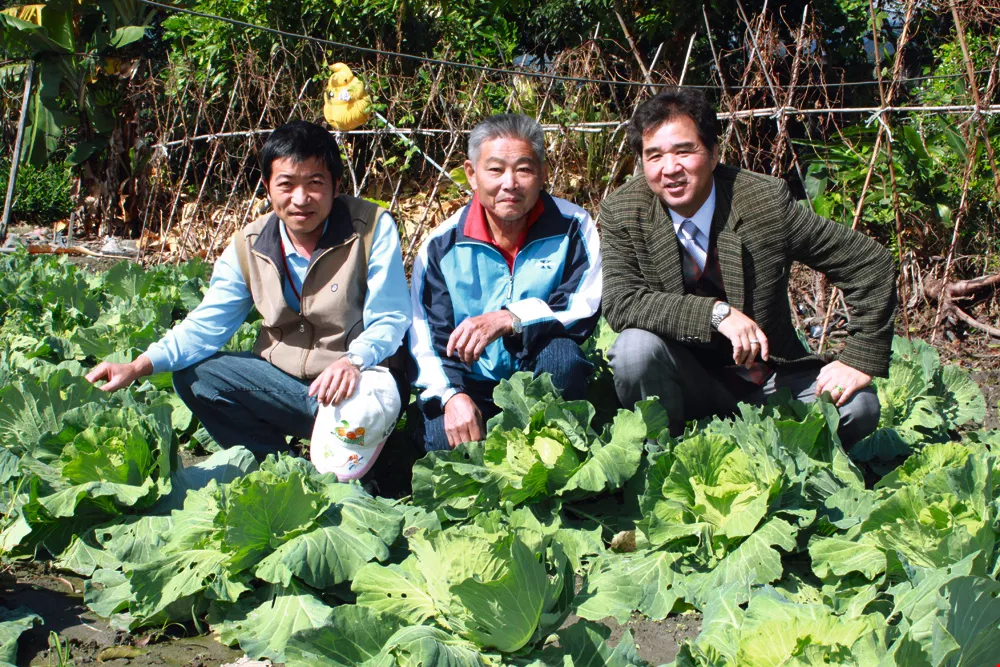
Ahon Shaw (second from right), one of News&Market’s founders, handles company operations. The company’s website seamlessly integrates with its brick-and-mortar outlet, which sells produce from small farmers.
It takes a diverse set of skills to manage the website’s broad range of content and innovative business model. Fortunately, its five founders—Wang Wenhao, Zhuang Huiyi, Feng Hsiao-fei, Ahon Shaw, and Yang Weilin—have backgrounds ranging from the news media, agriculture, and Internet technology to handicrafts manufacturing. They deploy these complementary skill sets in the pursuit of their shared ideals, communicating continuously online even though they live in different parts of Taiwan and rarely meet in person.
As is the case with many other social enterprises, the company does what it can afford to do. Surprisingly, it managed to break even in its first year. It undertook a major redesign in its second, aiming to better conform to online users’ expectations. By its third, it had won numerous journalism honors and awards. Feeling that it was on its way towards fulfilling its goal of creating a successful contributor-driven website, it began turning its attention to its next objectives: developing products, invigorating agricultural economies, and changing consumers’ habits.
To that end, News&Market opened a brick-and-mortar store near the National Taiwan Museum of Fine Arts in Taichung in January 2014. For this “real world” venture, it has inverted the focus of the website, placing the market functions front and center and relegating news to a secondary role.
The shop is located in a three-story townhouse. It uses the first floor to retail agricultural products and pastries, and as a venue for informing customers about healthy agriculture through an ever-changing array of slides. The second floor features a small bar area where friends can gather. The company has also mounted an LED signboard on the balcony to display News&Market’s daily headlines to passersby on the street below. It uses the third floor as office space and as a warehouse holding its inventory of the more than 260 products it sells online in tidy rows.
“The Internet is like a complex organism that links numerous communications channels,” says Shaw. “It also resembles the land in that if you cherish it, it will provide positive feedback.” Hsiao sees similarities between food and news as well, arguing that both require a passion for disclosing the truth, in the case of the first to cultivate healthy farmland and in the second a healthy society.
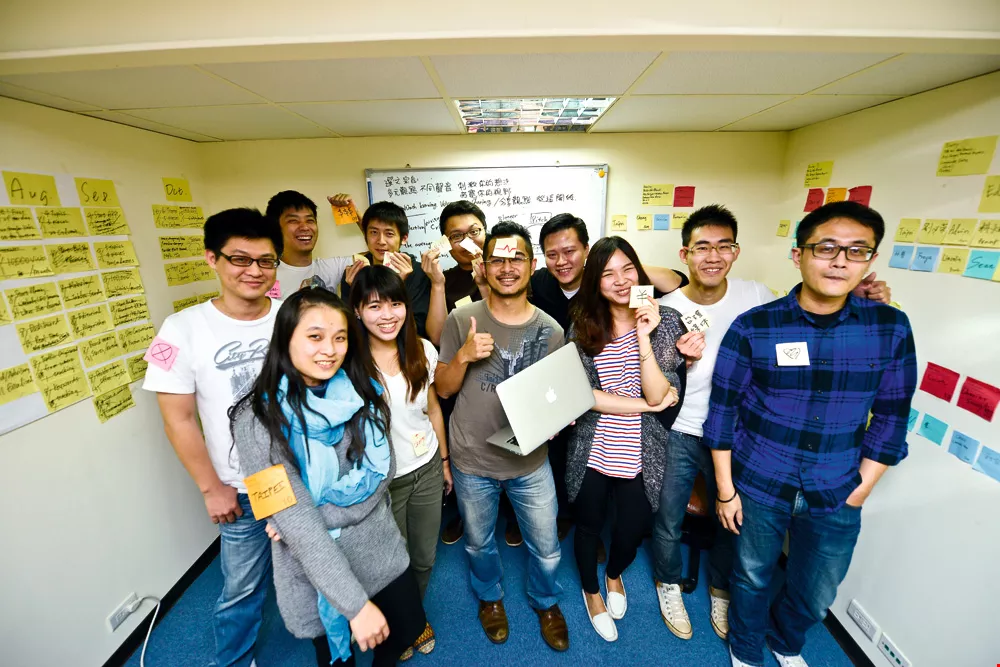
Joey Chung (fourth from right) and Mario Yang (center) handle executive and editorial duties at the company, and have succeeded in pushing the website’s view-through rates ever higher.
The News Lens, which launched in August 2013, has shown Taiwanese society the explosive power and potential of contributor-driven news sites.
As its English name implies, The News Lens focuses on the news that readers care about. And, as its Chinese name (literally, “the crucial commentary web”) suggests, it doesn’t have its own reporters, but instead aggregates written commentary from many authors.
The site’s front page piques visitors’ curiosity. The design is very clean—just columns listing articles—though the specific format varies slightly from device to device, with computers, tablets and cellphones each seeing their own version of the site.
Because the articles are current, they tend to be actively shared on social media sites like Facebook. In its first month online, The News Lens site received 200,000 visits. In its second, it had 620,000. It expects that figure to rise further to 1.8 million in January 2014, the site’s sixth month online. Meanwhile, its Facebook page has received 50,000 likes to date, and the number of contributors to the main website has grown from ten at its launch to more than 100. In short, the company has been a phenomenal success with growth far outstripping its original targets.
How has a contributor-driven site launched just six months ago done so very well? The expertise of its founders—Joey Chung, Mario Yang, and Xavier Wang—has been crucial.
Born in 1983, Chung is a former president of Sanrio, China. He was invited to write a column for the Business Weekly website in 2011, soon after receiving his MBA from Harvard Business School. Chung’s unique writing style and educational background attracted a broad audience, making him something of a celebrity among Taiwan’s young professionals. He also became friends with Mario Yang at around this time, foreshadowing their future business partnership.

More than 100 writers contribute to The News Lens. The website offers both news and commentary, and its pieces on social and educational issues, digital life and the job market have been particularly well received.
The two men decided to start a business together in the fall of 2012. Chung would be executive director, handling fundraising and operations; Yang would be editor-in-chief, overseeing content. Wang became chief technical officer and handled website planning. With The News Lens, they hoped to rewrite the media blueprint, to develop content suitable for reading on smartphones and other mobile devices, and make it easy for social media users to share, discuss, and participate in the issues in which they were interested. They also hoped to make the news something more than a description of facts, to enable it to incorporate multiple perspectives.
The company’s online vitality is reflected in its actual operations. When you enter its offices in Taipei’s Xinyi District, your eyes are immediately drawn to the Post-It-covered walls that dominate the open floorplan and offer visual evidence of the company’s productivity. One wall tracks monthly performance objectives with notes that record a time and a number. When these are then crossed out, it indicates that the goal has not only been achieved but surpassed. On another wall, the notes contain the names of authors and celebrities who the company hopes will write for it.
The atmosphere in the office is vibrant. Laid out like a newspaper newsroom, the desks are arranged in rows that face one another to make it easy for everyone to talk. Launched with just six employees, The News Lens now has a staff of 18 and in December 2013 relocated to larger offices.
Chung has also challenged the usual online media model to achieve the company’s content spillover objectives, working with entities ranging from cellphone maker HTC to Focus Media to deliver his news to the public on their cellphones and in elevators, movie theaters and even food courts.
By rapidly increasing the numbers of its contributors, the site has also rapidly increased the volume of its content, growing it from four articles per day at launch to as many as 16 per day now. As a result, Chung and Yang now see their company as on the verge of becoming a major news site.
“If you’re serious about starting a business, you have to give it your all and work to create the greatest possible synergies,” says Chung. “We aren’t just playing around in a garage somewhere.”
The online revolution appears to be unstoppable. While many people who grew up reading the news in print remain suspicious of digital media, Taiwan’s new media entrepreneurs are already opening up new territories. In the process, they are reinventing journalism and furthering the transformation of our society.
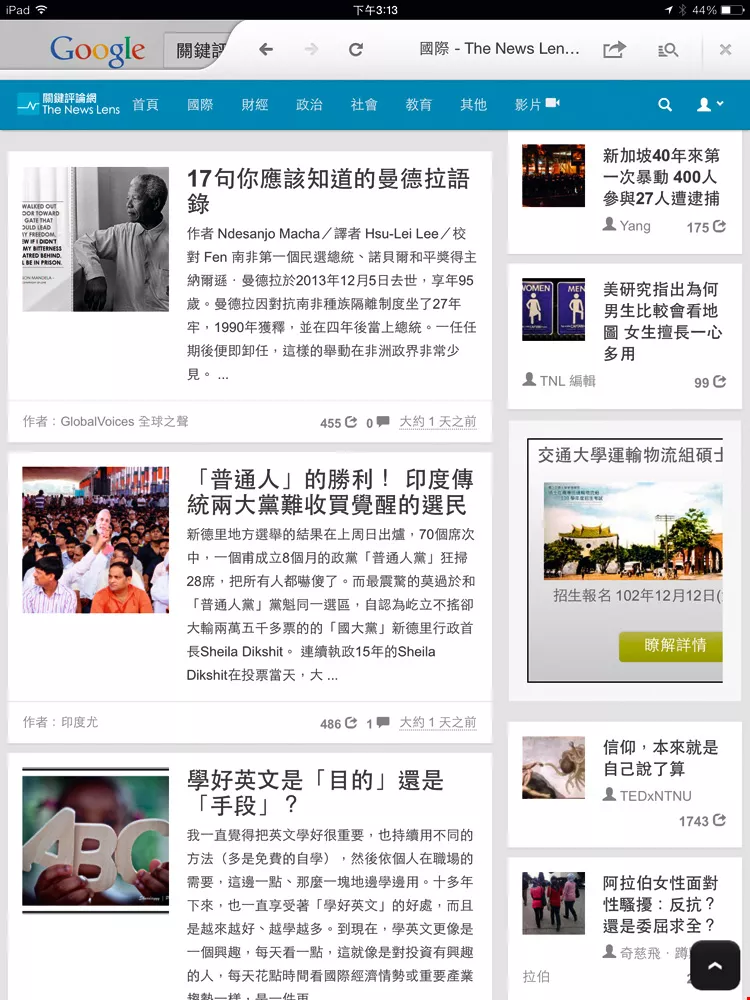
The design of The News Lens’s website is clean and uncluttered, in sharp contrast to that of most news sites.
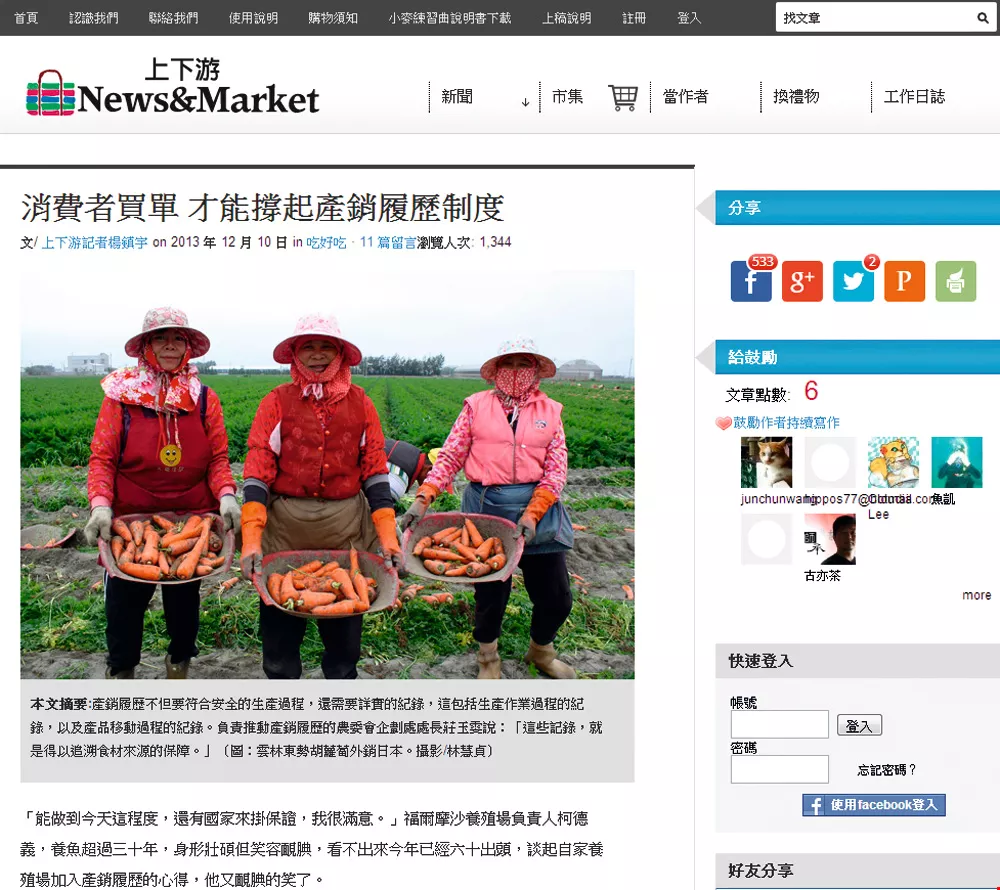
Launched in 2011, News&Market has already established its journalistic credibility.
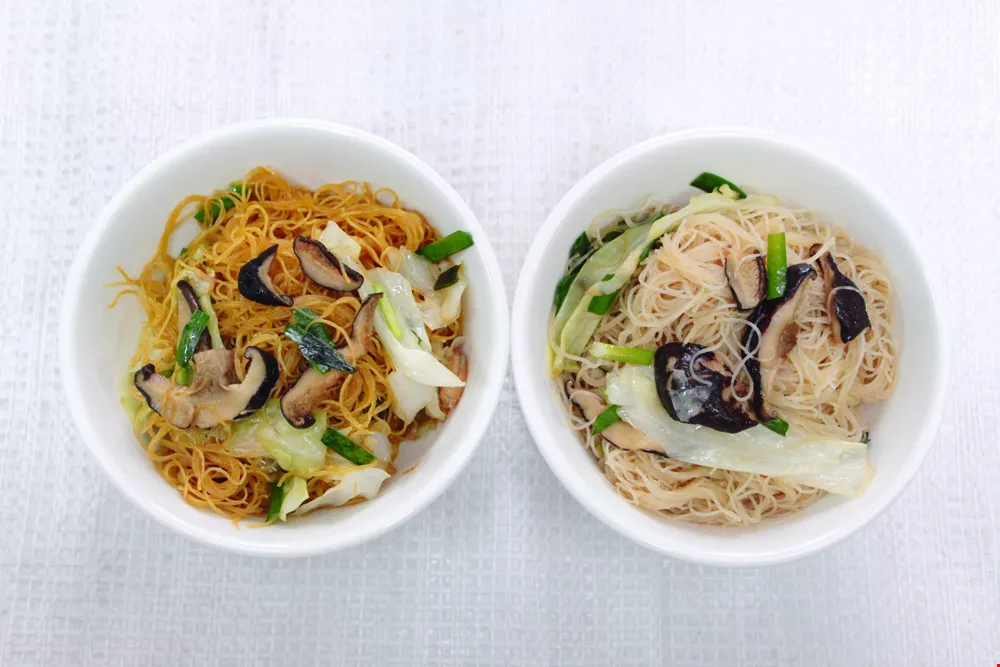
News&Market is tightly focused on food safety and has won accolades from the public for its treatment of issues ranging from where to find pesticide-free vegetables to “rice-less rice noodles” and drugs used to create leaner meats.
News&Market is tightly focused on food safety and has won accolades from the public for its treatment of issues ranging from where to find pesticide-free vegetables to “rice-less rice noodles” and drugs used to create leaner meats.
1.jpg?w=1080&mode=crop&format=webp&quality=80)
More than 100 writers contribute to The News Lens. The website offers both news and commentary, and its pieces on social and educational issues, digital life and the job market have been particularly well received.
-11.jpg?w=1080&mode=crop&format=webp&quality=80)
More than 100 writers contribute to The News Lens. The website offers both news and commentary, and its pieces on social and educational issues, digital life and the job market have been particularly well received.

@List.jpg?w=522&h=410&mode=crop&format=webp&quality=80)


