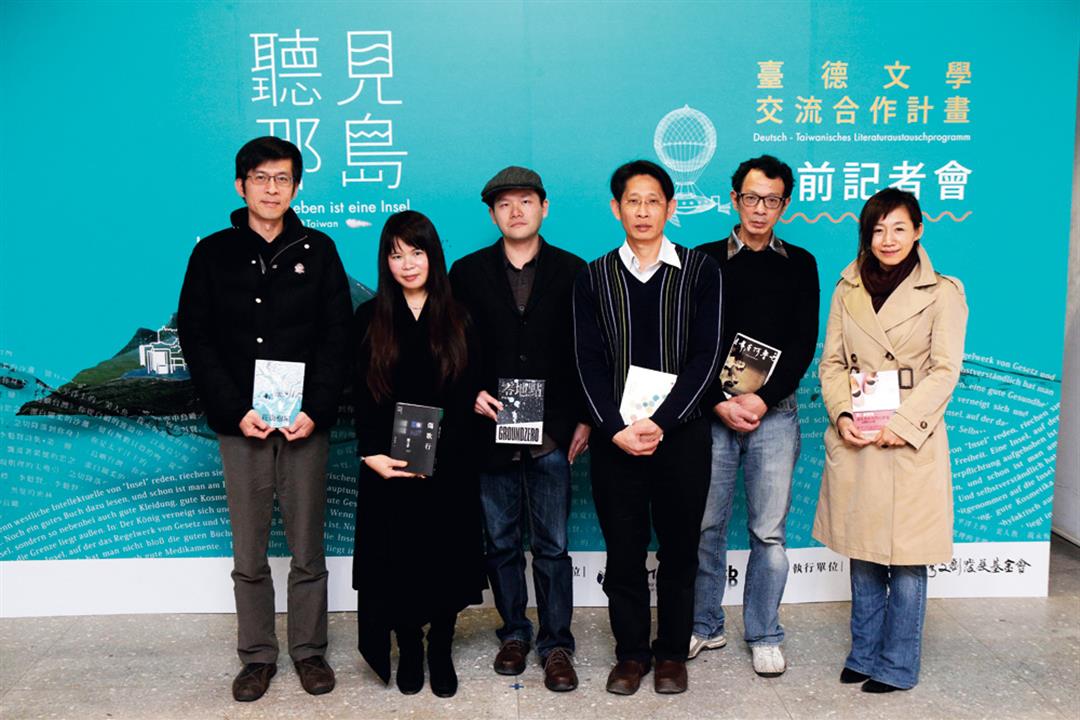
Taiwan’s literary exchanges with Germany are set to take another step forward in March when authors Chung Wenyin, Hao Yu-hsiang, and Ho Chingbin travel to Berlin to take part in a literary exchange. The writers will participate in a number of events and activities while in Germany, including a reading of selections from their work at the Leipzig Book Fair, which opens on March 12. This event will offer European book lovers an introduction to Taiwanese literature within the context of contemporary Chinese-language literature.
In June 2014, the ROC Ministry of Culture (MOC) and the Literarisches Colloquium Berlin (“Berlin Literary Colloquium”) signed on to an exchange plan that will send three Taiwanese writers per year to Berlin for a writer-in-residence exchange program. The program is slated to run for three years, from 2015 to 2017. Chung Wenyin, Hao Yu-hsiang, and Ho Chingbin will inaugurate the program. Egoyan Zheng, Badai and Li Chinwen will follow in 2016, and Lan Po-chou, Ho Chih-ho, and Rob Lo will bring down the curtain in 2017.
The nine authors selected include fiction writers, essayists, and poets. They range in age from 30 (Lo) to 57 (He), with six of them having been born in the 1960s. Though they themselves span genres and generations, their work shares a unifying theme: the literary representation and evocation of Taiwan. The MOC hopes that the writers’ participation in the program and associated reading events will help forge new connections between literary circles in Taiwan and Europe.

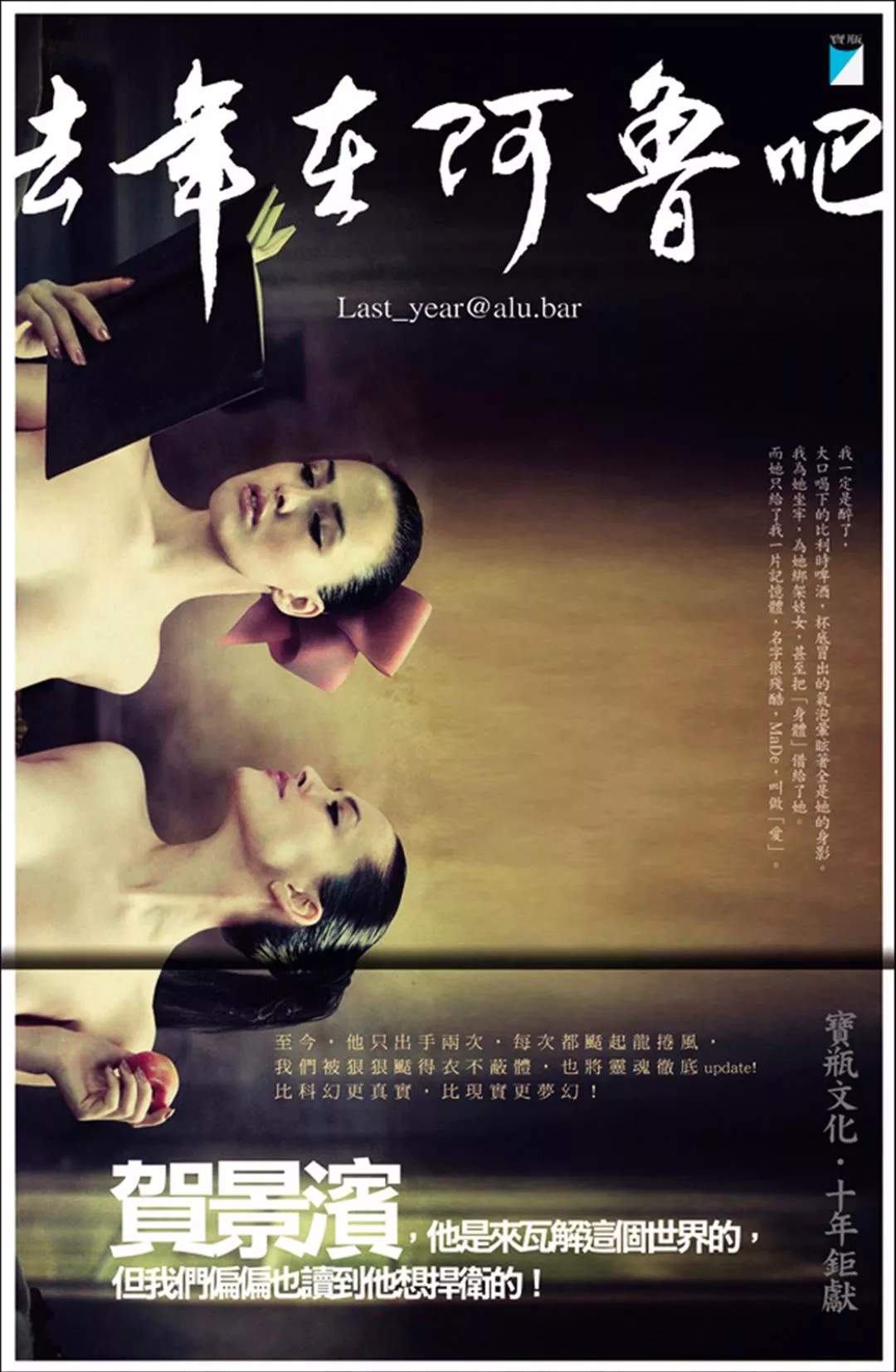
Ho Chingbin's Last_year@alu.bar.
This literary exchange is particularly important because Germany is at the heart of European Sinological research, and its scholars have long been fascinated by literary depictions of Taiwan’s open and diverse society.
Germany also happens to be home to Europe’s largest and the world’s third-largest publishing market, and releases some 6,500 volumes per year. The MOC therefore believes that success in the German market would provide Taiwanese writers with a foothold in the European and global markets. The key is getting their works translated and published there.
As founder of the Grayhawk Agency, Gray Tan has brought translations of many international bestsellers to Taiwan. He says that when you talk about literature in translation, the conversation always turns to Europe, where the market is far more receptive to translations than in the USA.
“Many Chinese-language writers have achieved international renown by first publishing European translations of their works.” Tan explains that releasing a translation in one of the major European languages enables editors in other nations to read a work for themselves, rather than relying on second-hand reports.
France is Europe’s leader in the publication of Chinese-language literature in translation. Early French editions of works by Taiwanese authors such as Kenneth Pai, Li Ang, Ping Lu, Wu He, and Wu Ming-yi sparked research into Taiwanese literature within the French cultural community.
In recent years, Taiwan has also sought to foster German interest in Chinese-language literature through author exchanges and the translation of works.
One such effort, the 2009 publication of German translations of Taiwan Dangdai Xiaoshuo Xuanji (“Contemporary Fiction from Taiwan”) and Taiwan Xiandai Shi Xuanji (“Modern Poetry from Taiwan”) by the Council for Cultural Affairs (now the Ministry of Culture) and the Taipei Book Fair Foundation, succeeded in catching the eye of European readers and publishers at that year’s Frankfurt Book Fair.
The German edition of Contemporary Fiction from Taiwan included works by the likes of Zhang Dachun, Chu Tien-wen, Luo Yijun, Hu Shu-wen, Hao Yu-hsiang, Egoyan Zheng, Chung Wenyin, and India Cheng. Günter Grass, the Nobel-Prize-winning author of The Tin Drum, reportedly loved the collection, having devoured it the moment it came out.
Dieter Stolz, the Berlin-based literary critic who edited the German edition of Contemporary Fiction from Taiwan, argues that reading fiction is the only option most foreign readers have for getting to know Taiwan in depth. He therefore suggests that Taiwan step up its promotion of author exchanges and literary translations.


Founded in 1963 with the goal of providing a forum for exchanges among authors, translators, critics, and publishers from around the world, Literarisches Colloquium Berlin has been crucial to the promotion of Taiwanese–German literary exchanges. The organization signed its first cooperation and exchange agreement with the Council for Cultural Affairs in 2009.
The resultant program ran from 2010 to 2012, sending nine Taiwanese authors to Germany for a month each. The authors were Syman Rapongan, Tsai Su-fen, Kan Yao-ming, Yen Hung-ya, Wu Ming-yi, Wu Yinning, Lai Hsiang-yin, Chen Ko-hua, and Liu Ka-shiang. Literarisches Colloquium Berlin also selected several German translators to visit Taiwan during the same period. The program’s success encouraged the Ministry of Culture and LCB to agree to a follow-on exchange program in 2014 covering the years 2015–2017.
For this second round of exchanges, the MOC solicited opinions from the German translation community and publishers. It learned that the Germans were most interested in contemporary fiction portraying urban and rural life in Taiwan, and in works exploring Taiwanese themes and the Taiwan–China relationship in depth.
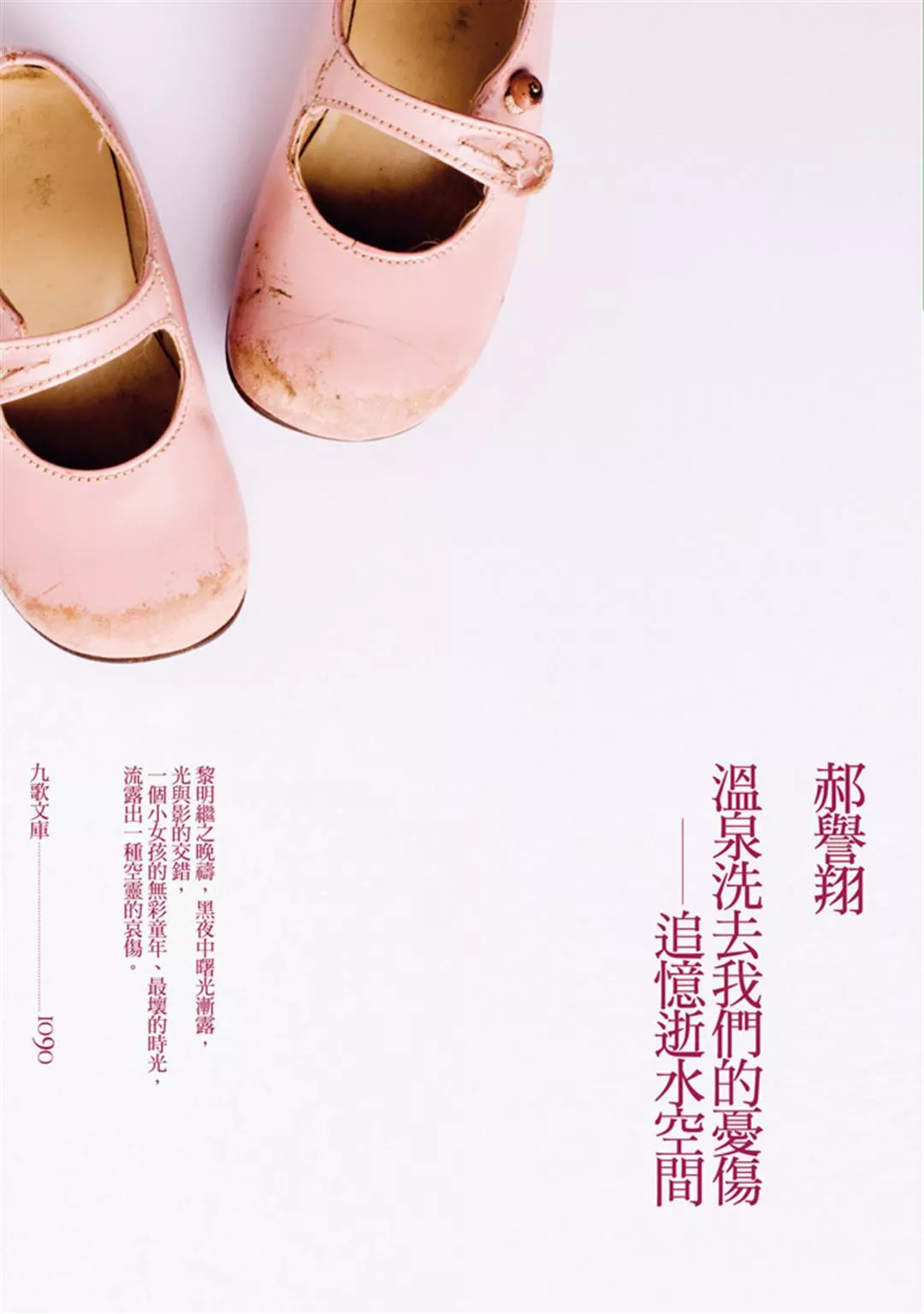
The three authors participating in this year’s exchange have already selected works for abridged translation into German. They include Zhong Wenyin’s Bingshen de Yihan (“The Cake Master’s Regrets”), He Jingbin’s Last_year@alu.bar, and Hao Yu-hsiang’s Wenquan Xi Qu Women de Youshang (“Hot Springs Wash Away Our Sorrows”). The translations will enable the writers to introduce European publishers to their individual work and to the “flavor” of contemporary Taiwanese literature in general.
In addition, the Germans will send exchange participants to the Leipzig Book Fair this year to meet European readers in person and, for the first time, to read from their works.
The writers’ attendance at the fair and their involvement with other networking activities will put them in direct contact with European publishers, enabling them to elaborate on Taiwan’s democratic society, urban lifestyle, and cultural touchstones. On returning to Taiwan, they will be able to open Taiwanese readers’ eyes to the larger world by sharing their exchange experiences at conferences and symposia.

Hao Yu-hsiang's Wenquan Xi Qu Women de Youshang (“Hot Springs Wash Away Our Sorrows”).