Pacific Islands on the Front Life of Environmental Change
Chen Hsin-yi / photos Chuang Kung-ju / tr. by By Scott Williams
October 2010
In December 2009, the Tuvalu representative of the Alliance of Small Island States addressed the Copenhagen climate summit on behalf of AOSIS's 43 members (one-third of which are located in the Pacific), presenting the summit with an alternative, more stringent proposal for reducing greenhouse gas emissions, one which called for reducing the targeted ceiling on global warming from 2° Celsius to 1.5°C. Though the members of the alliance left in protest after their proposal was rejected, the event introduced many in the larger world to the beauty and concerns of the world's island nations for the first time.
People say that islands enable you to think about the fundamentals of life because they give you the sense of existing at one with nature, of the interweaving of life's magnificence and insignificance, of its wonders and challenges. The environmental issues facing the Pacific islands provide those of us living in the "civilized world" with an opportunity to consider the problems that mass consumption and the promotion of development are causing. These issues also encourage a growing consciousness of our "transnational life community."
This issue's cover story first describes the threat that global warming and environmental change represent to the development and even survival of the Pacific's island nations, then delves deeper, examining the difficulties faced and countermeasures offered by two of Taiwan's important diplomatic partners-Kiribati and Tuvalu.
The Pacific's island states include three large island groups located south of the Tropic of Cancer: Polynesia, Micronesia, and Melanesia. With the exception of the large island of New Guinea, the thousands of islands in these groups consist of either atolls or islands of volcanic origin. Where the latter are graced with rich soils and abundant resources (examples include the Hawaiian Islands and the Solomon Islands), the former are resource poor, a circumstance that has constrained their inhabitants to a thousand years of tribal-style economics.

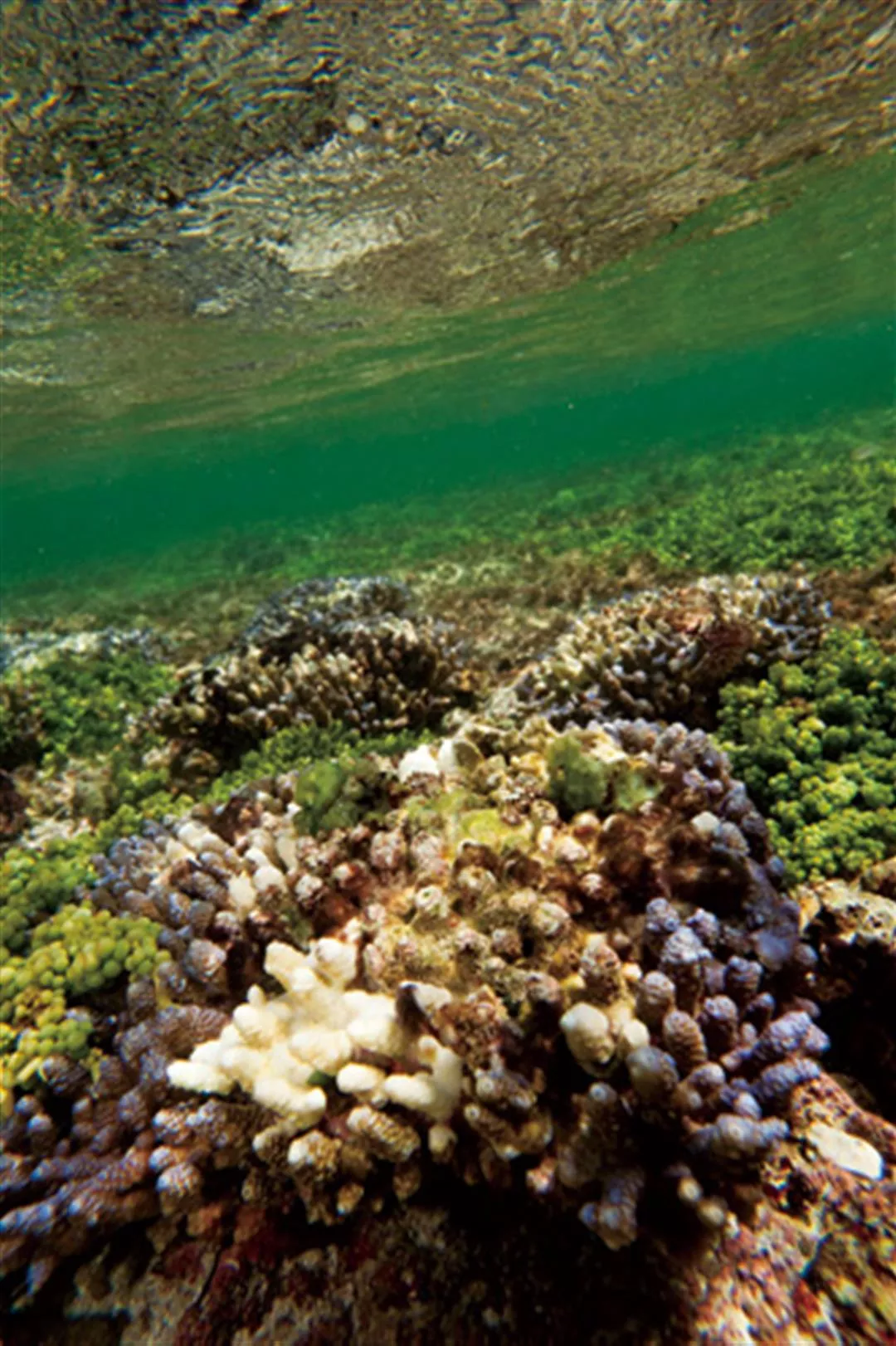
Global warming seriously threatens reef ecosystems, destabilizing the foundaation of life on the Pacific islands. The coral in the photo is Acropora, which grows in six meters or less of water and is one of the principal constituents of shallow reefs. The Acropora here is already beginning to suffer from bleaching.
Viewed from above, atolls are either circular, hook-shaped, or long and narrow. Their distinguishing features include an elevation of less than five meters above sea level, limited land area, and their reef detritus and sand composition, which supports only plants tolerant of high temperatures and persistently strong winds such as palms and screwpines. Only the largest of the atolls retain fresh water.
For these reasons, traditional island life is entirely Nature-dependent. The coconut palm, the "life tree" that all Pacific islanders of both sexes learn to scale at an early age, illustrates the point in a nutshell. Islanders drink coconut water, which contains sugar, protein, vitamin C, calcium, phosphorus, and iron; ferment juice from the buds of coconut flowers to make an alcoholic beverage; eat coconut meat fresh, or process it into coconut paste and coconut milk; use dried coconut shells to fuel their fires; and utilize sturdy palm logs as building supports and palm fronds as roofing materials.
Between the 16th and 20th centuries, Europeans (British and French) and later Americans colonized the Pacific islands. The colonizers were interested in the region's natural resources (e.g. white sandalwood, pearls, sea-turtle shells, and seafood products), and for its strategic (military and trade) significance. The Allies and Japanese fought fiercely over the islands during World War II. Christian missionaries also played an active role in the region, rewriting the pantheistic and naturalistic religions of the islanders.

A satellite photo of the Pacific atoll of Nukuoro.
When the power of the colonists began fading in the 1970s, the Pacific islands under colonial rule and UN trusteeship began moving towards independence. At the present time, the area holds 14 sovereign nations and 13 territories governed by other nations, that have in common their small land masses and tiny populations (see Table 1). Nauru, the world's third-smallest nation, is the littlest of the lot with just 14,091 people living on 21 square kilometers of land. Small and resource-poor, many of these island nations rely on foreign aid to prop up their national treasuries and deliver public services.
Stephen Lee, former deputy director of the Technical Cooperation Department at Taiwan's International Cooperation and Development Fund, says that small, developing island nations share the following developmental difficulties:
(1) Distance and isolation
Small, developing island nations are typically archipelagos scattered across remote areas of ocean. They are located far from the resources of the developed world and face high transportation costs. For example, passengers and cargo traveling to the Pacific islands from "nearby" Australia or New Zealand must first spend three to four hours in the air to get to Fiji, the gateway to the South Pacific. From there, they have to transfer to smaller planes that fly only two to three times per week to reach their destinations. The islands' remoteness and tiny economies have made it all too easy for the international community to marginalize them.
(2) Insufficient product diversity
Many of these small nations' economies are entirely dependent upon a single product, such as coconut oil or sea cucumbers, leaving them exceptionally vulnerable to changes in the environment or the market. Even though these nations control broad swathes of sea (see Table 1), many can only levy fees on Australian, Japanese, Taiwanese, and Korean fishing vessels to supplement their finances, or seek employment for their citizens on these foreign boats. In either case, the vast majority of their populations continue to provide for themselves via primary production in agriculture, forestry, or fishing, living in circumstances reminiscent of ancient agricultural or hunting villages.
(3) Inefficient public agencies
These nations' populations are scattered across multiple islands and it is impossible for their governments to deliver public services such as healthcare, education, water, and power to every island. Many donor nations have now concluded that training personnel and increasing government efficiency are crucial to improving conditions in the islands.
The islands of the Pacific have a long history of using regional cooperation in politics, culture, and education to overcome the difficulties posed by their small size and remoteness. Tsay Chung-han, a former legislator and the director of the Taiwan Indigenous Professor Society, regularly visits the islands of the Pacific on cultural missions. He notes that the region has been holding the Pacific Games, sometimes referred to as the "mini Olympics," every four years for nearly 50 years. The games, which stress fun and camaraderie, are like a Pacific islands version of Carnival. The University of the South Pacific further highlights the region's tradition of cooperation. The university's Fiji campus, which offers programs in education, travel, agriculture, and environmental management, serves as an educational resource for 12 island nations. The university also has a School of Law on Vanuatu and a School of Agriculture and Food Technology on Samoa. On the political front, the similarity of the islands' histories and social conditions has since the 1970s fostered an awareness of themselves as a kind of "Pacific Community."

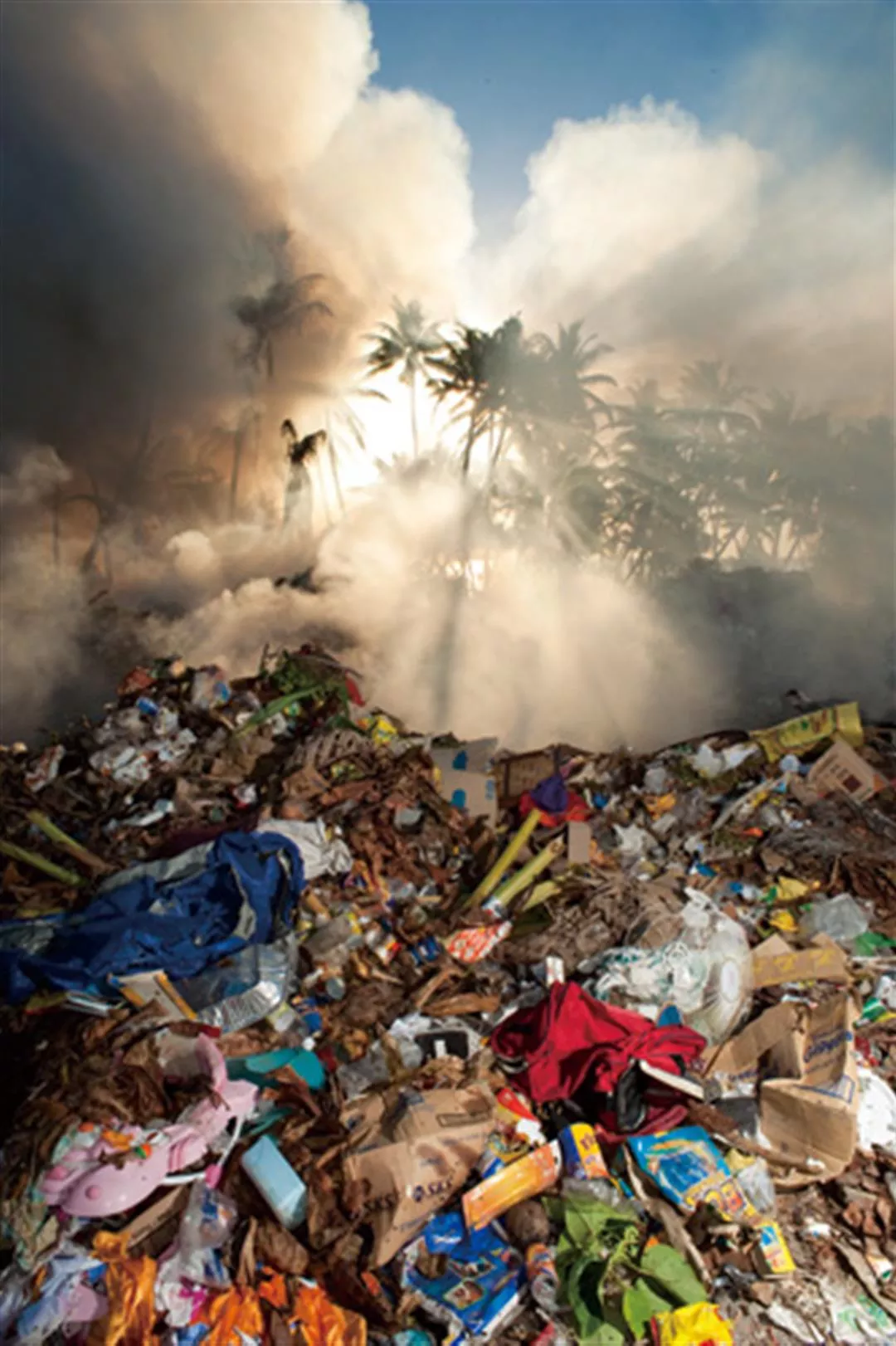
Neck-deep in trash! At the landfill on Funafuti, the site of Tuvalu's capital, the mountain of trash by the beautiful oceanscape is garowing at an exponential rate, viscerally demonstrating how the globalization of capitalism is eroding the environment.
For the last 20 years, the Pacific's island nations have struggled with modernization and changing lifestyles, and have suffered even more keenly from related environmental problems. A 1998 report by Global Environmental Change and Human Security entitled "Environmental Change, Vulnerability and Security in the Pacific" describes the region as facing three different environmental crises:
(1) Resource exploitation
The pressure to grow the economy (especially as population growth eats into economic gains) has accelerated the islands' exploitation of their natural resources, resulting in environmental degradation. For example, rainforest coverage on Pacific islands has fallen rapidly as a result of excess logging. This in turn has led to soil erosion, flooding, and species loss.
In addition, competition among foreign powers for economic and political perks, the need of the local governments to expand revenues, and the actions local governments have taken under pressure have not only failed to generate win-win situations but have frequently also extracted brutal environmental and human costs.
Bougainville Island in Papua New Guinea provides a well known case in point. In the late 1960s, the Australian colonial government granted a private Australian mining company a concession to build the world's largest open-pit copper mine. After independence in 1975, the PNG government continued the concession and thereafter took a completely hands-off approach to environmental management. Not only did copper mining come to dominate the island's economy and provide the government with 20% of its revenues, it also led to severe pollution of the Jaba River and the ocean, loss of forests, and social unrest. The mine shut down in 1989 after secessionists attacked it, but it left the environment and a shattered community in urgent need of restoration.
Nuclear weapons testing and the dumping of nuclear waste by Western powers in the last century represent the region's most extreme examples of environmental exploitation. The Great Powers saw the remote and sparsely populated Pacific atolls as uniquely well suited to such activities. The United States carried out the first of the Pacific-island weapons tests on Bikini Atoll in 1946. It continued testing weapons there for 12 years, forcing the islanders to relocate twice and afflicting many with radiation sickness. The region's last recorded test (the 188th!) was carried out by the French in 1996 on Moruroa Atoll, a French territory.
(2) Trash
Rapid urbanization, population growth, and, in a few places, industrialization, have made waste disposal another pressing regional issue. They have also highlighted the Pacific islands' lack of environmental governance. The islands have no mechanisms in place for monitoring environmental impacts, nor for overseeing the importation, use, and disposal of dangerous chemicals. Ordinary citizens are consuming canned foods, using plastic utensils, driving cars, and riding motorcycles oblivious to just how little environmental carrying capacity their islands have.
Ironically, large imported items like electrical appliances, cars, machinery and computers quickly rust and/or break down in the region's humid, salty conditions. Since the islands also lack the parts, tools, and skills to effect repairs, breakdowns are permanent, turning these items into toxic trash that the islands are ill equipped to recycle. Even though the situation has improved in recent years as Australia, New Zealand, and Taiwan have provided island governments with recycling concepts and techniques, the capital cities of these island nations remain disfigured by mountains of trash that will take time to bring down.
(3) Climate change
Atmospheric scientists have been publishing reports on global climate change and forecasts of rising sea levels since the 1990s. These are clearly the most vexing of the islands' environmental challenges.
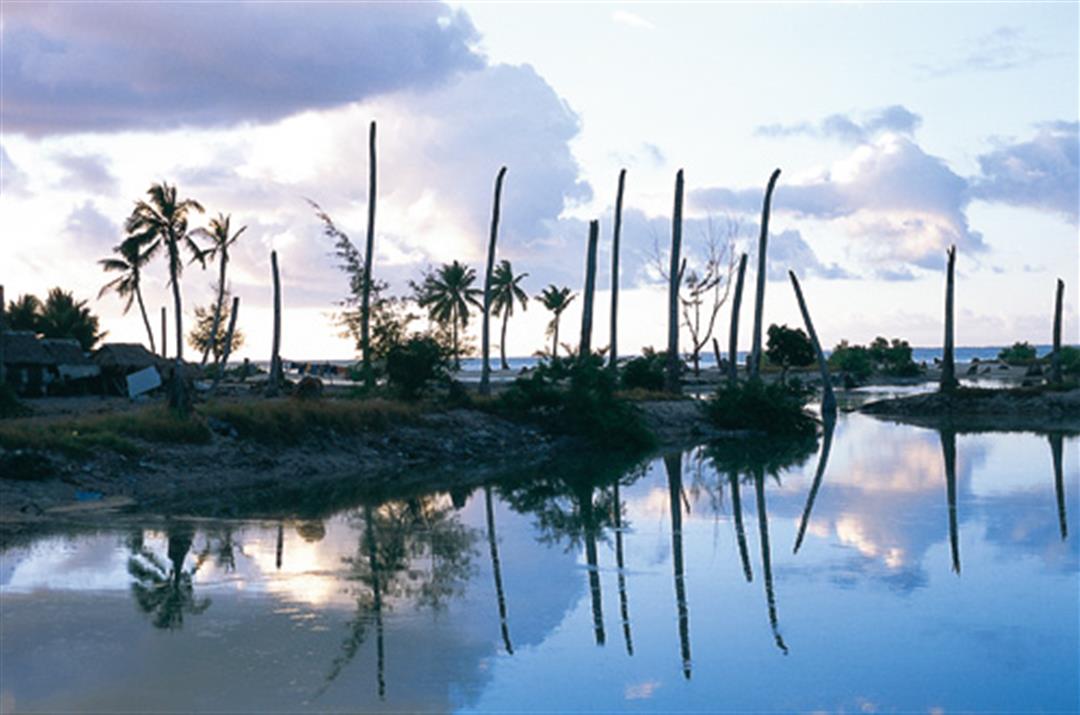
Let's first look at rising sea levels. Because coral atolls sit at an average of less than five meters above sea level, they are likely to suffer severe consequences from a rise in sea levels. These include coastal erosion, the disappearance of the mangrove trees that protect the shore, reductions in the amount of arable land, and saltwater intrusions into aquifers.
In addition, the newest report from the Intergovernmental Panel on Climate Change, released in March 2009, forecasts that average sea levels will rise by more than one meter by the end of this century. The prospect of "drowned islands" serves as a powerful warning on the effects of global climate change.
But Liu Tzu-ming, an assistant professor in the Department of Tourism and Hospitality at Taiwan's Kainan University and an expert in the management of ecological resources, says that sea-level forecasts have long been a subject of heated debate within the scientific community and notes that there are several models in use. For example, one model suggests that snowfall in the Antarctic is likely to increase, ameliorating the rising sea levels expected to result from rapid melting in the Arctic. Meanwhile, a 2010 study argues that gravitation is actually causing sea levels in the Pacific to fall.
Rather than getting hung up on whether sea levels are rising or falling, perhaps the top priority should be to deal with the immediately apparent effects of climate change, such as the increasing strength and frequency of wind and waves, changes in rainfall patterns, which are reducing the capacity of soils to retain water, and acidification of the oceans, which is resulting in coral bleaching and death. The last is particularly relevant to islanders, who live in a symbiotic relationship with the sea. When coral dies, the islands lose a natural protective barrier, allowing large waves to sweep in unobstructed. Collapsing reef ecosystems also cause dramatic declines in populations of the large predatory fish that feed on reef fish. This directly impacts the foundations and food security of these fish-dependent island nations.
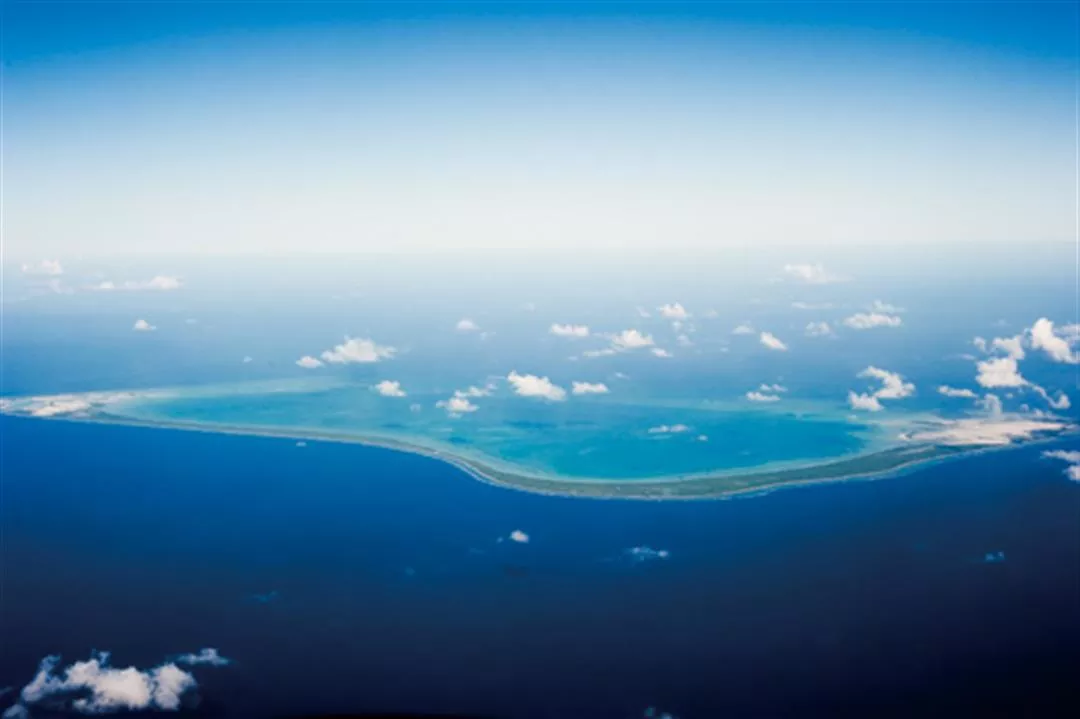
In this aerial view of Tarawa, Kiribati's second-largest atoll and the site of its capital, the light-blue inner circle is the lagoon, the deep blue outside it is the ocean, and the winding, ribbon-like strip between is the beautiful, fragile island itself. Tarawa has an average height above sea level of just 2 meters.

The Pacific islands have the world's lowest carbon emissions, but are facing the most severe consequences of global climate change. No wonder Kiribati president Anote Tong was very critical of this injustice during our interview: "Large nations argue that emissions reductions would impact their economies and increase poverty. But those of us from small island nations aren't talking about our economic well-being, we're talking about our survival as a nation and as a people."
Island nation leaders agree that the "relocation" of their populations is the last, worst option. Prior to seeing it implemented, they intend to do their utmost to protect their land. "It is a matter of maintaining our sovereignty and protecting our cultural identity," said Apisai Ielemia, Tuvalu's most recent prime minister, during an April 2010 visit to Taiwan. (Reelected to the parliament in September 2010, Ielemia is in the process of forming a new government and is likely to again serve as prime minister.)
On the plus side, the Pacific islands, which have a long tradition of cooperation, began mobilizing on climate change issues in the late 1980s. They established the Pacific Island Forum, the region's most important international organization promoting political and economic development. The islands have also, in cooperation with Australia, New Zealand, France, and the United States, formed the Secretariat of the Pacific Program on the Environment, which works on issues related to food security, water resources, and the protection of coral reefs. The region has also been active via the Alliance of Small Island States, and never foregoes the opportunity to speak at international conferences and forums.
Kiribati will host its first international conference on climate change in October. More than 30 nations from both within and without the region are expected to attend what is being regarded as a warmup to the UN climate conference taking place in Cancun, Mexico, at the end of the year. "There has to be an honest exchange of views," says Anote Tong. "We can agree what can and what cannot be done, what should and what need not be done. It's ambitious, but it's got to be done."
Are we going to take them up on their request?
| Nation | Land arer (km2) | Population | Exclusive economic zone (000 km2) |
| Nauru | 21 | 14,091 | 320 |
| Tuvalu | 26 | 12,177 | 900 |
| Marshall lslands | 181 | 56,000 | 2,131 |
| Cook Islands | 240 | 18,000 | 1,830 |
| Niue | 259 | 1,591 | 390 |
| Palau | 488 | 20,278 | 608 |
| Federated States of Micronesia | 701 | 107,000 | 2,978 |
| Tonga | 747 | 101,000 | 700 |
| Kiribati | 810 | 92,533 | 3,550 |
| Samoa | 2,935 | 177,700 | 120 |
| Vanuatu | 11,880 | 202,000 | 680 |
| Fiji | 18,272 | 819,000 | 1,300 |
| Solomon Islands | 28,369 | 490,000 | 1,340 |
| Papua New Guinea | 462,243 | 5,500,000 | 3,120 |
table by Tsay Chung-han
sources: ADB Statistics, 2004; World Bank Report, 1989:230; Pacific Economic Bulletin, NCDS, 1989:44; Land Issues in the Pacific, ed. Ron Crocombe and Malama Meleisea, Macmillan Brown Center for Pacific Studies, University of Canterbury and Institute of Pacific Studies, USP, 1994; Secretariat of the Pacific Community, 2006
(The nations listed above conduct their censuses in different years. Population figures are therefore only approximate.)