We Have Overcome! Restrictive Labor Laws Finally Amended
Chen Hsin-yi / photos Chuang Kung-ju / tr. by Phil Newell
June 2011


On International Workers Day (May Day) of 2011, there were not only the usual marches by laborers but also something much more novel: Several trade unions in non-traditional industries decided to formally establish themselves on that day. They included the Taiwan Telecommunication and Network Trade Union, the Taiwan Electronics and Information Industry Trade Union, and the Carre-four Enterprise Union. In addition, preschool education workers and nurses in various locations also declared on that day their intention to form labor confederations out of existing local unions, while teachers and social workers announced plans to start organizing.
Why choose May 1? It was not merely for the symbolism! It was also because this was the day when the newly amended versions of the so-called "three labor laws"-the Labor Union Act, the Collective Bargaining Agreement Act, and the Settlement of Labor Disputes Act-formally came into effect. With these reforms, for which labor organizations had been fighting for many years and which could be considered "late, but better than never," workers are able to organize or join unions with greater freedom and more protection, while labor-management relations in Taiwan should move into a new era in which collective bargaining will be central.
For the officers of the union at the Shu-lin store of the hypermarket chain Carre-four, Sunday, May 1 of this year was especially meaningful. At 10 a.m., more than 30 employees from seven Carre-four branches all over the Tai-pei metropolitan area met together to announce the birth of Taiwan's first-ever "enterprise union" in a high-volume retail business. Around midday, towing along a group of fresh new union members (including quite a number of young hourly-wage workers), they joined a May Day parade, shouting slogans like "Resist exploitation!" and "Solidarity!" After the march, several of the union officers stayed behind in an office borrowed from the Taiwan Railway Labor Union to draw up documents recording the minutes of the morning's meeting and the results of elections. Finally, in the wee hours of Monday morning, they rushed off to the Council of Labor Affairs for a stamp ensuring they would be first to be served when the CLA offices opened (just in case someone tried to preempt them by forming a pro-management union!) and formally delivered their documents at 8 a.m.
Chen Mingde, a key figure in the union at the Shu-lin branch of Carrefour, explains that their union was organized last June, and its founders waited with great anticipation for the coming into effect of the newly amended labor laws in May of this year, because these finally lifted former restrictions that prohibited people from organizing enterprise unions that include more than a single shop or factory floor, or that include people in more than one local government jurisdiction. "This way we can transcend the level of just a single store," says Chen, "and demand that the corporate headquarters come forward and negotiate with us. Also, the rights and benefits that we win will be applied in each and every branch."
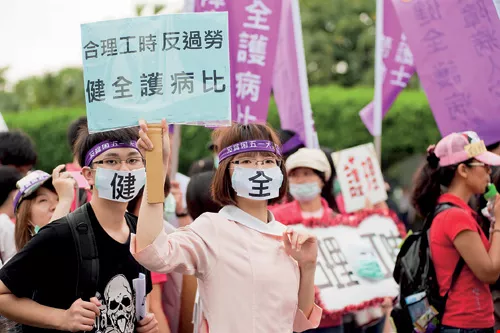
Just because your job is to take care of others doesn't mean you can't look after yourself! Nurses have taken to the streets for the first time in an effort to defend their rights as laborers.
The 51-year-old Chen, who has been employed at Carrefour for seven years, got transferred to the security department three years ago, and became a security guard. His starting salary (including a meal subsidy of NT$1800) was only NT$28,000 per month, and has never been raised at all.
Chen explains that early on the company benefits were quite good. In fact the company was a model in the hypermarket sector. But in recent years, as a result of overly rapid expansion and intense competition, the firm has started to squeeze personnel costs. "They stopped hiring replacements when full-time employees left, and only hired new employees on an hourly-wage basis, while the extra work was piled onto the backs of the remaining full-timers and there was no overtime pay for putting in extra hours." Seeing the company become ever more ruthless in its exploitation, he says, "The idea behind forming the union was just to try to communicate to the comp-any the rights we thought we deserved."
Seeing Chen as an influential opinion leader, last October the company fired him, saying he missed six days of work and insulted his superior. With help from an attorney with the National Federation of Independent Trade Unions, Chen filed several lawsuits, which are still ongoing. This assault on Chen's rights had the unintended effect of inspiring his co-workers, who had taken a wait-and-see attitude about jumping on the union bandwagon, to unite. "It was totally unfair!" a woman who is now a union official says angrily. "And to think that there are all kinds of lazy senior-ranking people who do nothing around the company who deserve to be sacked, while really responsible people work themselves to death. If we didn't stand up, who knows-maybe you'd be the next victim!"
Over the last year, the Shu-lin union has won a number of "concessions" which in fact simply require the company to restore rights that had been stripped from employees. For example, full-time employees now work seven hours a day for six days a week, thereby bringing the company into line with the legally mandated limit of 84 working hours every two weeks; there is now compensatory time off for overtime hours; "temporary" employees get special leave if they remain on the job for a full year; and pay is "double time" for national holidays. Now that the workers have an enterprise-wide union, they hope to work through the labor-management negotiation mechanism to win the establishment of a worker's welfare committee, trace and collect unpaid back overtime pay, increase meal subsidies, and make reasonable adjustments to the salary system.
"We hope that the company can change their mindset of trying to thwart the union at every turn. After all, from the experience of the Shu-lin store, there has been no impact on revenues in the whole year since the establishment of the union, and because of better benefits, the workers have better morale, so efficiency has actually increased!" says Chen.
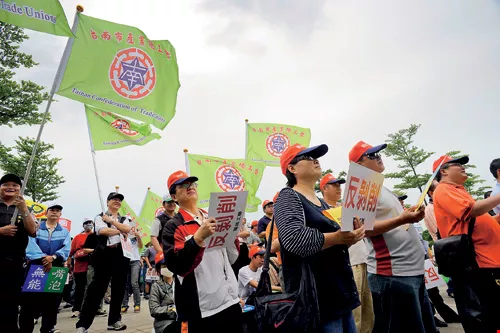
There are few young faces at meetings of traditional unions. Perhaps young people haven't been in society long enough to learn how important unions can be, but this is also a result of the fact that unions have made little headway into new industries, such as services. There could be a breakthrough in this situation when the new labor laws come into effect.
About two years ago, Mr. Zhang, a 36-year-old engineer in a well-known semiconductor manufacturer in the Southern Taiwan Science Park, got the same idea as Chen-"I really wanted to organize a labor union!" He recalls, "At that time the company laid off nearly 1000 people without any warning, including me, and tried to force everyone who got laid off to sign a voluntary resignation form [thereby excusing the company from various legal obligations]. I was one of the few to resist the threats and inducements, and one of only 10 people to insist that the company give us a certificate of non-voluntary departure."
After being laid off, Zhang quickly found another job, but continued to remain one of the most active members in the "self-help association" organized by himself and other employees laid off from his original company. After protests and negotiations, they won agreement from the company to give laid-off employees various options, one of which was to return to their original jobs. Zhang took this option. "The reason I came back had nothing to do with money. It was to organize a union to put the company on notice: Employees are not just puppets you can treat any way you want!"
However, it was no easy feat to find the legally required 30 people to form the union. "Of course the reasons are obvious-people were afraid the company would hassle them, that it would affect their future prospects. Even I had to stage a 'home revolution,' because my parents were initially opposed, and I had to win them over before I could really go ahead with forming the union without any hesitations."
Although progress in forming the union was harder than he had hoped, Zhang found support outside the company. Starting two years ago, the Labor Rights Association, which helped Zhang with his self-help association, created an online forum and conducted seminars, ultimately finding over 100 people who expressed their willingness to organize an industry-wide union, one of the new forms of organization now permitted by law. However, even these people were very cautious about revealing personal data, and for many months they only knew each other through pseudonyms used in the online forum.
On May 1, 33 founders (including Zhang) from all over Taiwan, working in many different firms and with many different occupations and job titles, finally gathered together. In their first year's work plan, the Taiwan Electronics and Information Industry Trade Union has listed a number of rather grand objectives, including: (1) a comprehensive reappraisal of the loopholes created in labor laws by the "responsibility system" of employment provided for in Article 84-1 of the Labor Standards Act, (2) a reassessment of the criteria used for determining "overwork" (a vital concern for persons seeking compensation when an employee has become seriously ill or died after working long hours), (3) monitoring the government to ensure that it devotes more effort to research into occupational hazards and their prevention, and (4) widespread and in-depth investigations into working hours and rates of pay in the industry.
Kao Wei-kai, a longtime behind-the-scenes labor activist who was elected as a county councilor in Hsinchu two years ago, emphasizes that "the bigger a union is, the more powerful it is." He also stresses that his colleagues have a lot to gain by pressing forward: "There are an estimated 210,000 workers in the science-based industrial parks around Taiwan; if the union can grow steadily to 2000 members, then to 20,000, its voice will carry a lot of weight."
He also suggests that labor not get divided into factions based on job titles and status. "There is little difference between an 'engineer' and a 'technician,' while there is an enormous gap between any employee and the chairman or CEO of a company. If you pay too much attention to the minor differences between employees, this will become an obstacle to maintaining unity in dealing with management."
A pillar of civil societyChiu Yu-bin, a former union official and now a researcher at a Kaohsiung-based union of NGO employees, observes, "In the past, workers in all professions and industries, no matter what their pay, and no matter whether employed in government or the private sector, faced hard going because the laws were very strict. They only got a chance to have their voices heard after some tragedy had happened. But now they can find strength through union organization."
In his view, in adopting action strategies new unions can initiate discussion about problems at the systemic level and prompt social dialogue. For example, preschool education workers' unions have already proposed creating public or community organizations to handle day care rather than leaving it all to the private sector, while the Taiwan Telecommunication and Network Trade Union has asked firms in their industry to bring outsourced contract laborers into the firm as formal employees. The new unions should also investigate and reveal rights violations at well-known firms, and ask these firms to uphold their corporate social responsibility. Through such tactics the unions can simultaneously raise their visibility and attract new members and supporters. Helping individual workers get their grievances resolved, though important, is only one part of a union's role.
Hong Qinghai, an advisor to the ROC Chinese Federation of Labor, has written in an article that although the revisions to the three labor laws have come into force, it is precisely at this time that labor is facing a very harsh larger environment. Globalization is leading to worsening structural unemployment, atypical employment (such as temps) is being used more and more extravagantly by businesses, and the distribution of wages is unjust. All of these challenges will be very difficult to tackle.
In such circumstances, the role of unions as pillars of civil society is even more pronounced. "Through the power of unions," Hong writes, "employment can be stabilized, income distribution can be made more fair and reasonable, and families will have more ability to engage in consumer, recreational, and educational activities, which will contribute to the development of the economy, culture, and society all at the same time."
Mere passage of a law does not make reality instantly different. The development of unions and their role in civil society is now in the hands of workers themselves, and their fate will affect us all.

@List.jpg?w=522&h=410&mode=crop&format=webp&quality=80)

@List.jpg?w=522&h=410&mode=crop&format=webp&quality=80)


