Two's a Company--Si Chi Ko and Jessie Fan
Yang Ling-yuan / photos courtesy of Si Chi Kuo / tr. by Scott Williams
April 2007
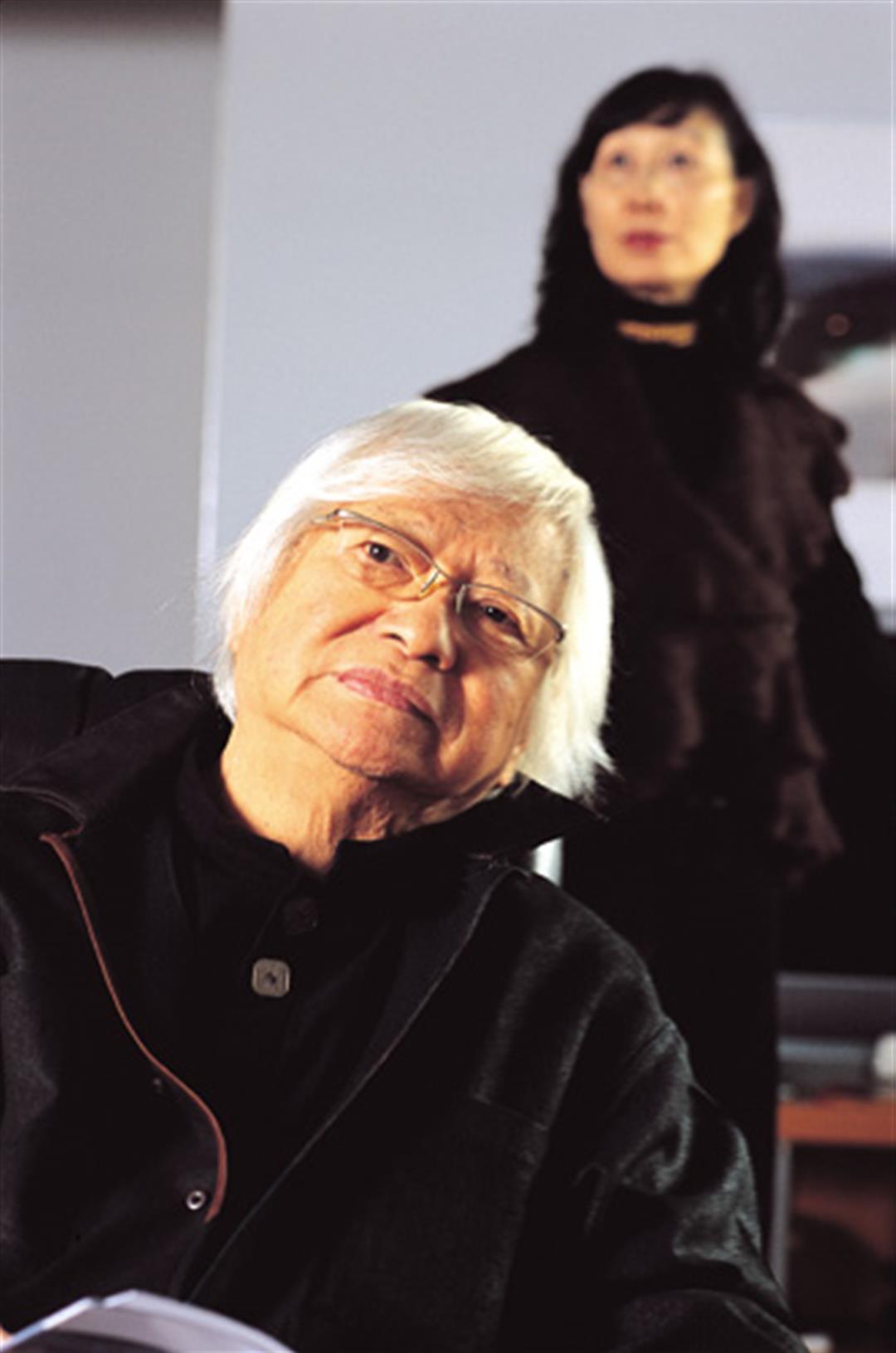
When photographer Si Chi Ko re-turned to Taiwan from the US 13 years ago, the quiet composition and terse-but-evocative style of his work intrigued the local arts community. In addition to his work, he also brought his wife, the New York dancer Jessie Fan, with whom he established a dance troupe called Ko & Dancers.
Fan had spent many years studying Dunhuang dance. She and Ko formed their dance company out of a desire to exploit Ko's visual sensibility and to hone's Fan's ability to interpret dance pieces inspired by and filled with a chan (Zen) aesthetic, as well as to pass on to other dancers the works she had made famous abroad.
In November 2006, Ko & Dancers published staged a 20-year retrospective of Fan's best work ranging from pieces inspired by the Dunhuang paintings to folktales about guardian deities. The retrospective combines Ko's photos with dance and voice-overs to introduce audiences to Fan's "Vu Shon" style.
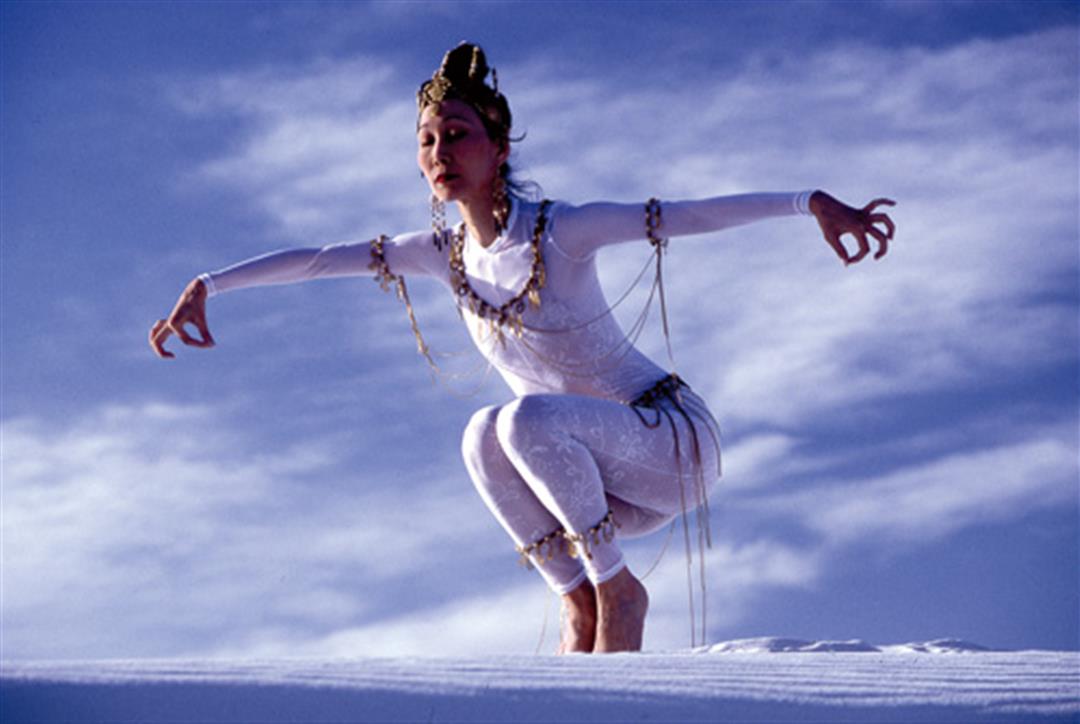
Resplendent in gold lace and accessories, Jessie Fan moves against a sky-blue backdrop like a flying demigod from a Buddhist text come to life on the stage. She twists her limbs and torso, forming the S-shapes that characterize Dunhuang-style dance to a Dunhuang-style tune by mainland Chinese composer Zhou Long, and stunning onlookers with her beauty.
While the whole of the dance is suggestive of the ancient Buddhist mural paintings of Dunhuang in northwestern China, the composition isn't as richly layered as that of the typical Dunhuang dance. In the piece entitled "Apsaras," Fan has done her utmost to keep the backdrops and movements simple. The choreography combines elements of Indian dance, yoga, and devotional gestures, but places more emphasis on facial expressions and graceful movements of the hands. She performs a beautifully realized interpretation of an apsara--a Buddhist flying spirit: One moment, she is curling and extending her slender lily-like fingers. The next, she looks like she is playing a flute as she presses her palms together in a devotional posture. The next, she is imitating a floating lotus.
Night falls and Fan becomes a young Minnanese woman dancing pensively in the moonlight to Nanguan music. In this piece, "Matsu Dance under the Moon," she casts aside the dazzling garb of the flying spirit and experiments with a completely new form that blends folk dance with martial arts. Here, an ordinary young girl named Lin Mo-niang trains herself spiritually until she escapes the mortal coil and becomes the Matsu of legend.
The retrospective, entitled "Vu Shon Apsaras," not only turns the audience's impression of Fan as strictly a Dunhuang dancer on its head, but also serves notice that her troupe is moving into the next stage of its development.
"This interaction with the audience has clarified my sense of where I want to take dance next," says Fan. As a choreographer, Fan believes that cutting extraneous movements eliminates distractions and heightens the purity and fluidity of the dancers' movements; she wants even the simplest of positions to immediately grab and hold the audience's attention.

When he married, Ko thought that he would wander Europe for a time after helping his wife achieve success. He had no idea how much she would end up helping him with his life and his work. "I was incredibly lucky," he says.
Admiring talent
Fan didn't begin creating her own pieces until she was past 30, but has been dancing solo for the 20 years since. In 2005, she took a break to have major surgery on her spine, not knowing if she'd ever dance again. But, having chosen to bear the risk of serious injury, she continues to dance, albeit carefully. Audiences watching her fluid movements on the stage have no idea of the stress she is under.
"The audience at this performance only saw 60% of Jessie Fan," says Ko with a note of sadness in his voice as he recalls his wife's struggles and pain. In fact, Fan has hardly danced at all over the past couple of years. In 2005, French publishers expressed interest in putting together a retrospective of Ko's 50-year career in photography. A chronicle of his life and work as a photographer came out the same year in Taiwan. Since Ko lacked a manager to oversee the projects, Fan took on the role of administrative assistant, giving up the troupe and her choreography while she collected and collated photographs and negotiated with publishers. Last year, she again took on administrative tasks, this time related to a 20th-anniversary dance performance, and was again left with virtually no time for her creative work.
"Now it's my turn to act as her manager," says the elderly Ko, his eyes still sparkling with life. "Next year, I'm going to help her devote all her energies to her creative work."
Ko believes that in addition to her consummate dance skills Fan has a natural aesthetic sense that turns her compositions into real works of art. He also remarks that her exceptional sense of rhythm enables her to move with the music in a way that makes her the best he's ever seen at realizing the beauty of a dance on the stage.
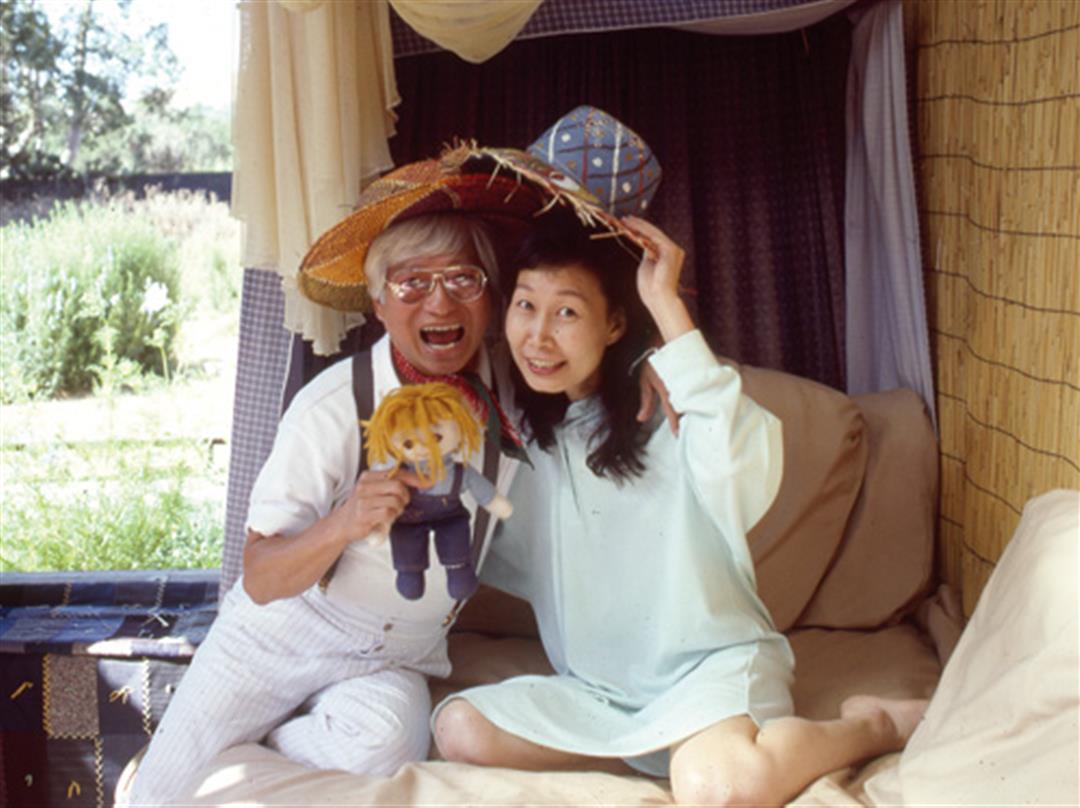
Though their ages differ by 24 years, Ko and Fan have enormous respect for each other's talents. They keep their love vital by continually pushing their artistic abilities to the limit; each admires the other's talent, and thus loves the other's person all the more.

When he married, Ko thought that he would wander Europe for a time after helping his wife achieve success. He had no idea how much she would end up helping him with his life and his work. "I was incredibly lucky," he says.
A tale of two pictures
"Our relationship is like that of the two snakes of the caduceus--we are intertwined and influence one another," says Fan. Her feelings for him are like those of a daughter for her father, of a friend for an intimate, and of a student for a stern teacher. She says it also includes a sense of having been recognized and valued, as well as spousal love. Interestingly, both were born in the Chinese zodiac's Year of the Snake, and when the subject of coincidences comes up, it gives rise to a story.
When Fan was 14, she reached a crossroads in her study of dance--she'd loved dance since she was very young, but was only allowed to study the then politically correct Chinese folk dance. She particularly despised the "joyful" smile you were required to plaster on your face for the length of these interminable dances.
"Why can't dance involve any other emotions," she wondered. She had just entered her rebellious teen years and was beginning to have doubts about her dream of becoming a dancer. In fact, she was on the verge of giving it up. But then she saw two photographs in the Central Daily News of a performance by Huang Chung-liang, a dancer trained in the US. Stunned by the tension and beauty of the dancer's body, she decided then and there that she would enter the Department of Dance at the Chinese Culture University (CCU). She now had a clear goal--she wanted to develop her own style of dance.

The call of the Silk Road
Fan studied ballet at CCU, and went on to join the Tani Momoko Ballet in Tokyo. But within the fantasy-like world of ballet, she gradually came to see her own "flaws." Though she rose to the rank of second prima ballerina with the company, she didn't have the small features and perfect proportions of the Western dancers; consequently, she would always be overshadowed on the stage regardless of how far she advanced her technique. She also had trouble getting visas to nations that did not maintain formal diplomatic relations with the ROC, causing her to miss out on many opportunities to perform abroad. Then, just as she began thinking about coming home, something apparently unrelated to her dance career transformed it: In 1980, the mummy of an ancient queen of Loulan was discovered in Xinjiang, triggering widespread interest in the Silk Road in Japan.
"It worsened my doubts about my career," she says. "Why was Western ballet the only choice available to Chinese people?" She wanted to visit Lanzhou to seek out the Chinese dance community, but instead soon found herself back in Taiwan where she unexpectedly met Ko.
While it was love at first sight for Ko, Fan at first simply regarded him as an elder. It wasn't until they started talking about dance and the arts that she began to appreciate his tremendous accomplishments and broad perspective. She couldn't help but develop respect for him, especially when she noticed that the people around him included the leading lights of literature and the arts--photographer Daniel Lee, painter Hsiao Chin, and dancers Huang Chung-liang and Lin Hwai-min, to name but a few.
"It was just like that," she recalls. "For the first month I knew him, I wanted to talk to him every day" She was shocked to find that this man who'd never seen her dance completely understood where she was coming from. When he told her that a dancer should perform her own style of dance, not that which the audience wanted to see, it was as if he'd peered into the innermost reaches of her mind and awakened the dreamer inside.
Still more startling was seeing in his room those two photos of Huang Chung-liang that had so influenced her youth. It turned out that Ko had shot them himself!
"Every time I recall the circumstances, I think that our love was fated," she says. "It really was as if there was an invisible red thread drawing us together."

Fan's Apsaras integrates elements of Dunhuang dance, the dances of minority groups in the Dunhuang area, yoga and Buddhism into a dance with a uniquely Chinese flavor.
Dance photography
Ko, who last year won the National Award for Arts, has been called Taiwan's leading modern photographer. It has been said that his work perfectly blends the poetic with the painterly. His life too has been anything but ordinary: He was born into wealth in Tainan in 1929, when Taiwan was under Japanese rule; saw his family fall on hard times, experienced the ravages of war, and even deserted from the military. His first opportunity to study photography formally in Japan didn't come until he was 30.
As a child, Ko traveled Taiwan with his wet nurse, who was then the leader of Tainan's largest Taiwanese Opera company. The experience exposed him to the rich and varied life of performers and sparked his interest in the performing arts. Ko left the military and picked up a camera at the age of 27. The richest of his early work shows the members of a theatrical troupe both on and off the stage experiencing life's joys and tragedies, and garnered the attention of Japan's photographic community.
He worked as a photographer for many years, but never forgot his love of the performing arts. While in Japan, he attended a performance by a famous Russian ballet company. Impressed by the aesthetic sense of the dancers, he became interested in photographing dance.
When he returned to Taiwan, he was presented with a fantastic opportunity: the chance to photograph the Alvin Ailey American Dance Theater. This important American company had incorporated elements of modern dance, classical ballet and jazz into African-American dance, and introduced African-American dancers to the modern dance community. Alvin Ailey was thrilled with Ko's images and invited him to exhibit them in the US, giving Ko the opportunity to photograph other international dance troupes and artists.
In those days, photographers working with dance troupes generally shot only publicity photos, but Ko went beyond far beyond their lifeless, mechanical approach. He was especially fond of photographing modern dance troupes, and always did his shoots out in the countryside, where he sought to make the abstract vision of modern dance more concrete. For example, when shooting Huang Chung-liang's dance work "Kite" in Tanshui in 1967, he used an optical illusion to make it look as if the dancers--Huang and his wife--in the foreground and background were flying, an effect no choreographer could pull off with such seeming realism on a stage.
Ko introduced Taiwan to a new style of dance photography, which led to collaboration with many artists. Huang Chung-liang, who was already well known in the US, was particularly enthralled by Ko's approach and recommended him to US contacts.
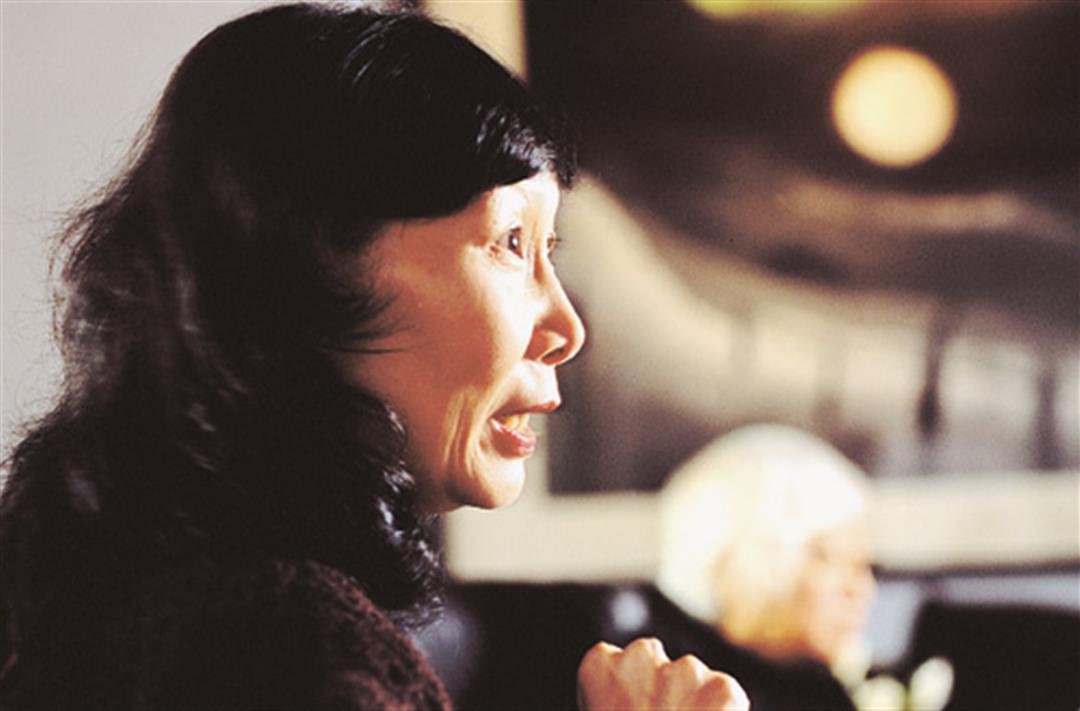
Fan believes that art goes on forever. In spite of a nagging injury, she is still striving to pass on the torch of Dunhuang dance, and Ko is her strongest supporter.

Rise to the top
Though Ko had long dreamed of going to the United States, he had been unable to get a visa. Now that he had a chance, he leapt at it. But his creative ambitions extended far beyond merely photographing international dance companies, and he entered the wide-open fashion photography field as well. He started out working for three well-known commercial photographers as an assistant, but was soon himself contributing to leading international publications such as Harper's Bazaar, Essence, and House Beautiful.
During his ten years in New York, Ko earned both fame and fortune, but he gradually wearied of commercial photography's shackles. Following the 1979 death of critic Ku Hsien-liang, who guided him early in his career, Ko gave up commercial work to devote himself to art photography. He spent six months wandering through southern Europe and North Africa, where he completed a series of breathtaking photographs combining minimalist composition with a profound aesthetic sensibility. These works established him as one of the world's top photographers.
.jpg?w=1080&mode=crop&format=webp&quality=80)
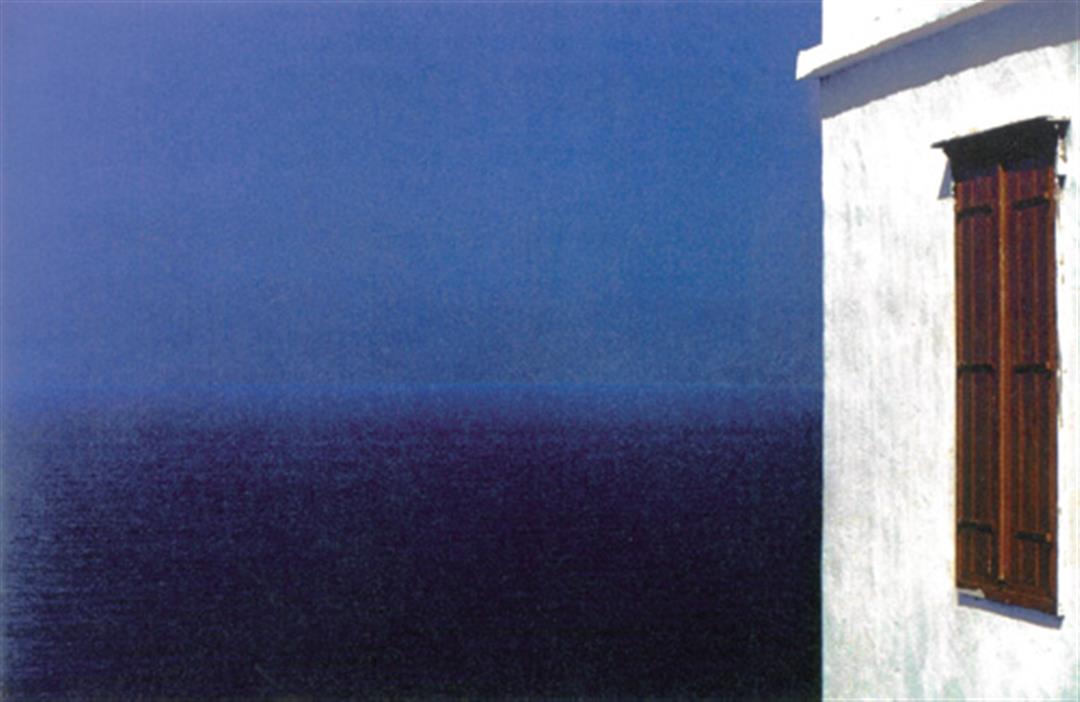
When Ko accepted a commission to shoot national publicity photos many years ago, he chose to use Fan's "Butterfly Spreading Its Wings" to represent Taiwan emerging from its chrysalis.
A precious wedding gift
Having seen all of the world's top dancers perform and having often photographed dance companies in the arts paradise of New York City, Ko couldn't help but wonder when Taiwan would develop its own style of dance.
That changed when he returned to Taiwan and met Fan. The first words out of her mouth revealed that he was speaking to a very intelligent dancer. He decided on the spot to take her to New York with him and cultivate her talent. He felt that only in New York, with its collection of world-class dance companies and performances, could she receive enough "nourishment" as a dancer. But the only way he could think to get her there was to marry her.
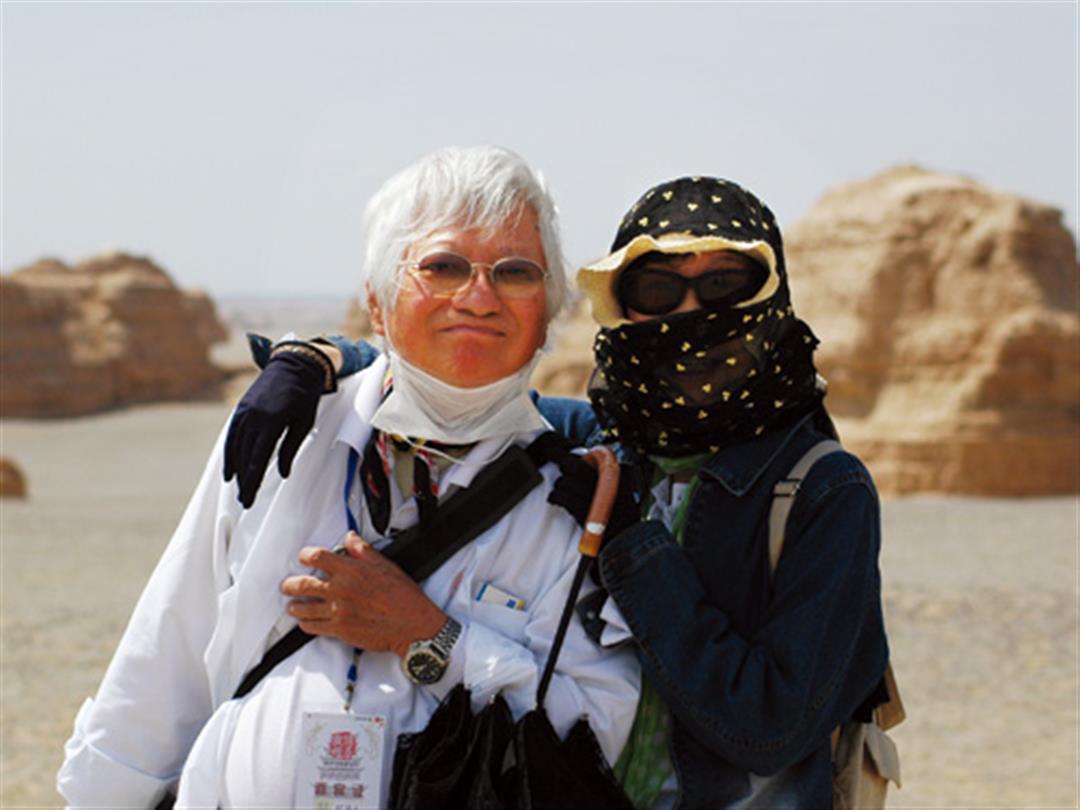
"It was only after we married that we began falling in love," laughs Fan. They were together almost every single day for the first month they knew each other, but had hardly any erotic interest in one another. Ko wanted only to help her find herself artistically, and when they married in 1985 they kept it a secret from their families. One week after their wedding, Ko went to Dunhuang to scout locations for a movie. While in Lanzhou, he talked with the headmaster of a school that trained Dunhuang dancers and attended a performance by its students. Deeply moved by the show, he now knew what to give his new bride as a wedding gift.
In addition to bringing back information on the Dunhuang dance in which she had so long been interested, Ko invited the school's director back to New York to tutor her. Ko had hoped that Fan would spark interest in Dunhuang dance in the US, but their collaboration with the director soon ran aground. The director, a doctrinaire atheist, rejected Fan's proposed use of a flying demigod to express Zen themes. He also opposed her desire to utilize a modern dance vocabulary. Instead, he insisted that young women dancers could only imitate flying and that Dunhuang dance be limited to what was depicted in the frescos.
Pained by his conservatism, which she felt would lead to the stagnation of Dunhuang dance, she ended their collaboration and began working on taking the form in a new direction. She began studying dance and choreography with new teachers and, when she had time, attending performances by New York's most avant-garde dance companies with Ko. After each performance, she and Ko would discuss what they had seen, which helped her develop further as an artist.
She premiered her new dance at New York City Center in 1987. As their good friend the poet Cheng Chou-yu described it, it wasn't traditional Dunhuang dance, but a modern dance that transcended Dunhuang. He christened it "Dun-Huang Resurrection though Dance." The work catapulted Fan into New York's international spotlight, and she continued to perform it there for seven years.

Two people's "Vu Shon"
"It was a solo piece, so staging it didn't involve a lot of worry," she recalls. "I was always relaxed and happy." But when she and Ko returned to Taiwan in 1994, she was astonished to find that many local companies spent the bulk of their energy on networking and the endless paperwork involved with grant applications. As much as she missed those simpler days performing in New York, the US itself can be overwhelming and New York is extremely competitive--the world's best dancers and companies are constantly pouring into it. But a large part of why she came back and established her own company was because she had no one in the US with whom to dance her Dunhuang dances, and no one to whom she could pass on her skills.
On returning to Taiwan, Fan discovered that she would have to face a great deal of pressure--in the public's eye she became "the wife of the great photographer Si Chi Ko." Since nobody knew her here, she could only hang on Ko's arm and smile at public events. Even close friends urged her to give up dance and play the dutiful wife so her husband could focus on his own creative work. The fact that no one in Taiwan was familiar with Dunhuang dance made her practice of it an even more solitary and difficult pursuit. People told her that Dunhuang dance was out of step with the current focus on "native Taiwanese culture" and that it was thought of as an unfashionable folk dance, so she would have trouble getting funding for performances.
"I was very frustrated during this period," she says, "and questioned my decision to return to Taiwan." She got little serious attention here. In fact, when she was invited to perform in Egypt and India, her funding came from the host nations and the Japanese government.
Fan kept working in spite of these difficulties and continued to seek choreographic inspiration through meditation. She calls her style of dance Vu Shon, a name based on the Taiwanese words for "dance thoughts." It blends movements from Hinayana Buddhist dance, breathing techniques from Chinese martial arts, and the reserved tension of Japanese Noh theater into a Dunhuang framework to produce an almost poetic dance vocabulary of hand, eye, foot and body movements.
Six years ago, Vu Shon 2001 took the stage at the National Theater, giving Taiwanese audiences an opportunity to see for themselves Fan's transformation of the nearly 500 poses of Dunhuang dance into an apsara. Four years ago, Tchen Yu-chiou, then the chairwoman of the Council for Cultural Affairs, praised her work and provided her with funding to perform her signature pieces in Paris.
Ko & Dancers has finally realized its goal, becoming recognized as a Taiwanese dance company representing Taiwan to the world, and these two wonderful collaborators in the arts and life continue to produce dazzling work, awing and moving audiences the world over.