

Of all the people who operate organic farms, how many can stand in the middle of a vast stretch of land and wave their arm in a broad circle while declaring, “Everything you see here is land for organic farming”?
Champion Farms, located in Fuxing Township of Changhua County, covers 62 hectares across the villages of Erlin and Pitou. It is the only area in Changhua to be certified as organic and dedicated exclusively to organic farming. This is virtually the sole example in all of Taiwan of organic farming being done in open air over such a large area.
What makes Champion special is also what makes it difficult to run. After five years of running heavy financial losses, last year it started growing crops under contract for Pxmart supermarkets. Champion president Huang San-rung says excitedly, “We can finally see the light at the end of the tunnel!”
Late January. The sun is shining, but it’s still pretty chilly out here. Champion Farms is harvesting carrots, bok choy, and Arden lettuce.
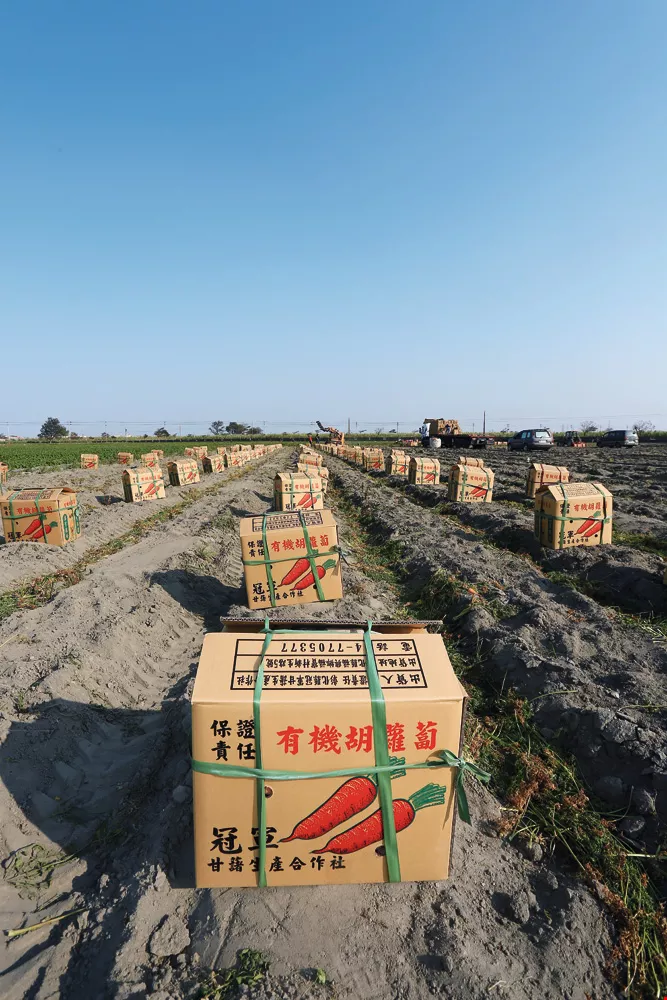
Looking out over the fields one after another, the broccoli has only just started to sprout; the Arden lettuce field is a sheet of emerald; the carrots, just brought to the surface by turning the soil with a tractor, lie on the ground in intertwined reds and greens, waiting to be graded and boxed.
“We’ve got sandy soil here with good air permeability, so you can plant anything,” says Champion Farms president Huang San-rung. There are trees and other natural barriers on all sides of the organic farmland, so they don’t have the usual management problems caused by having non-organic farms next door. This is excellent land for organic farming, of the kind you dream of but rarely can get.
Huang, who is following in the footsteps of his farmer father, used conventional farming methods for more than 20 years. But one day he discovered, “Every time I looked at agrichemicals, I just felt uneasy, like something wasn’t right.”
“There’s a lot of cancer and other ‘diseases of civilization’ in our society, so I decided to grow some toxin-free vegetables, just for myself, family and friends,” says Huang. But the more he planted, the more interested he became, so he expanded his production again and again. Today he has more than 60 hectares, and has been certified under Japan’s MOA Nature Farming criteria (set by the Mokichi Okada Association) as using natural growing methods, becoming indeed a “Champion” of organic farming.
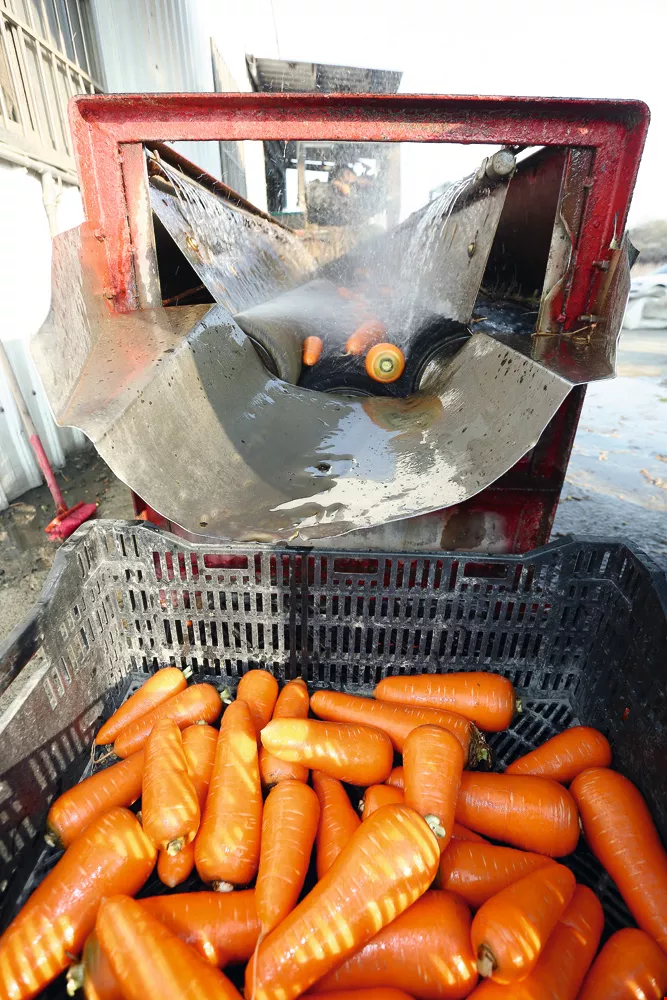
January and February is peak season for carrots. After being picked they are washed, air dried, packaged, and put into cold store, providing a year-round supply for the market.
Wide open spaces
At the beginning, because he didn’t really know the proper techniques and also because it takes several years for land to recover from agrichemicals, Huang lost a lot of money. But he considers that “tuition,” because eventually he learned the right techniques and understood the right way to go. Unfortunately, though he could grow the crops, he lacked any channels to sell them, so he continued to lose money.
After five years of being heavily in the red, his parents were opposed to his going on, his neighbors laughed at him, and even his wife had turned against him. But Huang refused to go back on his original idea. “Once you start cultivating using organic methods, you somehow can’t bear the thought of giving up!” he says, shaking his head and giving a wry laugh.
Fortunately, like-minded friends have been there to support him, and struggle alongside him. Huang rented land from Taiwan Sugar Corporation and became the farm’s managing director, in charge of overall planning. The main crops are potatoes and sweet potatoes, while remaining plots are planted with carrots, cauliflowers, pumpkins, Arden lettuce, green peppers, bok choy, spinach, and other crops.
The biggest problems facing organic farming are disease and pests. To deal with these, Huang sought out his good friend Guo Yancheng, who holds a doctorate in plant pathology and epidemiology, and invited him to return to Taiwan from Malaysia as a consultant.
Champion exclusively uses natural farming methods. “However a crop grows in nature, that’s how it grows here. All we do is use some materials to make their growth a little easier,” says Guo. Organic farming means going with the flow, following nature, not manipulating things to work against their natural tendency.
In order to keep the land well-rested and fertile without the use of chemical fertilizers, ten hectares of the farm’s 60 hectares are left fallow at any given time, in rotation.
Guo says that the length of the fallow period depends on the crop being grown. The deeper the roots grow, the longer the land must rest. Generally speaking, for leafy vegetables the land should be left fallow for one month following the harvest before it can be replanted. For root-tuber crops, which have deeper roots, the land has to rest for three or four months.
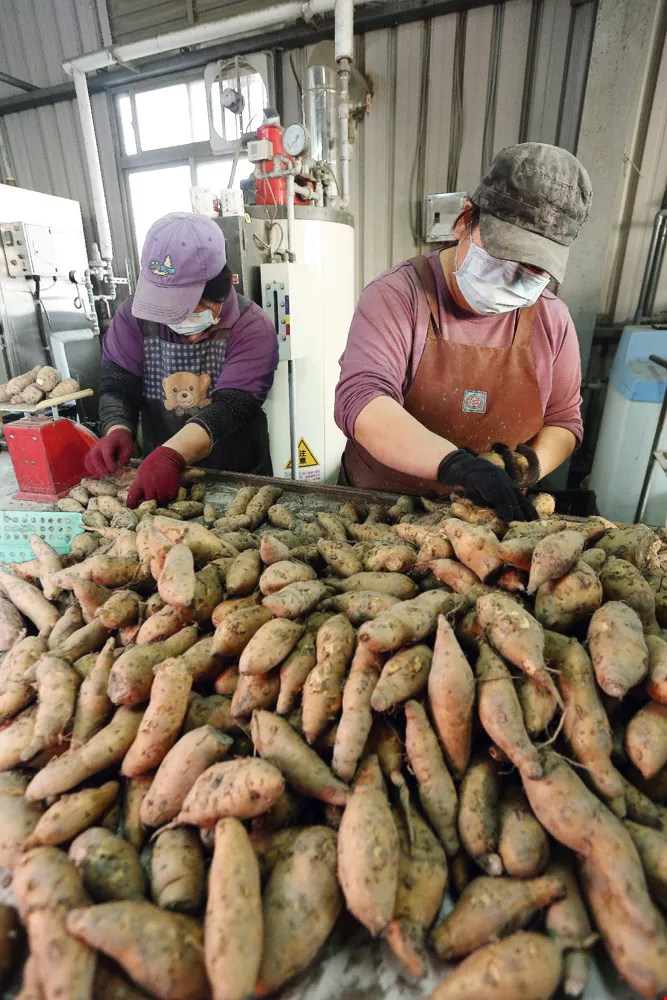
These Tainong 66 sweet potatoes, which grew underground five months before harvest, are sweet and juicy, with dense but delicate flesh.
Weeds and insects
Cultivating in the open air, so that the crops can absorb nature’s sunlight, air, and water, seems to be a no-brainer. In fact, this is just an expediency for Huang, adopted because he does not have adequate capital.
It costs a lot to build greenhouses or put up nets, and also takes a lot of energy, so it’s not what you would call environmentally friendly. But the fact that consumers want each and every piece of fruit or vegetable to look flawless forces farm operators to head in the direction of cultivation in greenhouses and net-houses. Huang San-rung says that when he has enough money he also hopes to erect some simple net-houses. “Diseases and insects never stop or go away, and putting up nets can reduce the threat somewhat.”
Organic farmland is a playground for insects. To combat these armies of pests, Champion Farms uses biological defenses like Bacillus thuringiensis and traps baited with sex pheromones, as well as that age-old but still reliable weapon, the human hand.
“Where there is a lot of grass and weeds, you will find a lot of insects,” says Huang San-rung. Because Champion cannot use herbicides, they have to rely on good old-fashioned elbow grease to pull up weeds and grass. In fact, they have to spend NT$2 million per month just hiring people for weeding.
Moreover, “the longer a vegetable is in the field, the greater the risk,” says Guo Yancheng. Unlike vegetables grown with conventional farming methods, which grow quickly because of all the chemical fertilizers they get, organic crops have to stay in the fields for 25 days to a month. This is why Champion Farms has not yet dared to take on the challenge of raising “head” vegetables like cabbage.
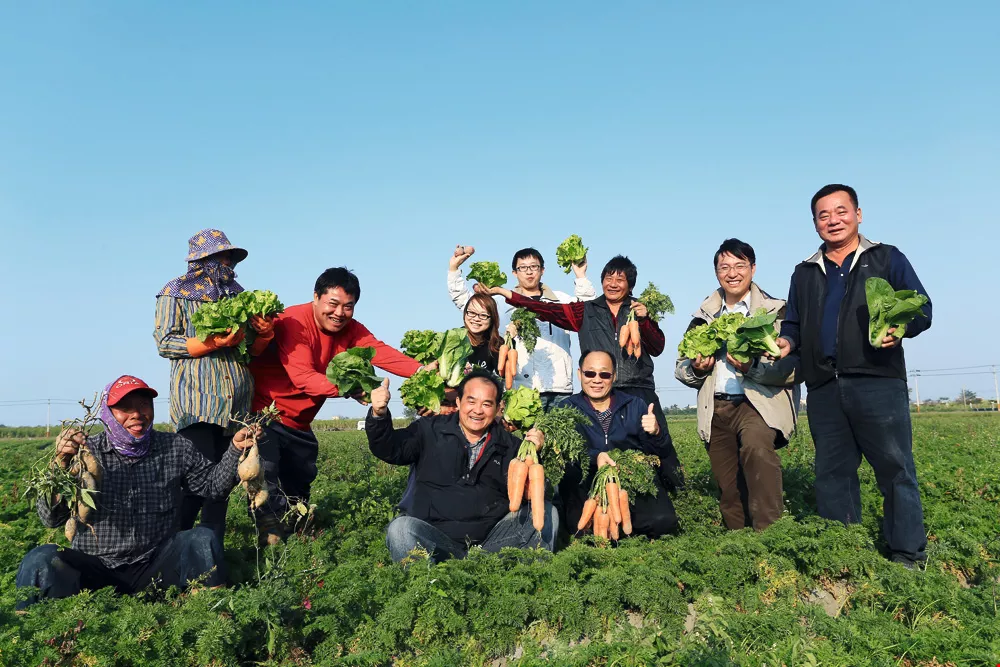
Huang San-rung (front row, center) and his team have overcome countless difficulties to reach the place they are today: virtually the only large-scale open-air organic farm in Taiwan. Now they can celebrate the fruits of their labors.
Sweet taste of success
Sweet potatoes are the main crop at Champion. Huang, whose family has been growing sweet potatoes for generations, says proudly that he can resolve any and all questions having to do with sweet potatoes. He is known as “the sweet potato maestro.”
Contrary to what most people might imagine, tubers that grow below the surface are even more difficult to raise organically than vegetables that grow above ground.
“The reason is that you can’t see whether or not there are insects under there eating away.” For example, says Huang, take the sweet potato weevil (Cylas formicarius), one of the main insect threats to sweet potato. It only drills a small hole through the skin, so that from the outside the potato looks perfect. It is only when you cut it open that you find out that the inside has been completely eaten away. If you don’t have a lot of experience, it’s hard to determine what’s going on down there.
No matter what the hardships, however, in the end the fruits of the arduous labor of organic farming are sweet indeed.
You can’t get the same quality in conventionally farmed vegetables as you can in organic ones. For sweet potatoes, for example, “the fibers you get from conventional cultivation are coarser, whereas organically grown sweet potatoes are fine and tender,” Huang reveals, “and what’s more they are sweeter.” The difference is that in conventional farming, the sweet potatoes are picked after 120 days, whereas organic sweet potatoes stay in the fields for 150 days. “During this time the starch transforms into oligosaccharides, making the sweet potatoes taste better.”
The carrots and bok choy produced by Champion are likewise so fragrant, sweet, crispy, and refreshing that you can’t help but give them a big thumbs up, says Chu Guimin, executive assistant in the marketing department at Pxmart, with a laugh: “The only flaw is that from time to time a consumer will politely complain that they have found an insect inside.”
Huang San-rung (front row, center) and his team have overcome countless difficulties to reach the place they are today: virtually the only large-scale open-air organic farm in Taiwan. Now they can celebrate the fruits of their labors.
Light at the end of the tunnel
A few years ago, Huang tried selling his produce through organic food stores. But the stores kept making ever more rigorous demands about the appearance of the vegetables, and anyway sales volume would never have been very much at such stores. Huang was left with little choice but to sell his hard-won organic produce as if it were ordinary veggies. “I would lower the price trying to get someone to buy them, but people still thought they were too ugly. I felt like crying,” sighs Huang.
But last year fortune finally knocked on his door. Pxmart sought out Huang and signed a contract with him, guaranteeing that they would purchase a certain amount of organic food on a regular schedule.
“Pxmart gives us better conditions, and holds special marketing activities for us during peak harvest season. Sometimes the vegetables don’t have an ideal appearance, but Pxmart still takes everything as agreed,” says Huang gratefully. He notes that a typhoon struck and inundated the fields during the most recent growing season for carrots, so that some of them ended up split in two like a pair of human legs, and others looked like pig’s feet. Although this didn’t affect the flavor, it made them more difficult to process; but Pxmart still bought the whole lot.
Looking at the crop of carrots being harvested right now, they are full and beautiful, making Huang beam. Ah-Meng, who has direct responsibility for managing the carrots, guarantees they are delicious—“cross my heart!”
At the current stage, Champion Farms is sending Pxmart about 9000 metric tons of carrots, more than 6000 tons of sweet potatoes, and about 6000 tons of potatoes per week. At the same time the farm is producing an average of 3000 bags of vegetables per day, and is advancing toward their target of 8000 bags per day.
“We don’t sleep all night long, we are all out catching insects!” Now that they have a regular and stable outlet for their products, and moreover aren’t getting exploited by middlemen, the 70–80 employees of Champion Farms are no longer anxious about the future. Like the organic vegetables they grow, they look invigorated.
In order to ensure that supply remains dependable as Pxmart expands sales of organic foods, Champion Farms is looking for an additional 50-hectare piece of land in southern Taiwan where they will begin operating another organic farm.
“Organic farming is the way things are headed for the future. Even if you don’t start now, you will have to start eventually. As a farmer, once you know this is true, then you might as well get started as early as possible,” says Huang, fully prepared to show what he can do.

@List.jpg?w=522&h=410&mode=crop&format=webp&quality=80)

@List.jpg?w=522&h=410&mode=crop&format=webp&quality=80)


