

Will Stock 20 be demolished?
In mid-June, the Taiwan Railway Administration announced a piece of news that astonished the island's art world. Stock 20 was once a railroad warehouse bustling with people and goods. It eventually fell into disuse, but has since become a model for the adaptive use of unused spaces in Taiwan, as well as the Council for Cultural Affair's locomotive for the promotion of railroad art. No wonder Taiwanese artists have sounded a clarion call of action to save Stock 20. Their hope is that the railroad can carry art to stations everywhere where it can be enjoyed by travelers, and that abandoned railroad warehouses in Hsinchu, Taichung, Chiayi, Fangliao and Taitung can become turntables of art that will bring lively exhibitions and art performances to places that have never seen them before.
In mid-June, the Ministry of Transportation and Communications' Railway Reconstruction Bureau announced that if the project to build an elevated rail track at Taichung central station was approved by the end of the year, a temporary station and platform would be necessary while work was in progress, and Stock 20 Art Center would have to be demolished.
For a long time, Stock 20 was not used by Taichung train station. Its managers made it clear from the start that for an unspecified but temporary time period, the railroad would not be using the warehouse, and that whoever occupied it during that period would have to leave once an important use was found for it again. What no one could have foreseen when initial feasibility studies for Taichung's Stock 20 Art Center were conducted, was that over the past six years it would become a model for the adaptive use of an unused space which has come to be highly regarded by artists and the public alike.
Today, people are up in arms at the prospect that Stock 20, a milestone in the railroad art network, may be irretrievably lost if it is torn down to make room for a temporary station and platform.
Fortunately, when the news got out, the leadership of the Council for Cultural Affairs and the Ministry of Transportation and Communications discussed the problem and decided that Stock 20 would not be torn down for a period of at least two years. An alternative solution is currently being sought for the elevated track project.
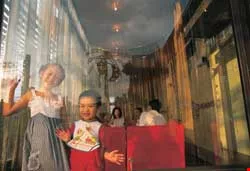
A train thunders past a crowd of people on a platform. The warehouse behind the station provides an appreciation of art quite unlike that found in traditional galleries. (photo by Hsi Yueh)
Railroad warehouse charm
Having won a fierce battle for its own survival, in July Stock 20 put on a non-stop series of superb exhibitions and performances. With a blend of body language and improvised percussion instruments, including iron stools and wooden chairs, the local band Banging Good Time made the audience's hearts beat to the rhythm of the music.
In warehouses 21 to 26, artists enjoy absolute freedom to work in ten studios with four and five-meter tall ceilings. In the coffee shop, you can look through a glass wall at people coming and going on the platform and feel your cup vibrate to the roaring sound of passing trains. Stock 20 is an invigorating and unconventional venue for the creation and appreciation of art.
Taichung station was built in 1908 as a point of transit on Taiwan's north-south railroad. The seven warehouses behind the main train station were originally used to store goods to be conveyed north or south. In those days, rice, sugar, and lumber were transported to the port cities of Keelung and Kaohsiung, whence they were shipped to Japan.
An old man who lives behind the Chiayi warehouse remembers: "In the old days this was the starting point for train journeys to Mt. Ali. Motorized trucks and oxcarts would stand in line around the clock waiting to load and unload goods." Taiwan was once a land of the railroad, but after 1945 goods were increasingly transported by road rather than railway. During Qing times, train station warehouses were strategic military entrepots; during the Japanese occupation they were used as storage facilities by the sugar, salt, and forestry industries; and after the war they were used to accommodate rail passengers on their way south or north. Although they were located in urban centers with good communication links, these warehouses stopped being used for freight storage many years ago. Some were leased to park locomotives or store commercial goods.
"Most countries were developed along their rivers and lakes, but Taiwan was developed along its rail network," says Dr. Chen Chih-sun of the department of architecture at National Cheng Kung University, who is currently in charge of Taiwan's railroad art projects. According to Dr. Chen, the historical value of the railroad cannot be ignored.
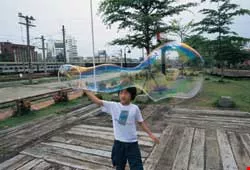
A child plays in Chiayi's Railroad Art Village. The railroad art network is not just a paradise for artists: it is also a place for ordinary local people to enjoy art. (photo by Jimmy Lin)
The appeal of decay
To most people, railroad warehouses are nothing but dark and dilapidated buildings, but to artists such spaces exert a primordial attraction not found in conventional art galleries. These surreal art sanctuaries give free rein to the imagination, enable the artistic vanguard to enter the mainstream, and function as alternative spaces for the experimental showcasing of new designs prior to commercial exhibition.
Artists with a keen nose for possibility rediscovered the historical legacy of railroad warehouses, industrial sites that once teemed with railroad men, travelers, and student commuters. Long before railroad art was all the rage, Huang Ching-ho, whose works have been shown at the Venice Biennale, decided to rent an old railroad warehouse as a studio for his huge paintings. Now that installation art has gone mainstream and space is used as a canvas in a creative dialogue with works of art, artists are even more attentive to choosing the right locale.
"In this empty space nothing exists. Standing here, I feel the temperature, the humidity, and the wind," says Chen Ching-hsiu, who used to exhibit her work at the Railroad Art Center in Chiayi. Once, Chen fashioned white columns of flour that resembled stalactites and let them dry in the wind, harden, and fall off one by one.
Sung Wei-te, an architecture student visiting Stock 20, has also fallen under its spell: "There's something fascinating about buildings with a special history such as this one, which are now put to a use that is diametrically opposed to the function they performed in the past. Although they may lack all the equipment and facilities found in professional galleries and studios, they exert a unique attraction."
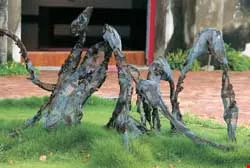
In a bustling train station people experience art in unpremeditated moments. The photo shows Huang Fang-chi's work "Moment."(photo by Jimmy Lin)
An art village hops aboard
Huang Ching-ho's pioneering idea of renting a railroad warehouse as a studio made a big impression on Hung Meng-chi, then director of the cultural affairs department in the Taiwan Provincial Government. The railroad art project was born soon afterward.
Art villages began to sprout in Taiwan when, following a decade of discussion, it was announced in 1990 that construction of the Mt. Chiuchiu Art Village project would be halted, and the Council for Cultural Affairs decided to turn a single big art village into many small ones. Shortly afterward, in June of 1990, Stock 20 was opened as the first station in what would gradually become Taiwan's railroad art network, which currently comprises Chiayi, Fangliao, Taitung and Hsinchu.
At the end of last year, Chiayi's Railroad Art Center organized a "Black Gold Festival" to commemorate the city's history as Taiwan's largest coal depot. Featuring contemporary art, works created by local people, music, films, and numerous events, the festival publicized the work of Chiayi's Railroad Art Center and raised the city's artistic visibility.
Fangliao's F3 Art Center is the most atypical of Taiwan's family of railroad art centers, both in character and spatial layout. A large mosaic greets train passengers on the platform, and along the rail track sculptures create a captivating effect. Fangliao was once the busy southern terminus of the north-south railroad. After the Southern Link Line was opened in 1991, Fangliao lost its position as a transportation hub.
Next to the train station more than 50 dwellings and cabins that had originally been used as living quarters and storage rooms by maintenance engineers and workmen on the Southern Link Line fell into disuse. Fortunately, a local history association, a bird-watching society, and other organizations leased the premises from the Taiwan Railway Administration at a low rent and proceeded to move in. After local people began to gather here in large numbers, the "Fangliao Good Life Society" was established to promote artistic and literary events in the community. A resounding success, in 1998 the site was voted a national model for the improvement of urban landscapes.
Having directed all its energies toward promoting art education, the Fangliao Good Life Society also plans to rent as yet unoccupied lodgings to artists who will turn them into studios. Unlike the huge railroad warehouses at the vanguard of Taiwanese art, small residential spaces attract artists specializing in stone, wood and copper carving, paper and leather engraving, prints, spatial design, mosaics, and other art forms close to the pulse of life. Financial assistance to defray all expenses has enabled local art wizards to give a completely new face to every workroom and to create community of artists with the allure of a European village.
Who runs the village?
In principle, an art village ought to be run by a group of artists capable of endowing it with an artistic character of its own. Unlike art villages overseas, which rely on private donations, national foundations, private enterprises, local governments, and investment revenue, Taiwan's railroad art centers depend on financial assistance from the government. Fangliao's F3 Art Center is an exception in this respect, but for most art centers government support also entails certain restraints on their freedom of action. Since the railroad art centers are open to everyone, they play a major role as educators and community builders.
Many artists lament that our art villages resemble cultural centers or "literature and history workshops" in which precious little "pure art" is found, but local people see things differently. When an art consulting company took over the management of Stock 20, the exhibits it put on got consistently good reviews, but people living near the gallery were wary of dropping in to see what was inside, thinking that it was yet another deserted building.
Monica Tsai, head of Grace Studio, which took over the management of Stock 20 earlier this year, says: "This place will be a forum for communication between artists and the local community."
The first exhibit, Taokao Labor--Industrial Kaohsiung, included a work by blue-collar artist Liu Ting-tsang, who welded together scrap metal from old motorbikes to create sculptures of giant mosquitoes and bicycles, which attracted children from the local community to touch and ride them to their hearts' content. Chen Chih-sun says, "To my mind, the railroad 'art' network ought to be called a 'culture' network." In his view, given the current level of art and literature in Taiwan, art villages ought to open their doors more widely to ordinary people.
On Saturday and Sunday afternoons, small parties of stylish youngsters can be found in Stock 20's coffee shop, and old men in T-shirts stroll with their grandchildren around the exhibits. Sometimes, groups of soldiers garrisoned in Taichung also flock to the gallery.
Most people feel that they have to dress up to enjoy art in traditional municipal galleries, and they have to make a special trip to get to them.
But railroad art centers are bustling with life and allow people to experience cultural and artistic events in a natural and unplanned way. Art has been confined to museums and temples for too long: let it hop on a train and be carried from station to station around Taiwan!


@List.jpg?w=522&h=410&mode=crop&format=webp&quality=80)


