Supermarket-Style Food Banks Come to Taichung City
Sam Ju / photos Chuang Kung-ju / tr. by Phil Newell
August 2013
There is a place where picking up charity relief products is like going to a supermarket. And some people can even get home delivery! The Taichung Love Food Bank, a joint effort by the Taichung City Bureau of Social Affairs and the Red Cross, looks more like an ordinary consumer service provider than a non-profit charity. It is the first institution of its kind in Taiwan.
It is 7:30 in the morning, and there is a long line of people outside the high-rise of First Square shopping center in Taichung. A 65-year-old woman, Grandma Li, has the pole position, and she waits by the elevator, pulling her shopping cart behind her.
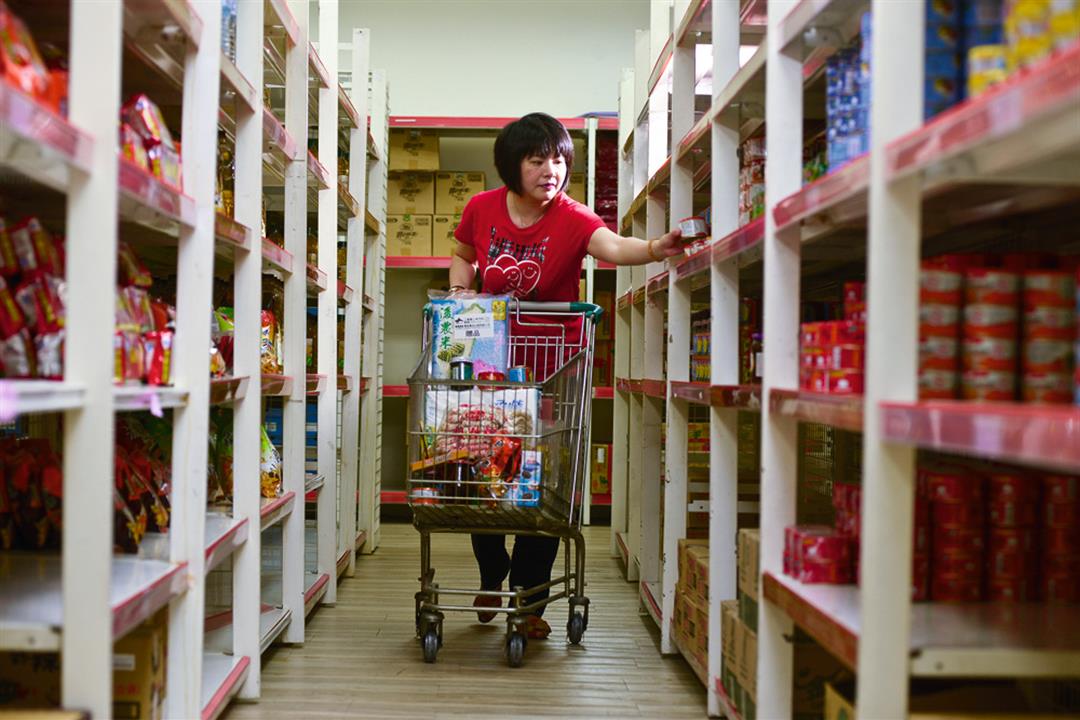
This is the last Saturday in June, the one day each month when the Taichung Love Food Bank (TLFB) “opens for business.” Picking up food here is like shopping in a supermarket—you can choose anything you want off the shelves and drop it into your cart, settling your bill with “compassion points.”

The Taichung Love Food Bank operates like a supermarket, where recipients can freely choose the items they want. This is a more dignified way for people to accept charity.
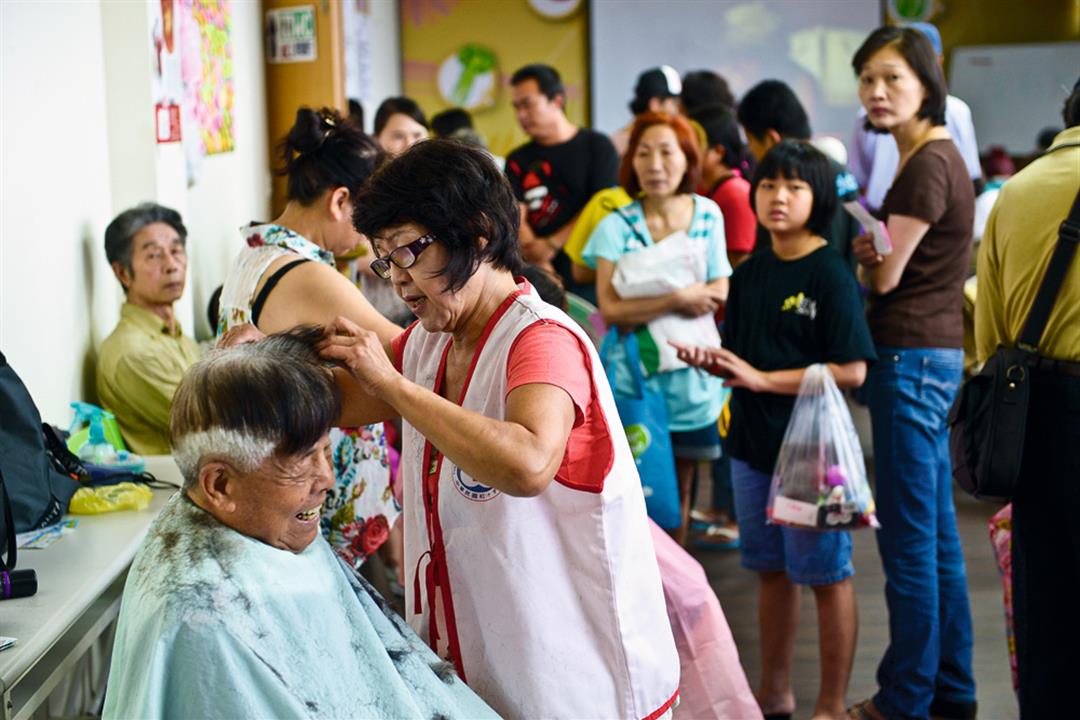
The TLFB, operated by the Taichung branch of the Red Cross under the guidance of the Taichung City Government, opened in August of last year. Covering 660 square meters, it includes a warehouse and walk-in refrigerator. On distribution days it also offers hair cutting services.
This is the first food bank in all of Taiwan to be fully equipped to both store and distribute relief products. They deal primarily in food, secondarily in household products. More than 90% of their stock is donated by businesses, with only a small number of products—like disposable diapers and vitamins, that are hard to get through charitable channels—being acquired through subsidies from the municipal Bureau of Social Affairs.
As only about 10% of city recipients get their food directly from the TLFB, its most important role is as a “central bank” to coordinate food relief for the whole city. It is the hub for 27 distribution stations and for home delivery for remote areas. Its services cover 29 administrative districts within the municipality, assisting about 3000 households each month.
Jeff Chen, director of the TLFB, says the main beneficiaries of their assistance are the “near poor,” people who need a helping hand to avoid desperation-level poverty.
The TLFB collects relief applications from these near-poor households via ward chiefs, community leaders, schools, and social welfare organizations. After an evaluation process that takes two to four weeks, the TLFB assigns qualified households a certain amount of “purchasing power” for relief products, which they can use on each month’s distribution day.
Jeff Chen says that to avoid “welfare dependency” among beneficiaries, each relief period is limited to six months. At the end of each six-month stretch, the individual case is re-evaluated to determine whether the recipient household should be eligible for an extension for another six months.
Because the TLFB is like a supermarket, with a wide variety of products both edible and practical, if you receive your assignment to pick up your goods here, it is just like going shopping, and you are free to choose what you want.
Although there is no limit to the supply of love, it would be wasteful to allow people to take unlimited amounts of relief goods. That is why recipient households, whether at the main bank or at a distribution station, are limited to a certain quota.

After picking up your items at the food bank, you can even get a free haircut. There is a lot of compassion and generosity out there in our society.
The TLFB has designed a system of “compassion points” for people to acquire goods. For each distribution day, a household with seven or more persons receives 2000 points, one of four to six persons gets 1500, and homes of three or fewer are allocated 1000 points. In cash terms, each point is worth NT$1 (about 3.3 US cents).
At the central bank, the points required for each product are posted on the shelves, and points are deducted when you check out.
If you pick up your supplies at a distribution station, you can use your points to get three types of premade packages of goods (A, B, or C, from most “expensive” to least). The contents of the packages vary, but all include white rice.
Bright and early on distribution day in June, volunteers from the Xinmin High School Red Cross Youth Service Team are at the TLFB, the boys moving rice, the girls at the checkout counters. All are getting ready for the day to come.
When pick-up time begins, in order to prevent crowding in the facility, at any given time only 10 recipients are allowed in, and each one is accompanied by a guide to help them find their way as they push their shopping carts and select products.
One of the recipients is an 82-year-old woman, living alone, known as Grandma Xu. Wearing a lower back brace, she slowly moves through the aisles and selects several packages of bean thread noodles, wafer cookies, and ready-to-heat packaged meals, which she plops into her shopping cart. The volunteer accompanying her keeps track of her selections on a calculator, deducting each item from Grandma Xu’s 1000 points.
In the “odds and ends” area of the facility, Grandma Xu chooses a cloth puppet and some doll’s clothes, saying without reserve that she is “very happy” to be able to get these. She will give these to an intermediary to deliver to her great-granddaughter.
The day of our visit, the food bank has a selection of “freebie” items, such as bread, pencils, small toys, and reusable water bottles, for which no deduction of points is required. Jeff Chen tells us that these are items that come in irregularly and in small quantities, and the bank simply gives them away.
At that moment Grandma Li, who was the first person to enter the facility, uses up her points and prepares to depart. She says that she will take no rice today: “Things at home are pretty stable right now, so the rice should be left for people who need it more.”

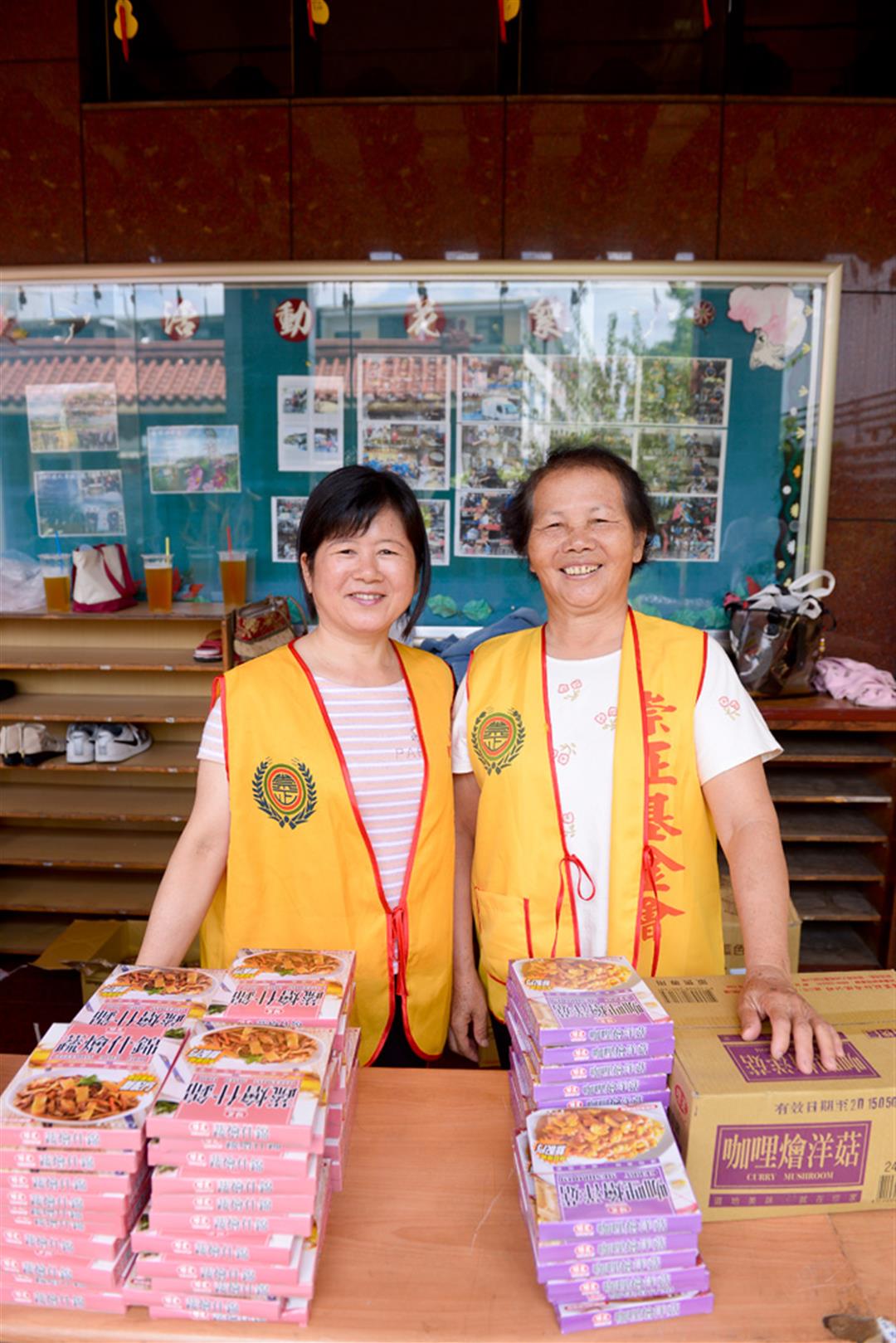
Once each month, tireless and cheerful volunteers from the Chong Zheng Foundation help TLFB to distribute resources in the Taiping District of Taichung City.

Walking into the warehouse, which is closed to casual visitors, there is a cold room where white rice is stored at a controlled temperature of 15°C. The rice stored here has been donated by the government from public reserves, or is pre-packaged rice contributed by generous individuals.
Jeff Chen says that donating rice has become a formulaic form of charity for citizens of Taiwan, so much so that there has come to be rather too much uniformity. There in fact needs to be a much greater diversity of donations of food and household items.
Reusable leftovers are one good example. Take for example Wu-Mu instant ramen, donated by Sing-Lin Foods Corporation. Chen relates that the factory gathers up all of the product that is screened out during the production process, then puts it in different packaging, with a different name, from that used on the market, and donates it to the food bank.
One of the more interesting donors is Shen Hsiang Tang, a cosmetics and bath products firm which from time to time provides shampoo, body wash, and the like. Recipients are always delightfully surprised to find these available at a food bank.
Chen notes that household products have a long shelf life, much longer than food, and even if you take such products home and they pass their expiry date, they can still be put to some use, such as using bodyfoam past the expiry date to wash your car or clean the toilet. That’s really letting no resource go to waste!
Given its role as the hub for relief food and household goods for Taichung City, the most important thing at the TLFB is its “first in, first out” stock management. Because as yet the TLFB has not set up any computerized data system, stock management is still done entirely by hand.
Volunteers do a complete inventory every two weeks. They screen food and materials into various categories, including “past expiration date,” “within two weeks of expiration date,” and “within one month of expiration date,” with items “priced” cheaper the closer they are to expiry. They then further divide the items up by type and shelve and label them. They make a special point of reminding recipients of especially good deals to look for on distribution day.
In addition, on distribution day volunteers will try to dissuade people from taking an excess amount of any one single item, for fear that they will turn around and sell the items for cash, thereby undermining the very purpose of the food bank.
The TLFB uses “compassion points” to manage the distribution of goods, but it is by no means obsessive about it. Chen says that so long as you don’t go over your point quota by too much, say 10 or 20 points, you can still get everything you want.

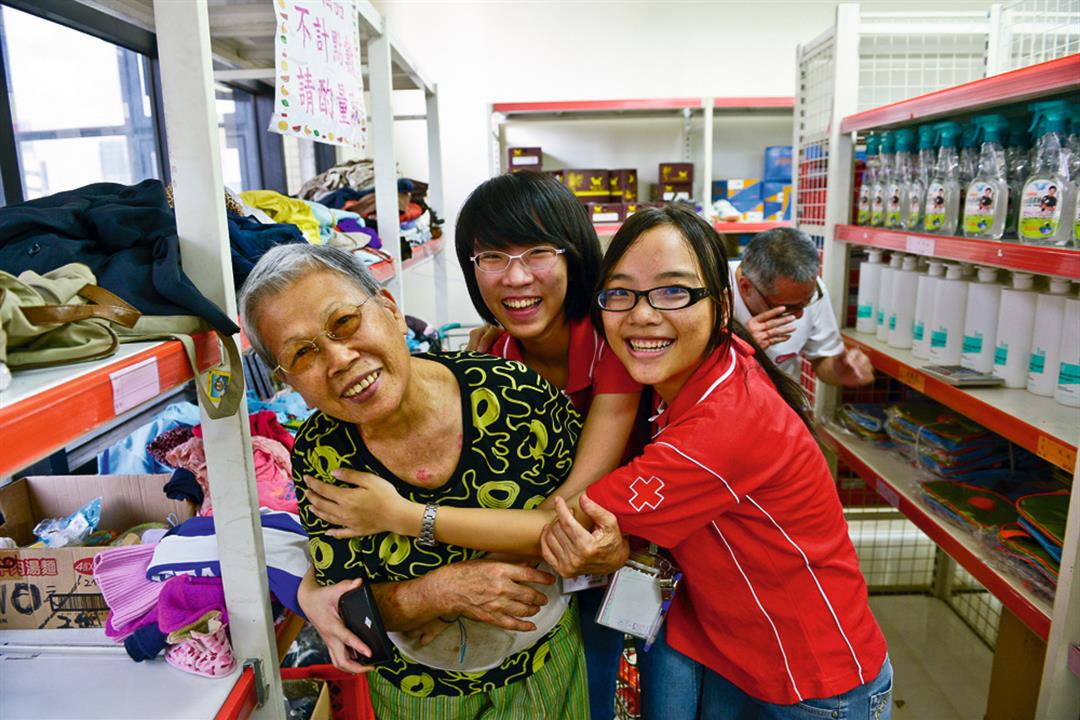
The volunteers at the food bank become almost like family to elderly women who go there regularly for assistance. It’s always a happy occasion each time they meet.
Statistics from the Taichung branch of the Red Cross indicate that in 2012 the TLFB helped more than 2000 families per month on average, but in 2013 that figure has risen to about 3000. Chen takes a positive tack in interpreting this trend. He says that marginalized households are no longer so worried about “losing face” and are willing to accept short-term material assistance.
Food distribution stations run by non-governmental community groups recruited by the Bureau of Social Affairs play a critical role in distrubuting TLFB food on the last Saturday of each month. (Some of these groups had in fact already been doing food redistribution before the founding of the TLFB, and still do their own activities in addition to distibuting goods from the TLFB.)
In the Taiping District, for example, early in the morning on distribution day in June, more than 20 volunteers from the I-Kuan Tao Chong Zheng Foundation have already erected tables and are setting out food delivered from the TLFB.
For religious reasons, this distribution center only passes out vegetarian food. But this does not affect the willingness of recipients to come here—even before 11 in the morning, 80% of the more than 200 registered beneficiary households have already come to pick up their items.
Station chief Su Zhenrong says that when the distribution is halted in the early afternoon, volunteers will take any leftover food and combine it into A, B, and C packages, and notify recipients to choose a day to come and pick them up. In the case of elderly people living alone who are homebound or have reduced mobility, volunteers will deliver the packages directly to their doors.
Sometimes the distribution stations have special surprises for recipients when holidays come around. On Dragon Boat Festival this year, the Chong Zheng Foundation mobilized volunteers to make enormous amounts of zongzi, the traditional food eaten on this holiday. For the Moon Festival, which is coming up in the autumn, the foundation plans to raise money to make moon cakes, likewise the iconic food for the day, which they will pass out to recipients in hopes of making their holiday a little brighter.
Though the TLFB and the distribution stations may have different roles and responsibilities, and approach their work in different ways, they share the same goal: to see that marginalized households get help in a dignified manner so that they don’t end up in the vicious cycle of poverty.