Yeh Tien-lun and the Taiwanese Tastes of Night Market Hero
Lin Hsin-ching / photos courtesy of Green Film / tr. by Geof Aberhart
May 2011


Following in the footsteps of Cape No. 7's record-breaking NT$530 million box office and Monga's stunning NT$260 million takings, this year Taiwanese film produced another surprise winner. In just 20 days after its Chinese New Year release, Night Market Hero pulled in over NT$100 million, making it the third locally produced film to pass that mile-stone, before going on to reach a box-office total of almost NT$140 million.
Director of Cape No. 7 Wei Te-sheng had previously worked as an assistant to legendary director Edward Yang, and Monga's helms-man Doze Niu was a child star and has vast experience in front of and behind the camera. In contrast, director of Night Market Hero Yeh Tien-lun was a 30-something first-timer, but nonetheless managed to hit the big time with his first outing, an effort to revive the long-dormant Taiwanese comedy genre. How did he manage to accomplish so much with his first film? And does this string of successes signal a renaissance for Taiwanese film?
As the sun sets and the streetlights flicker on, 888 Night Market is a hive of activity. But behind the apparent success of this assortment of stalls are stories of the hard work and sacrifice of their owners. The owner of Enjoy Large Fried Chicken, the most successful stall in the market, and her trouble-making younger brother are in a constant competition for customers with neighboring A-Zhu Steak. The eponymous A-Zhu, meanwhile, appears to the world to be a strong, confident woman, but is in actuality a single -mother and past victim of domestic violence, who is watched over in silence by her admirer, the owner of 18 Wang, a neighboring sausage stall. Meanwhile, cosmeticist A-Shui succumbs to temptation and starts selling pirated DVDs, as she and her flirtatious daughter Mei--xiang work to support her stroke-afflicted husband.
Bringing together these disparate people is the young head of the nightmarket management committee, A-Hua. A dyed-in-the-wool taike, A-Hua sets up a service kiosk, organizes regular competitions to liven up the atmosphere, and even offers a fantastic childcare service.
But even as business begins to boom, a local property developer has an eye on the land the night market calls home. In the name of "urban renewal," he gets politicians and the media on his side, while attempting to drive out these low-profit "scavengers" by any means necessary. 888 Night Market's troubles have only just -begun....
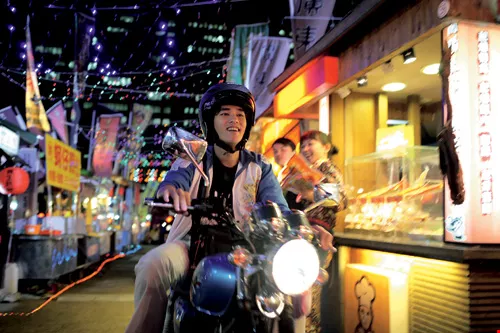
The bustle of the night market and distinctively Taiwanese "Techno Nezha" dancers are part of the main structure of Night Market Hero. Two of the biggest box-office draws, Blue Lan and Zhuge Liang, impressed by playing against their well-known television images, while Lotus Wang-who hit the big time with her song "Bobee"-also proved more than up to the challenge of a big-screen appearance. Above we see various moments from the film.
Combining stories of the "little people," a battle between good and evil, and the issue of urban renewal with down-home Taiwanese flavor, Night Market Hero's plot felt like it could be the story of any of Taiwan's myriad night markets.
"Night markets are one of Taiwan's most distinctive hallmarks," says director Yeh Tien-lun. "Everyone can find a little something there to stimulate their tastebuds and bring back memories."
So who exactly is Yeh Tien-lun? A few months ago, the mention of his name would have elicited little more than blank looks and scratched heads even in the industry, but since the breakout success of Night Market Hero, this 36-year-old has become the most celebrated newcomer to Taiwanese film. Now his name can be found all over Taiwan's electronic and print media.
Many have been left wondering how a newcomer could achieve such success not only with his first directorial effort, but one in that rarely seen genre, Taiwanese comedy. So well received was this film, in fact, that it blew away the Hollywood release The Green Hornet despite the latter's US$120-million-dollar budget and its boasting a cast including such bankable stars as Seth Rogen and Jay Chou!
To understand how Yeh was able to so accurately target the tastes of his audience, we need to go back into his childhood.
Yeh and his sister Yeh Tan-ching-writer of Night Market Hero-are the children of renowned Taiwanese advertising producer Yeh Chin-sheng, director of the films An Unmarried Woman and Sayonara, Goodbye, and television producer Pan Fengzhu.
"I don't really remember having any kind of home life as such," says Yeh. "Mom and dad were generally busy with work, so we were usually taken to the sets or left with our grandma."
As children, the Yehs didn't travel especially much, instead ending up standing around bored on sets waiting for their parents. "I used to wonder what all these people were doing, and how they could still be working on the same thing every time I woke up after falling asleep there." They were at their happiest when their parents took them to midnight movie showings, after which they would talk excitedly until morning about what they'd seen.

Night Market Hero was nominated for Best Comedy at the 2011 Okinawa International Film Festival, with Yeh, along with stars Blue Lan and Alice Ke, getting the red carpet treatment.
Given their surroundings, it seemed almost inevitable that these two impish siblings would develop a much stronger interest in the world of film than their peers. This was only compounded by their parents' encouraging them to become independently minded, laying the foundations for their imaginative and creative minds.
The carefree life these two children led began to change once they became teenagers, though. Their father was a lifelong lover of Taiwanese literature and friends with writers like Yang Qing-chu and Huang Chun-ming, and with encouragement from both the film and literature worlds, Yeh Chin-sheng decided to try his hand at filmmaking.
Yeh Tien-lun's mother Pan Feng-zhu recalls that her husband was considered one of the top five advertising directors in Taiwan at the time, and between that and the strong economy, they felt confident in making the leap. Yeh's first film, An Unmarried Woman, was a modest box-office success, making several hundreds of thousands of NT dollars, and leading to his investing about NT$20 million in adapting his friend Huang Chun-ming's newest work, Sayonara, Goodbye for film. They even secured Hong Kong megastar Cherie Chung and several big-name Japanese actors for their cast. They never expected that the distribution company would go back on their word to repay Yeh, sending him bankrupt and in debt to the tune of over NT$10 million.
This unfortunate occurrence, though, did nothing to diminish the passion Yeh Tien-lun and his sister had for working in film. After graduating from senior high school, Yeh decided to major in film at Shih Hsin University despite his parents' strong objections. His sister, even more of a firebrand, waited until their parents were out of the country to test into the School of Theatre at Taipei National University of the Arts.
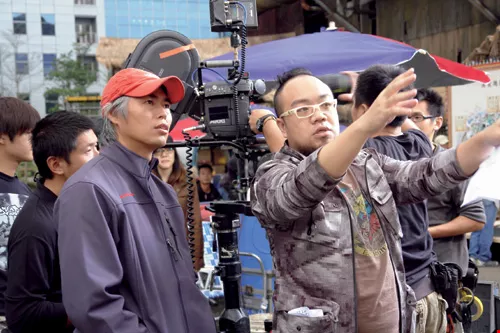
Yeh Tien-lun grew up around film and television, and has been a voice-over artist, actor, host, and presenter, amongst others, so the job of director is one that he is not unfamiliar with. This photo shows Yeh on set discussing a shot with cameraman Qin Ding-chang (left).
But Yeh would never have imagined that studying film would actually start crushing his dream of becoming a director.
During the early 2000s, while Yeh was at college, Taiwanese films were enjoying a surge in popularity at international film festivals, with more "auteurist" sensibility coming to the fore. All Yeh's classmates were struggling to measure up to big-name auteurs like Hou Hsiao-hsien and Tsai Ming-liang, and Yeh himself began delving into the works of European filmmakers like Fran-cois Truf-faut, Jean-Luc Godard, and Luc Besson. He was shocked to realize that his own skills were such that he could never hope to be part of that high-class world.
And so Yeh decided to set aside his dream of directing for a while, instead focusing on acting. He and a group of classmates formed the "Roaming Night Market Troupe"-so named for their having discussed the idea extensively while at the neighboring Jing-mei Night Market-and took their show on the road, performing at events organized by local governments around the island. As well as this, Yeh branched out into hosting, working with celebrity Chung Hsin-ling on a Taiwanese-language children's show, even earning a nomination at the Golden Bell Awards for Best Children's Television Host. He also began working as an advertising voice-over artist, becoming one of the most sought-after talents and earning more than NT$3 million a year from this work alone.
After several years trying his hand at various other jobs around the television industry, Yeh discovered his dream of getting involved in film was still as strong as ever.
In 2009, he served as presenter for the film Blue Brave, attending a variety of Q&A sessions for the film. "The audience were great! They were so engrossed in the film and so keen to ask questions and share what they'd taken from it. That experience actually got me thinking that I really should just give directing a go," says Yeh.
And so he began preparing, talking it over with his sister and ultimately deciding to write something to do with night markets. In 2009, the Government Information Office awarded the Yehs and their script a NT$4 million grant; Yeh also sold one of his apartments and secured sponsorship from Ji-shi Entertainment, ultimately gathering a total of NT$60 million in funds before beginning shooting.
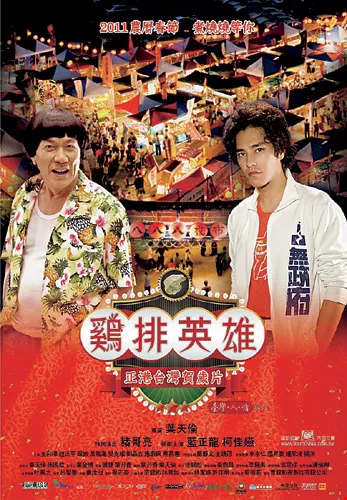
Growing up around film and television, coupled with a keen eye for what the market wants, has helped Yeh Tien-lun hit a home run with his first directorial effort.(right photo courtesy of Green Film)
So why did Yeh choose to set his film in a night market? Did it have anything to do with the popular prime-time -drama Night Market Life?
"It was a total coincidence," says Yeh. "When we got our idea, that show hadn't even started airing! The Tourism Bureau had declared 2010 to be the Year of the Night Market, and we couldn't miss that kind of free publicity!" joke the siblings.
When Yeh Tan-ching developed her initial concept, the only character she really had figured out was the male protagonist, A-Hua. A-Hua would be a young man dedicated to helping the community, but also a bit impulsive, as well as being the epitome of the blunt and brash taike; no matter what happened, A-Hua would always have a "never fear, I'm here!" attitude. "I quite like this kind of 'old-school' Taiwanese man," she says with a smile.
The hard part now was figuring out the right setting for A-Hua and his associates.
"We wanted something that would speak to the audience and resonate with them, so a night market seemed perfect," says Yeh Tan-ching.
Picking a setting the audience would be so familiar with, though, has its risks. In order to make sure the night-market setting was totally authentic, the siblings visited famous night markets all over Taiwan, from Taipei's -Raohe Street and Shi-lin markets, out to the Luo-dong, Feng-jia, and -Liuhe markets further afield. On several occasions they even visited markets that regularly set up on abandoned lots in Lin-kou, Tao-yuan, and Bali.
The result of all this fieldwork was 888 Night Market, which wasn't modeled after any market in particular, but rather designed to give the audience the sense that "this could totally be that night market down the road." Even the foods sold at their fictional market were carefully thought over-the two biggest ones, chicken cutlets and steaks, were provided and overseen by two well-known stalls in the Shi-lin and -Shida Night Markets. The other stalls were even organized with the help of the man in charge of -Yonghe's Le-hua Night Market, who aside from providing advice, even organized it so some of the stalls from the market would help out with shooting. As you can see, there was a tremendous amount of dedication to authenticity behind the film.
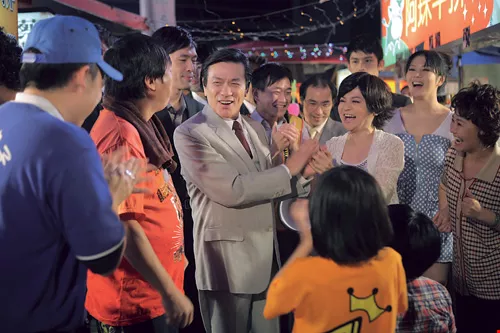
The bustle of the night market and distinctively Taiwanese "Techno Nezha" dancers are part of the main structure of Night Market Hero. Two of the biggest box-office draws, Blue Lan and Zhuge Liang, impressed by playing against their well-known television images, while Lotus Wang-who hit the big time with her song "Bobee"-also proved more than up to the challenge of a big-screen appearance. Above we see various moments from the film.
Not only did Night Market Hero succeed in putting on screen a convincing night market, it also attracted attention for its use of down-home Taiwanese humor.
Cross-strait cultural differences were lampooned right from the start of the film. Mainland tourists spoke with mainland accents, wore the suits that tend to mark them out against the -gaudy shirts and flip-flops of locals, and even browsed the market differently-where Taiwanese take their time and just wander, the mainlanders would have a list of places they wanted to see and zip from place to place. When they were particularly enraptured by the chicken cutlets, they even broke out into song, singing about how wonderful Taiwan is and the like, which raised big laughs from the audience at the irony of mainlanders singing a patriotic Taiwanese song.
They also charmed the audience by piercing two targets commonly acknowledged as big sources of trouble in Taiwan-politicians and the media. Veteran entertainer -Zhuge Liang appears as Zhang Jin-liang, an ignorant and incompetent figure who got where he is through his connections, which make him little more than a loud-mouthed pawn. The media, meanwhile, are shown as eager to use any scurrilous means to perpetuate their chosen "David vs. Goliath" narrative, taking comments out of context and even digging up dirt on A-Zhu, to leave the audience laughing through their tears.
"We're just poking fun," says Yeh seriously. The questions over possible illegal land use are common to many of Taiwan's night markets, as many are set up on what are public roads by day; similarly, the audience has long since developed their dissatisfaction with the media and politicians. The film has so accurately struck a nerve with its viewers that after the it opened, a movement to save a night market in -Miaoli from its land permit problems received a huge boost, and a petition was even set up on Facebook.
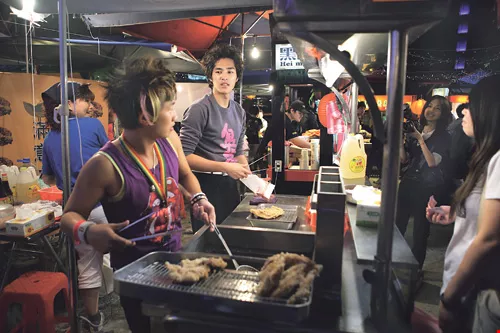
In order to fully capture the atmosphere of a night market, Yeh even specially invited stallholders from popular stalls at the Shilin and Shida night markets to serve as "technical advisors." This photo shows actors Cai Changxian (left) and Blue Lan frying up chicken cutlets.
As is often the case with Taiwanese films, much of the cast of Night Market Hero was drawn from television, including actors Blue Lan, Alice Ke, and Esther Liu, along with several well-known "B-listers" from variety shows, including Lotus Wang, a variety-show regular who had just become a musical superstar with her song "Bobee."
Some may ask, why would an audience want to spend money to see stars at the cinema that they could just turn on the TV and see for free any day of the week? Yeh notes that Taiwan's film industry has never been especially well developed, and aside from a few exceptions like Chang Chen and Shu Qi, most of Taiwan's better-known actors like Ethan Ruan and Barbie Hsu work on both sides of that particular fence. On top of this, those who focus on film tend to have high standards for what script or character they'll take on, whereas TV stars look at film as an opportunity to show a different side of themselves, which then becomes a major selling point for the film concerned.
For example, Yeh says, Blue Lan is better known for his TV role as a rich playboy, but in reality he's Yi-lan born and bred and down-home Taiwanese through and through; not only does he speak perfect Taiwanese, he even suggested the -taike perm his character sports in Night Market Hero. Lan was reportedly ecstatic to "finally have the chance to play someone more like himself."
The other big attraction, at least for the media, was Yeh's ability to get -Zhuge -Liang on board. An A-list celebrity in Taiwan in the 1980s and early 1990s as host of his own variety show, -Zhuge -Liang disappeared suddenly from public view for about 16 years, ostensibly to "investigate options abroad," but in actuality hiding from the massive gambling debts he had accrued. Yeh explains that the character of Zhang Jin-liang, a man who had racked up massive gambling debts before turning over a new leaf, but who was still torn between his love of money and his good conscience, was virtually tailor-made for -Zhuge -Liang.
"Getting -Zhuge -Liang on board wasn't nearly as tough as the media made it sound," says Yeh. "He could tell we were being totally sincere with him, and we both were of the same mind about the script and story. We clicked almost immediately. Finding someone like him to help out was like finding buried treasure!"
With the help of this icon of "real" Taiwan, the Yehs were thus able win over audiences in central and southern Taiwan.
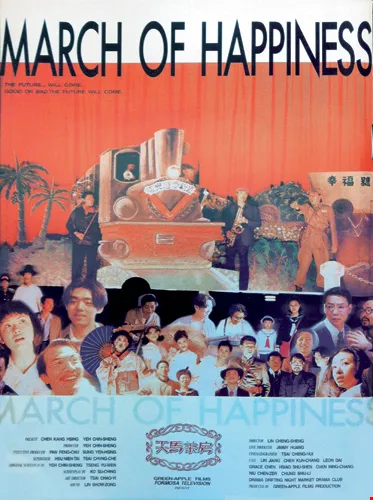
Yeh and his family set up Green Film, which has contributed to several well-received local films and television shows. March of Happiness (1999) was screened in the Un Certain Regard section of the 1999 Cannes Film Festival, and the 2008 film Blue Brave was up for Best Drama at a Singaporean film festival.
With Taiwanese films from Cape No. 7 to Night Market Hero capturing audiences and box offices over the past few years, does this herald a comeback for the long-moribund Taiwanese film industry?
Yeh believes that for a Taiwanese film to capture local audiences, it needs to have three things. The first of these is a truly local story, rather than one that focuses just on Taipei. The majority of the audience didn't grow up in the city, and so settings and stories that fixate too much on the cities can leave audiences from outside the capital feeling left out.
The second is at least US$1 million (approx. NT$30 million) in funding. This is the most basic threshold for films made by small- to medium-sized businesses looking to succeed in the Greater China area. Additionally, since Taiwanese audiences have already been spoiled by big-budget Hollywood spectaculars, if a local film doesn't have a big enough budget, its makers may not be able to get the settings and big-name stars that are necessary to entice people to fork over their hard-earned cash at the theater.
Finally, they need outside help to get the film distributed. Yeh believes that with their well-developed distribution channels and good relations with theaters, foreign distributors serving Taiwan can ensure the film gets broad exposure, such as through promotion at 7-Elevens around the island. After all, no matter how good the film, if it can't get out there, it'll suffer financially.
Taiwanese films still have a long way to go before they can match their American counterparts in terms of marketing and attention. When it was decided that Night Market Hero was to be released for Chinese New Year, distributor Fox -wanted Yeh to promote the film as a "family film," so as to maximize the audience size. They were similarly demanding when it came to casting decisions: even for roles like the ex-boyfriend of Alice Ke's character, who had just one scene, and that of her late father, Fox specifically went after popular names like James Wen and Li Li-ren respectively.
Marketing of films is also a strong suit for American firms, and so for Night Market Hero's premiere at Xi-men-ding, the distributor worked with over 20 night-market stallholders to let viewers of the film exchange their ticket stubs for food. This not only created a buzz in the media, but also proved invaluable for getting people buying tickets.
And the blockbuster successes of Cape No. 7, Monga, and Night Market Hero seem to back up Yeh's perspective. In addition to all telling very local stories, each had a tremendous budget, blowing away the long-standing stereotype of Taiwanese films as being "low budget." Cape No. 7, for example, cost between NT$50 million and NT$60 million; Monga as much as NT$70 million; and Night Market Hero NT$60 million. They also worked with foreign-owned distributors, namely Buena Vista, Warner Brothers, and Fox.
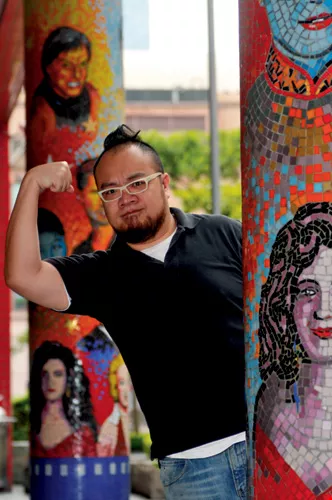
Growing up around film and television, coupled with a keen eye for what the market wants, has helped Yeh Tien-lun hit a home run with his first directorial effort.(right photo courtesy of Green Film)
Respected film critic Lan Tsu-wei criticized Night Market Hero for "riding on the coattails" of previous successes. He commented that the film traded in stereotypes and cliches-the ambitious young reporter; the meddlesome media; the greedy, profit-driven property developer and politician, etc.-and said that although it was able to strike a chord with audiences, it did so through overuse of tropes and showed little artistic merit.
Feeling like an upsized television show, Night Market Hero may have relied on affectations and leaps of logic, but it nonetheless earned its support through well-done comedy.
Yeh Tien-lun may have managed to strike while the iron was hot this time and thus have the good fortune to have his film's minor flaws overlooked, but many people look forward to seeing what's next for this audience-oriented newcomer. There is hope that his success will bring in more new blood and new perspectives, and help create a new chapter in the history of Taiwanese film.
For years now Taiwanese film has been stuck dangling between art and commerce, having trouble finding a balance. It managed to escape the bounds of the unrealistic romantic movies and move into more down-to-earth subjects before, but then fell back into the trap of focusing too much on the whims of directors and the pursuit of "authenticity" in the form of amateur actors, losing the audience and ignoring the drawing power of stars. This new generation of Taiwanese audiences is finally free of past prejudices, enjoying rapidly spreading word of mouth online, and tapping into local identity, and as such it could offer new opportunities for ambitious and passionate local film buffs to try their hands. Could this be a new start for Taiwanese film? Only time will tell.
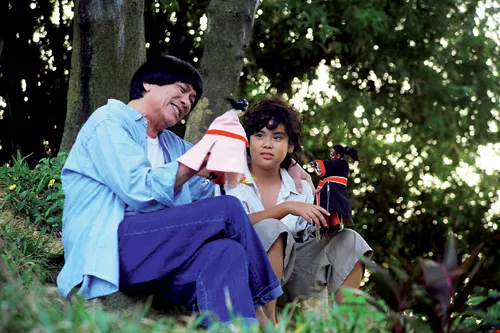
The bustle of the night market and distinctively Taiwanese "Techno Nezha" dancers are part of the main structure of Night Market Hero. Two of the biggest box-office draws, Blue Lan and Zhuge Liang, impressed by playing against their well-known television images, while Lotus Wang-who hit the big time with her song "Bobee"-also proved more than up to the challenge of a big-screen appearance. Above we see various moments from the film.

Yeh and his family set up Green Film, which has contributed to several well-received local films and television shows. March of Happiness (1999) was screened in the Un Certain Regard section of the 1999 Cannes Film Festival, and the 2008 film Blue Brave was up for Best Drama at a Singaporean film festival.


@List.jpg?w=522&h=410&mode=crop&format=webp&quality=80)


