Tug of War over Taipei Railway Workshop
Sam Ju / photos Chuang Kung-ju / tr. by David Smith
October 2012


By the end of 2012 at the earliest, the Taipei Railway Workshop will wind up operations in Taipei’s Xinyi District and move out of the city, leaving behind a 17-hectare industrial site. The Taiwan Railway Administration, which has run up a deficit of some NT$100 billion, has been wanting to sell off the site to pay down its debts, but some of the workshop buildings have been provisionally approved for designation as historic monuments. The result has been a tussle over whether to put greater emphasis on commercial use or historic preservation in deciding what is to become of the premises.
The Taipei Railway Workshop (TRW) is located in a choice swath of Taipei’s high-rent Xinyi District, sandwiched between Civic Boulevard and the Living Mall. It is not the oldest railway workshop in Taiwan, but it is the biggest, and it handles the highest-level maintenance work. The buildings were constructed by the Japanese, but the machinery is even older, dating in some cases back to the Qing Dynasty. The buildings themselves have been around for up to 77 years, but house some equipment that is well over a century old.
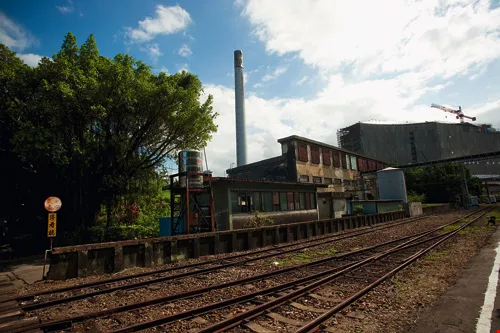
The power plant could become one of four TRW facilities to be designated as historic sites. It supplies steam power to the entire workshop, and its tall smokestack is a city landmark.
The TRW is the successor to the Bureau of Machinery (BOM), built during the late Qing Dynasty in the area of modern-day Zhengzhou Road during the administration of Governor Liu Mingchuan. Originally established to manufacture weaponry, the BOM later branched out to produce railroad equipment, mint coins, and repair ships. After China was defeated in the Sino-Japanese War of 1894–95 and Japan took control of Taiwan, the BOM was renamed several times. “Taipei Weaponry Repair Workshop,” “Vehicle Plant,” and “Taipei Plant” are among the names it has gone by in the past.
After the north-south rail line became fully operational in 1908, Taiwan’s railway industry began to undergo rapid development. The Taipei Plant was soon insufficient, so in 1931 the decision was made to build a bigger plant at the site of today’s TRW. The facility was completed in 1935 and renamed the Taipei Railway Plant. After Taiwan was recovered from Japan, the Taiwan Railway Administration (TRA) took over the plant and renamed it the Taipei Railway Workshop.
The TRW was designed by Kazuhiko Hayami, an engineer with the Railway Department of the Taiwan Governor-General’s Office. It was built at a cost of ¥4.75 million, which would have been sufficient to build the former Taipei Provincial Third Girls’ High School (today’s Zhongshan Girls High School) 14 times over. The huge project attracted a lot of attention in Japan, where the headline of one newspaper article reporting on its completion described it as “the largest in all of the Japanese Empire.”
According to TRW director Lai Shin-lung, the facility is mainly responsible for maintaining rail cars and equipment, and producing parts and components. In the early years, it principally maintained steam engines, passenger cars, and freight cars that ran on the Western Line. As steam engines were phased out, all-electric and diesel-electric locomotives took over as the mainstays at the TRW.
However, despite its formal attachment to the TRA, the TRW has always been first and foremost a defense contractor whose operations are somewhat shrouded in secrecy. For most Taipei residents, it is as if the premises were hidden behind a mysterious veil. An employee has revealed that the TRW won a contract several years ago to produce howitzer components for the military, and more recently has also begun disposing of old military helmets.
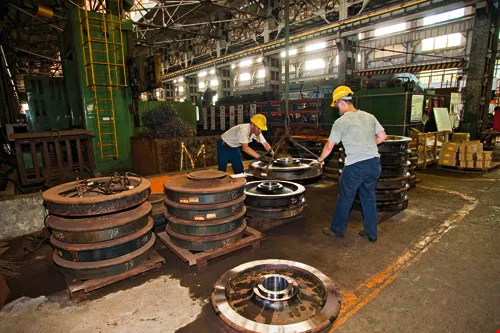
TRW operations will soon be transferred to another site, but for the time being, employees continue to perform maintenance work here every day.
Because new types of transport are always being developed, old railway maintenance facilities eventually go obsolete. The TRA began planning over 10 years ago to phase out the TRW. It eventually decided to begin this August transferring maintenance operations to Fugang Station in Yangmei City, Taoyuan County.
However, very little information about what goes on at the TRW has leaked out to the public during its 67 years under the TRA. Over time, the facility has evolved into a virtual Pandora’s box of gnarly issues in need of resolution. When the issue of transferring operations to Taoyuan came up, lots of those issues began popping into public view.
The TRA, as owner and operator of the facility, had been hoping to have the 17-hectare site converted to commercial use, so that it can take the proceeds from sale of the land to pay down an accumulated operating deficit of over NT$100 billion.
Rail buffs, along with Taipei City councilors concerned about historic preservation, went into an uproar when they learned of the TRA’s plans. They felt that the entire history of the rails in Taiwan could be seen on display at the TRW, and that the complete facility should be preserved. Indeed, the employee bathhouse had already been designated as a municipal historic site in 2000.
With controversy swirling, news media reported that the National Cultural Association (NCA) was wanting to make the site into a Taiwan version of the Musée d’Orsay in Paris. These plans alarmed rail enthusiasts, who pointed out that the former railway station which houses the Musée d’Orsay is an extraordinarily beautiful piece of architecture that, by virtue of its proximity to the River Seine and the Palace of Versailles, succeeds in forming part of a larger arts corridor. The historical background and urban environs of the TRW are in no way comparable, and some critics feel that the NCA’s proposed museum would be utterly discordant with its surroundings.
Anyone can float an idea, but it won’t necessarily come to fruition. There’s been lots of talk and little action on the “Orsay in Taipei” proposal. The main focus of debate has now returned to the question of commercial use versus historic preservation. As the final shutdown of the TRW looms nearer, the standoff is getting more intense.
The shutdown of TRW is already in progress. Just before 5 p.m. on January 31 of this year, the last employee commuter train shuttled out of the TRW yard, never to return. The site is no longer joined to the rail network, and in this sense has lost its connection to a rail industry of which it has long been a key part.
So, now that the TRA has cut it adrift, how should the TRW be integrated into the urban landscape and the lives of its inhabitants? What should it look like?
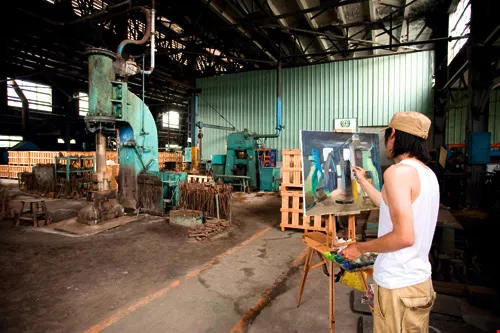
The TRW site was recently opened to the public, providing visitors a rare glimpse of the premises. A visitor is shown here making a painting of a steam hammer in the blacksmith shop as it heads toward retirement.
This past July, a cultural asset review commission under the Taipei City Department of Cultural Affairs provisionally approved a proposal to designate the site’s assembly shop, blacksmith shop, and power plant—all of which went into operation in 1935—as historic monuments, and to register its head office, diesel-electric locomotive shed, passenger car shed, transfer table, and overhead crane as historic structures.
The assembly shop, which now serves as a maintenance shed for all-electric locomotives and electric multiple units (EMUs), covers an area of 6,800 square meters and has 8,800 m² of floor space. At 167 meters long, 20.4 m high, and 23.8 m wide, it is the largest workshop on the site. The huge clear-span is a notable feature of the building, and the framework of riveted steel beams is extremely solid. As one employee marveled, “They’ve never had to repair it once since it was built.”
Another key feature of the assembly shop is the natural lighting. The roof ridge is raised to create a long skylight under each side of the raised part.
The blacksmith shop, mainly used for production of the various parts needed for repairing trains, has three steam hammers that could well be the most valuable pieces of cultural heritage on the site. One of the hammers was purchased by the Bureau of Machinery in 1889, and has been in service ever since.
The power plant, meanwhile, is the heart of the TRW, for it supplies the entire facility with steam power, and has never stopped running even once in all the years the workshop has been in operation. Every afternoon, as employees are getting ready to knock off for the day, the power plant shunts extra steam over to the employee bathhouse (now designated as a municipal historic site) so that the male employees can clean up after a hard day’s work.
The power plant’s tall smokestack is a Taipei landmark, and is among the parts of the facility that have been provisionally approved for designation as historic monuments.
For rail buffs, provisional approval for designation of additional TRW historic sites was a big initial victory. If the remaining procedures can be successfully completed, there will be a legal basis that ensures preservation of TRW cultural assets. Final endorsement of the plan by the Taipei City Government would add three more TRW cultural assets to Taipei’s list of municipal historic sites (along with the employee bathhouse, which was designated as a municipal historic site back in 2000).
The Cultural Heritage Preservation Act provides that “a monument shall be managed and maintained by its owner, user or manager,” that it “shall be preserved in its original appearance and construction method,” and that “no construction or development work shall damage the integrity of a monument.” Accordingly, once the assembly shop, blacksmith shop, and power plant are designated as historic sites, the preservation of their original appearance will be required by law, and the ability to convert them to commercial use will be greatly restricted, a prospect that the TRA finds most unwelcome.
The TRA has estimated that designation as a historic site would generate costs of more than NT$2.4 billion for construction, maintenance, redesign, remodeling, and preparation of visitor access. And this figure doesn’t even include an estimated annual operating budget of NT$600 million. For the debt-laden TRA, all this is a very heavy burden.
At an August 31 public hearing to discuss the possible designation of historic sites, the TRA fought its case valiantly, knowing full well the odds were stacked against it.
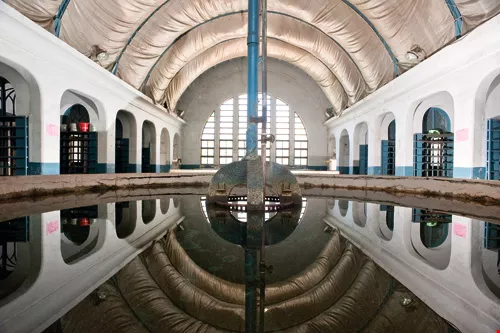
The TRW employee bathhouse was designated as a municipal historic site in 2000. The geometric beauty of its design reflects worldwide architectural design trends of the 1930s.
Representatives of TRA and its union went on the offensive at the hearing, pointing out that TRW employee incomes are tied up with the future of the site. They asked that the assembly shop, blacksmith shop, and power plant be downgraded to historic structures, and that restrictions on reuse be relaxed in order to “leave the TRA employees a little something to live on.”
Hung Chih-wen, an associate professor at National Taiwan Normal University’s Department of Geography who had registered to speak at the hearing as an expert in railway culture, listened with dismay to the arguments of the TRW union representatives. In Hung’s view, the deficits run up by the TRA are due to mismanagement by the Ministry of Transportation and Communications, and should not be linked to discussions about preservation of the TRW site, or to employee incomes.
As for the requirement that the TRA take responsibility for the site’s future upkeep, Hung suggests that since the TRA has enough money to spend NT$400–500 million on the Taroko Express trains, it ought to take some of that money and redirect it to a fund for historic preservation.
One TRW union member criticized people in cultural circles for “eating his lunch.” But a Ms. Xiao of Taipei, whose father had worked for the TRA, noted that after designation as a historic site, “Everyone who has worked at the TRW can be an excellent guide there.”
An official at the Taipei City Department of Cultural Affairs points out that the TRW site is currently zoned for industrial use. After all operations have been transferred to Taoyuan and the status of the site and its historic structures has been confirmed, the TRA will be required to submit a cultural assets preservation plan. Only then will it be possible to carry out the necessary urban planning redesignation and convert the site to a new use.
The TRA Planning Department has adopted a scheme that calls for “a fusion of old and new” at the TRW site. In contracting out the various parts of the project, it intends to solicit bids from foreign as well as domestic contractors, and an Italian group has already expressed interest in taking part.
One thing is certain—the TRW that once was, can be no more. There is nothing for it but to move forward. The history it has seen, and the lives that its employees have known (including, during the Japanese colonial period, annual sports festivals and sumo tournaments), may be a thing of the past, but the associated memories ought to be kept alive.
Taipei’s August skies were blue beyond compare, and beneath them the TRW grounds were opened to the public for a whole month as the countdown to the facility’s closing proceeded. We wish the facility all the best as it winds down in its final days.


@List.jpg?w=522&h=410&mode=crop&format=webp&quality=80)


