The Influence that Starts in the Cradle--Motherhood
Kaya Huang / photos Hsueh Chi-kuang / tr. by Phil Newell
May 2008


"Infancy's the tender fountain, / Power may with beauty flow, / Mother's first to guide the streamlets / From them souls unresting grow- / Grow on for the good or evil, / Sunshine streamed or evil hurled; / For the hand that rocks the cradle / Is the hand that rules the world.
"Woman, how divine your mission / Here upon our natal sod! / Keep, oh, keep the young heart open / Always to the breath of God! / All true trophies of the ages / Are from mother-love impearled; / For the hand that rocks the cradle / Is the hand that rules the world."
--William Ross Wallace
There is a very touching story in the international bestseller Chicken Soup for the Soul. An elderly woman has fallen into a coma, and makes no response to anything that is said to her. Then her daughter remembers a certain understanding that she and her mom had when she was just a small child. Hand in hand, three presses on the palm meant "I love you," two presses meant "me too," and four presses meant "I love you too." So the daughter takes her comatose mother's hand in hers, and presses three times. Amazingly, the mother responds with two presses. Though she no longer is conscious of what is going on around her, she still remembers the secret code she had with her small child. This little tale illuminates the eternally unbreakable ties, transcending even life and death, that bind children to "the earliest teacher"-Mother.
In 1997, two Harvard University professors released an astonishing study. They had discovered that there was a correlation between the answers given on a psychological survey to incoming Harvard students back in the 1950s, and the physical health of these same students in middle age. Of students who responded that their relationship with their mother was not close, by middle age 91% had heart disease, ulcers, alcoholism, high blood pressure, or asthma. The corresponding figure for those who had close relationships with Mom was only 45%. (For those who checked that they did not have a close relationship with either parent, growing up largely self-reliant, the rate of such illnesses was 100%!) That is to say, whether a person enjoys a mother's warmth as a child has an enormous impact on their psychological resilience and physical health.

The quiet impact
In his autobiography, Jack Welch describes the way he felt when he became CEO of GE, the world's largest multinational corporate group, in 1981. While he looked very self-confident, and others thought of him as decisive and tough, and even overbearing, arrogant, or rash, inside he was still insecure. He had to struggle with a speech impediment, and was self-conscious about his height (5 feet 8 inches).
How did Welch overcome these obstacles? The answer came from his mother's encouragement. She told him that his speech impediment was "because you are so smart that your tongue can't keep up with the speed at which you think." This one sentence resolved his low self-esteem and changed the way he looked at things, allowing him to become an expert at motivating himself and others.
"I think my mother never let me off easy because of my bad legs. If I did something wrong, she would punish me severely!" Rex How, chairman of Locus Publishing and a major figure in Taiwan's publishing industry, who has been confined to a wheelchair since being struck by polio as a child, relates that the impact of his mother's tough education was that "it is only right that one should be punished for doing the wrong thing, and feel shame, and so be able to change." Although his mom passed away when he was only 13, How has always felt that she has been there at his side. "Without my mother there never would have been me. I don't just mean biologically, but also spiritually. For me to have been able to become who I am today, the greatest influence has been my mother."
Jay Chou, the pop music superstar who is immensely popular on both sides of the Taiwan Strait, says forthrightly that the greatest pillar of support emboldening him to jump into show business was the strong emotional bond he has with his mother, Yeh Hui-mei. He even wrote a song, "Do What Mama Tells You," to express his gratitude to the mother who worked so hard to raise him single-handedly. Yeh herself is modest about her role in her son's success, saying that she never took any special approach, but only made one demand of Jay from the time he was small: Since he liked music, and chose music himself, then he had to be faithful to his own choice, and practice tirelessly.
Ultra-marathon champion Kevin Lin, who set off on April 6 to again take the challenge of the North Pole marathon, has very fond memories of the time his mother bought him a wristwatch.
The first day of primary school, when Lin's mom was taking him to the school, they reached a stationery shop less than 50 meters from the school gate when his mother suddenly stopped. Uneasy, Lin reminded her that they had already bought all the paper and pens they needed, hadn't they? It was only then that he saw her take out her money and carefully choose an imported Japanese digital watch.
Then his mother crouched down until her eyes were at the same level as Lin's, and said earnestly: Mom has to go "far away" to work now, so she hopes you will be able to keep track of the time yourself, that after school you will go right on time to the shop run by old Auntie on the first floor and wait there, and not wander about. The sense of time that his mother gave to him allowed Lin to develop the rigorous self-discipline required of the athlete, who strives for improvement every minute, every second.
A mother's influence is implanted quietly in children, no matter what nationality or what field of endeavor.

President-elect Ma Ying-jeou has said, "Father is the theorist, mother is the doer." His non-confrontational and sincere style of handling matters also comes from his mother's admonitions to "seek progress through being criticized."
You decide yourself!
"You decide yourself!" This is what Celia C. Hong, now chairman of Hong's Foundation for Education and Culture, used to say to her son Royce Hong. "I always allowed my son to decide things for himself, although before deciding we would always talk things over." Celia Hong allowed her son, the now 40-year-old third-generation heir to Matsushita Electric Taiwan, to develop in the direction of his own preferences, giving him as much freedom as possible in the process of growing up.
Royce Hong has publicly stated that he most admires his mother's eye for art and culture, as she is often able to see the potential in a given artist or performer long before he or she begins to come to public attention. For example, she provided financial support to both Cloud Gate founder Lin Hwai-min and Aboriginal singer Kimbo Hu many years back. His mother's molding also planted in him the seeds of his orientation toward art and design. Eventually, he founded a design workshop with his architect wife Grace Cheung, and the first work they produced won top prize in the Shaw Prize Trophy International Design Competition.
"You aren't me, so how can you know what I think?" Ko Chih-en, one-time recipient of a Golden Bell award for best host of an educational program, and now director of the Graduate Institute of Educational Psychology and Counseling at Tamkang University, has been chosen as an outstanding teacher at the university and in the public eye is an excellent program host. And her children have all been selected for the advanced classes in school. She used to firmly believe that you can achieve anything if you persist at it. But four years of constant conflict with her son upended all her assumptions. Over the course of countless arguments with her son Hung Fu, she felt frustrated but also gained a deep appreciation for the fact that "each child is an individual."
"Only when you clearly determine the nature of matters will the role of the mother not be unreasonably expanded, and only then will the child not be filled with unreasonable expectations." Once Ko "let go" and frankly admitted her "misguided approach" to her son, they could do things like discuss classical music or the martial arts novels of Jin Yong (Louis Cha) rather than argue. Last summer, she learned even more to "let go" when-after detailed planning-she allowed her 14-year-old son to get on a jetliner by himself, change planes in Chicago, and fly on alone to visit friends in Rhode Island.

Because Kevin Lin's mother was very busy with work, plus the fact that he lived at school starting in junior high school, this is one of the few photos that he has of himself and his mother together.
Character first
You've got to let go in terms of attitude, but what about the effects of behavior? Hsiung Chih-jui, the husband of Wang Ting-lan, famous for having raised five PhDs, says that in fact they rarely concerned themselves with their children's schoolwork, but instead invested a lot of energy in character development. The most important thing their mother taught them was "kindness." "Character education is simply that adults teach by example, and clarify values. This is the most important part of education," emphasizes Ko Chih-en.
Abraham Lincoln, the most respected president in American history, was known as "Honest Abe." Although his family was poor and he received only a limited formal education, and was only baptized as a Christian late in life, the influence of the Bible was deeply imprinted on his heart as he sat on his mother's lap as a small child and listened to her stories.
Lincoln later said: "I regard no man as poor who has a godly mother." This jibes with the ancient proverbial wisdom, "A good mother will produce a good king, and lead the country toward good deeds; a bad mother will produce a bad king, and lead the people toward wrongdoing." A mother's influence shapes the character of her child, which then impacts on the governance of the whole country, affecting the happiness and well-being of millions of people-this is true everywhere.
It is the Lunar New Year, and in a rain-soaked traditional market in Taipei, there is a tumult of voices. President-elect Ma Ying-jeou, still a candidate at this point, is with his mother Chin Hou-hsiu, buying holiday foodstuffs. Asked about the constant verbal attacks on Ma by his opponent, Mother Ma, who rarely speaks in public, says she has no complaints, and in fact frankly accepts the criticisms. "This is an election for president, not for Mr. Perfect or a saint. My son is not a saint; everyone has some faults. It doesn't matter if he is criticized, because this is all part of the process of making progress." Ma stands by nodding in agreement with his mother's admonitions.
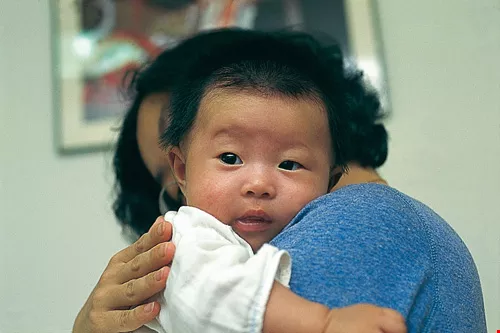
President-elect Ma Ying-jeou has said, "Father is the theorist, mother is the doer." His non-confrontational and sincere style of handling matters also comes from his mother's admonitions to "seek progress through being criticized."
Authority... and power
"The biggest problem today in parent-child relationships is that people don't talk about things." Ko Chih-en confesses that during her four-year "war" with her son, each day she felt, "My child is continually challenging my thinking." Fortunately their mother-and-child arguments were constructive, and frustration and anger gave Ko the opportunity for reflection, change, and problem-solving. Celia C. Hong likewise says, "To discuss things with your children is a way to help them grow, and indirectly to help them move forward in figuring out what to do with their lives."
No matter how busy one may be, communication with one's children cannot be neglected. Elaine Chao, the first Chinese-American in history to be appointed to a cabinet post, would go to church every Sunday with her family, after which, over lunchtime dessert, they would always hold a family conference at which each child would talk about their experiences and opinions and ask advice of their parents. So while outsiders were amazed at the discipline and obedience of the Chao sisters, what they didn't know was that this was the result of consensus reached between parents and children, without the least compulsion or pressure.
On the other hand, it was a very different story in the household of Lee Kai-fu, vice-president of Google Inc. International and a member of the world's ethnic-Chinese technology elite.
Lee Kai-fu has five older sisters. One of them, Lee Kai-ming, a well-known psychological counselor, recalls that when her mother turned 70 the order went out for her seven children, scattered around the globe, to return home for the big day. Not only that, but the five sisters had to have matching qipaos tailored for the family photographs. It was only after everybody had returned home that the nine family members remembered that it had been 16 years since they had all been together. And it was only then that Kai-ming realized that it was the nightmare demon of her growing-up years-maternal authority-that held them together spiritually even as they fragmented spatially.
"Raising children is not science, and there are no patterns that can be reproduced, because everyone is different. Mothers should have faith in their own methods for raising and educating their children." Daisy Hung, an expert in childrearing and a professor in the Institute of Neuroscience at National Yang-Ming University, adds a most fitting footnote to the role of mothers. When children grow up, although mother's scent may fade and dissipate, her influence on her children remains, like "another kind of aesthetics," to float forever in the landscape of the child's life.

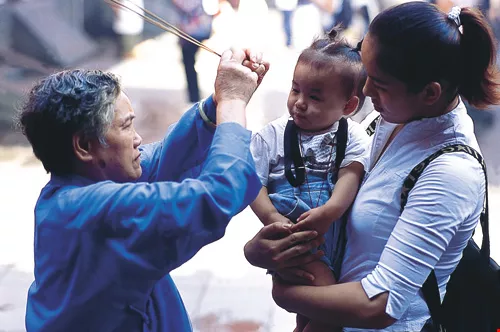
Mothers come in countless forms, but whether for good or ill each and every kind has a profound influence on their children. As mothers everywhere celebrate Mother's Day, let us remember their heavy responsibilities.
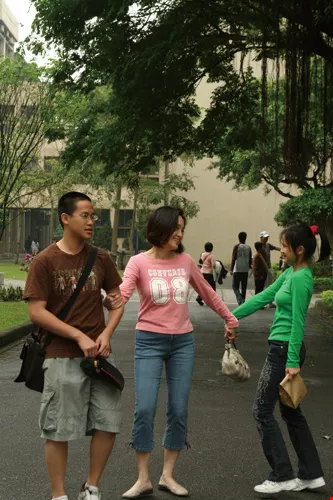
Hung Fu (left), who has recently just shaved his head in preparation for the tough year of study he faces prior to the senior-high-school entrance exams at the end of the third year of junior high, is pictured with his mother Ko Chih-en attending an activity of younger sister Hung Chun.
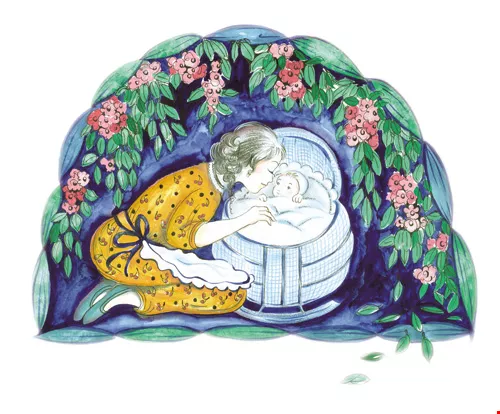

Mothers come in countless forms, but whether for good or ill each and every kind has a profound influence on their children. As mothers everywhere celebrate Mother's Day, let us remember their heavy responsibilities.


@List.jpg?w=522&h=410&mode=crop&format=webp&quality=80)


