Comics Genius--Master Cartoonist Tsai Chih-chung
Teng Sue-feng / photos Chuang Kung-ju / tr. by Jonathan Barnard
June 2004


Tsai Chih-chung represents an ex-clamation mark in the history of comics in Taiwan. At a time when comics are regarded as a field of meager financial reward, his works have been translated into more than 20 different languages. His readership stretches from Taiwan to mainland China and Japan, and on to Europe and America, covering more than 40 nations all told. Earning over NT$10 million a year in royalties, he could fairly be described as "Taiwan's richest cartoonist." Even high-tech corporations have sought him out as a creative consultant.
Tsai's cartoons and comics demonstrate a great diversity of content. Early in his career he created spoofs such as Drunken Knight. In his middle period he delved into the realm of Chinese classics, both novels and non-fiction. And in recent years, he has become fascinated with math and physics and will soon be releasing what he describes as a "series of major engineering works"-comic books about calculus and physics. Tsai is confident that he still has hundreds of volumes in him, and that his works will stand the test of time and be in print for centuries to come. What native talents has Tsai relied upon to shake up the field of comics for 40 years and to maintain such a high profile even today?
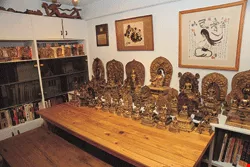
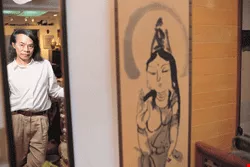
Tsai Chih-chung's high-rise apartment in central Taipei looks like a "city of 10,000 Buddhas." As soon as the door opens, a room full of Buddhas greets you. From the living room to the study there are more than 3500 of them-an abundance that seems all the more remarkable when you realize that Tsai is a Catholic and always has been, having been baptized as a small child.
"Like a madman, I throw myself into whatever I do. I love Buddhist statues, but I'm not a Buddhist," says Tsai, whose shoulder-length hair has become his trademark. In order to buy Buddhist statues, he once liquidated most of his assets, leaving only NT$500,000 for his family to live on.
"Rather than looking at something tens of thousands of times," runs the Chinese expression, "it is better just to paint it once." The Buddhas Tsai has drawn seem to come alive.
Content is king
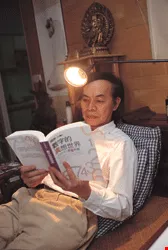
In addition to his Buddhist statues, his bookshelves are stacked with more than 1200 handwritten files that he has compiled in recent years on Zen, math and physics. His creativity extends far beyond the comic book versions of the Chinese philosophical classics with which most associate him.
"It's not as if I draw better than other comic book creators," says Tsai. "My success has always been rooted in the content. What will sell well? Those works that benefit readers." Tsai says Chinese who don't understand Chinese philosophy will buy cartoons about it. He plans to write a comic book that will enable junior high school students to learn calculus in an hour. His choice of subjects is based on the idea that "demand will come from anyone who knows he should know something he doesn't."
How will his comic books on calculus differ from those currently on the market, translated from foreign works?
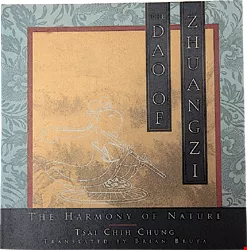
"They're completely different," he says. "Those foreign books were drawn by cartoonists who were hired by math professors, but who may not even understand calculus themselves. I'm different. It was the same when I made a comic book about Zhuangzi-I'm a Taoist, and I deeply understand Zhuangzi."
Wasn't studying calculus hard? "Well, it's like joining a trek in the Himalayas. Everyone has to ascend the slopes. Do you consider that a hardship?" Describing "counting" as one thing and "measuring" as distinctly another, Tsai says that when you understand mathematical theories you can begin to play mathematical games. Many regard his comic book Tsai's Illustrations, which explores the Chinese mathematical classics Map of the Yellow River and the Book of the Luo River, and Hanhsin Counting his Troops, as an outstanding mathematical reference work.
Apart from demonstrating great diversity in his work and interests, this master cartoonist is also a lively thinker and conversationalist who speaks his mind. From the numerous folders in his living room and study, he can find any information he needs about calculus, physics, Buddhism and the Chinese classics within 30 seconds-a skill that bears witness not only to his broad base of knowledge but also to his filing ability.
When creating a work, Tsai first selects the main theme, then reads related books, researching the topic in depth. This has been his modus operandi for more than a decade.
Wanting to depict the Buddha in a lively manner, 12 years ago Tsai went to Taipei's Kuanghua Market to buy antique Buddha figures. Once, ten of these statues were grouped on the table of his studio. He found this deeply moving, and resolved to learn more about Chinese Buddhist iconography. He now collects them and writes about them in notebooks.
During one period Tsai traveled frequently to mainland China, India and Japan, collecting Buddhist statues and visiting high monks to discuss Buddhist doctrines. On the statues in his collection, he carried out systematic analysis of their varied expressions, gaining a deep understanding about the spirit and esthetics of their cultures and eras. Now he can talk about their origins as if they were family heirlooms.
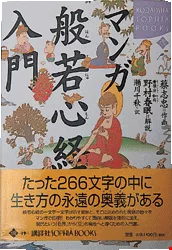
"Rather than looking at something tens of thousands of times," goes a Chinese expression, "it is better just to paint it once." Each of the statutes Tsai has drawn seems to have a language of its own. Recently, he has completed the Comic Heart Sutra, The Buddha Speaks, and The Dhammapada. With his earlier Zen Speaks: Shouts of Nothingness and The Sutra Spoken by the 6th Patriarch, they comprise a set of Chinese Buddhist classics.
The power of the pen
"A creator can't cloister himself in a room and expect to produce works that the world will welcome. We always have to know a little bit more and walk a little ahead of the readers, but not so far ahead as to appear crazy. You want to be a 'prophet,' but only as much as is appropriate." Tsai says with his usual frankness that only by "reading 10,000 books and walking 10,000 miles" can a cartoonist know more and think more deeply than his readers.
In order to write comics about the Buddhist sutras, Tsai collected over 3000 Buddhas, and in order to create a comic about calculus he audited math classes at National Taiwan University. These are just two examples of his extraordinary commitment to his work, but then Tsai, who began his career and became famous at an early age, has done many startling things.
Born in 1948 in Changhua, Tsai Chih-chung was the youngest child in his family. Before he was even born, four brothers and two sisters had died in infancy. When he arrived, his parents' only expectations were that he grow up healthy and happy.
When Tsai was a child, comic books were all the rage and he would go to comic book stores after school. After reading many of them, he started to imitate them. He drew constantly, and he would staple his creations into books and give them to his classmates to read. "By third grade, I sort of knew already that I was going to work in a field that employed my drawing skills."
Upon graduating from elementary school, he was the only student from his school to win a place at Changhua Junior High School. There he tried writing his own screenplay and he sent his comic books to publishers in Taipei.
When he was 15, after eighth grade, in the summer of 1963, Sheisha Comic House in Taipei asked him to draw comics for them. Although he was young, the choice between school and comics wasn't hard. After all, two of his older brothers had also left school for jobs when they were 15 or 16.
In Taipei, Tsai worked with a group of young men who had just completed their military service. His job was to copy the comics his boss brought back from Japan or to draw comics with absurd plots that combined elements of popular martial arts novels with the stuff of his own imagination.
In 1971, he began work as a graphic designer for Kuangchi Program Service. The cartoon credit sequences he produced for the Taiwanese-dialect serials Silly Son-in-Law and Green Oyster Madam earned him renown. But his proudest accomplishment in his five years at Kuangchi was to marry Yang Wan-chiung, its youngest director. A year after their marriage, their daughter was born. Tsai was well on his way to attaining the "five worldly measures of success": having money, a wife, a house, a car and offspring.
In 1977, he opened an animated film company with friends. They produced Older Master Cute, adapted from the earlier Cartoonist Wang Tse's Old Master Q. Playing in theaters across Taiwan, the film earned NT$70 million at the box office and won a Golden Horse for best cartoon. In 1983, basing characters on the popular Hong Kong comic martial arts stars Sammo Hung and Karl Maka, he created the comic strips Fat Dragon and The Bald Detective, which were published in newspapers and magazines in Taiwan, Singapore, Hong Kong, Malaysia and Japan.
"I would often draw late into the night, drawing sustenance from the thought that over 15 different printers around the world were churning out my work."
Having published little work recently, Tsai might appear to be semi-retired. Nothing could be farther from the truth. A self-described workaholic, he has been reading and drawing every day at home, preparing a series of educational comic books about calculus.
Rabbit-eat-rabbit world
It may seem as if Tsai drew for himself a picture-perfect career path. But the fact is, as someone who dropped out of school after eighth grade, he constantly had to overcome obstacles and had to be very aggressive in seeking opportunities.
Right before he was released from military service, he saw a help wanted ad from Kuangchi Program Service in the newspaper. Among the listed job requirements were completion of military service, two years experience and a college degree in a related field. Tsai only qualified on one count: his military service. But he took samples of his work to show the man in charge, Father Raymond Parent, and asked for a chance to take the job test. He ended up getting hired even though he hadn't even finished junior high school.
Back then Kuangchi Program Service had an animation studio and top-of-the-line recording, editing and projection equipment. This new technology and equipment spurred his thirst for knowledge. The only problem was that no one at Kuangchi knew how to create cartoon animation. Tsai asked Father Parent to bring him six cans of master tapes from Disney in the United States. He then borrowed a slide projector in which he inserted individual frames and projected them onto his ceiling at home. By so doing, he learned how to mimic the tiniest animated movements.
"I am a person who likes to knock on doors," Tsai says. "I try again and again until the doors open." More importantly, his confidence isn't hurt when he "doesn't succeed in opening a door." After Drunken Knight and Fat Dragon were published, he sent them to comic book publishers in Japan and made a detour to visit them when he went on a promotional tour in Southeast Asia. But he did not get a definite answer.
To him, submitting his works to publishers again and again does not represent bravery but just a lack of concern about "winning or losing"-an obliviousness to worldly success or failure.
In his files there is a work he created for fun: A Wolf Who Thinks. When his daughter was still young, he asked her why she thought it was that the Chinese character for wolf was a compound of the character for "dog" and the character for "goodness" rather than "badness." He then explained that by eliminating the unfit in nature the wolf had become a beneficent beast.
He describes a field of grass with hundreds of thousands of rabbits. At first, they all had enough to eat, but as the number of rabbits grew, the grass became insufficient. Typically, most rabbits just tried harder to find grass, but there was one rabbit who pondered the problem. One day it occurred to him: Why don't I eat rabbits instead of grass? As a result of this realization, that rabbit ended up leading the best life. Tsai emphasizes that changing one's perceptions isn't easy and that breaking deeply rooted ideas is very challenging.
Zhuangzi's soulmate
In 1984, Tsai started up an animation company with friends. They accepted more work than they could handle, and Tsai was forced to work day and night. With ever-looming deadlines and clients calling constantly for their work, the sound of the ringing phone became like an arrow in his heart. "I can jump out the window and be rid of all this right now," he would think at times, dreaming about finding a way out from all the pressure.
After courageously closing the company, he went to Japan to study Japanese, think about new ideas and prepare a comeback-by publishing his works in Japan.
Long before he went to Japan, some of his friends had asked him to work with them on a series of comic books about Chinese history, but publishers in Taiwan and Southeast Asia were pessimistic about its potential, believing that young people would not be interested in ancient philosophy. After he went to Japan, he pitched the same idea to the publishers there, but they felt that it would be hard to make a decision without seeing the actual work.
One day, he picked up a copy of Zhuangzi and started to read. He felt a powerful attraction toward the book. He discovered that ideas he had held since he was a youngster were very much in harmony with Zhuangzi's philosophy. He put his thoughts onto paper right away and started to read Zhuangzi seriously. After he read it once, he finished some 20 drafts. The second time around, he came up with another 40 drafts, and felt that the concept and the ideas grasped the essence of Zhuangzi.
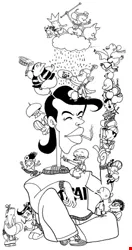
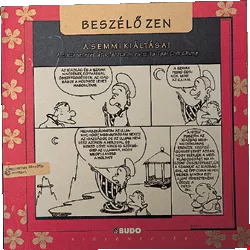
Showing remarkable diversity, Tsai's work is by turn resolute, sophisticated and spontaneous, as well as being humorous and serious all at the same time. His numerous books have been translated into many different languages and sold all over the world. (courtesy of Tsai Chih-chung)
Rewriting the history of comics
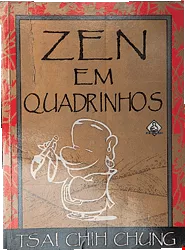
His first comic book based on a Chinese classic, Zhuangzi Speaks: The Music of Nature, was published in the summer of 1986. It heralded a new era for comics. By the end of the year, in early winter, it replaced the longtime chart topper The Wild Fires, by Lung Ying-tai, at the top of Kingstone Bookstore's bestseller list. It would hold that position for ten months.
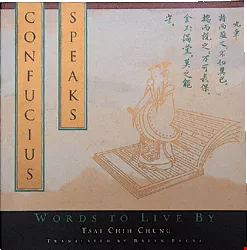
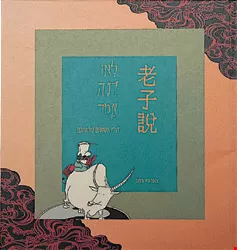
Tsai then became a soulmate to other ancient sages when he published in rapid succession Laozi Speaks, Words to Live By: Confucius Speaks, Austere Lessons of the Legalist School: Han Fei Zi Speaks, and Philosophy of Riding the Wind: Sayings of Leizi. He published 24 volumes in all. Through easy-to-understand explanations and rounded graphic lines, he shares his understanding of Chinese philosophy with his readers.
In 1992, Princeton University Press published an English translation of his Zhuangzi Speaks series, and in 1994, Japanese publishers Obunsha put seven pages from his Zhuangzi Speaks series into a high school textbook.
The comic book series Zhuangzi Speaks was a pivotal turning point in his early career, between 15 and 40. He turned from the humor and sarcasm of his earliest works to the Chinese classics, making comics that were no longer just for kids. Through them, adults learned about the ancient sages' philosophies of life.
From his comics about the Chinese philosophical classics, to his soon-to-be-published comic book Calculus, Tsai has continued to explore one new realm after another with zest. He is not running short on inspiration.
"I like whatever stimulates me, and painting well is not just a matter of technique," he says. "In this sense, comics are not drawn by one's hands but by one's brain. When I drew my comics of Laozi, Zhuangzi and the Buddhist sutras, I was expressing ideas. Constantly drawing from wisdom is a way to tap into a creative spring that never runs dry." He says that any process that turns "nothing" into "something" is magical. If he couldn't think, he says, he might as well be dead.
"Creating is my heroin or cocaine. I like to get up early and ponder physics and math while I drink coffee and have a smoke. There is nothing more interesting than wisdom." Tsai cites the Arabic prophet Kahlil Gibran, who said that wisdom was dipping a pen of light into ink of light and writing out words of light onto paper of light.
Describing life through comics
Apart from creating comic books and collecting Buddhist statues, Tsai likes to play bridge, garden and do interior design. He decorated his own home in Taipei, his house in Hsintien and his Tomorrow Studio. His basic concept for interior design is for the space to be simple, neat and modern, and the older the furniture the better. All these hobbies benefit his creative work.
Displayed on the top shelf of a bookcase in his home is a row of bridge trophies. He has received over 90 trophies in bridge tournaments in Taiwan since 1986. He plays bridge with Nie Weiping, a master of the game of go, whenever he goes to mainland China to promote a new book. "Bridge exercises your brain to help you think quicker. For someone who paints, elegance is very important, and playing bridge can help a person stay in an elegant frame of mind. One can't rush when playing bridge, because rushing leads to panic, which keeps the brain from functioning properly."
After creating comics for over 40 years, Tsai's works have been published in over 40 nations and have sold tens of millions of copies. Stacked in a pile, they would be as tall as him.
Tsai quips: "To achieve that honor you would have to be short." After a moment's pause, his thoughts start to run wild again: "Many people think publishing is a very ancient profession, but that isn't true. The first clearly dated book was a Diamond Sutra printed in the Tang Dynasty in 868. Up to now there haven't been many innovations in the form of books; but it's hard to say what will happen over the next 15 years...."
Foreseeing rapid technological change, he has been happily experimenting with different media. You can see characters from his works in multimedia books, mobile phones and on the Internet. And Jamar Idea Production has released a set of DVDs of his work in both Taiwan and mainland China.
Tsai says he is against selling the rights to his works outright, but instead wants to earn some royalties. His principle is simple: as long as both parties can reap some profits together, he will agree to a deal. "We have to install a tap and let the water flow out instead of trying to distinguish whether the well belongs to you or me," he says.
Tsai, who has enjoyed the scratch of pen on paper since he was a youngster, reckons the best choice he has ever made in life was to seek a career doing what he loves. If he were drawing only to make money, he would lack creative inspiration. He interprets his name Chih-chung thus: chih (?) represents a heart (?) that is determined to see things through to the end; and chung (?) denotes faithfulness to himself. This master cartoonist who has always been true to his own nature will continue putting pen to paper and expressing his unique wisdom.
Tsai's living room is full of Buddhist statues he collected on his travels. These ancient artifacts have had a tremendous influence on his work.

@List.jpg?w=522&h=410&mode=crop&format=webp&quality=80)


