Connecting resources is connecting love
According to the CYPC, from January to May of this year they helped 10,000 people in 2600 households with donations of bread valued at NT$15 million.
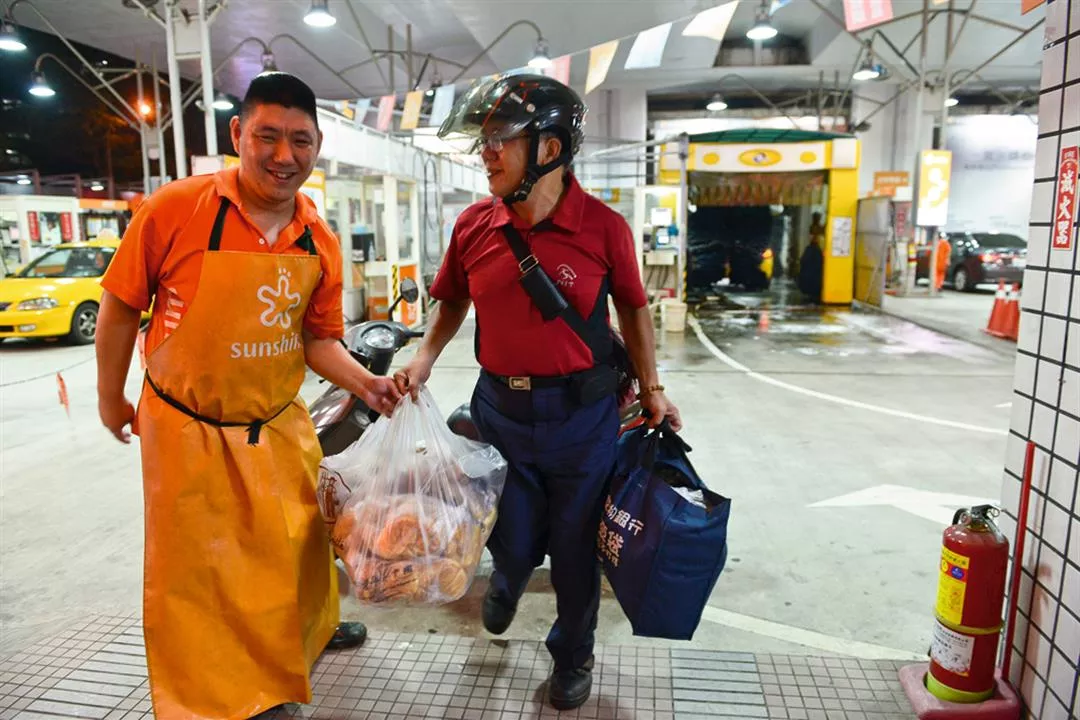
Shijie, 18, works at the gas station and loves bread. Every Sunday night he eagerly anticipates the arrival of “Uncle Bread.”
The gas station’s manager explains that some of the young workers have unusual family situations and need special care. If those workers don’t have a shift on the day the bread arrives, the station will put some of it aside for them in the refrigerator.
On the evening of our interview, Lian gives two bags of bread to the gas station. Of the remainder, he brings a portion to the Jianjun Group Home on Taipei City’s Dingzhou Road, and a portion he takes home and puts in his fridge, before delivering it to the Sunshine Carwash the following morning, so the disadvantaged kids on its staff can have some breakfast.
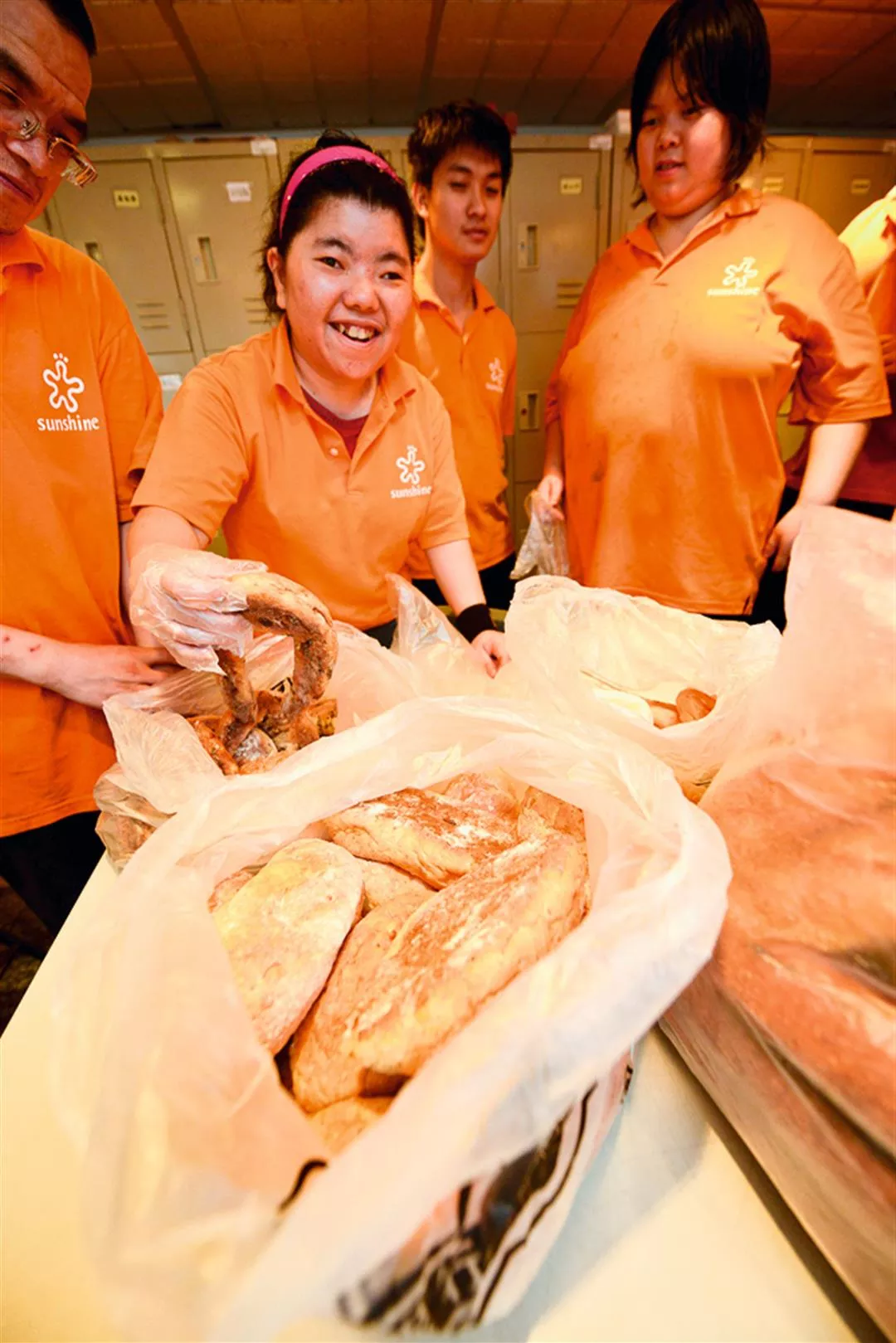
The Jianjun Group Home has more than 20 mentally handicapped children, mostly from low and low-middle income families. For the last two years Lian has been regularly delivering donated bread there on Sundays. The home’s director Chen Yunyu says that its residents all know that the bread has been donated, but they don’t view it as “something other people don’t want.”
“Connecting resources is connecting love,” says Chen.
Saving face
Volunteers play a key role in distributing donated bread. Tu Yongxian, who was born in 1976, is one of the younger volunteers.
He mainly works at Taipei City’s low-income housing projects managed by the Department of Social Welfare. Of those who receive his bread, 70% are elderly living alone and 30% are single-parent families. In all they constitute about 100 low-income and lower-middle-income households. In Wanhua District, which has Taipei City’s lowest average income, he comes across a great variety of circumstances that are often at odds with images of the urban poor.
He notes that some households in the projects simultaneously receive child, family and disability support from the government. He has seen lower-middle-income households who own fancy cars and whose children carry smart phones. Tu refuses to deliver bread to households that he feels are abusing the social welfare system.
He also declines to deliver to drug addicts, to heavy drinkers and to those who fight and cause trouble.
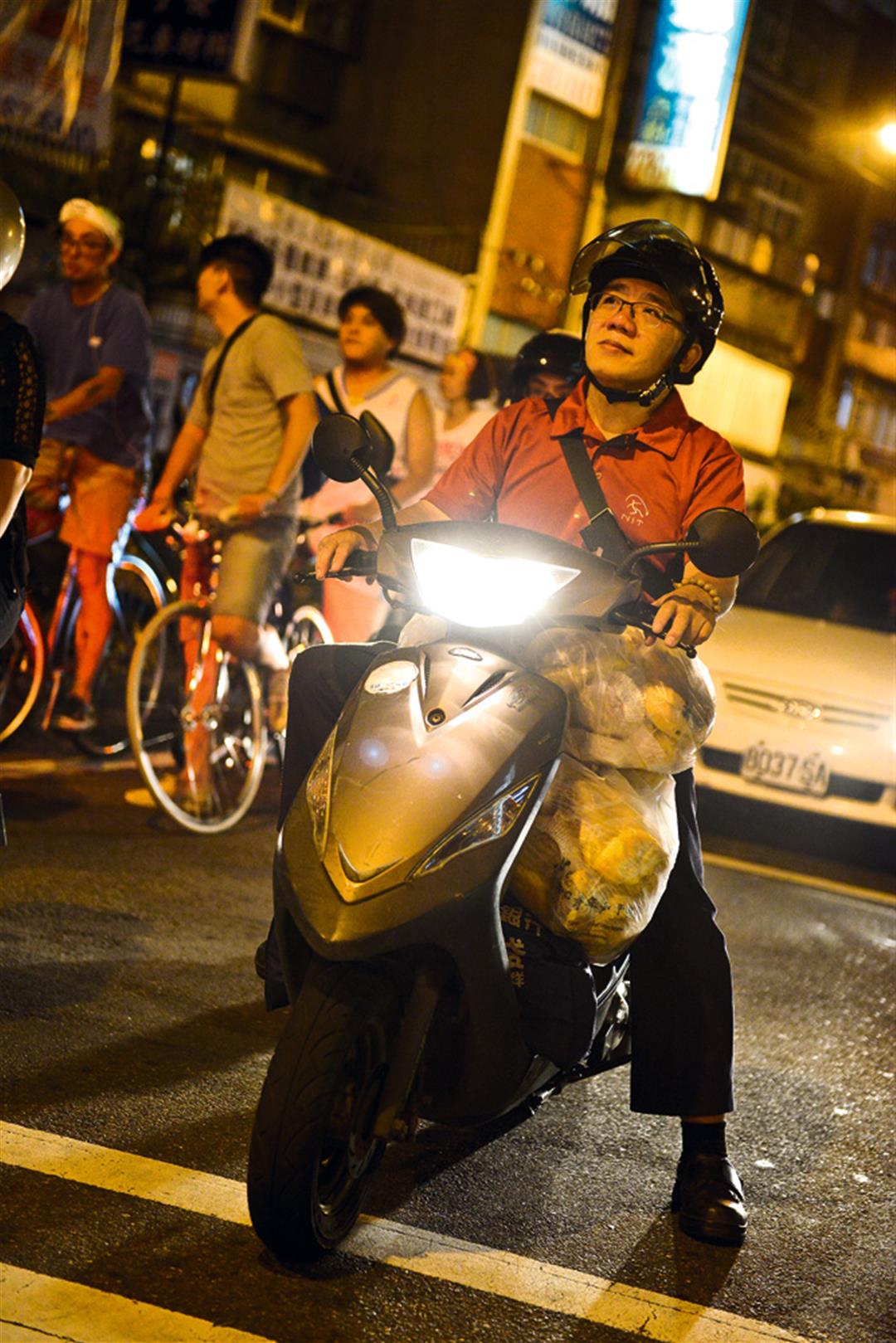
Twice a week Tu drives his motorcycle to bakeries near the Taipei Railway Station to pick up leftover bread. All those who receive the bread are economically disadvantaged, but that status in itself is not sufficient to receive it.
The first time Tu delivered to one of his new households this year the parent refused the bread, shouting, “I didn’t ask for these deliveries.” Tu decided just to leave the bread hanging on the door knob. Not long afterwards, the bread was tossed down from the home on the fifth floor.
After being refused there several times, Tu no longer rings the bell to announce himself. He has changed his tactic to simply leaving the bread at the front door, so that the family can bring in the bread at a suitable time.
“You’ve got to consider their sense of self respect,” says Tu. “The poorer people are, the more they fear losing face.”
Saving on disposal costs
Producing too much bread easily leads to waste—of ingredients, water and electricity. It’s all good and well to view surplus bread as a means to provide charity, but shouldn’t bakeries, while continuing to make donations, also try to prevent unnecessary waste? They shouldn’t think, “We don’t have to worry about making too much, because we can just donate any extra.”
Upon receiving nearly 100 loaves of bread, one staffer at the Sunshine Gas Station states that he doesn’t complain about getting “too much” and doesn’t worry that they can’t eat it all, because disadvantaged individuals come from disadvantaged families, and everyone receiving aid has a lot of people behind them who also need help. The hope is that many more bakeries will participate.
Yang Zhi’an, the director of the business department at the Sunshine Foundation, used to manage a branch of the Children Are Us bakery, where he arranged bread donations.
Yang believes that making too much bread is wasteful. But in order to adhere to the bakery’s marketing strategy of attracting customers into the store with well-stocked shelves, surplus production was regarded as a necessary evil.
“When bread comes out of the oven at chain bakeries, if you can’t fill up the shelves, business will suffer,” he says.
From the standpoint of consumer behavior, this analysis makes sense. Customers often wrongly believe that if shelves are largely empty, then it must be because the bread there is stale and no one wants to buy it.
Consequently, Yang explains, chain bakeries usually expect to lose about 12%. If they bake 100 loaves, they expect at least 12 of them will go to waste.
Drawing from his previous experience as a bakery manager, Yang points out, “If you cut the rate of waste down to 5%, you’d lose 30% of your business.”
Evelyn Wang, project manager at CYPC’s food bank, observes that some bakeries limit production, working toward greater efficiency. SunMerry Bakery is one such example.
In fact, disposing of waste bread is itself an expense. In Yang’s estimation, turning over surplus bread to a food bank every day could save a baked-goods shop as much as NT$10,000 per month.
The situation regarding leftover bread varies greatly from nation to nation. According to a UK survey, British households throw away 4.4 million metric tons of bread each year, meaning that for every three loaves that are purchased, one goes to waste. Turkey produces 6 million excess loaves of bread every day, so that the amount of money wasted in a year would be enough to build 500 schools.
Bread has become an important part of the Taiwanese diet, but to date no one has formally tried to put a dollar figure on the waste.
If the amount of donated bread in Taipei City and New Taipei City could create a stack the size of 14 Taipei 101s, then the amount of tossed bread is likely to be several times larger. Is not that thrown-away bread the true waste of food and bakers’ love?


@List.jpg?w=522&h=410&mode=crop&format=webp&quality=80)