Losing Their Souls To War--The Takasago Volunteer Detachment
the editors / photos Chuang Kung-ju / tr. by Geof Aberhart
August 2005


"In forests without discernible tracks, they would dart about scouting out enemy movements. They could pick out distant noises, and lure the enemy into giving up their exact position. They could bring the full force of guerilla warfare to bear on their opponents, and were the driving force behind our troops." Such is the recollection of a Japanese soldier of the Takasago Volunteer Detachment's actions during the Second Sino-Japanese War.
In the three short years between 1942 and 1945, between 4000 and 8000 Taiwanese Aborigines were dispatched by the Japanese to the most heated battlefields of Austronesia. Over half of these conscripts lie buried in foreign lands. Those fortunate enough to make it home were left haunted by their memories of war, suffering alone and in silence.
I traveled to the Meihsi Indigenous Community in the Nantou County township of Puli, to the home of Takasago Volunteer Detachment veteran Tseng Yuen-shih. The 83-year-old Tseng is surprisingly vibrant as he says to me, "It gets lonely living here on my own, it's great you decided to come see me."
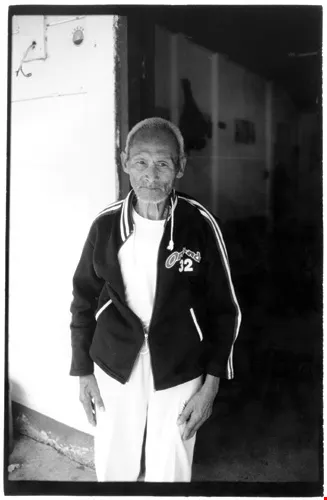
How many nightmares of the battlefield does this silent face conceal? When he returned from battle to his home, Tseng Shi-yuan, who served in the Takasago Volunteer Detachment, frequently felt as if he was still at war, throwing stones as if they were hand grenades and dropping down to crawl on the ground.
Back to the battlefield
Taiwan Historica writer and editor Lee Chan-ping, who led our trip here, starts singing old Japanese battle songs in an attempt to jog Tseng's memory. Suddenly Tseng, who had previously looked like he was miles away, shoots out, "That's not how that line goes." It seemed his mind had found its way back to the battlefield.
Switching between Atayal and Japanese, he starts telling his story:
"When the time came to see us off, the village was alive with people wishing us well, but my mom and dad were heartbroken.... When I heard the Japanese had lost, I was elated at the thought of getting home soon.... When I got home, I learned my daughter had been killed in the war...."
After that, he spent the majority of the interview immersing himself in his memories of his time in the jungle, a time where he almost died of poisoning.
In the later stages of the war, Japanese troops began to run low on ammunition and supplies. Taiwanese-born troops and the Takasago Detachment were forced to live with the corpses of fallen comrades, with many of those corpses stripped down to the point that all that remained was a pair of underwear. "Some bodies had been sliced up so much that only bones were left," says Tseng. The food shortages got so severe that some soldiers turned to cannibalism, even going so far as to kill local indigenous people for food. Tseng himself refused to eat human flesh, catching snakes and frogs to feed himself. On one occasion, he ate two small fruits he had found, which then turned his whole body numb. He passed out and had to undergo emergency treatment by Japanese medics, saving his life.
Statue-esque
Sung Tsai-yu, our interpreter, grew up in the village of Meihsi. She recalls how, when she was growing up, Tseng threw stones at virtually every one of the local kids at some point. Back then, Tseng worked at her family's mushroom farm, where he was always very quiet. He would sit, alone, by the stove that smoked the mushrooms "not moving for ages, sitting there like a statue."
When a group of kids started playing around outside, he would be startled out of his reverie and start throwing stones at the kids and then hit the deck. During Chinese New Year, the moment Tseng heard firecrackers going off he would frantically find a dark corner to hide in.
"When I was a bit older I realized that he thought we were enemy troops and that he was throwing grenades at us!" No-one had ever tried doing anything to help heal these terrible scars the war had left on Tseng.
When the old man's condition was at its worst, he would start wrecking virtually everything around him-even his pillows and bedding were torn to shreds. He eventually had to be locked away in his home. Looking at Tseng today, with his sincere, good-natured countenance, it's hard to imagine this is the same person.
Examples like this are far from extraordinary. Sun Ta-chuen, Dean of the National Dong Hwa University Graduate Institute of Indigenous Development and former chair of the Council of Indigenous Peoples, had three veterans of the Takasago Detachment in his family. Sun recalls that after his uncle returned from the battlefield, his once vibrant and cheerful disposition had vanished, replaced by a man who kept himself sealed off, refusing to take part in any local celebrations. At that time they were still under surveillance by the Kuomintang and were regarded as untrustworthy, so he chose to retreat from everyday life, spending his days carrying around a radio and listening, transfixed, to Japanese songs.
In his twilight years, Sun's uncle was sometimes found by his family crawling around, prone, on the floor in the middle of the night. "No-one could get close to those veterans, so they couldn't let out all the emotions they'd been repressing for 60-odd years," says Sun.
The dependable Aborigines
Winding back the clock, when the Takasago Volunteer Detachment was first formed in 1942, 4247 Aborigines fought to secure one of the 500 places in the detachment. They were motivated by the atmosphere around them of going on a "crusade" for their country and a desire to erase the stigma of being regarded as a "lower caste" in colonial society. Bringing knives wielded by their ancestors and pledges written in blood, wave after wave of Aboriginal warriors joined the Takasago Detachment.
Since antiquity, Aboriginal warriors have faced battle with the determination to fight to the death. They considered it an honor to head out to battle. Fighting for their leader-in this case, the Japanese Emperor-is part of the traditional Aboriginal spirit. For them, village and country overlapped, and the individual and the group were indivisible. "How these people identified themselves at that time-as both Japanese and members of the tribe-meant things were more complicated than a simple right-wrong duality," says Sun.
On the battlefield, the dedication of the Takasago Volunteers was second to none; they would choose to starve to carry food to other troops. One Japanese veteran, who had been looked after by members of the Taka-sago Detachment, once excitedly exclaimed, "Every New Year's Day, the first thing I feel I have to do is turn to the south, toward Taiwan, and pray to them in a show of my sincere respect for them."
But these soldiers who were "loyal until death" were not fairly compensated by the Japanese after the war, which angered many Aborigines no end.
"When they lost the war, they promptly forgot all about us. Thinking about it just annoys the hell out of me, and if there were any Japanese left here, I would kill them one by one," says Chen Kan-hsiung, a Takasago veteran who lives with his wife in post-921 Earthquake emergency prefabricated housing. On the wall of their prefab hangs a photo of Chen from over 60 years ago, before he was dispatched to the Austronesian theater.
Civilian memories
What happened during that period not only affected the veterans themselves, but also had a strong impact on their families, and even their entire villages.
The militaristic ideal, the concept of the tragic beauty of hara-kiri-these became the lasting impression of Japanese culture held by the next generation of Aborigines.
"Thinking back to my childhood, I remember being incredibly moved by the local pastor talking of Jesus giving his life for us. I now see that feeling was influenced by the Japanese concept of sacrifice," says Sun Ta-chuen.
After the war and the Republic of China regaining sovereignty over Taiwan, the loyalty the Takasago soldiers had shown the Japanese was viewed as almost treasonous and criminal. Their memories and history from the war became a nightmare they were virtually prohibited from sharing.
"I think that what needs to happen now is a show of understanding and support for veterans, so that they don't end up leaving this world still wrapped in a shroud of silence." In these days of confusion over ethnic identity, this is Sun's greatest wish.
@List.JPG?w=522&h=410&mode=crop&format=webp&quality=80)

@List.jpg?w=522&h=410&mode=crop&format=webp&quality=80)


