Taipei Mass Transit Makes Another Leap as Xinyi Line Opens
Lin Hsin-ching / photos Chin Hung-hao / tr. by Phil Newell
January 2014


The Xinyi Line of the Taipei Mass Rapid Transit (MRT) system, which took eight years to build at a cost of NT$26.8 billion, was formally opened to passenger use at the end of November of 2013. This line, which runs through several major shopping zones—the Yongkang boutique area, the Tonghua Street night market, and the Xinyi department store district—promises to be a huge financial boon to those along the route.
When the Songshan Line, which traverses the major financial artery of Nanjing East Road, opens at the end of 2014, the first phase of the MRT network within Taipei City proper will have been completed.
This system, which carries over 1.9 million passengers daily to a multitude of destinations, is the primary means of public transportation for the “Greater Taipei” metropolitan area (Taipei City plus its suburbs in New Taipei City). It has been a spur to economic activity and urban development, and is the “invisible hand” behind the vision of a low-carbon sustainable city.
The recently opened Da’an Park Station of the Xinyi Line of the Mass Rapid Transit (MRT) system has become one of Taipei City’s hottest tourist and leisure destinations.
It is a weekday afternoon, and right outside we see children excitedly racing around trying to be first to climb the big brass frog lying in the garden plaza; meanwhile an elderly couple are sighing with admiration as they take in the “Autumn Leaves Traveler” installation artwork that conceptually encompasses the MRT, the people, and nature. There are also quite a few foreign tourists, pausing in their walkabouts to wait for the regularly scheduled and very lovely “fountain curtain” water show.
When you are ready to leave Da’an Park, get back on the Xinyi Line and in just minutes you can be at the Yongkang Street boutique area, the Tonghua Night Market, or the Xinyi District department store conglomeration. Given the tony neighborhoods it passes through, the Xinyi Line is indeed worthy of the nickname “the Golden Artery.”
Besides its commercial worth, the Xinyi Line is also the second east-west line in the Taipei MRT system, and should take a lot of the rush-hour load off of the heavily trafficked Bannan Line. Most of the current routes of the system run north-south as they pass through downtown Taipei City. Before the Xinyi Line opened, the downtown portion of the Bannan Line was the only east-west route, carrying 640,000 passengers a day. Now that the Xinyi Line is up and running, the Bannan Line should have a much easer time of it.
A third east-west subway, the Songshan Line, is scheduled to open at the end of 2014. The line will run along Nanjing East Road, which has Taipei’s densest concentration of financial institutions, for a good distance. With its completion, the initial MRT network within the boundaries of Taipei City proper will be fully formed, at which time citizens headed in any direction will be able to choose from a wide range of timesaving routes with minimum transfers.
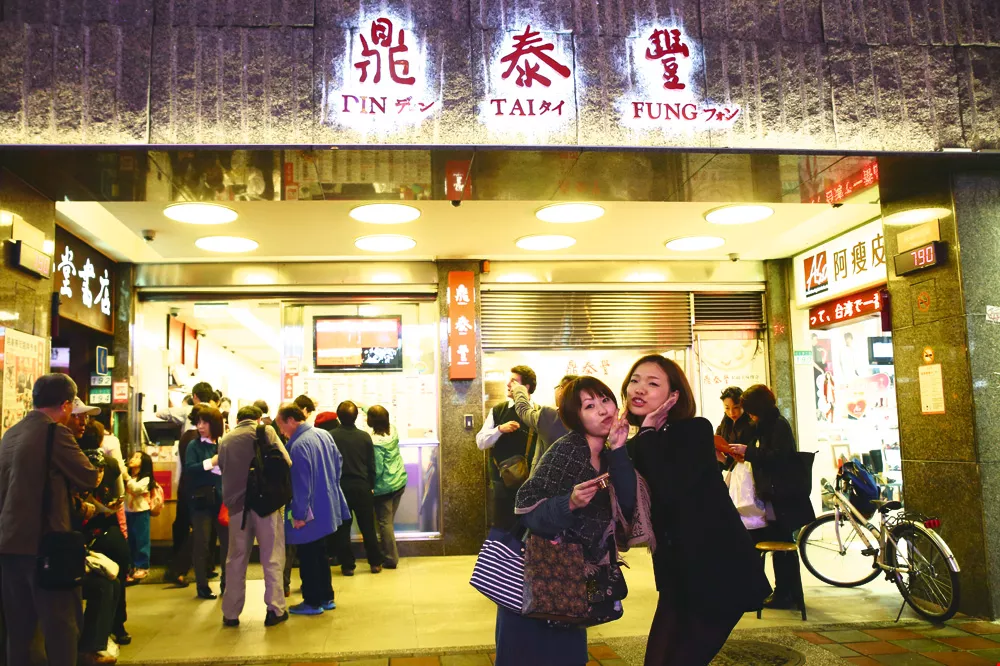
The Dongmen Station of the Xinyi Line is located next to the Yongkang Street boutique area, and carries countless international visitors to the flagship branch of the world-famous Din Tai Fung restaurant chain.
The clean, fast, and extremely reliable MRT system is the circulatory system for the Greater Taipei metropolitan area (composed of Taipei City at the core plus the most densely populated areas of New Taipei City that surround Taipei City in all directions). It has been no easy feat to construct the system, with the earliest conceptualization of a metro for Taipei dating back more than 40 years.
Back in 1968, Sun Yun-suan, who then was head of the Ministry of Transportation and Communications (MOTC), publicly stated that the government was studying the feasibility of building an MRT system for Taipei. But because of the enormous projected cost, and the fact that citizens didn’t seem to feel any urgent need for such a system at that time, the idea was shelved.
But as the economy boomed in the 1970s, Taipei’s population and traffic volume grew rapidly, and terrible traffic jams became the norm. There was little choice but to bring in some kind of MRT system.
At the beginning of the 1980s the MOTC’s Transportation Planning Commission (now the Institute of Transportation) and the Taipei City Government came up with separate blueprints for an MRT system. The MOTC’s plan called for four routes, several to be high-capacity underground lines. Taipei City objected to the fact that the MOTC plan did not serve districts like Xinyi and Muzha, and to meet the needs of these areas proposed an elevated, medium-capacity system.
The central government then decided to assign the Council for Economic Planning and Development to hire three specialized consulting firms from the US to reconcile the plans. Out of this process emerged, in 1986, the first-phase blueprint for the Taipei MRT. Three lines (Red, Blue, and Orange, which are today the Tamsui–Xindian, Bannan, and Zhonghe lines) would be high-capacity, while the fourth (the Brown Line, today’s Muzha Line) would use the less expensive medium-capacity elevated model.
In 1987, the government created the Department of Rapid Transit Systems (DORTS) under the Taipei City Government. DORTS promptly made some adjustments in the plan based on public opinion survey results, extending the Bannan Line to the suburb of Nangang and rerouting the elevated Muzha Line along Wanfang Road instead of Muzha Road. They also added a maintenance track (the Xiaonanmen Line). In the early 1990s, DORTS added two more lines, one running to the northeastern suburb of Neihu, and another to Tucheng, traversing the suburbs south of Taipei City. This is the Greater Taipei MRT system that today plays such a profound role in the lives of citizens of the metropolis.
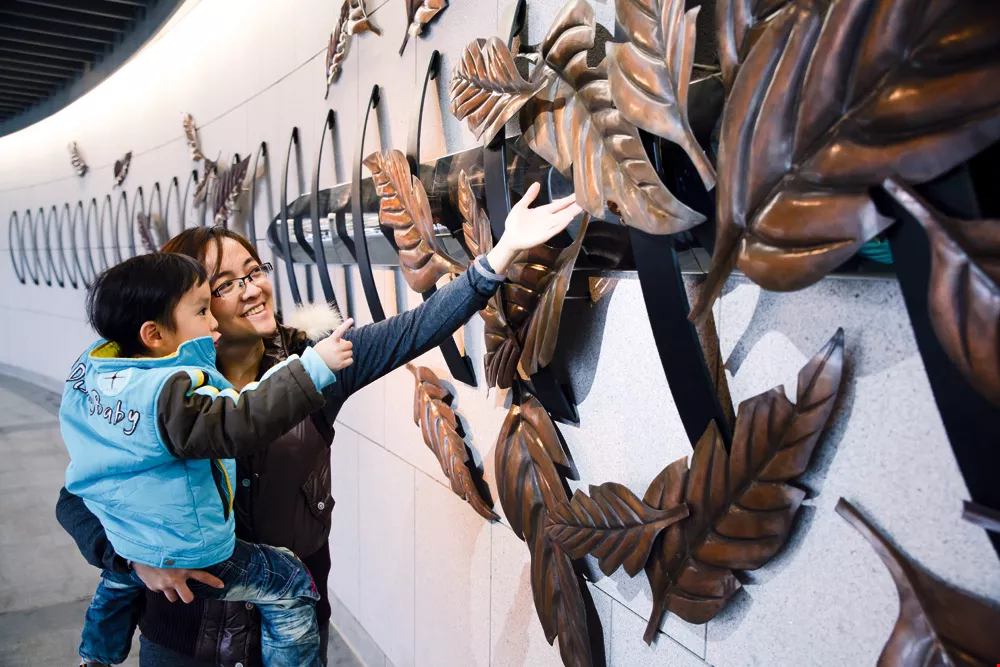
Public art adorns stations along the Xinyi Line; in the open-air plaza at Da’an Park Station, you will find a brass frog (right) as well as the installation art work Autumn Leaves Traveler (center); and at Taipei 101 Station, the motif is faces of old and young displayed on a futuristic mechanical installation called Meeting Time (left).
Work began on the MRT in 1988. In order to get the system up and running as quickly as possible, DORTS decided to begin work on all six lines simultaneously. Construction crews began digging along many of Taipei’s main avenues, including Zhongshan North Road, Zhongxiao East Road, and Roosevelt Road. As streets that were once six lanes wide were reduced to four or even fewer lanes, traffic jams became worse and worse with each passing day, writing the darkest page in the history of transportation in Taipei.
Former DORTS chief Richard C.L. Chen, who took part in the entire process of planning the Taipei MRT, says that compared to other cities in the Asia–Pacific region, Taipei started on its MRT system relatively late. “Generally speaking, when a city reaches a population of 1 million, that’s the best time to start work on an urban mass transportation system, but by the time digging began in Taipei, the city’s population was already 2.6 million, for which we ended up paying a very heavy penalty in terms of traffic congestion caused by construction work.”
This traffic nightmare lasted, day after day and night after night, for more than a decade.
Making matters worse was the fact that the Muzha Line, which was supposed to be the earliest to come into operation, ran into numerous problems during the construction stage. At one point, there was even a fire during a trial run, causing many citizens to become deeply cynical about the whole system.
Current DORTS commissioner Tsai Hui-sheng, who was then the vice general manager of the Taipei Rapid Transit Corporation (TRTC), says that the French contractor, Matra (now a subsidiary of the Lagardère Group and operating under that name), had built light rail cars consisting of two-car units for a number of urban transit systems in French cities including Lille and Toulouse. But in order to meet the capacity requirements of the Muzha Line, they bid for the contract using a format of “two linked two-car units” (i.e. four cars per train). DORTS, which was a complete novice to the world of urban mass transit, naively accepted that this would be feasible.
Zut alors! Things did not go as planned. The cars for the Muzha Line were designed to be fully automated, with no drivers, making them very different from the simple “hook-em-up” cars used in an ordinary railroad system. Each two-car unit built by Matra had its own independent control system, and it was not possible to link these controls together. When two such units were tied together, their control systems often worked at cross purposes, one telling its cars to stop, the other telling its cars to keep going. The friction was too much for the rubber tires to bear, and ultimately during one trial they burst into flames. This was the cause of the fire.
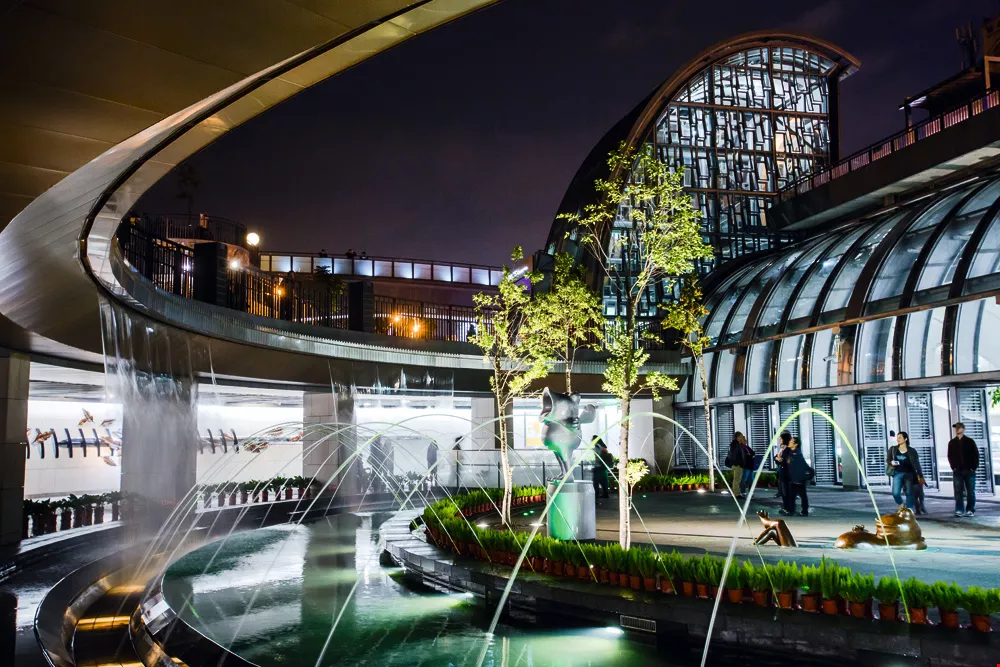
The refracted light coming through the glass tower, combined with the multicolored light show accompanying the dancing fountains, give Da’an Park Station the appearance of a treasure chest full of glittering jewels.
In March of 1995, Taipei mayor Chen Shui-bian commissioned several independent experts to do a thorough diagnosis of the Muzha Line, after which the problem-ridden project was finally completed. It formally opened to passenger traffic on March 28, 1996.
But even after the Muzha Line opened, contract disputes continued between DORTS and Matra. Shortly thereafter, Matra suddenly announced that they were pulling out of the Taipei MRT project, and would halt all system upgrading and maintenance tasks.
Tsai Hui-sheng says that Matra had already begun to make preparations for their pull-out as long as half a year before formally withdrawing. During that period, whenever printed circuit boards (PCBs) used in the MRT system or the electrical or mechanical equipment became non-functional, Matra invariably directly replaced them with new ones, never assisting in repairing them, so as to keep their knowledge a trade secret.
Matra thought that Taiwan lacked the capacity to repair and maintain the MRT system on its own, and that Matra’s withdrawal from the project would give them the upper hand in negotiations, forcing Taiwan to agree to any conditions just to get the company to come back.
But it turned out that DORTS was not as naïve as Matra had counted on. In fact, DORTS had early on formed a “super secret” R&D team composed of elite Taiwanese engineers (recruited from organizations like the Chung-Shan Institute of Science and Technology, Academia Sinica, and the Industrial Technology Research Institute) to “decipher” each and every PCB in the Muzha Line system.
A few days after Matra pulled out, the control center for the Muzha Line experienced, with no forewarning, a freeze of its computer system. Fortunately TRTC was a step ahead, and they had previously recorded all the boot-up programs exchanged between Matra in Taiwan and the company’s headquarters in France. Thanks to such farsighted measures, the Muzha Line continued to run safely and dependably for more than a decade until July 4, 2009, when work was completed to convert the entire line to a system installed by train manufacturer Bombardier of Canada.
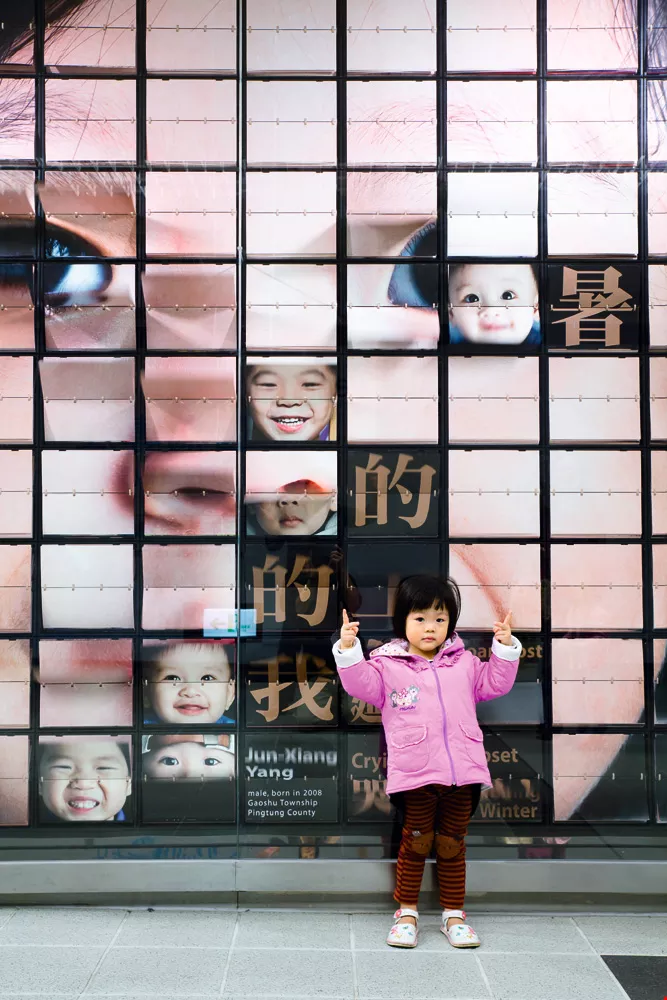
Public art adorns stations along the Xinyi Line; in the open-air plaza at Da’an Park Station, you will find a brass frog (right) as well as the installation art work Autumn Leaves Traveler (center); and at Taipei 101 Station, the motif is faces of old and young displayed on a futuristic mechanical installation called Meeting Time (left).
The contract problems with the Muzha Line, as convoluted as any spy movie, proved to be a valuable learning experience for DORTS. Since then they have always maintained firm control over the system software and electrical and mechanical maintenance skills for every MRT route, so that if there is any natural disaster or unforeseen human error, the system can be restored to full operations as quickly as possible.
In September of 2011, Typhoon Nari caused heavy damage in Taipei City, and the MRT system was severely impacted. There was serious flooding in the train maintenance center in Nangang, in the main MRT hub beneath the Taipei train station, along the Bannan Line all the way from the Kunyang to the Longshan Temple station, and all along the Tamsui–Xindian Line from the Guting to the Shuanglian station.
It was widely believed at the time that it would take at least a year to get the MRT up and running again. But within three months, all of the heavily damaged underground track had been reopened and operations had resumed. “This kind of efficiency has never been matched anywhere in the world!” says Tsai Hui-sheng with pride. And it was only possible because DORTS had firm control over the software and repair skills.
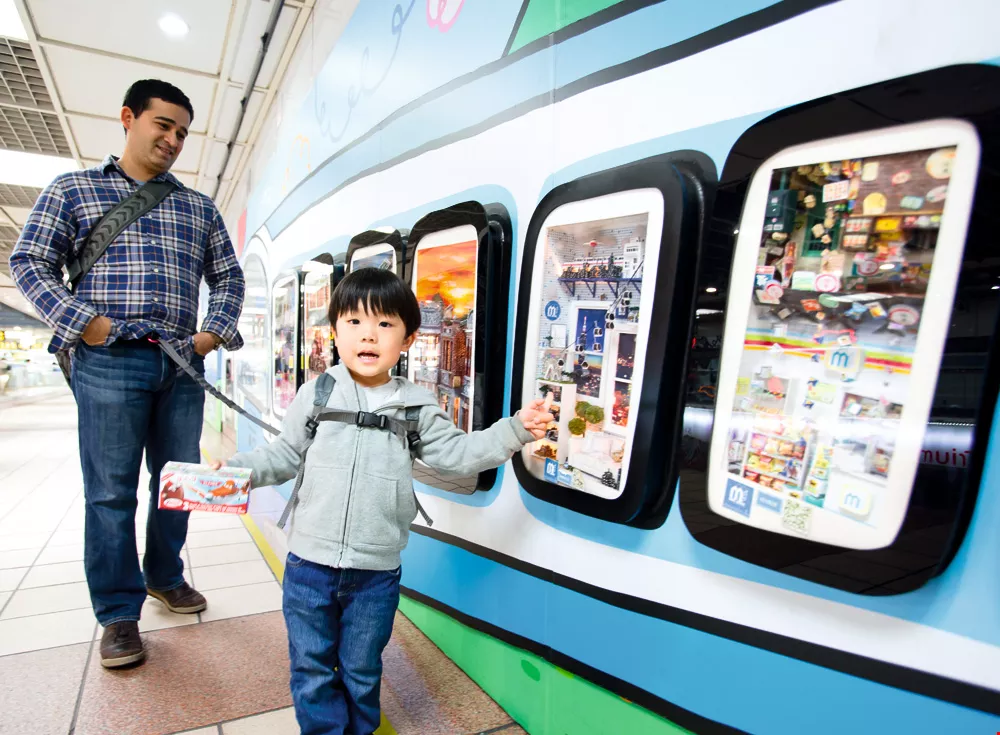
The “SuperWOW” illustration/installation exhibition, designed specially for Zhongxiao Fuxing Station, draws attention to some of the different life themes and city scenes that define Taipei City.
After all the trials and tribulations of the construction period and initial phase of operations, the fruits of the strategy of building six lines at once began to be harvested from 1997 to 2000. The Tamsui Line, Xinbeitou Branch Line, and Xindian, Zhonghe, and Bannan lines were opened to traffic one by one. The street traffic situation steadily improved, and people gradually began to feel more positive toward the MRT and to rely on it more and more.
Chan Shi-tsung, director of the planning division at TRTC, points out that the real turning point came with the opening of the Bannan Line in 1999. At that point two lines—Tamsui–Xindian, and Muzha—were already open, but they ran parallel to each other north to south without intersecting, earning the layout the dubious nickname of “the chopsticks network.” Bannan, running east to west, crossed both of the north-south routes, creating an interconnected network of three lines shaped like a double plus sign (++). Usage rose sharply from 240,000 passengers per day to 930,000.
Moreover, it was only with the opening of the Bannan Line that TRTC, after bearing up for so many years, finally began to turn a profit, and, as further lines opened, passenger volume and revenues rose in tandem. At present, with the system serving over 1.9 million passengers per day, annual revenues exceed NT$15.5 billion, with after-tax profits of NT$600 million. The system has become “a money tree” for Taipei City.
It is more difficult to estimate the economic value generated as a byproduct of the MRT, but it is considerable. Not only have property values near stations skyrocketed, businesses along the lines have thrived. Suburban districts like Tamsui, Beitou, Neihu, Muzha, Tucheng, and Xinzhuang, once thought too inconvenient to visit for traffic reasons, have also been major economic beneficiaries of the MRT system.
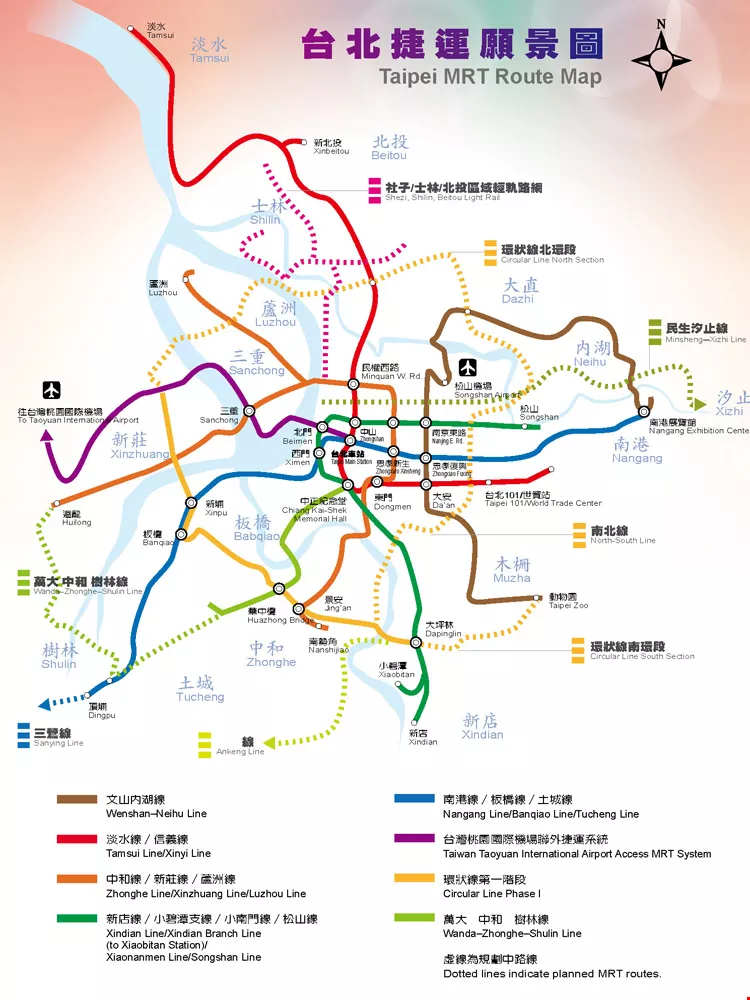
The MRT system is fast and convenient, but how did the layout that citizens now take for granted get formulated? For example, why is it that there are still no MRT routes paralleling (running under or over) heavily trafficked eight-lane roads like Ren’ai Road or Dunhua South Road?
Tsai Hui-sheng of DORTS explains that choosing where to put the MRT lines was no easy matter. DORTS had to undertake extremely rigorous evaluations of population and traffic trends in order to determine where future passenger demand would be highest.
For example, where there are wide roads to drive on, people are less likely to use the MRT, which requires them to walk to a station and go up or down escalators or stairs. But where roads are narrow and traffic more congested, the MRT becomes a better choice. “It was better to build MRT lines under congested roads like Zhongxiao East Road and Xinyi Road. If we had built one under Ren’ai Road, considering how broad it is, we could very well have ended up losing money,” says Tsai with a laugh.
Besides considering passenger demand, notes TRTC chairman Richard C.L. Chen, construction of the MRT system also followed paths blazed by the obsolete railroad system. For example, the Tamsui Line was built along the route followed by the old Taipei–Tamsui rail line; parts of the Bannan Line overlap with the old Taiwan Railways Administration tracks running through downtown Taipei (which have also been put underground); and the Xindian Line retraces the private Taipei–Xindian rail line that passed into history decades ago.
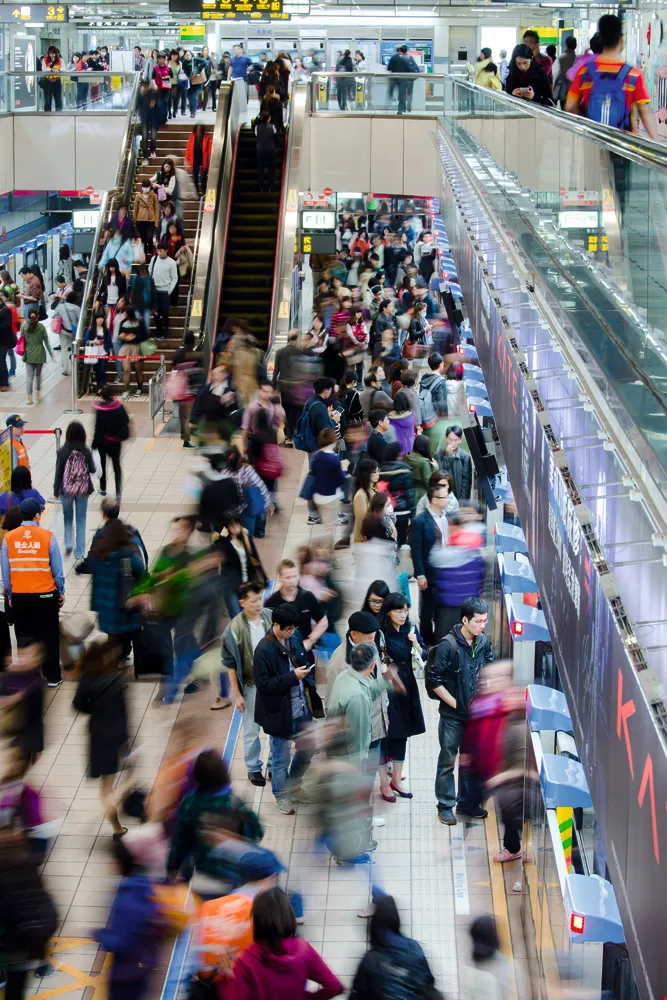
The Bannan Line, so named because it runs between Banqiao and Nangang, is the busiest line in the Taipei MRT system, and reaches sardine conditions during rush hour. The photo was taken at the Zhongxiao Fuxing Station.
Looking to the future, there needs to be better coordination between the MRT and public bus systems in order to increase the usage rate of the public transport system.
Associate Professor Lee Ker-tsung, of Feng Chia University’s Department of Transportation Technology and Management, says that right now the proportion of residents in the Greater Taipei area who use the MRT plus bus lines is only about 43%, and even if you add in walking and the YouBike public bicycle system, that figure would reach at most 50%. Considered against average rates of over 80% in places like Hong Kong and Tokyo, there is still a lot of room for improvement in Taipei.
Lee advises, “Buses should play a bigger role ferrying people to MRT stations; they shouldn’t be competing with the MRT for the same passengers along the same routes. Only if the two systems are complementary can they serve the optimum number of citizens.”
Another problem is that the Mass Rapid Transit Act forbids passengers to bring food or drink on the system, and there are strict fines for violators. Lee says that the authorities could replace the fines with simple reminders from staff.
Finally, Lee also suggests that the MRT could consider using a simpler and easier-to-understand route and station identification system. Lines and stations could be numbered, rather than being named, as they currently are, after places. This would make it easier for out-of-town visitors to use the system.
The Taipei MRT system, which has now been operating for 18 years, has become the circulatory system of Greater Taipei. In the future, we hope to see it go farther, and operate even better, providing a framework around which we can build a genuinely first-class metropolis.
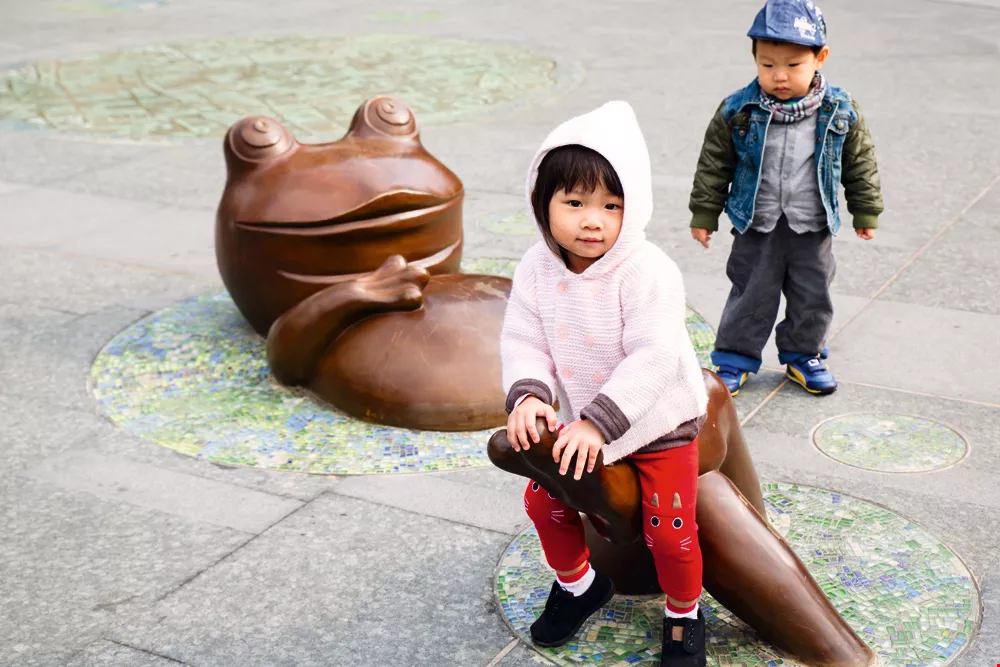
Public art adorns stations along the Xinyi Line; in the open-air plaza at Da’an Park Station, you will find a brass frog (right) as well as the installation art work Autumn Leaves Traveler (center); and at Taipei 101 Station, the motif is faces of old and young displayed on a futuristic mechanical installation called Meeting Time (left).
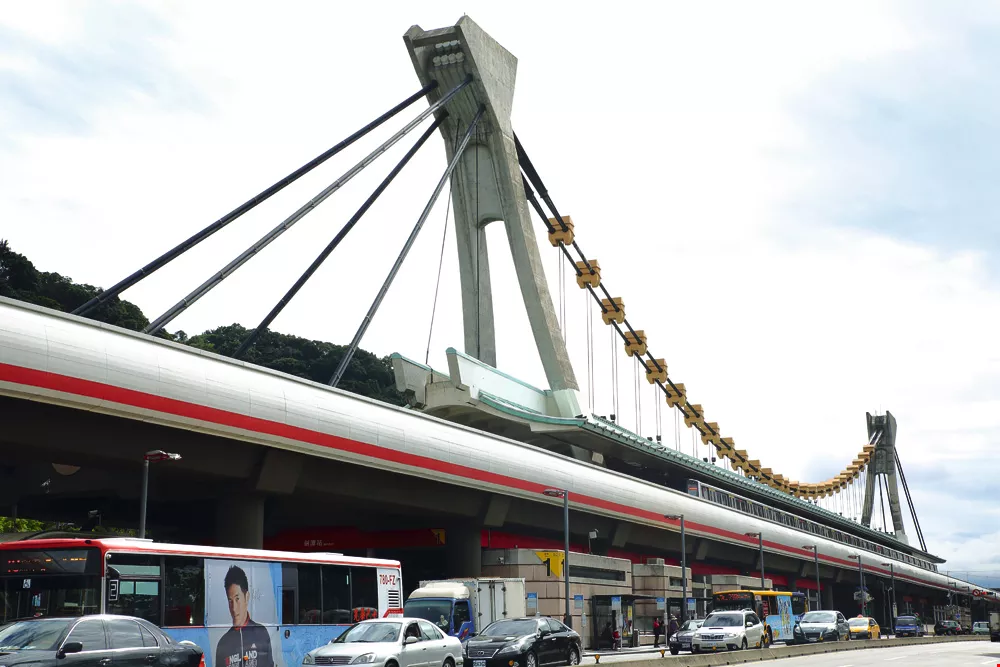
The MRT trains of the Tamsui Line start underground, then rise up onto elevated tracks, and then return to ground level to finish their journey. The route follows the old Taipei–Tamsui railroad line, overlaying historical with contemporary transportation technology. The photo shows Jiantan Station, on the elevated portion of the line.


