Always Second Best?--The Disappearing Senior Vocational High School
Chang Chiung-fang / photos Jimmy Lin / tr. by Anthony Sariti
July 2003


Early on when Taiwan adopted a planned economy, it laid
out plans at the same time for vocational senior high school education, and at one time as many as 70% of young people, on finishing their compulsory junior high school careers, eschewed the long road of completing senior high school and competing for a scarce place at university, and chose instead to study at a vocational senior high school. Although in recent years the number has gradually shrunk to about 50%, it is still on the high side when compared with the world average of less than 30%.
With a more advanced industrial sector, greater opportunities for higher education, and the need for a higher-quality workforce, there have been many calls for delaying the separation of students into senior high school and vocational senior high school streams. What should the vocational schools do? Should they retire after a job well done? This question has set the stage for public discussion.
Research by Assistant Professor Liu Chia-ju of National Kaohsiung Normal University's graduate institute of science education shows a close connection between Taiwan's technical and vocational education system and its economic development.
In the 1950s, in support of the government's policy to "nourish industry through agriculture, develop agriculture through industry," industrial and agricultural education were actively expanded to train the basic technical labor force needed for development. In the 1960s, when Taiwan's economy had changed course to emphasize exports, there was again a great increase in industrial/vocational classes. In the 1970s, as the center shifted to the chemicals industry, technical colleges in Taiwan flourished, and the ratio of student intake between senior high schools and vocational senior high schools was 3:7.
In the 1980s the electronics and information technology industries took center stage in Taiwan, and the technical and vocational educational system expanded into IT education. At the beginning of the 1990s, Taiwan underwent a complete economic restructuring and industry moved up another notch. Nowadays, the "knowledge economy" is vaunted above all else and biotechnology, nanotechnology, and advanced wafer technology rule the roost. In these high-tech workplaces most technical jobs are beyond the ability of current vocational senior high school graduates. So, what are the vocational schools, which used to train basic level technology workers, supposed to do now?

When should streaming into general education and technical and vocational education (TVE) begin? How should the TVE system transform itself? And what is the object of education? These are all questions worth our serious consideration.
Retire with a job well done, or fade into history?
Lee Yuan-tseh, the president of Academica Sinica says: "Let the vocational schools become a part of history." But can the vocational schools really become part of history? And should they become a thing of the past? There are people who think they should and people who think they shouldn't.
Chen Chin-chin, principal of Taichung Industrial High School, feels the technical and vocational education system, an alternative to the usual route through high school and then college and sometimes referred to as the "second track," was very difficult to set up in the first place and that it is an integral part of the nation's wellbeing. So, how can one talk lightly about abolishing it? "Thirty percent of Taiwan's industrial sector is still made up of traditional industries," Chen says. "If vocational schools are abolished, how will a labor force for those industries be trained? Isn't this the same as just forcing these industries out of existence?"
Tien Chen-jung, director of Taiwan Normal University's Department of Industrial Education, says that if vocational schools are done away with, this will create a gap in the training of workers for Taiwan's industries, and if this gap is not made up in some other way, there will be serious consequences.
Some people may think importing foreign labor is the panacea that will solve the deficit in the workforce, especially since the movement of labor across borders has become a necessity in the "global village" and because of the demands of industrial specialization. But Tien Chen-jung says that even if the need for a domestic workforce diminishes in the future, there are a number of jobs for which, under no circumstances, foreign labor could substitute. For this reason, the government should make adjustments in the orientation of technical and vocational education but not abolish it.
Tien points to the example of a healthcare profession-nursing. Because similar culture and language are assets in the profession, one should not depend completely on foreign labor. Nevertheless, as nursing schools reorganize into technical institutes and healthcare personnel turn toward administration, the proportion of personnel opting for clinical practice will gradually diminish. The fact that during the SARS epidemic some nurses with university or college training have been willing to perform front-line care is illustrative of this crisis.
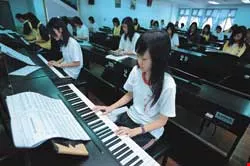
Vocational schools train child care workers who must know music, dance and also how to raise children, making each into a virtual "master of all trades."
Continuing up the education ladder
Although there are those who oppose the abolition of vocational schools, there is no lack of academic heavyweights who hope to see them go.
Chu Ching-i, a scholar at Academia Sinica, thinks that a child should not be forced to enter brutally competitive streaming before he has an understanding of his own subjective, natural disposition and objective, outside choices. Only by experiencing culture as far as possible in all its facets and richness can a student discover his own real interests and talents-and then make his own decisions.
"It's right to do away with the vocational high school system," says Hsia Hui-wen, principal of Kai Ping Senior High School. There is no need to determine the field of concentration for 15 to 18 year-olds if they are not yet decided. But he points out that in Taiwan the average senior high school is also, in fact, a kind of vocational education because it specializes in teaching the techniques for taking the national entrance examinations. "The unified curriculum, system of diplomas, and the entrance exam have long ago turned school education into a training ground for students to become test-taking machines," says Hsia, who feels that the vocational senior high schools offer children more room for creativity and imagination. He says that whether or not vocational schools continue, vocational education is a part of life education and must figure in the curriculum for students between 15 and 18 years old. The fact is that the time when one is able to establish his goals depends on the person.
Lin Chun-hong, a third-year student at Ching Mei Junior High School who graduates this year, decided himself to participate in the Junior High School Technical Class. Every Tuesday he goes to Kai Ping Senior High School to bake cakes. He says that his father operates a small eatery and that he himself has a great interest in the food business. At a very young age, he had decided that he would follow this profession.
Chu Yun-peng, formerly of the Economics Institute of Academica Sinica and now president of the Jin-Wen Institute of Technology, notes that debate over when students should be guided into a career path is of long standing. Germany streams early on, the US streams later, and each has it own advantages. He says it's more important that after streaming students have an opportunity at any time to "jump the track," so that their decision does not lead to a dead-end street. In other words, there should be some connecting lines between the nation's "first track" and "second track" so they are not separated by an impassible boundary.
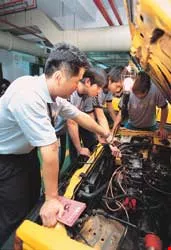
Auto repair and maintenance is a practical skill. The auto department of Nanchiang Senior Vocational High School emphasizes: "graduation means a job."
Not dying, but fading away?
Leaving aside the question of when streaming should occur, the atrophying of vocational senior high schools in recent years is a fact all agree on.
Lin Teng-chiao, a senior specialist at the Ministry of Education's Department of Technological and Vocational Education, points out that vocational schools are currently facing recruitment difficulties. Before 1991, graduates from junior high schools numbered more than 400,000. By 2001, there were only just over 302,000, representing a decline of almost 25%. Vocational senior high schools have faced the brunt of this decrease.
In 1992 some 170,000 students entered vocational senior high schools, a figure amounting to more than 45% of all junior high school graduates that year. In 2001 this number had dropped to 110,000 and represented only 38% of junior high graduates.
Not only had the market for vocational schools greatly retracted, some schools were unable to attract any students at all. During the 2001 school year, there was a 25.4% deficit in technical and vocational high school recruitment with 25 schools attracting less than 100 students. Taiwan's largest vocational school, the Yu Da High School of Commerce and Home Economics, had a total of 15,000 students during its heyday but currently has only half that number.
To attract students, schools are employing every method conceivable. School principals and teachers visit students at home and award generous scholarships. Some schools have even built "five-star" dormitories to attract students to come and study.
In addition to a diminishing enrollment, vocational schools are facing the concerns of students in not being able to find future employment opportunities. "The trend to do away with vocational education is already quite evident, the only thing is that there are no measures for coordination," points out Chen Chung-en, vice principal of Yu Da. Currently almost 100% of junior high school graduates go on to senior high school-how can the vocational high schools compete? Once everyone is a senior high school graduate, how will vocational high school graduates be able to compete in the job market?
Chen Chong-en notes that in the past when, for example, airline companies recruited for stewardesses, they welcomed vocational high school graduates. Today academic requirements have been raised across the board, and vocational high school grads have been squeezed out. Not only have employment possibilities been affected, even opportunities for practicums during school have decreased. In the past Yu Da cooperated with convenience stores and had its students actually go out to the stores and get hands-on experience. But last year the convenience stores got "promoted" and now they only deal with technical colleges.
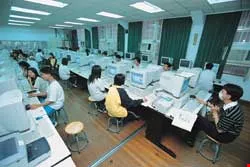
The goal of the information management courses in vocational senior high school is to train basic-level technical personnel. However, in recent years, most vocational school grads have given up the idea of going out immediately into the workforce and instead have opted for continuing their education.
Better to continue school than get a job?
With employment opportunities decreasing, more and more students are choosing to continue their education. For example, Chen Chong-en points out that in the past 100% of Yu Da grads went straight into the workforce as bookkeepers, assistants sales staff, telephone operators, data entry operatives, secretaries, caregivers, and so on. Today the number who are choosing to continue their education has risen dramatically. In 1992 some Yu Da 190 students who went on to higher education, while last year the number had climbed to over 1800-an increase from only 8% to 75%.
In addition to technical and vocational students continuing on in education in large numbers and thus leading to the withering away of the "inherently" inferior "second track," the lack of official expenditures in this area have amounted to "kicking a man when he is down," and the gap between the two national educational "tracks" has widened significantly.
Tien Chen-jung points out that although the technical and vocational is the "second" track, expenditures and opportunities in this area fall far behind those of the "first" track. He argues that, logically, the government should offer more assistance and better treatment to those students with limited academic ability and who come from a lower socio-economic background. However, for many years the top-notch public senior high schools have been the domain of the children of well-heeled families, while the less advantaged students have been "selected" into private vocational schools that charge higher tuition fees but attract less able teaching staff.
The mechanisms for continuing on in education are also not fair to technical and vocational students. Logically, after students are streamed into the vocational educational system, the future path to higher education should not be determined on the basis of general subjects. "But whether they want to become nurses or civil engineering technicians, and whether they are applying to a technical college or a technical university, in the exams they are tested in Chinese, English and math," says Tien. "There is no emphasis on professional abilities at all."
Professor Tseng Hsien-cheng of the Department of Chemical Engineering at National Hsinchu Teachers' College replies that if basic knowledge like Chinese, English and math is lacking, this will affect a student's ability to acquire new knowledge in the future. "Given the speed with which science and technology are developing and changing today, high-tech personnel must have the flexibility to meet changing circumstances and to enable them to acquire new knowledge and adapt new technology to solve problems," Tseng argues. "For this reason, we should raise the students' abilities in basic coursework at the vocational high school level and not just have them learn specialized techniques that will be soon outmoded."
No takers for work-study programs
Everyone has his own opinion on the wisdom of separating students into academic and technical streams in secondary education, but the market itself has a method of natural selection. A lack of market demand will eliminate one or the other approach. The vocational high schools themselves have experienced the natural rise and fall of particular courses. Professor Huang You-min of the Department of Mechanical Engineering at National Taiwan University of Science and Technology points out that the lathe is an excellent example. Because industry now exclusively uses computer-controlled lathes, men are no longer employed for this purpose and so the course on lathes at the University has been eliminated.
By contrast, because there are some traditional vocational skills for which there will always be a demand, there is no fear they will ever be "selected out." Wu Jung-feng, a section chief in the Office of the Ministry of Education in Central Taiwan, says there will always be a need for some professions like auto mechanic, glazier or beautician, because they cannot be mechanized. "For these jobs, National Taiwan University Science and Technology graduates are not necessary, vocational high school grads can handle them," he says.
Nevertheless, an increasing number of vocational high school grads are choosing to continue their education rather than seek employment. As a result, companies that in the past participated in work-study programs with vocational high schools now have no takers.
Wu Jung-feng notes the imbalance in supply and demand between vocational high schools and the industrial workforce is steadily worsening. "Some traditional industries still want to hire vocational high school grads but schools, students and interest are all lacking," Wu says. By way of example, he says that recently the metal foundries association enquired through the MOE's central Taiwan office to find vocational high schools with metal casting courses for possible work-study programs. But because the students were all intent upon continuing their education and the schools themselves showed no interest, they had to drop the idea.
Lin Chin-chu, a senior specialist at the office, points out that currently only work-study programs for catering and beautician course students are easily promoted. On the one hand, industry demand is high, and on the other hand students can study on the job. This is an excellent model for a win-win cooperative program.
In technology-based industries, such as electronics, products are driven by time-efficient production and most of this production is automated. As a result, students are rather limited in the skills they can learn on the job, so opportunities for work-study programs here are few.
Comprehensive senior highs-losing out at both ends?
In order to solve the problem of vocational high schools the Ministry of Education in 1966 began to advise vocational high schools to transform themselves into "comprehensive senior high schools" and has provided subsidies of NT$5-6 million a year to these experimental schools.
A comprehensive senior high school carries out a policy of "first year-foundation building, second year-exploration, third year-specialization," by which students study basic skills in the first year and only begin to study specialist subjects in the second year. Some people say straight out that the comprehensive high school can only attract students of middling ability. Requiring these students to study with a dual orientation and to "explore" multiple areas causes them to fall even further behind their senior high school counterparts in the general curriculum. Added to this, they are not as good as vocational high school students in technical subjects-so they end up "losing out at both ends."
By academic year 2002, the number of vocational schools had dropped from 203 down to 107. Adding the 36 comprehensive senior high schools that had been transformed from vocational high schools, there were a total of 143. Yu Da, with a history going back 54 years, began to transform three years ago. Vice-Principal Chen Chong-en notes that although the comprehensive senior high schools represent the mainstream of secondary education for the future, recruiting students is difficult. Last year Yu Da estimated an intake of eight classes but in the end it was able to recruit only four.
The Ministry of Education, moreover, is planning to establish a selection mechanism. Lin Teng-chiao notes that education in Taiwan has become a buyer's market, in which everything is oriented toward satisfying students' demands, leaving schools with very little scope for development. In the past, private schools in Taiwan were not able to close down willy-nilly. They had to be "donated" to the local county or municipal government or another educational entity. In line with the trend toward allowing free-market pressures to influence the school system, Lin Teng-chiao says, a law on private schools should be written as soon possible to set up a fair and reasonable "exit mechanism," allowing private schools to have some room for mergers or for going out of business.
Key to success-specialization
Those vocational high schools that remain will become more specialized. "They must have a unique quality to remain of value," says Lin Peng-chiao.
The Ministry of Education plans call for the current seven types of vocational high schools with their 70 different courses to develop in different directions. Navigation and nursing courses, for example, will be raised to the technical college level, equivalent to higher education. Some industry sectors will be adjusted to the post-technical college level, commerce and home economics will primarily train people for the service industry, and responding to Taiwan's entry into WTO, agricultural studies will develop in the direction of specialized agricultural education.
"The biggest problem for the technological and vocational fields is the mindless expansion of numbers," says Chang Tien-fu, chairman of National Chi Nan University's Educational Policy and Administration Department. Chang points out that in the past technological and vocational schools easily attracted tens of thousands of people, but no thought was given to the ability of the labor market to absorb their output. In the future, we should follow a policy of "picked troops," a policy of selective specialization, in other words. This is the key for the success of technological and vocational education.
Twelve years ago Kai Ping Senior High School created a food and beverage department and followed a "specialization" policy. Principal Hsia Hui-wen says he worked hard to set up "food-and-beverage humanities" courses to raise the department's profile. In the new curriculum are courses such as "master of kitchen arts" (a chef and expert on the ins-and-outs of the kitchen itself) and "food consultant" (who advises customers on dishes and attends to the dining area of a restaurant). In addition, he introduced the German concept of "sandwich teaching," according to which students first study theory and general education at school then go out into the industry for on-the-job polishing of technical skills and verification of what was learned in theory.
The economy is not the goal of education
Chang Tien-fu argues that given the speed of industrial change today, the future is uncertain and everyone is looking for answers. People go wherever there is profit. The same applies to training talent. Everyone is looking for the right direction. Faced with such a situation, an education system that behaves like an old ox dragging its feet is unable to meet the challenges of changing circumstances. "We must meet industrial change with flexibility," Chang says.
"Economic development is not the object of education," says Chu Ching-i, a researcher at Academia Sinica. "The object of education is people, and the benefits of education are not just the achievement of a perfect match between supply and demand in the job market." In any case, the labor market has its own regulating mechanisms, so one doesn't have to worry about it too much. When there is a lack of labor in some particular technical sector and supply does not meet demand, the "market" will naturally see this and will attract more students to this particular technical area. In a year or so supply and demand will adjust themselves.
Chu Ching-i notes that Amartya Sen, the 1998 Nobel laureate in economics, once said that "the object of economic development is to realize and to protect freedom." What then is the object of education? This is a topic worth thinking about for all of us... and perhaps it is the answer to all our questions.


@List.jpg?w=522&h=410&mode=crop&format=webp&quality=80)


