Sense, Insecurity and Unruliness—Childhood SPD in Taiwan
Lin Hsin-ching / photos Jimmy Lin / tr. by Jonathan Barnard
April 2012


“Fear of heights and swings, inability to stay in line, proclivity to constantly run around and bump into things or to cry inconsolably at the smallest hurt, frequent falls, inability to stay in one’s seat, dislike of being touched, extreme finickiness, including refusal to eat food that is either ‘too soft’ or ‘too hard’….”
As children grow, many demonstrate some of the characteristics on that long checklist. However insignificant those behaviors may seem, they can result in never-ending headaches for parents.
Although such behaviors may seem to have no cause, they might be symptoms of “sensory processing disorder”—in which case interventions to modify particular environmental factors could prove ineffective. What is sensory processing disorder? And what effects can it have on a child’s physical and psychological development?
Saul (changed name) has always been a source of pride for his parents. His linguistic abilities and cognitive capacities are outstanding. At two, he had already developed a good sense of direction, and could count and retell stories. At the same time, he was very physically active. He liked to run and jump and charge into things, and he would twirl around and around without ever getting dizzy.
And yet when Saul entered nursery school at three, his teachers and classmates came to regard him as a troublemaker who was unable to sit compliantly in his seat for more than 10 minutes at a time! He simply couldn’t stop moving, and he would often run and jump around the classroom. His classmates complained about Saul playing too rough and grabbing their toys.
On one occasion, Huang Chien-hsuan, a good friend of Saul’s father and a physician specializing in pediatric rehabilitation at Taiwan Adventist Hospital, experienced Saul’s behavior first hand. Immediately she wondered if he might have vestibular hyposensitivity and tactfully suggested that her good friend give his child more opportunities to skateboard, go to playgrounds with slides and swings, and even experience extreme stimulation such as found on rollercoasters.
Though skeptical, Saul’s parents tried two weeks of play training. Previously unable to sit still, Saul began to be able to make it through an entire class in his seat. Surprised and delighted, his parents worked harder at designing play activities that met Saul’s needs. After entering first grade, Saul’s behavior grew increasingly stable, and his schoolwork improved.
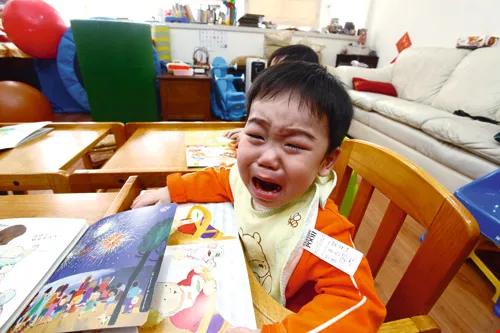
When children can’t sit still in their seats, teachers and parents should use interesting objects or games to attract and train their attention spans.
What is vestibular hyposensitivity? And why do high-speed games seem to calm some children? Answering those questions requires an understanding of sensory processing.
Sensation refers to the impressions the body has of stimulation from the outside world. Everyone has a variety of sensory organs responsible for receiving information from the outside world, which is transmitted to the brain via the nervous system. The brain takes this information and classifies it, eventually sending its own signals about an appropriate response. The entire process is what is described as “sensory processing.”
If mistakes are made as the nerves transmit or interpret sensory input, then the brain will make misjudgments and respond inappropriately to the environment.
Based on clinical observations in the 1970s, Dr. Jean Ayres, an American occupational therapist, discovered that sensory processing has a key impact on emotional and motor development. At first, she used these theories to treat children with learning disabilities. Later, she discovered that various neurologically based problems, including mental disabilities, autism and hyperactivity are all connected to varying degrees with sensory modulation disorder.
What’s more, even among children with normal intellectual and behavioral development, it is still possible that less-than-ideal development of certain portions of the sensory system will cause clumsiness and emotional difficulties and impede interpersonal relations and academic performance.
Kau Lee-jyy, head of the Taiwan Community Psychiatric Rehabilitation Development Association and the occupational therapist who introduced the concept of sensory processing disorder to Taiwan, cites US estimates that 15 out of every 100 children suffer some degree of sensory processing disabilities. That’s a high proportion.
Yet with added pressures caused by the high-density living environment, the problem is even more serious in Taiwan. Based on clinical experience, Dr. Huang of Taiwan Adventist Hospital estimates that the proportion of children with sensory processing disorder in crowded, hurried Taipei is greater—perhaps as high as one in three.
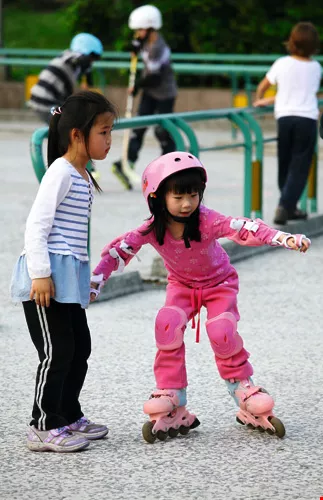
In-line skating is a great way to foster sensory processing abilities, and thus to improve a child’s sense of balance, suppleness, agility, perception of speed, and limb coordination.
Although the five senses of sight, hearing, smell, taste and touch are most familiar, the vestibular, tactile and proprioceptive senses have the deepest impact on a person’s basic ability to survive.
The vestibular system, with its sensory receptors in the inner ears’ semicircular canals and otolith organs, provides the body with signals about gravity and space, so that the body can maintain a state of balance at all times. With a poorly developed vestibular system, balance, muscle tension, impulse control and posture are all affected.
So why was Saul diagnosed with a vestibular disorder? Huang explains that in patients like Saul a portion of their vestibular system doesn’t function properly, leaving them hyposensitive to stimulation. Unlike most people, they can experience large amounts of twirling or falling, without feeling dizzy or queasy.
Children with vestibular hyposensitivity are like wild horses, whereas children who suffer from vestibular hypersensitivity are just the opposite: sensations of motion and gravity distress them, so that they may complain of “the world being their enemy.” They fear heights, easily become dizzy, and tend to avoid physical activity.
Huang explains that vestibular hyposensitivity and hypersensitivity can both be improved through exercise and play. For instance, those who are hyposensitive should engage in activities that exercise their sense of speed. When their vestibular systems get sufficient stimulation they won’t thrash about incessantly seeking it out. Those who are hypersensitive need psychological support and a greater sense of security. For them, the stimulation of their therapy can slowly increase as it moves to deeper levels, gradually improving vestibular functioning.
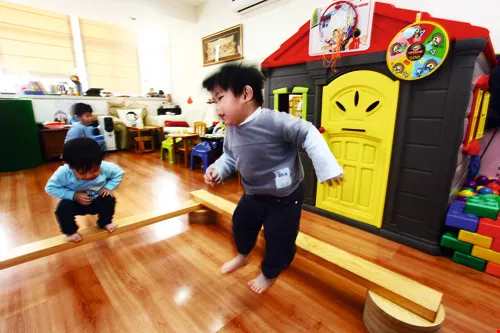
Jumping, and walking on a balance beam, are excellent ways to train a child’s vestibular sensory system.
The tactile system’s receiver—the skin—is the largest in terms of area of any sensory receiver on the body; it also is the sensory organ that develops first. Beginning with development of the fetus, the human body requires constant tactile stimulation to bolster bodily functioning. The tactile system helps to transmit various sensory signals, including those related to temperature, vibration, itch, pain and so forth. These have a long-term impact on bodily awareness, emotions and capacity for social interaction.
Kau Lee-jyy once encountered a classic case of tactile defensiveness when she was invited to speak in Zhengzhou in mainland China’s Henan Province. On her last day there, the sponsoring organization asked a Mr. Yue (who turned out to be a 32nd-generation direct descendant of the Song-Dynasty general Yue Fei) to personally drive her around sightseeing.
Yue never buckled his seatbelt the entire time, even when driving at high speeds on the freeway, in serious violation of the law. When asked, he revealed that he had always greatly disliked being tied down, and had difficulty dealing with people at close proximity. Crowds prompted discomfort and even difficulties breathing. Consequently, he couldn’t take mass transit and would never go anywhere he had to stand in line. Many regarded him as antisocial and hard to deal with.
After graduating from college, Yue, though introverted by nature, got a job in sales. At first, his performance was very poor. After several dressings down from his boss, he resolved to overcome his congenital shortcomings, and worked at bearing all manner of uncomfortable situations and social interactions. His sales record gradually improved. Although his social skills were better, he still tried to avoid physical restraints and getting physically too close to other people.
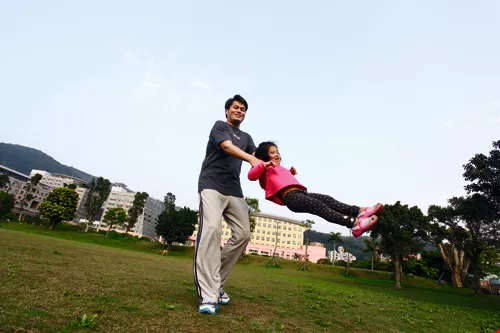
On weekends and holidays, when fathers take their children to parks to twirl around happily and to play tag or hide and seek, these activities help to promote the children’s sensory processing.
“Tactile defensiveness,” explains Kau, refers to tactile systems that are oversensitive and thus raise alarms about normal, non-threatening tactile input. For instance, although most people accept seatbelts as a reasonable bodily restraint, they are much harder to bear for those with tactile defensiveness—who may feel as a normal person would if his whole body were tightly bound.
Children who suffer from tactile defensiveness are a handful for their parents because they will scream bloody murder about activities as simple as washing their hair. Clothes that aren’t perfectly creased—never mind a visit to the dentist or getting jostled on the playground—can spoil their mood for a day.
On the other hand, children with tactile hyposensitivity tend to roughhouse in an extreme manner, heedless of adults’ warnings. And they don’t have much of a reaction to scrapes, cuts and bruises. Being less sensitive to pain themselves, they are more likely to inflict physical pain on animals and other people.
To help promote normal tactile development, Kau advises parents to massage these children’s hands, feet and back before they wash and go to sleep, thereby stimulating the system and easing any tension that has arisen from tactile sensation. What’s more, one can use toothbrushes, washcloths, tactile brushes and other tools to provide stable and ample stimulation, so as to aid the integration of all of the child’s tactile nerves.
Proprioceptive dysfunctionFinally, the proprioceptive system is a major behind-the-scenes player in getting the body to orient itself, sense the location of its various parts, adopt a posture, and modulate proper levels of force. The sensory receptors of this system are found mainly in the joints, ligaments and connective tissues.
Su Chia-ting, chair of the Department of Occupational Therapy at Fu Jen Catholic University, notes that children with impaired proprioceptive systems often aren’t clear about how to control the various parts of their bodies. Seemingly lacking a clear map of their own bodies, they are much clumsier when learning how to move. “Unfortunately, children can often be very cruel, so kids who can’t dance or throw or kick balls well can easily get ostracized,” says Su.
Games that depend on heavy use of the muscles and joints, such as kicking balls, jumping rope, hopscotch, tossing Frisbees, bouncing on trampolines and so forth are all good ways of exercising the proprioceptive system. And when children with proprioceptive disorders try new activities, parents and teachers need to grant them sufficient time to practice and learn from their mistakes. These kids need to slowly gain confidence. They can’t be rushed.
An explanationSu emphasizes that one of the biggest contributions made by the theory of sensory processing is providing parents with an explanation for their children’s behavior. Parents and teachers used to try to use carrots and sticks to control these kids, but the results would never live up to intentions. But once people gain a conception of sensory processing, they realize that when these children “misbehave,” their behavior is rooted in neurological development and they aren’t intentionally causing trouble.
Another problem is when parents bury their head in the sand and say of children with sensory processing dysfunctions that “they’ll grow out of it.” Experts point out that the golden period of sensory processing development extends to the age of seven or eight. Any sensory processing disorder can be greatly helped by therapy during this period. Conversely, there is also the possibility that the situation can worsen.
“For instance, if left untreated, children with vestibular hyposensitivity are almost certain to suffer from ADHD when they grow up,” Huang says.
The right to playHow do you prevent children from suffering from sensory processing disorders? Apart from making sure that mothers-to-be get suitable exercise and aren’t overstressed or do drugs during their pregnancies, education, culture and the environment all can have a big impact.
Sensory stimulation during infancy has an even bigger impact on personality development. Su Chia-ting, who dealt with many Yugoslav war orphans in the United States, notes that those children had been confined to cribs and cared for en masse in churches. Although they were adopted by kind parents in the US, they continued to display signs of high anxiety as they grew and would frequently scream and shout—all as a result of being denied the stimulation of being hugged, caressed and rocked as infants.
Because “sensory deprivation” can have a big impact, parents should encourage and respect activities that children seek out or initiate. For instance, crawling is essential for cultivating infants’ tactile discrimination. If parents, out of fears that the ground is too dirty, or for reasons of safety or convenience, put them in baby walkers instead, it could result in impaired tactile development.
And during childhood, when play is so important, parents must take a hands-off attitude and let their children play and explore the world as much as possible. If children’s days are filled with scheduled classes, the lack of physical activity could impact the development of their vestibular and proprioceptive systems.
In comparison to the educational philosophy of helping children “win the race by getting a head start,” sensory processing theory emphasizes “how to help exhausted ‘little racers’ to run without working so hard.” It aims to provide an understanding of why children may stumble as they grow up and of how to help them run the race of childhood both healthily and happily. That’s the collective wish of all parents, and a responsibility that they cannot shirk.