Lone Ranger Chang Sheng-Kai and His World-Class CSK Bicycles
Chang Shih-lun / photos Chuang Kung-ju / tr. by Michael Hill
April 2006


Taiwan is one of the world's larg-est bicycle manufacturers, and with high-quality products, low prices, and high production rates, it has long been known as the world's "bike kingdom." With many years of work by Giant and Merida, these two companies are among the world's top bike makers.
Facing competition in recent years from China and Southeast Asia, companies in Taiwan have gradually begun to shed their image as mass producers of low-priced products, moving toward production of mid- to high-price bikes. One part of this trend has been the CSK-brand bike, custom built by owner-manager Chang Sheng-kai. With their unparalleled quality, they drawn attention from buyers worldwide, even serving as the wheels of choice for the US president's security detail. Chang's bikes have also found international renown and have been featured in reports by CNN.
Pony-tailed, with protective goggles clapped over his eyes, the dark-skinned, burly Chang Sheng-kai looks more like a weathered cavalryman than a business manager. Now 44, Chang was one of Taiwan's best cyclists. After retiring, he started his own company and brand, CSK, to manufacture hand-built, custom bikes that have been well received worldwide. After Giant and Merida, CSK is one of the few Taiwanese bicycle brands to make it internationally, and a rare example of a professional athlete using his experience to make a second career in retirement.
All of this begins with Chang Sheng-kai's fated relationship with bikes.
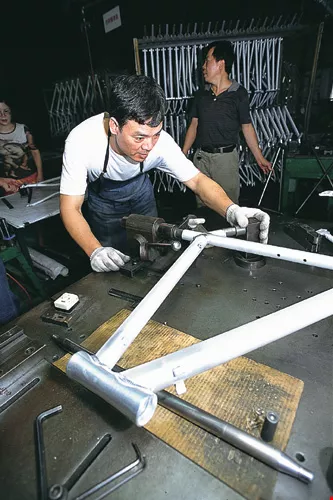
Bike makers in Taiwan have been moving toward higher-end products, as here at the Yoan Technologies, which makes bike frames for CSK.
A champion on the track
Chang started his competitive career rather late. An avid film watcher, in his third year of high school he saw the American movie Breaking Away, which told the story of a group of young people who pursue their cycling dreams, overcoming all kinds of obstacles to finally reach their goal. "After I saw it, it was like I had been poisoned with a love for bicycles. I started saving up every dollar my mother gave me for the movies, and after a year I bought my first ever bike." Chang's love of cycling has been going strong for almost 30 years, something that amazes even him.
At the time, raising greyhounds was the Chang family's business. Chang Sheng-kai feared that when he grew up he, too, would live a monotonous life of washing and feeding dogs. He says, "Only when I could get on my bike and go faster and faster could I seem to symbolically distance myself from that tedious way of life."
For most young athletes, becoming a competitive cyclist means at least three years of specialized training. Since he felt he was biking for his freedom, however, after only one year of training on his own without a coach, Chang became national champion, earning a spot on the national team--truly an impressive display of his natural talent.
To devote himself to training, Chang gave up a guaranteed spot as a university student and the chance to earn a degree in athletics, and in 1980 he became Taiwan's top competitive cyclist. A strong racer both on the flat and in the mountains, he has won a string of medals in the Tour de Taiwan--three gold, six silver, and six bronze--breaking nationwide records for the number of prizes won in single competitions. In 1988, pedaling against a field of top competitors from over ten countries, Chang took top honors in the Tour of Hong Kong--the first Taiwan cyclist to win first place in an international competition.
In 1990, Chang retired from competitive cycling at age 30. He used his wealth of experience to start his own business importing high-end bicycle parts. He soon discovered that many high-grade goods from European manufacturers were in fact made in Taiwan. "They only provided the trademark and design, but walked away with most of the profits--it was really galling!"
The September 21, 1999 earthquake was a turning point for Chang, whose family lives in Nantou. Even though parts sales were badly affected by the devastation from the earthquake in central Taiwan, Chang set himself to the task of turning this crisis into an opportunity for his business, taking NT$200,000 put up by his family to create CSK, his own bike brand.
CSK, of course, is the initials of Chang's name. "Having been an athlete, I used my own name as the trademark, and saw starting my own business as another big race--and my only option was to win!" As a professional cyclist, Chang was often called "The Lone Ranger" for the way he stayed ahead of the pack. As he moved from the racetrack to the business world, Chang also found ways to stand out from the crowd.
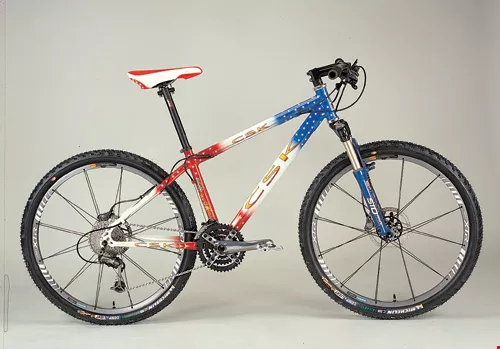
The stars-and-stripes mountain bikes ordered from Chang Sheng-kai by the White House
Made to measure
Taiwan's bike makers began as contract suppliers, mainly building low-priced, high-volume models. Chang Sheng-kai took another route, aiming for the global market for high-end racing bikes.
Within the fine division of labor in bike manufacturing, Chang Sheng-kai designs and makes the bicycle frame, adding wheels, pedals, and other parts according to customers' needs. Many of the raw materials and parts for CSK bikes are imported from Europe. As the cutting, aligning, spray painting, and detail painting are all done by hand, and Chang himself supervises production, he can do his best to ensure high quality in every bicycle.
As a former competitive cyclist, Chang is very knowledgeable about the many special needs of professionals and enthusiasts. He says, "CSK can tailor a bike to their individual situation and produce a hand-made, limited-quantity, high-quality bike for them. That is what sets us apart from companies that mass-produce bikes."
Due to their particular nature, bikes used in competition will have a variety of demands in terms of parts and materials. For example, because the terrain and the road surface often vary greatly in long-distance road racing, bike makers use shock-absorbing carbon fiber for the frame. On the other hand, for speed competition on even track surfaces, manufacturers are concerned mostly with the frame's aerodynamics. In this situation, the smoother and more streamlined the surface of the bike frame, the less it will be affected by wind resistance. In designing a mountain bike, aside from light weight, one must also consider the relative pliability and resilience of the frame to make a bike that is suitable for offroad climbing.
Even more unusual is that CSK provides custom painting services. One company manager, for example, ordered a bike with his wife's name on it as a wedding present. Others include a "strawberry bike" for the Strawberry Festival in Tahsi, and a bike featuring the lead character in the Swordsman movies. Some people may see these bikes as rather cheesy, but they are in fact the result of Chang's imaginative thinking.
Even the White House has taken notice of CSK's professional quality and custom art service. The head of White House security made a special order from CSK for four mountain bikes painted with the stars and stripes, and they are now used by members of George W. Bush's security detail on the president's exercise outings.
Since its detailed craftsmanship cannot be adapted to an assembly line, CSK's strategy is to produce small numbers of top-quality products, demanding the highest quality in every process, including welding, aligning, painting, and firing the frames. Because of this, the company's annual production is less than 1,000 bikes per year, and with prices ranging from NT$30,000 to NT$400,000, it is at the very top of the market for high-end bikes. Currently 95% of orders are from abroad, and CSK has sold to customers in 15 countries, with more than 50 retail sales outlets in the US alone. Currently the company's annual sales revenue is about NT$20 million.
Currently most of CSK's customers are professional cyclists and company bosses. Chang freely admits that not everyone can pay hundreds of thousands of NT dollars for a high-end bike, but for well-off cycling enthusiasts, this kind of tailor-made, high-quality, personalized bike holds a unique attraction in an era of mass production.
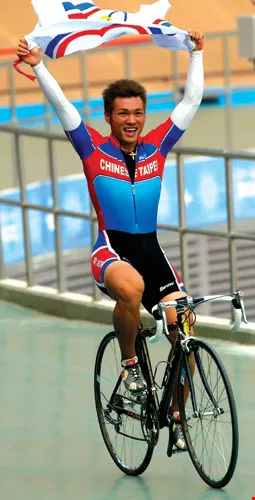
Taiwan cyclist Lin Chih-hsun rode a CSK bike to first place at the Asian Games in Busan, Korea in 2002.
Upgrading the industry
Over six years of hard work, CSK made a name for itself in the cycling world, appearing in interviews by CNN and other international media. What surprised many people, however, was that CSK did not have its own factory or employees, and that Chang Sheng-kai came up with the designs independently, collaborating with like-minded people in the business to manufacture his bikes.
While Taiwan's bike industry may be flourishing and boasts extremely high-level production technology, Chang initially had to look hard for a factory willing to work with him. Since most manufacturers are only looking to fill high-volume, quick-turnaround, high-profit orders, they were not interested in working for CSK, whose low production volume and detailed demands could not match the revenue from high-volume orders, even with the hefty price tag on CSK bikes. It was probably Chang's experience as an athlete that drove him on: "It was like climbing against the wind," he says. "The harder it got, the more determined I became!" Chang finally found factories willing to work with him. One of them, Yoan Technologies in Tachia Township, Taichung, is responsible for making CSK's bike frames.
Johnson Chen, Yoan's general manager, says that Taiwan bike makers' strategy was long focused on high-volume, low-priced bikes, but faced with price-slashing, upstart competitors from China and Southeast Asia, Taiwan's competitive advantages are slipping away. The reason that Yoan wanted to work with Chang Sheng-kai was "mostly that we saw it as an opportunity to transform our factory into a producer of high-end bikes."
With the usual fast assembly-line manufacturing, Yoan can turn out over 300 mass-produced framesets a day. For handmade bikes like CSK, however, no more than 20 frames a day can be completed as each step is painstakingly completed by hand and the product is constantly checked for quality. Moreover, Chang Sheng-kai travels to the factory each week to personally check their work, demanding perfection in every detail.
According to the Industrial Development Bureau's 2004 statistics, although China's annual bicycle manufacturing output reached 79 million units, most were of the low-cost variety. While less than 5 million units are produced annually in Taiwan, the average unit price is US$165, or NT$5,500, much higher than the average price of US$32 for bikes from China. The overall export value of bicycles from Taiwan has seen steady annual increases of 20% or more in recent years, a statistic that demonstrates that Taiwan's manufacturers have succeeded in transforming their businesses and have differentiated themselves from Chinese makers in the market.
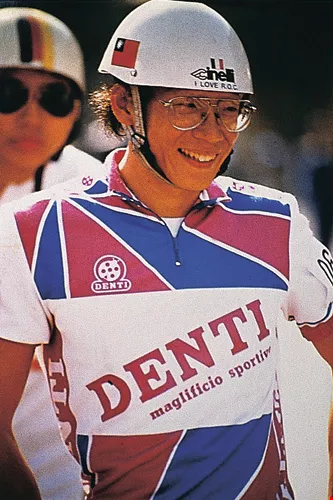
Chang Sheng-kai was a top cyclist in Taiwan during the 1980s.
The "global roadside stall"
Most major international bike makers increase their visibility through endorsements by sponsoring star athletes or holding international competitions. Without the kind of capital needed for these activities, CSK has a tough time competing, and depends on word-of-mouth recognition and Chang Sheng-kai's "global roadside stall" strategy to make a name for itself.
Many of the coaches for the world's international cycling teams were Chang Sheng-kai's competitors when they were professional cyclists. Since he knows these coaches so well, Chang often takes his bikes all over the world with his family, marketing his product directly at major cycling competitions. "This 'strategy' is a lot like carrying your wares with you to set up a roadside stall. But since the product is good enough, the response from the market has been good." Using this nontraditional marketing plan, CSK has made a name for itself on the world biking scene.
Currently there are cyclists from teams in Australia, Japan, Indonesia, Vietnam, and Malaysia using Chang's products, and members of Venezuela's national team have even come to Taiwan to buy his bikes. After all, however, CSK is not a big company, and cannot spend millions to sponsor established stars the way that major sporting goods manufacturers do. Because of this, Chang Sheng-kai has defined CSK bikes as "the bike of choice for champions before they make their name." When Taiwan cyclist Lin Chih-hsun took a record-breaking first place at the Asian Games in Busan, Korea in 2002, the bike he rode across the finish line was a CSK.

Taiwan cyclist Lin Chih-hsun rode a CSK bike to first place at the Asian Games in Busan, Korea in 2002.
The marathon of entrepreneurship
In CSK's Taipei store, Chang Sheng-kai reverently shows off two of his own Italian-made bikes. "This is a Colnago, and this one is a Cinelli, the finest brands in the world, and the dream of every cycling fan. My dream is that one day the words 'Made in Taiwan' and 'CSK' will have the same ring to them and will become the dream bikes that everyone wants to have," he says.
Aside from building his business and CSK's high-end image, Chang is also looking for manufacturers to partner with, and hopes that in the future he can develop another brand--this one based on his nickname, "Akai"--to enter the national mid-priced bike market. He has also bought land in Miaoli, where he hopes to open a bicycle museum to document the history of bikes in Taiwan.
Six years after starting his business, Chang has a thousand different plans in his head, but it is a lot like running a marathon: "I've only gone six kilometers so far, and my experience in competition tells me that to win, I have to hold on to the end!"
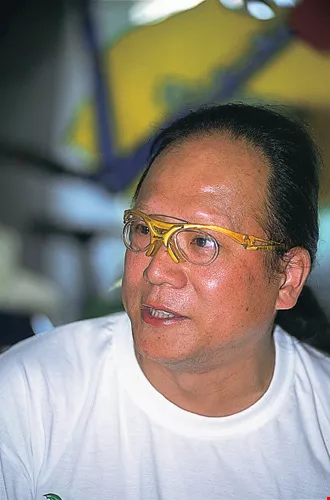
Winning depends on performance, and products are all about their quality. Renowned Taiwanese cyclist Chang Sheng-kai has entered the global market with his CSK brand bikes.
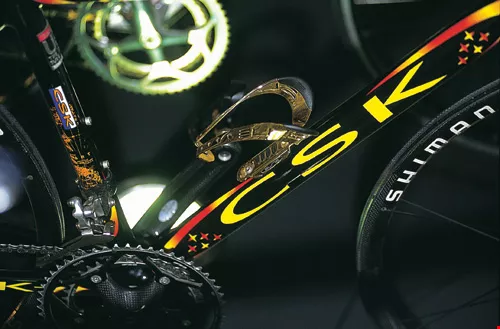
Winning depends on performance, and products are all about their quality. Renowned Taiwanese cyclist Chang Sheng-kai has entered the global market with his CSK brand bikes.
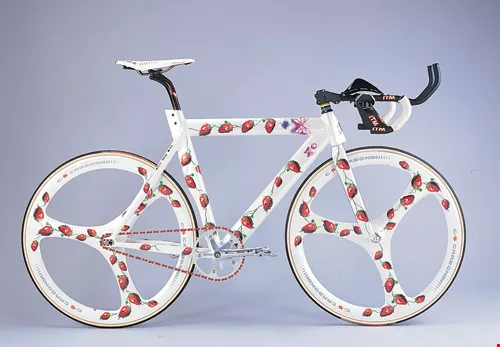
The "Strawberry Bike," inspired by the Tahsi Strawberry Festival.


@List.jpg?w=522&h=410&mode=crop&format=webp&quality=80)


