Low-key but Deeply Felt Passion: An Interview with Tsai Ing-wen
interview by Chen Hsin-yi / photos courtesy of Eurasian Publishing / tr. by Phil Newell
July 2012


“You can cry, but don’t be despondent. You can feel sad, but you can’t give up. Because tomorrow when we get up, we must have the same dedication that we have felt these past four years, our hearts and minds must be filled with hope. We must courageously bear the responsibility for this country, and we must optimistically continue to do everything we can for this land, Taiwan.”
Throughout the rainy night, supporters cried their hearts out, but she alone did not shed a tear. Indeed, she was still able to make a speech, however touching, that was judicious, calm, rational. It immediately became a popular email attachment, being forwarded through web networks on both sides of the Taiwan Strait, and its readers, besides gaining an appreciation for the speaker’s character and deportment, came away with a deeper understanding of what democracy in Taiwan really means.
Tsai Ing-wen thus brought to a close an important phase in her life. Now, after months of staying out of the public eye, she has begun to reappear more often in the media. And on the day before she turned over the chairmanship of the Democratic Progressive Party to her successor, this most prominent of all women political figures in Taiwan gave an exclusive interview to Taiwan Panorama magazine to talk about her life and personal growth.
Q: You have had many roles in life. How have you adjusted?
A: In each case I first gained a clear understanding of the responsibilities and duties of the role, and then I was always willing to change myself and make the necessary adjustments.
When I was a professor, things were more structured. The job was to get the students to understand the knowledge that was being taught. The role of government ministers, on the other hand, is to set policy direction. You have to learn how to think on a macro level, and consider the overall long-term interests of the country.
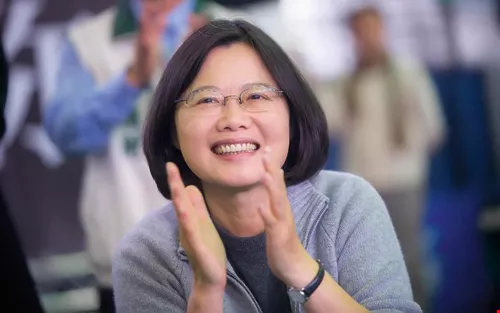
Tsai Ing-wen has a complex, layered personality. Just as there is a hint of bashfulness behind this happy smile, there is a strong underlying passion beneath her thoughtful, judicious and logical exterior.
My chance for a meaningful political career came with the Democratic Progressive Party victory in the 2000 presidential elections. The biggest challenge for the DPP was turning the ideas that they had while in opposition into feasible policies.
Because of my academic training I knew we would have to set our policy sights at the macro level in order to pull the country forward. At that time, I handled technical and professional opinions coming from the civil service, I had to respond to and deal with political expectations, and I also spent a lot of time communicating with elected officials, because they represent different interest aggregations. It was a kind of “interface” role.
When I became party chairman, I had to go from the macro back to the micro level, to make the lives, feelings, and hopes of party members and supporters my main concern. In terms of mindset it was a transformation to a role of “looking out for everyone’s individual welfare.”
Q: Your concession speech the night of the presidential election was very composed and very rational. How did you do it?
A: Political leaders not only have to manage their own emotions, they have to lead and manage the emotions of the general public. Simply letting your own emotions follow the crowd is mere demagoguery, and that is not right.
On the night of January 14, when I saw everyone crying, I too was very moved. But I was very clear about what my role was at that moment: “I can’t let my supporters lose confidence.” My own feelings and emotions were not of paramount importance.
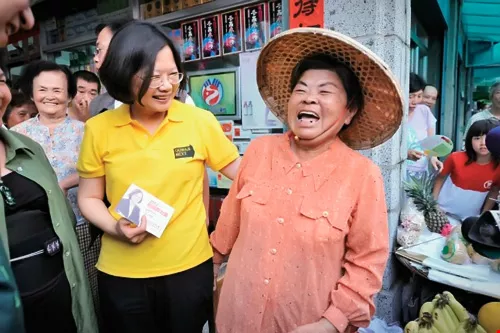
When campaigning in the countryside, Tsai felt a particularly strong sense of responsibility to listen to the hopes and admonitions of her women supporters.
Q: You haven’t had a very long or deep relationship with the Democratic Progressive Party [Tsai joined the DPP only in 2004], and your wealthy family background seems to set you apart from the DPP’s “grassroots” base. How did the environment in which you grew up affect your life?
A: My father always insisted that we go to public schools, especially in primary school, so we could come in contact with people from all different backgrounds. My family is ethnically very mixed—my father was Hakka, my grandmother an indigenous woman from the Paiwan tribe, my mother Southern Fujianese. Because of this, I didn’t grow up thinking there was only one right way to look at things, or that there were some fixed rules about who you could relate to and how.
Especially when I was at the London School of Economics, I was exposed to a lot of new things. The school was like a mini-United Nations, and this strengthened my powers of observation and my sense of empathy.
I never had any friction with my dad. My personality is a lot like his. He was a businessman, so he was also a sharp observer of life and people, and good at seeking compromise. The only time I heard a complaint out of him was when I got appointed vice-premier. He called and said, “In future, when you get a new job, tell me first, I don’t want to have to read about it in the newspapers!”
In fact my dad never wanted me to go into politics. He had a more traditional mindset, and didn’t think that a daughter should be weighed down with a lot of responsibility. If he had still been alive, there’s no doubt that he would have opposed my decision to become party chairman! But he always respected the choices his children made.
It takes a rebelQ: Why is it that you were willing to take on the job of party chairman when the DPP was at its lowest ebb? What do you feel you accomplished?
A: At the time I looked at the situation as if it were a balance sheet of assets and liabilities. You could consider my own status and reputation a kind of repository of cumulative assets of our society. I thought that if I could turn those into political assets, it would enable me to lead the party forward, and might be the chance the party needed to turn things around. If I failed, it would simply be a case of returning those assets to society.
After being elected party chairman, the first thing I did was to gather together a group of younger or middle-seniority people who could transcend factional lines. They had already been through a lot of political struggle, and all had developed their own special areas of skill and expertise. I viewed them as assets that belonged to the party as a whole, and asked them to take on the heavy lifting of pulling the party back up from its nadir.
In my four years as chairman, I succeeded in restoring confidence to party supporters. That was very important, because only when your supporters have confidence can you open up new space for reasoned thinking. Other things I achieved were to insist on reason and logic in policy positions, and to escape the party’s dependence on big business groups by appealing to a wide mass of small individual donors.
Supporters of the DPP have a lot of energy and vitality, and enormous capacity for thinking about issues. This is because, right from its founding, the DPP’s supporters have always had a rebellious character, and their emotional commitment has been very real. My goal was to add more thoughtful deliberation into the mix, because that is the best possible citizen structure for a modern democratic society, which will lead to the biggest and most beneficial changes in society.
Q: Is the political culture of the DPP more conducive to nurturing women political figures?
A: Some foreign media outlets were very surprised when I emerged. It was mentioned in the press that almost all women leaders in Asia have come from important political families, whereas my political career was more “Western” as it got started because of my personal professional qualifications.
Emergence of gender equalityWomen in Taiwan are increasingly able to create political space for themselves through their own credentials and expertise. They can “be themselves.” This shows that the ideal of gender equality has already taken root and begun to put forth green shoots.
The DPP is more likely to produce women political figures whose foundation is their own skill, and who have followed their own autonomous political pathways. This is because being in the DPP means facing greater political dangers, because the party has no resources of its own and it does not have the advantages of being in power—so everything depends on individual effort. In any case, the women in the DPP have always been very capable, and don’t need any patron to deliberately “groom” them for responsibility.
Moreover, though the DPP’s grassroots base has a certain masculine, rough edge to it, the party often makes dramatic gestures in the interests of gender equality. For example, Chen Shui-bian was the first president to truly implement “government jointly by both men and women,” with women accounting for a quarter of cabinet ministers. And I hardly need mention that we broke barriers by electing the first woman party chairman and nominating the first woman presidential candidate.
Women should be in a position where they can compete with men on a level playing field, and they shouldn’t be discriminated against. But there is no reason to give women especially easy treatment, either. I felt reservations about making my identity as “a woman” prominent in my campaign, but I realized that doing so could have the effect of drawing attention to gender issues and triggering forward-thinking ideas. However, there was not necessarily any gain to be had in terms of number of votes, because in our society today there are those who will tilt toward one candidate simply because she is a woman, and others who will vote against the same candidate for exactly the same reason. I think the two groups cancel each other out.
Avoiding a two-front campaignQ: It seems that women have to “sacrifice” a lot more to get involved in politics than men do; for example a lot of women political figures are still single. What’s your opinion?
A: Women in politics are pretty much in the same position as other professional women. Our work is very stressful, while we are also expected to carry more family responsibilities than men, such as looking after the children, so there’s double the pressure.
You have to deal with all kinds of people in politics. It’s very complicated and messy, so you have to manage your own emotional state right. If her family doesn’t get behind her all the way, a woman has to cope with a completely different “interest group” when she gets home, and in fact this is a very big learning process to go through. From this point of view, staying single at least has the advantage of “not having to fight on two fronts.”
In traditional society, it was thought that if a woman didn’t marry then her life was somehow incomplete. But in today’s society, a person who is not married can still get all the things that marriage has to offer.
Q: Taiwan is facing the closing pincers of declining birthrates and a growing population of elderly people. Do you have any thoughts on this problem?
A: Some people blame declining birthrates on women not getting married, but they never think about it from the woman’s point of view. Society should build some systems to help ease the double burden on working women, and the culture must change, people’s mindsets must change. When women think that getting married and having children don’t come with so much heavy baggage attached, they will naturally reconsider doing those things.
People need a sense of belonging and a sense of security, which are the roots of a sense of confidence. If there is no sense of belonging, no sense of security, then you can’t nurture citizens with confidence, and democracy will not mature.
In modern society, you can no longer depend entirely on family and marriage to provide a sense of security. We have to adapt the way we think, and develop a whole variety of networks of interdependence. For example, I have found that in many communities organizations of the elderly are very active.
Building a social security system is the government’s responsibility, and it has substantive economic significance. If we don’t do it now, then the next stages of Taiwan’s economy and democracy will never develop.

@List.jpg?w=522&h=410&mode=crop&format=webp&quality=80)


@List.jpg?w=522&h=410&mode=crop&format=webp&quality=80)
@List.jpg?w=522&h=410&mode=crop&format=webp&quality=80)
