Mixed Messages--The Rise of Microblogging
Lin Hsin-ching / photos Chuang Kung-ju / tr. by Geof Aberhart
November 2009


"Have you Plurked today? Twitted anything? Did you see the news I posted on my Facebook?" Such questions have become common among online Taiwanese lately, and what they are referring to are the websites Plurk, Twitter, and Facebook, three services that have exploded in popularity with the rise of "microblogging."
Just how big is microblogging? The most popular site that provides microblogging functionality, Facebook, has almost 300 million members. At the beginning of 2009, Taiwanese users accounted for a bit over 100,000 of these, but as of the end of September this had exploded to a whopping 3.22 million. Plurk, another extremely popular microblogging site, has over 300,000 Taiwanese members. Twitter, which grabbed the media spotlight for its part in boosting the presidential campaign of Barack Obama, has had trouble breaking into the Taiwanese market due to not yet having a Chinese-language interface. As a result, Taiwanese Twitterers number only about 30-50,000.
The strength of microblogging is nothing to be sneezed at: these new services have begun gradually rewriting the relationships between users and their friends, running contrary to the old model of interaction based around weak ties and strong ties. And more to the point, with these services offering a place to speak your mind and have your words transmitted to others almost instantaneously, people have begun inadvertently letting slip their most personal details.
"Hi XXX, I set up a Facebook profile where I can post my pictures, videos and events and I want to add you as a friend so you can see it. First, you need to join Facebook! Once you join, you can also create your own profile. Thanks, YYY."
So goes the invitation letter sent out by Facebook users to friends without accounts. Undoubtedly many of you have already received such letters from colleagues, friends, or friends of friends, maybe long-lost lovers or elementary school classmates, and possibly even complete strangers.

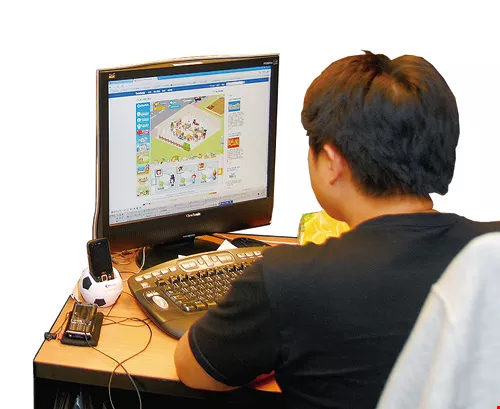
The Facebook app "Happy Farm," which has swept Taiwan, can satisfy ordinary people's desire to get something for nothing. But with people tending their fields during work time, stealing other people's crops in the dead of night, or spending money buying dogs that don't dutifully guard their fields, there have been lots of debates and disputes.
Person-to-person transmission
At first, such a letter might have you suspicious that this is some new virus, but as the invites keep coming, one day you'll realize, to your surprise, that all your friends are on Facebook. Whether out of a desire to share information and events or play games with your friends, out of fear of being left out of the loop, or simply because you figure "Why not?" you'll sign up. Then it's your turn to start pumping out the invites, sending them out to the emails of friends who don't have their own accounts yet.
This kind of viral marketing is the central factor behind the stunning growth of sites like Facebook, Twitter, and Plurk in just three or four short years.
Online trend analyst George Liu notes that unlike past social networking sites, which relied more on word of mouth to draw in like-minded users, these new services are more about actively pulling users' friends in by essentially casting a net across their whole social network.
For example, when a new user first logs in to Facebook, they might be surprised to find the ability to pull names from their email addresses, with those contacts who are already Facebook users marked, along with a list of people they may know. The site will constantly nag you to add more friends, all but saying "Hey! This guy could be your friend-you've got seven friends in common!" Or perhaps your curiosity will just get the best of you and you'll sneak a peek at your friends' Plurk or Twitter pages, to see who is following them that you might know, regardless of how familiar (or otherwise) you may be with them.
"And so once you start using these services, you might find yourself accumulating 'friends' almost unawares, almost like you're suffering some kind of 'compulsive friendship disorder.' This way of pulling people in is how these services have become so popular in such a short time," says Liu, who himself has already accumulated over 7000 "fans" on Facebook.
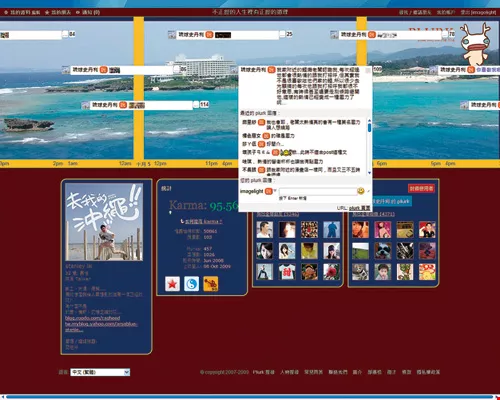
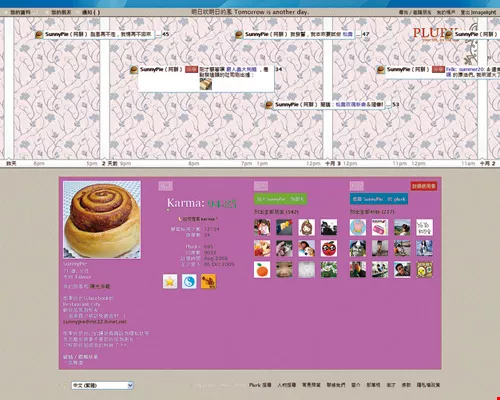
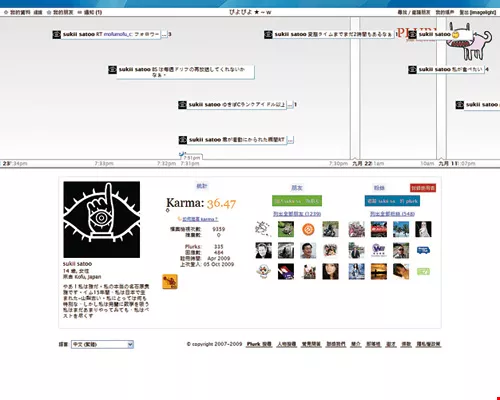
Microblogging services like Twitter and Plurk allow users to customize their profiles and create pages that fit their style. The barrier to entry for such services is low, providing friendly user interfaces and offering a channel for those too busy with modern life to write the kinds of long articles expected of traditional blogs. These characteristics have helped microblogging rival, and even surpass, traditional blogging in popularity.
Gaming the system
This aside, the other "killer app" for Facebook has been the provision of almost compulsive games-most recently a Facebook game called "Happy Farm" has been a tremendous hit with Taiwan's nine-to-five set.
In May 2007, Facebook launched the Facebook Platform, enabling users and software developers to freely create their own applications ("apps") that could integrate into Facebook itself. These have included innumerable quizzes, along with games like "Mafia Wars" and "Happy Farm."
So just how popular are these games? Taiwan presents an excellent example. At the beginning of 2009, Taiwanese Facebook users numbered only around 100,000, but since the release of the Chinese-language version of Happy Farm, numbers have risen by 10% or more per week, making Taiwan one of the fastest growing markets for Facebook in the world. By the end of September, Taiwanese Facebook members numbered 3.22 million.
So how did this one little game create an endless stream of Taiwanese signups and start a farming craze? It comes down to the mechanics of the game-not only can players raise animals and crops in an online world, leveling up and earning in-game cash for their efforts by selling their harvests, other players can try and steal crops or eggs, pandering to people's desire to get something for nothing or to experience the thrill of the theft.
Facebook isn't the only one to understand the attraction of games. Plurk has introduced a "karma" system, and members earn points for updating their profiles, leaving messages, or inviting friends. As your karma rises, you gain access to new emoticons or pet icons. Meanwhile, if you go too long without logging in, you post too many updates and just get annoying, or your friends decline your invitations, your karma score can go down, limiting your options again.
Lucifer Chu, an online author known as "Taiwan's top nerd," explains that Taiwanese people are happy to engage in such competition and get a huge sense of achievement from it; whether it's Happy Farm or karma points, such mechanics pander to Taiwanese people's love of "honing their skills" in online contests, and thus their booming popularity.
"And so, while Plurk and Twitter have a lot in common service-wise, the latter doesn't have this game mechanic, which is why Plurk easily broke 300,000 Taiwanese members, while Twitter is languishing at around 30,000 to 50,000," says Chu.

Microblogging's ability to let users quickly assemble large personal networks has helped many greatly enlarge their circles of friends. The egalitarian, one-to-many messaging model they use, however, has left some users concerned and uncomfortable with the prospect of revealing too many personal details and potentially changing the way they relate to their friends.
Redifining relationships
Whether it's for making friends, sharing your thoughts, spreading news, or just mucking around, microblogging and social networking have shown massive pull with Taiwanese around the country. But behind all of the glitz and showiness, these sites are also gradually rewriting the nature of interpersonal relationships.
Online trend analyst George Liu explains that everyone has people in their social circle that are "strong links"-close friends, and people like colleagues and classmates-and others who are "weak links," those you don't know so well. But on Facebook or Plurk, this distinction is all but gone.
So when you're posting things on such sites, whether it's just something that happened to you that day, office gossip, or news about how your baby's growing up, all of your online "friends" have the chance to read and respond. "Of course, through these sites you can strengthen your relationships with these 'weak links,' but this across-the-board egalitarianism in communication ignores the intimacy of close friendships."
Liu offers one of his own experiences as an example: having re-established contact with old classmates from elementary school and high school, he and these old classmates would constantly share reminiscences about their wild youths. Meanwhile, his closest friends would complain that they were drifting apart because he "spent all [his] time talking with them."
"One good friend I'd known for years complained, 'You spend so much time online every day meeting new friends, but you can't even be bothered to find the time to give your old friends so much as a phone call?!' Such is the danger of the popularity of these sites," says Liu, embarrassed.
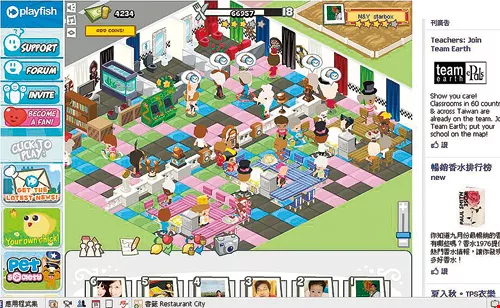
Facebook has successfully increased user retention through the release of the Facebook Platform, an open user platform that enables developers to create any kind of game or app they want. Games built on the platform, such as Happy Farm and Mafia Wars, have earned legions of die-hard supporters.
Shooting the messenger
While making these changes to interpersonal relationships, these sites have also increased interactivity, earning praise from their users. This makes them a threat to the near-monopoly of Taiwan's social networking market enjoyed by Windows Live Messenger (commonly known in an abbreviated form of its previous name, MSN), which was at one point used by over 90% of Taiwanese online.
As George Liu notes, MSN and Yahoo! Instant Messenger (YIM) offer predominantly one-to-one communications, wherein one party sends out a message to a friend and waits for their response. If they're online and the response is taking a while, you might begin wondering what's keeping them so busy they can't even respond.
On the other hand, microblogging services offer one-to-many, even many-to-many messaging; just post a few lines on your page, not specifically directed at any one person, then sit back and wait for the responses. Friends can jump straight in, or maybe wait until they feel inclined to before replying, removing the stress that can come with the one-to-one model.
This kind of one-to-many model, though, has left some users cold.
Take Mr. Xu, a record company employee, for example. As he says, it may be because he's not a particularly sociable person, but he feels that sitting online with a bunch of people-from close friends through colleagues he barely knows to his usually aloof boss-exchanging good mornings and making smalltalk about how good such-and-such a hotpot place is or how you saw the hottest girl on the MRT this morning is just a meaningless waste of time. On top of that, he says, is the knowledge that anyone can just "eavesdrop" on the conversation. All of this results in Mr. Xu feeling restricted in such conversations.
"Before, I would chat with close friends in the industry or elsewhere in music on MSN, talking about how this or that album was garbage, all that kind of thing, but on these sites it's halfway to being right out in public, so we can't really do that. I'm a little nostalgic for the days when one-to-one was the way to go, when I could say what I felt without having to worry about who else might hear it."
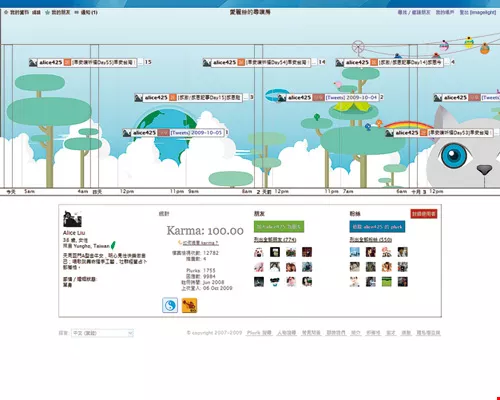
Microblogging services like Twitter and Plurk allow users to customize their profiles and create pages that fit their style. The barrier to entry for such services is low, providing friendly user interfaces and offering a channel for those too busy with modern life to write the kinds of long articles expected of traditional blogs. These characteristics have helped microblogging rival, and even surpass, traditional blogging in popularity.
Blogging in brief
As well as these social effects, microblogging has had a big impact on another aspect of the Internet-blogging.
Unlike traditional blogging services, which are "expected" to be strewn with images and long screeds-Twitter and Plurk posts are restricted to 140 characters in English (70 in Chinese), making them more like community bulletin boards. For people today, always strapped for time, this is a much more sustainable blogging style.
"Writing a blog post that has a distinctive viewpoint and interesting content takes a long time," says Chen Shun-hsiao, professor of communications at Fu Jen Catholic University and prominent Taiwanese blogger. Chen says that his blog has a regular readership with whom he builds relationships, so if he doesn't post anything for a while, people will write and offer him "friendly reminders" to update.
But Twitter and its ilk are another beast entirely. Despite being pressed for time, Chen can still just post a few words to let his followers know what's going on. The content doesn't have to be spectacular, and there aren't the same content expectations on him there as there are on his blog, but at the same time he is still able to keep up good relations with his readers.
Twitter has also shown the ability to provide first-hand news across the Taiwan Strait-Chen points to the Lantern-Festival fire at the headquarters of the mainland's China Central Television network, and more seriously the riots in Urumqi, Xinjiang. In both cases, the news caught on through Twitter, with its ability to quickly and concisely provide information. "Thanks to the speed and convenience of microblogging, a lot of blogs-my own included-have seen a huge dropoff in levels and lengths of content, with some bloggers even abandoning their blogs completely."
While this has left many fans of the longer-form blog post anguished, it has also led to an overall rise in quality in blog posting, as the once-flooded blog market starts to sort the wheat from the chaff.
Attending psychiatrist at Taipei's Wanfang Hospital Billy Pan-who is also a famous Taiwanese blogger-notes that since he started posting on Plurk, he's found it the perfect place to just throw out the occasional idea or thought, while he reserves posting on his blog for those ideas that take more time to organize and write up.
"While it's true that I don't post on my blog as much as I used to, each posting carries more weight now. I don't have to worry about trying to keep the number of posts at a certain level, and I don't get nearly as much comment spam," says Pan, talking about how the ability to channel each post through the more appropriate medium has proved a stimulus for bloggers.
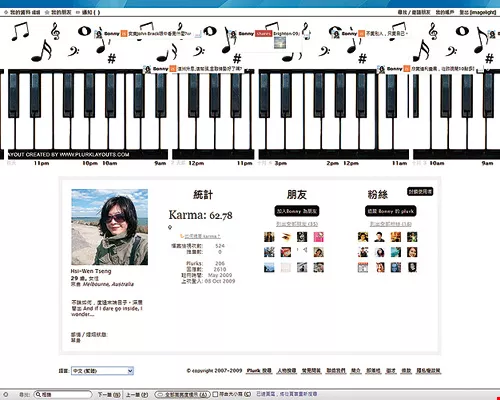
Microblogging services like Twitter and Plurk allow users to customize their profiles and create pages that fit their style. The barrier to entry for such services is low, providing friendly user interfaces and offering a channel for those too busy with modern life to write the kinds of long articles expected of traditional blogs. These characteristics have helped microblogging rival, and even surpass, traditional blogging in popularity.
Privacy concerns
So just how will these positive and negative impacts of microblogging on traditional blogging pan out? That remains to be seen, but there is another aspect of microblogging and social networking that has many observers of the Internet concerned. Could these new platforms in fact be too fast and too convenient, leading to users inadvertently exposing a little too much about their private lives?
President Obama himself has said, in a talk at a Virginia high school, that kids need to be careful about exactly what they put up on the Facebook pages.
"I want everybody here to be careful about what you post on Facebook, because in the YouTube age, whatever you do, it will be pulled up again later somewhere in your life. And when you're young, you make mistakes and you do some stupid stuff. And I've been hearing a lot about young people who... you know, they're posting stuff on Facebook, and then suddenly they go apply for a job and somebody has done a search," said Obama, giving this group of teenagers a valuable warning about revealing too much on such sites.
Kuan Chung-hsiang, assistant professor of telecommunications at National Chung Cheng University and chairman of Taiwan Media Watch Foundation, supports such advice. He notes that with the advent of highly interactive, Web-2.0-style social networking sites, our "online identities" are no longer as anonymous as they once were, and in fact have started to become an extension of our "real lives."
Take Facebook for example. Not only does Facebook encourage users to enter their full names, it also offers the ability to pull your contact list from your email, and if it does this for everyone, it makes it easy for the company to build up ever more detailed maps of interpersonal relationships. While Plurk, Twitter, et al. don't require a real name, it can nonetheless be relatively easy to look at how and to whom users talk and build up similar maps and figure out exactly who a given user is.
"You shouldn't be lulled into posting just any old thing because you think the only people that can read it are those on your friends list," emphasizes Kuan, as modern Internet search technology and password hacking methods mean that once you post something, it could potentially be seen by anyone. Before you post anything-message, photo, whatever-you must remember that it will be seen, and that once it is on the Internet, it is essentially there forever.
George Liu is also emphatic about this. In the age of the Internet, we can never be sure who will see what we put online, "and more concerningly, if someone has a mind to they can readily find out who you are, who you're friends with, and what you've been doing lately."

The strengths of microblogging are its conciseness, instantaneousness, and convenience, which make it a great tool for getting your thoughts and feelings out or just getting in touch with friends. This photo shows Plurk's distinctive "timeline" interface, which makes it easy for your friends and fans to click on, read, and respond to any message you have posted.
From friends to paparazzi
Despite the warnings of people like Kuan and Liu, however, young people with a tendency for showing off and attention seeking can find themselves almost addicted to these services, leading to them dropping their guard.
Liu notes that many people new to Facebook and the like will quietly "lurk" for a while, see what other people post, and then eventually start posting themselves and interacting more with others. Then over time they get used to the idea of a bunch of people following them on a daily basis.
"When your friends start posting about how cute their kids are, you might not be able to help posting a picture of your own kid as well, out of some desire to be part of the group, to not get left out. At that moment, you may not even think about what impact uploading a photo of them could have on your child later in life."
And even if you're cautious and watch your online steps, it can still be difficult to stop your "friends" from posting things that might come back to hurt you, even with the best of intentions.
As an example Liu points to a young stewardess hired by an American airline who claimed to have injured her spine at work and asked for unpaid leave and compensation. The company was planning to give her disability leave for 18 months, until someone saw a photo of her skiing on Facebook, leaping around and having fun as if nothing had actually happened to her back.
"The interesting thing is that this photo was not uploaded by that young woman, but rather one of her travel companions. Her friend had inadvertently become a paparazzo of sorts, revealing something of this stewardess that she didn't want anyone else to know about. This is one of these negative impacts we must bear in mind with the popularity of microblogging and social networking sites," says Liu.

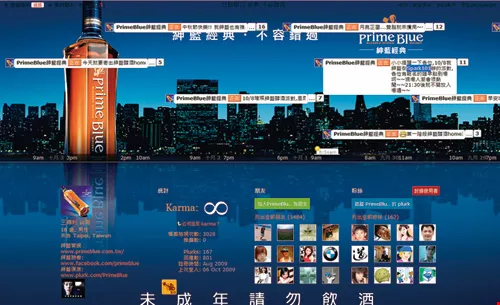
Since the rise of microblogging, several companies and brands have jumped on the bandwagon, seeing it as a valuable marketing tool. Whiskey brand Prime Blue recently held a promotional party, using Plurk and Facebook to get the word out and get whiskey lovers on board quickly.
Win some, lose some
Microblogging and social networking have become a major part of life for many today, from Barack Obama using Twitter to drum up votes (which the media made much of), through social commentators using it to break through political barriers and stir up community action, to companies using it as a tool to market their brands and products, and even just everyday people like you and me playing around in this playground combination of blogging, socializing, and gaming.
But as the amount of information out there and the scope and interconnection of people's networks continues to grow, perhaps we should stop and ask ourselves if there is really that much that warrants sharing, that much that is so urgent it has to be posted right this second, and if there are that many friendships that demand the Internet for maintenance. As Taiwanese author Wang Wenhua said in his essay "Losing Face through Facebook," "I work hard at updating my Facebook, but not at updating myself"-making friends online can be fun, but you shouldn't let it suck you in like quicksand. Don't forget there's still a big, wide world out there for you to explore!
Microblogging services like Twitter and Plurk allow users to customize their profiles and create pages that fit their style. The barrier to entry for such services is low, providing friendly user interfaces and offering a channel for those too busy with modern life to write the kinds of long articles expected of traditional blogs. These characteristics have helped microblogging rival, and even surpass, traditional blogging in popularity.
The Facebook app "Happy Farm," which has swept Taiwan, can satisfy ordinary people's desire to get something for nothing. But with people tending their fields during work time, stealing other people's crops in the dead of night, or spending money buying dogs that don't dutifully guard their fields, there have been lots of debates and disputes.
Microblogging services like Twitter and Plurk allow users to customize their profiles and create pages that fit their style. The barrier to entry for such services is low, providing friendly user interfaces and offering a channel for those too busy with modern life to write the kinds of long articles expected of traditional blogs. These characteristics have helped microblogging rival, and even surpass, traditional blogging in popularity.
Since the rise of microblogging, several companies and brands have jumped on the bandwagon, seeing it as a valuable marketing tool. Whiskey brand Prime Blue recently held a promotional party, using Plurk and Facebook to get the word out and get whiskey lovers on board quickly.
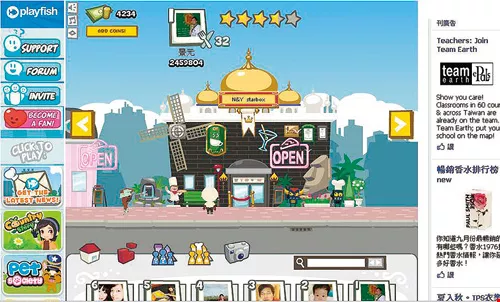
Facebook has successfully increased user retention through the release of the Facebook Platform, an open user platform that enables developers to create any kind of game or app they want. Games built on the platform, such as Happy Farm and Mafia Wars, have earned legions of die-hard supporters.
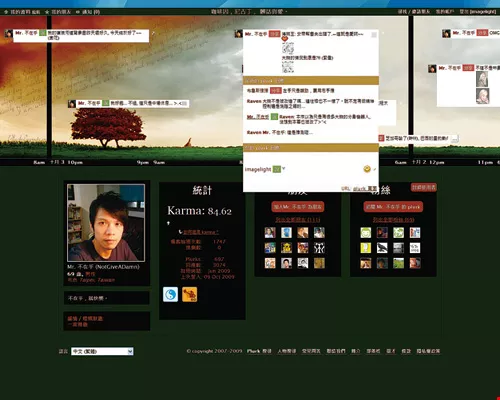
Microblogging services like Twitter and Plurk allow users to customize their profiles and create pages that fit their style. The barrier to entry for such services is low, providing friendly user interfaces and offering a channel for those too busy with modern life to write the kinds of long articles expected of traditional blogs. These characteristics have helped microblogging rival, and even surpass, traditional blogging in popularity.
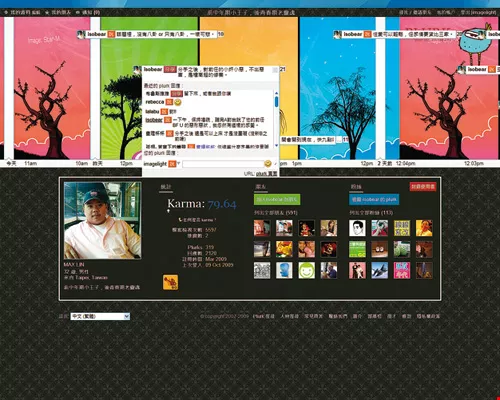
Microblogging services like Twitter and Plurk allow users to customize their profiles and create pages that fit their style. The barrier to entry for such services is low, providing friendly user interfaces and offering a channel for those too busy with modern life to write the kinds of long articles expected of traditional blogs. These characteristics have helped microblogging rival, and even surpass, traditional blogging in popularity.
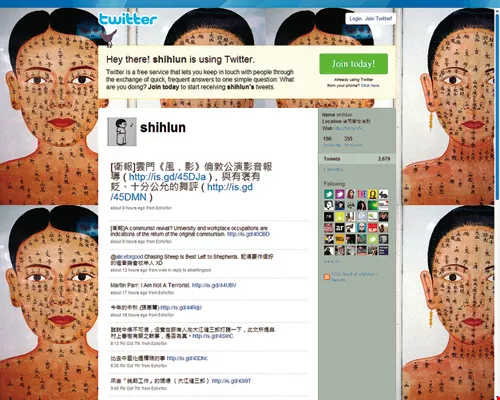
Microblogging services like Twitter and Plurk allow users to customize their profiles and create pages that fit their style. The barrier to entry for such services is low, providing friendly user interfaces and offering a channel for those too busy with modern life to write the kinds of long articles expected of traditional blogs. These characteristics have helped microblogging rival, and even surpass, traditional blogging in popularity.

Facebook has successfully increased user retention through the release of the Facebook Platform, an open user platform that enables developers to create any kind of game or app they want. Games built on the platform, such as Happy Farm and Mafia Wars, have earned legions of die-hard supporters.
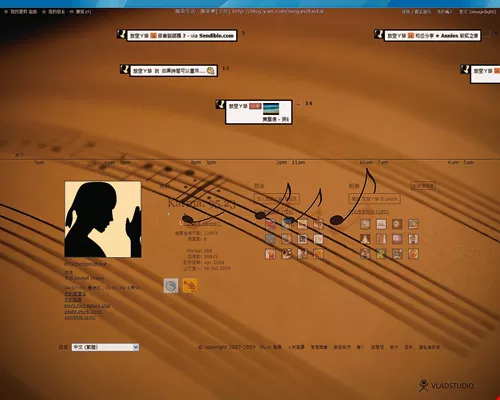
Microblogging services like Twitter and Plurk allow users to customize their profiles and create pages that fit their style. The barrier to entry for such services is low, providing friendly user interfaces and offering a channel for those too busy with modern life to write the kinds of long articles expected of traditional blogs. These characteristics have helped microblogging rival, and even surpass, traditional blogging in popularity.


@List.jpg?w=522&h=410&mode=crop&format=webp&quality=80)


@List.jpg?w=522&h=410&mode=crop&format=webp&quality=80)
