

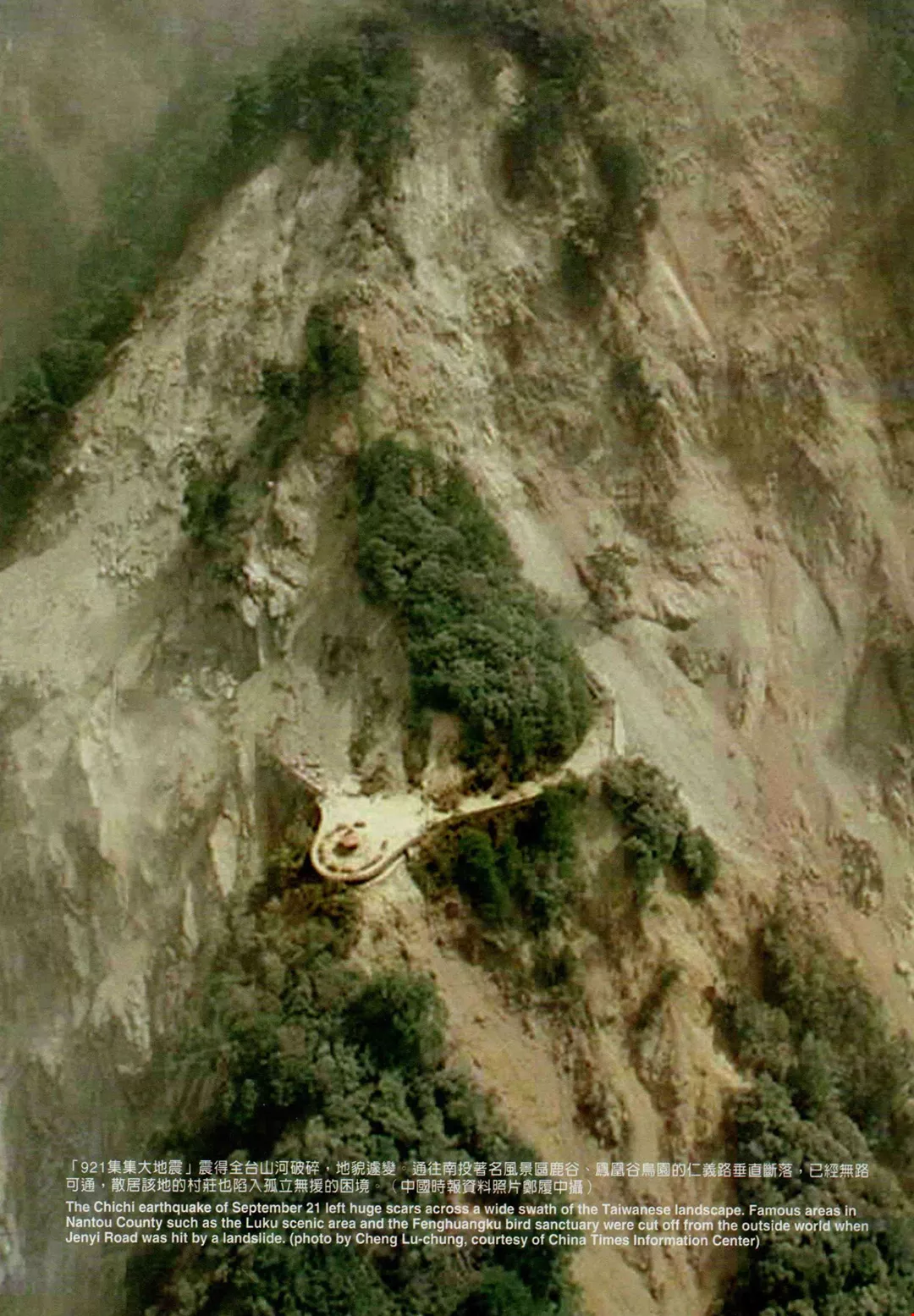
The Chichi earthquake of September 21 left huge scars across a wide swath of the Taiwanese landscape. Famous areas in Mantou County such as the Luku scenic area and the Fenghuangku bird sanctuary were cut off from the outside world when Jenyi Road was hit by a landslide. (photo by Cheng Lu-chung, courtesy of China Times Information Center)
At 1:47 a.m. on September 21, 1999, Taiwan was hit by its most powerful earthquake in 100 years. Over 2,000 people died, and tens of thousands lost their homes. After the quake, everyone put aside political and social divisions and came to each other's aid, volunteering money and services. With lives on the line, we have shown where our priorities lie.
As we work to recover from the disaster, we must take a hard look at how well we have responded to the emergency. Many precious lives have been cut short, and property losses are virtually incalculable. What have we learned from the experience?
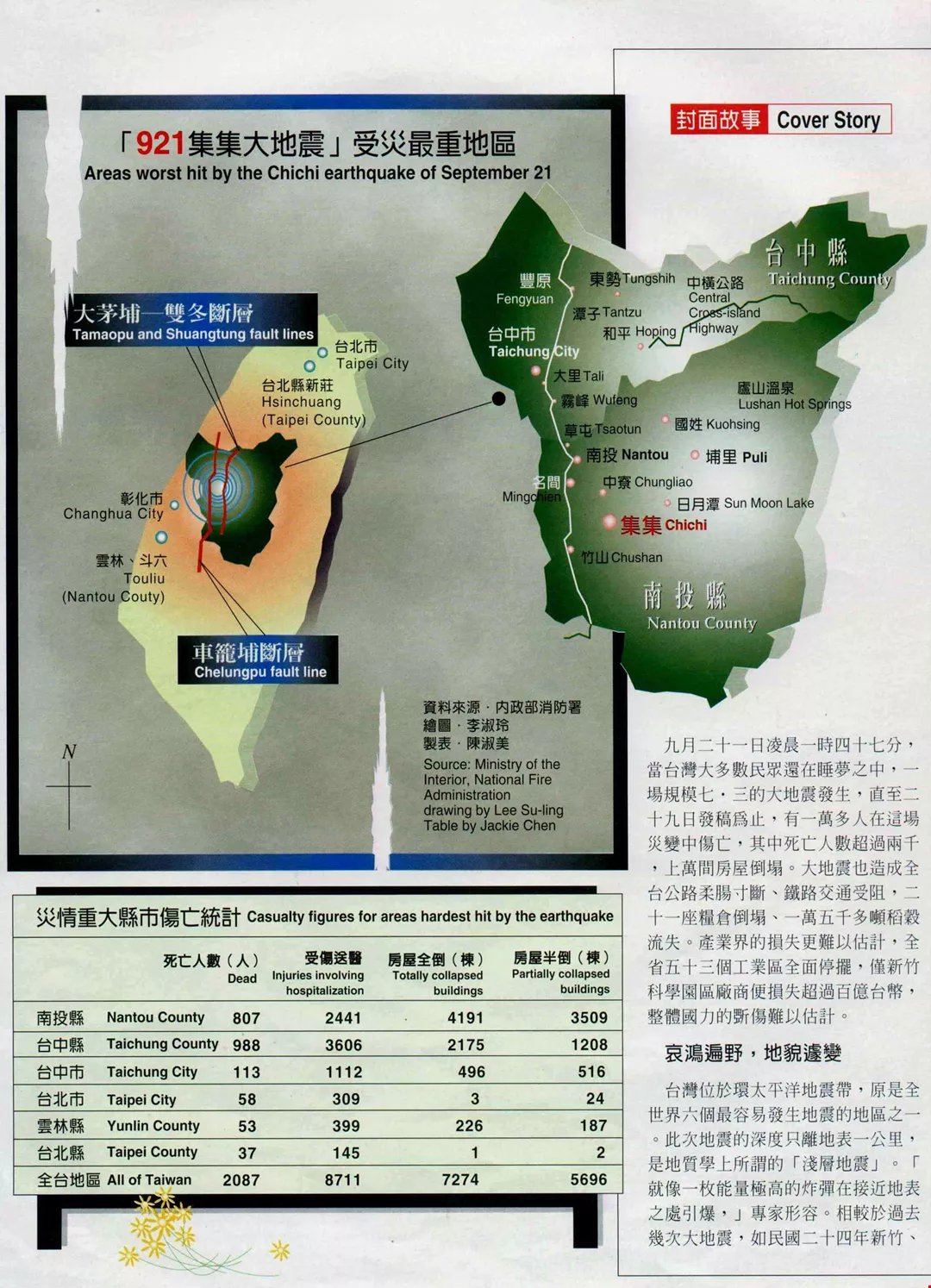
Source: Ministry of the Interior, National Fire Administration drawing by Lee Su-ling Table by Jackie Chen.
Most people in Taiwan were asleep at 1:47 on the morning of September 21 when the island was hit by an earthquake measuring 7.3 on the Richter scale. By the time Sinorama went to press on September 29, the quake had caused over 10,000 casualties, including more than 2,000 deaths. Over 10,000 homes had collapsed. Roads throughout much of Taiwan were rendered impassable and rail traffic was disrupted. Twenty-one grain silos burst, spilling over 15,000 tons of unhusked rice onto the ground. Losses in the industrial sector have been astronomical, with operations grinding to a halt at 53 industrial parks across the island. Firms at the Hsinchu Science-based Industrial Park alone lost more than NT$10 billion, and total losses across the island will never be known for certain. Cries of anguish
Taiwan is one of the six most earthquake-prone areas in the world. The quake of September 21 occurred just one kilometer from the earth's surface, and geologists would thus categorize it as a "shallow earthquake." According to experts, "It's like exploding an extremely powerful bomb just below the surface of the earth." Shallow earthquakes have a greater impact near the epicenter than deeper ones do. The big earthquake that hit the counties of Hsinchu and Taichung in 1935, for example, raised the earth in some places by as much as three meters, but last week's earthquake in the township of Chichi lifted the ground five meters in some places. This earthquake resulted in greater vertical and lateral displacement than we have seen in the past. Experts estimate that the destructive power of the Chichi earthquake was double that of the 1995 earthquake in Kobe, Japan.
The Central Weather Bureau estimates that the main quake in the wee hours of September 21 has been followed by nearly 8,000 aftershocks as of September 27, with eight of these registering 6 or greater on the Richter scale. The combined force of all the tremors has exceeded that of 25 atomic bombs, thus making this the largest earthquake of the century in Taiwan.
According to Wang Chien-ying, a professor of geophysics at National Central University, the Chichi earthquake, as it has come to be known in Taiwan, started along the Tamaopu and Shuangtung fault lines, both of which are located in central Taiwan. This activity subsequently triggered a violent upward thrust along the Chelungpu fault line, which lies parallel and to the west of the other two fault lines. The greatest destruction occurred in Taichung County along the fault lines (in Tungshih, Fengyuan, Tali, and Wufeng) and Nantou County near the epicenter (in Puli, Chushan, Mingchien, and Chungliao). The quake actually changed the shape of mountains and the course of streams in these places, and it also wreaked extensive damage upon buildings and other structures throughout most of Taiwan, with numerous damage reports coming in from the counties of Taipei, Miaoli, Changhua, Yunlin, and Tainan. The only areas to escape without major damage were eastern Taiwan and Kaohsiung.
The quake triggered a massive landslide on the eastern face of Chiufen Mountain #2, a 1,174-meter peak near Kuohsing township in Nantou County, turning a once-verdant mountainside into a barren escarpment. The landslide dammed a creek and resulted in the formation of a small lake. The once-verdant Mt. Chiuchiu in Tsaotun township now looks more like a lunar landscape. The famous tourist destination of Sun Moon Lake has not been spared either-the venerable Tienlu Hotel was flattened, and Kuanghua Island was split in two when part of it sank into the lake.
When the earth itself cannot withstand the force of a quake, one can well imagine the danger to fragile humans. In Taichung and Nantou counties, cries of grief continue to echo everywhere. The landslide on Chiufen Mountain #2 gouged as much as 100 meters from the mountainside, leaving at least 40 people buried alive in the village of Nankang. In the township of Chungliao, over 90% of all buildings sustained damage. Out of a population of no more than 20-30 thousand, fully 154 people died, with some families wiped out entirely. Anyone in Chungliao would agree that a big earthquake is more frightening even than war. In Puli and Chushan, the United Daily News reports: "Survivors are completely cut off from the outside world because fallen buildings block every single road leading out of town. Everyone is camping out in school playgrounds, and many children in town have become orphans." A huge explosion and fire occurred at the brewery in Puli, famous for its shaoxing rice wine, and the Central Cross-island Highway is badly damaged. In the township of Tungshih, Taichung County, entire rows of buildings have been razed, while houses located near the mountains have been obliterated by landslides. The death toll there stands at 451. In Wufeng, part of the Lin gardens, recently renovated at a cost of NT$100 million, has been demolished. In the city of Tali, several buildings over ten stories tall have collapsed, and survivors wail inconsolably amidst the rubble.
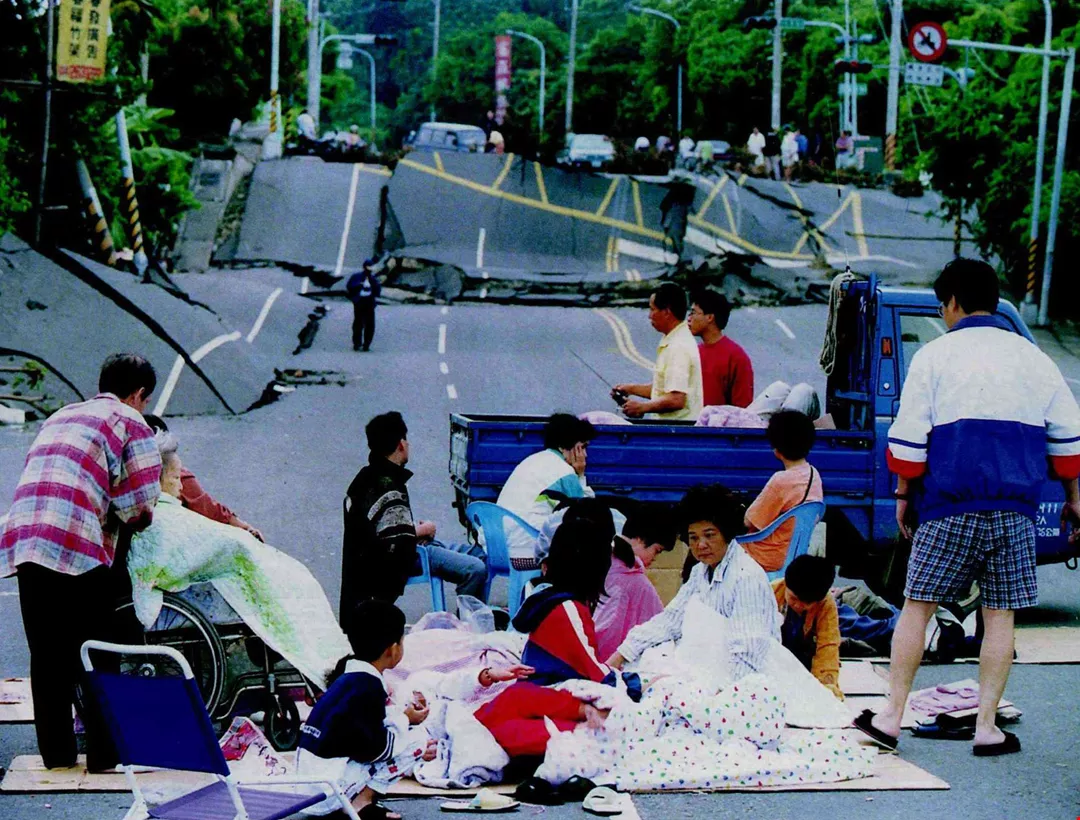
Chungtan Highway, which connects Taichung and Nantou, was completely destroyed.
The mountains of central Taiwan have been disfigured dramatically. Near the borders of Yunlin and Chiayi counties, landslides on two adjacent mountains have blocked a creek and created a 30-hectare barrier lake. Because the rising lake threatens to burst its dam, military authorities have ordered residents below the new lake to evacuate the area. Shihkang Dam, the main source of water for Taichung County, has been badly breached. In Changhua County, Pakua Mountain (famous for its enormous Buddha) has been measurably displaced. Shoddy construction
High-rise buildings have been popping up all over Taiwan in recent years, but across the island many well-known structures regarded as local landmarks were destroyed in the recent earthquake. Some fell over like building blocks, while others collapsed into their basements. In many cases, injuries and deaths have numbered over 100, and a chorus of complaints has arisen: "Building codes aren't strict enough." "Construction workers don't care enough about doing quality work." Some note that many fancy-looking buildings were totally vulnerable to the earthquake. They ask pointedly whether the deaths that these buildings have caused should be considered an act of God or a man-made disaster, and have demanded that construction companies take responsibility for their mistakes and misdeeds.
In fact, many construction company executives have already been taken into custody in connection with the collapse of several buildings. Investigations are still in progress, but construction experts have tentatively concluded on the basis of preliminary inspections that the problem almost certainly entails: (1) architectural designs that failed to provide for adequate earthquake resistance; (2) shortcuts taken by workers in the course of construction work; and (3) flagrant use of substandard materials by construction firms interested only in making a quick profit. Japanese rescue workers who have now been in Taiwan for seven or eight days exclaim: "Why are the walls so thin yet the floors so thick in the buildings here? That increases the likelihood of collapse, and makes it more deadly when it does occur."
The Hanchi Building in Touliu City is a good case in point. It has been examined by Dr. Su Nan, a professor of construction engineering at National Yunlin University of Science and Technology, and the professor's preliminary inspection indicates serious problems with the building's tall entryway, which had very few walls, many windows, and outer walls that lacked necessary reinforcement. In addition, the columns didn't have enough steel reinforcement bars, the reinforcement bars were not tied together properly, and the cross-section of the columns was too small. As a result, the building was not sufficiently earthquake-resistant. There were other problems as well. It appears that too much fly ash had been mixed into the concrete, and the steel reinforcing rods in the beams were not anchored deeply enough in the columns. When the earthquake hit, these factors made it easier for the concrete in the columns and beams to crumble.
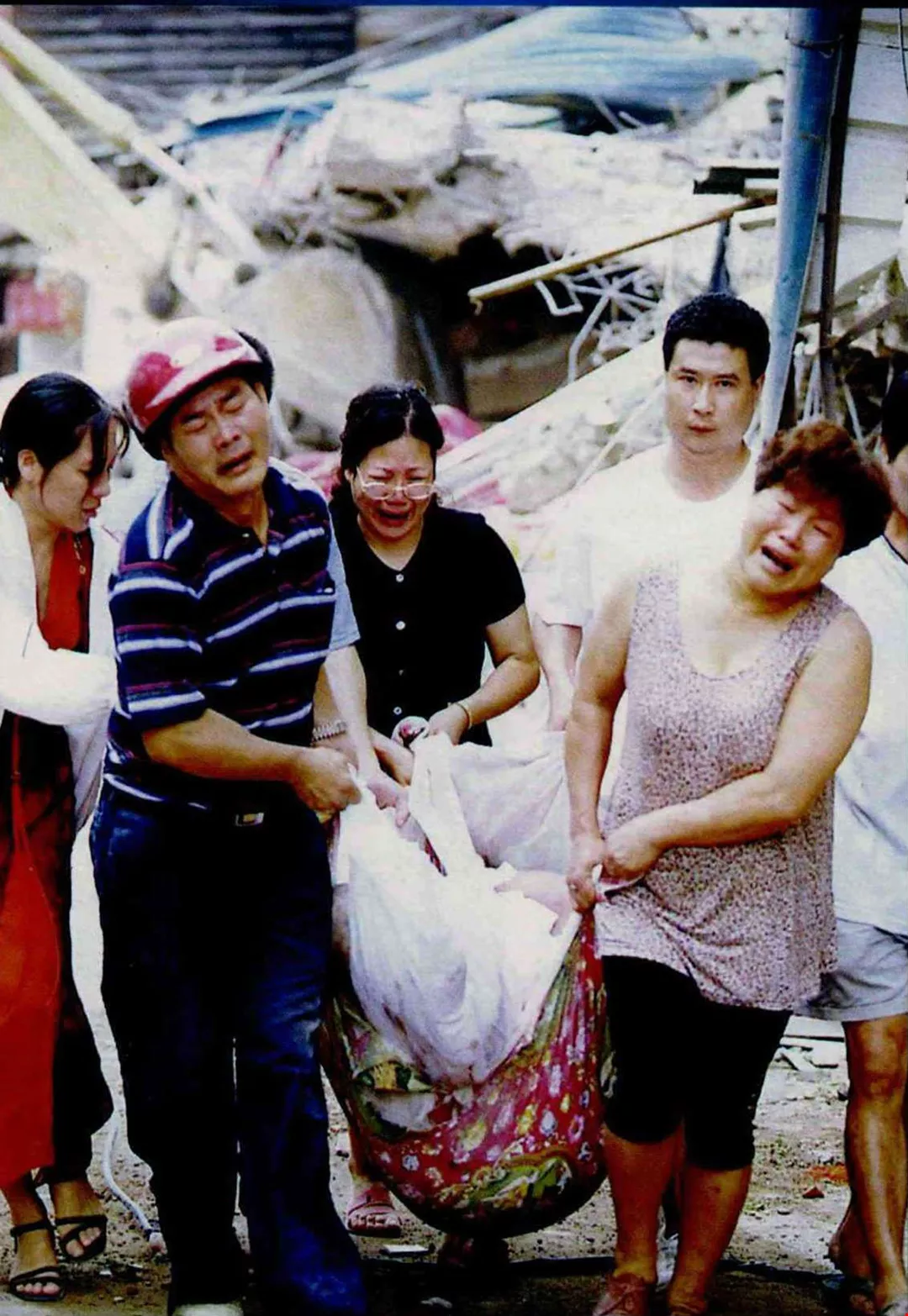
Survivors in Puli weep as they carry dead relatives from the rubble of their former home. (photo by Lin Hsi-ming, United Daily News)
In at least three buildings in Taichung County, empty salad oil drums and paint cans have been discovered inside damaged columns. One cannot help but suspect that these construction practices may have been the cause of deaths, and when the news was reported abroad it caused the entire world to wonder about the ethics and competence of Taiwanese construction firms, and to question the effectiveness of our government regulations. Lack of preparedness is exposed
The Chichi earthquake has brought to light a serious lack of coordination in Taiwan's disaster response system as well as insufficient understanding about disaster preparedness both within the government and without.
Within 20 minutes after the quake, the Ministry of the Interior's National Fire Administration had established the "emergency management center," and Premier Vincent Siew soon thereafter held a news conference at which he ordered the military forces to take part in rescue efforts. He further called upon the public to remain calm and stay on guard against aftershocks. Still in the early morning hours of September 21, the Executive Yuan established the "disaster response center" in Puli and announced 15 measures aimed at assisting efforts to rebuild from the quake. These measures included a decision to use funds from the postal savings system to provide NT$500,000 (later doubled to NT$100 million) to the family of every person who died in the earthquake, NT$200,000 to every family whose home had totally collapsed, and NT$150,000 to every family whose home had partially collapsed. On September 22, the Executive Yuan established the "center for coordination of earthquake rescue operations" in Chunghsing Village, the seat of Taiwan's provincial government. This center, which is headed by Vice-President Lien Chan, is responsible for coordinating the disaster response measures of the central and provincial governments.
The cabinet-level ministries and agencies have all taken measures to deal with the disaster. The Ministry of Finance, for example, has announced plans to sell over 4,400 units of public housing at 70% of the official price to people who have lost their homes. In addition, banks making housing loans will extend the repayment period by five years and reduce interest rates in order to help people get through this difficult crisis. In addition, county and city governments are looking for publicly owned land where they can build temporary housing that will afford people a place to stay until their homes can be rebuilt. The Central Bank of China has also decided to provide NT$100 billion in low-interest loans to help people buy new homes and rebuild or repair existing ones. .
In order to facilitate the rebuilding process, President Lee Teng-hui on the evening of September 25 issued a directive ordering government agencies to use simplified procedures in raising funds, reissuing personal documents lost in the disaster, and launching urban redevelopment projects in the earthquake-affected areas. The directive applies only "for a limited time, in specifically identified areas, and to specifically identified activities."
Nevertheless, the public has been sharply critical of the government's earthquake relief efforts, with many commenting: "You sure can't tell that the government has been doing anything!" The main problem has been a lack of coordination.
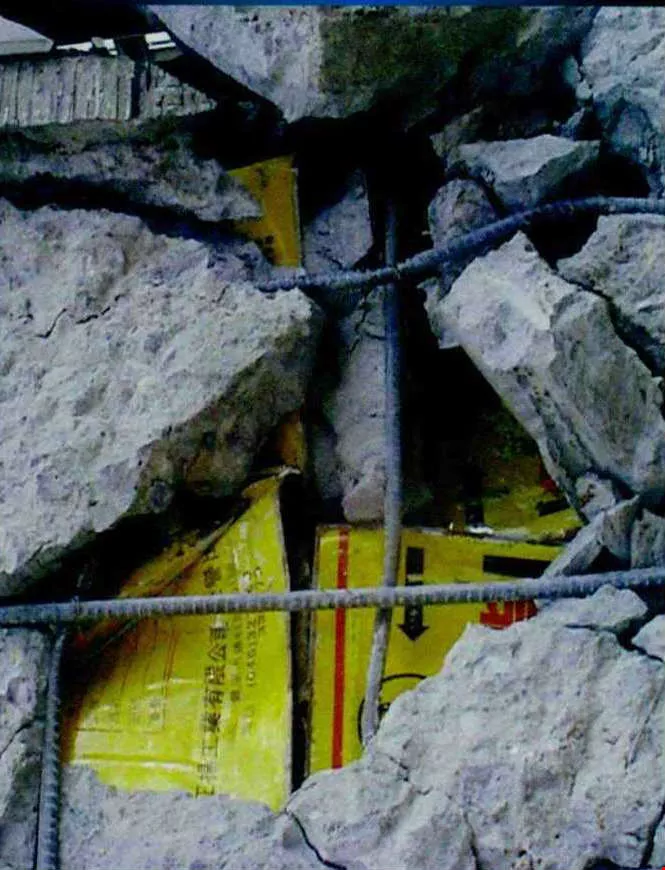
Empty metal drums were found inside destroyed walls and concrete columns in several collapsed buildings in Taichung County. An expert explains that it is common practice in Taiwan to fill in decorative columns with empty metal containers, but that it would be very unusual for anyone to put such things in a column that actually bears weight. Building inspectors are now checking structures throughout Taiwan to determine why they collapsed. Several construction company executives have been detained. (photo by Chou Tsung-chen, United Daily News)
The first step in any disaster relief effort is to find out the scope and seriousness of the disaster, determine what human and material resources can be mobilized, decide where to deploy these resources, etc. Unfortunately, the government was not able to act effectively in the all-important first two to three days after the Chichi earthquake. Impassable roads and disrupted communications made it extremely difficult to obtain basic information-How widespread is the destruction? What roads have been damaged? Where might there be casualties? What types of casualties will we be seeing? Because the central government's "emergency management center" was unable to get a clear picture of the overall situation, many doctors and overseas disaster relief specialists who arrived in central Taiwan one and two days after the quake ended up wasting time on circuitous detours because they couldn't find out which roads were passable. Rebuilding homes
Problems were compounded by ordinary citizens who got in the way of relief efforts during the first 72 hours. Every radio station in Taipei, for example, rushed reporters to the quake-stricken areas to interview local citizens, and they monopolized the few communication channels that remained in operation. By the afternoon of the first day, worried relatives and friends swarmed to Nantou and Taichung counties, where they combined with poorly deployed rescue vehicles to paralyze the few roads that remained intact.
The question of how to manage resources in the disaster area has also been a major headache. Donations have come pouring in by the truckload-instant noodles, mineral water, crackers, sleeping bags, blankets-and medical personnel have also swarmed to the area, but a lack of coordination has resulted in an excess of personnel and materiel in some areas and a complete lack in others. When well-equipped international rescue operations arrived at the disaster area, the lack of information forced many of them to set out on their own in search of victims. In some cases, five or six different rescue groups converged on a single site.
In one of the most moving aspects of the disaster, ordinary citizens have generously donated money and materials. Although the quake and its aftershocks have left people with severely jangled nerves, there has been no looting. People from all walks of life have freely donated money, blood, and other items to help the people in the disaster area, and members of the news media have worked around the clock to keep the public up to date on the situation. Official channels have also been established to route donations to where they are needed. Rescue teams from 21different countries (including America, Japan, Germany, Russia, Korea, and Turkey) have worked alongside local police, firemen, soldiers, and religious groups, risking their lives in an effort to save earthquake victims. Against a backdrop of tragedy and loss, these people have shown the heights that the human spirit is capable of reaching.
As Sinorama goes to press, many people remain trapped under the rubble, and it is unknown whether any of them remain alive at this point. We are deeply saddened by the deaths of more than 2,000 of our fellow human beings, and pray for the rescue of anyone who may still be alive and waiting to be rescued.
The only thing we can do now is put this sorrow behind us and look to the future. We hope that the casualties suffered will serve to awaken the people of Taiwan to the dangers we face. The government must take a hard look at the inadequacies of its disaster response system. Laws must be amended to provide for greater earthquake preparedness. Buildings, roads, and bridges must be inspected to determine whether they are strong enough to resist earthquakes, and when necessary they should be reinforced. The general public, for its part, must squarely face the fact that we live along an earthquake belt. After the 1995 earthquake in Kobe, people in Japan began keeping "disaster kits" (flashlights, mineral water, crackers, etc.) to be used in times of emergency, and we would do well do learn from their example.
In addition to giving our sympathy and support to earthquake victims, we will need to pool our collective wisdom and make a sustained effort if our compatriots are to rebuild their shattered lives. (Sinorama wishes to thank United Daily News, China Times, and Taiwan Daily News for their assistance with this report.)
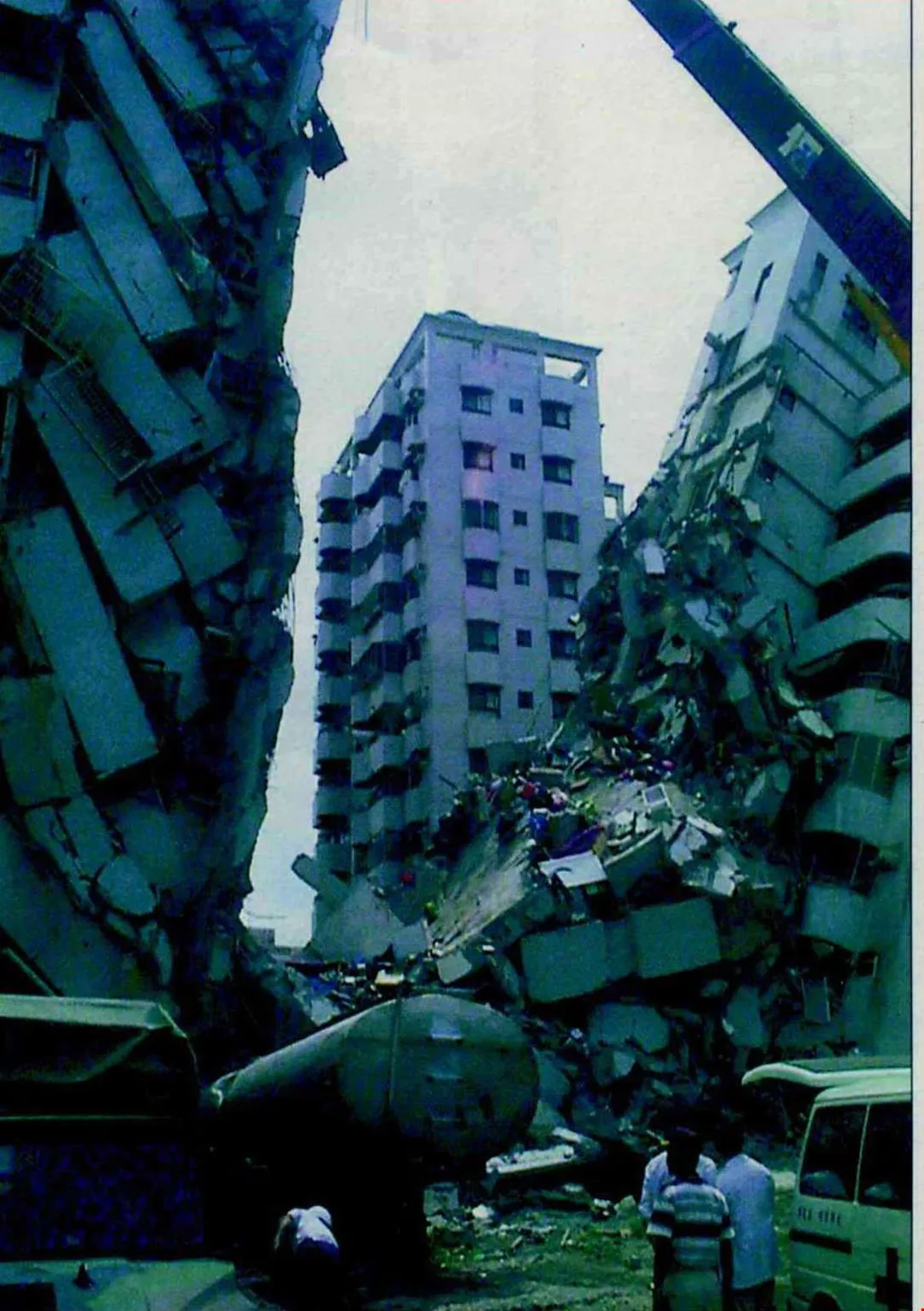
The Golden Paris, a 17-story building in Tali City, Taichung County, has split in two. (photo by Lin Chung-ying, United Daily News)
Buildings sustaining majordamage (as of Sep. 29)
| Location | Height | Nature of damage | Casualties |
|---|---|---|---|
| Taipei City, Sungshan District: Tunghsing building |
12 stories |
Sank into basement, currently leaning |
72 dead, 26 trapped |
| Taipei County, Hsinchuang: The Doctor's Home |
12 stories |
Fell over |
39 dead, 7 trapped |
| Taipei County, Hsinchuang : Lungko apartments |
11 stories |
Collapsed into basement |
1 dead |
| Taichung County, Fengyuan: Hsiangyang Yungchao building |
12 stories |
Collapsed into basement, currently leaning |
41 dead |
| Taichung County, Fengyuan: Hsinkao building |
8 stories |
Currently leaning |
5 dead |
| Taichung County, Tungshih: Tungshih Dynasty building |
14 stories |
Collapsed into basement and fell over |
15 dead, 16 trapped |
| Taichung County, Tali: Golden Paris building |
11 stories |
Fell over |
54 dead, 4 trapped |
| Taichung County, Tali: Taichung Dynasty building |
11 stories |
Collapsed into basement and fell over |
23 dead, 7 trapped |
| Taichung County, Tali: Taichung Miracle building |
11 stories |
Fell over |
18 dead, 1 trapped |
| Taichung City: Tehchang New World building |
14 stories |
Collapsed into basement |
4 dead |
| Changhua County, Yuanlin: Lungpang building |
16 stories |
Collapsed into basement, currently leaning |
19 dead, 9 trapped |
| Yunlin County, Touliu: Chungshan Kuopao building |
12 stories |
Collapsed into basement, now leaning |
14 dead, 3 trapped |
| Yunlin County, Touliu: Kuanti building |
16 stories |
Collapsed into basement and fell over |
9 dead, 8 trapped |
| Yunlin County, Touliu: E. Sun Bank building |
10 stories |
Leaning |
No casualties |
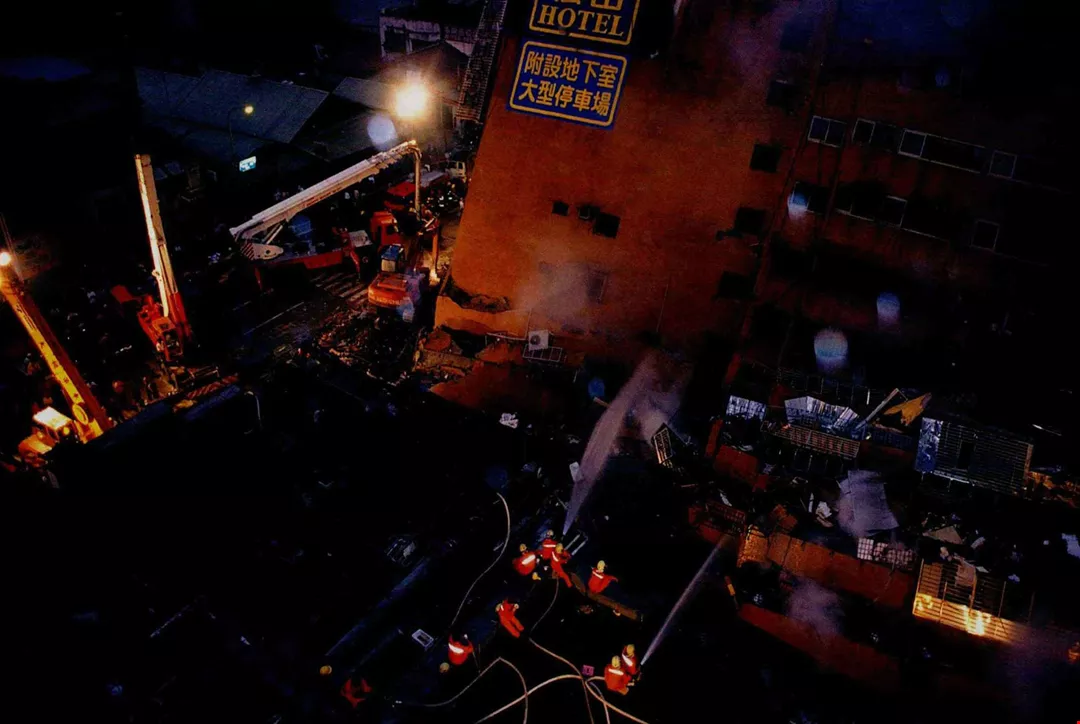
(Upper right) The first catastrophe reported by the media was the collapse of the Tunghsing building on Pateh Road in Taipei. Of the building's 12 stories, only four remained above ground while the other eight collapsed into the basement. (photo by Diago Chiu)
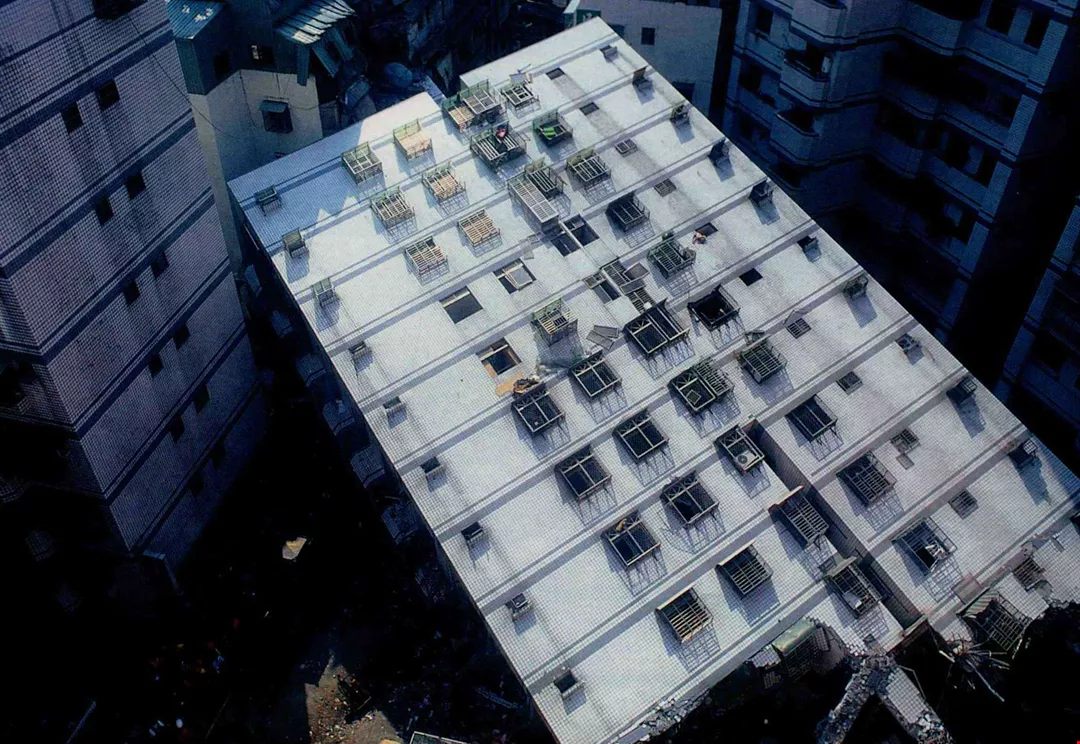
(Lower right) A building called "The Doctor's Home" in the Taipei suburb of Hsinchuang fell over with a thunderous roar, knocking down a neighboring five-story building. (photo by Hsueh Chi-kuang)
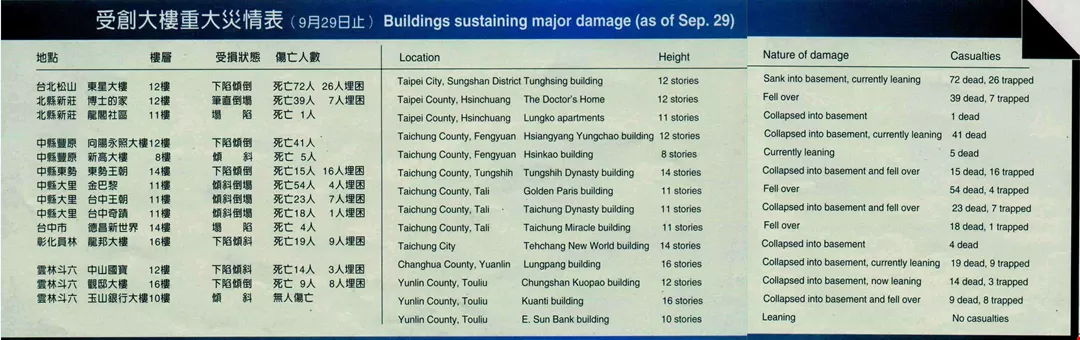
Sources: Ministry of the Interior, National Fire Administration; Fire departments of Taichung County, Taichung City, and Changhua County; Fire department of Yunlin County/Table by Jackie Chen.
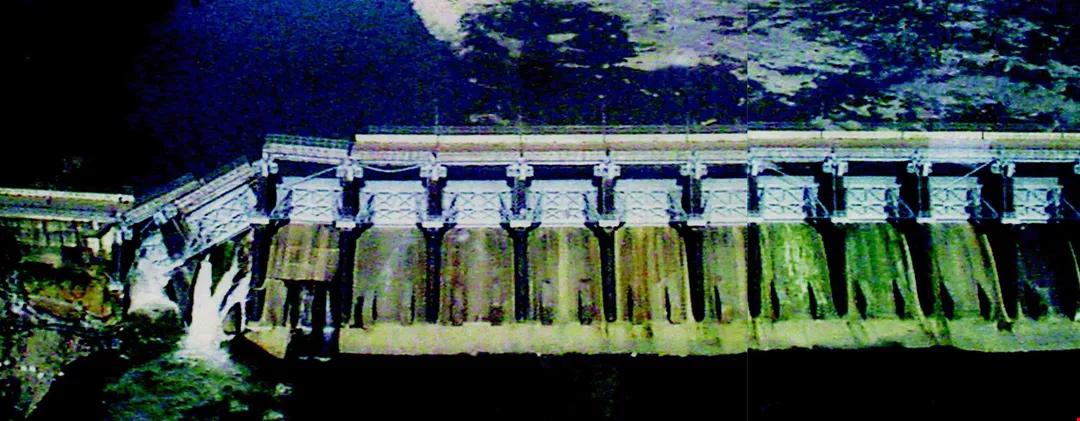
Shihkang Dam, which supplies household water for Taichung County, has been badly breached, but seven days of round-the-clock repair work have brought a temporary fix and ensured central Taiwan's water supply for the time being. (photo by Chang Po-fu, United Daily News)
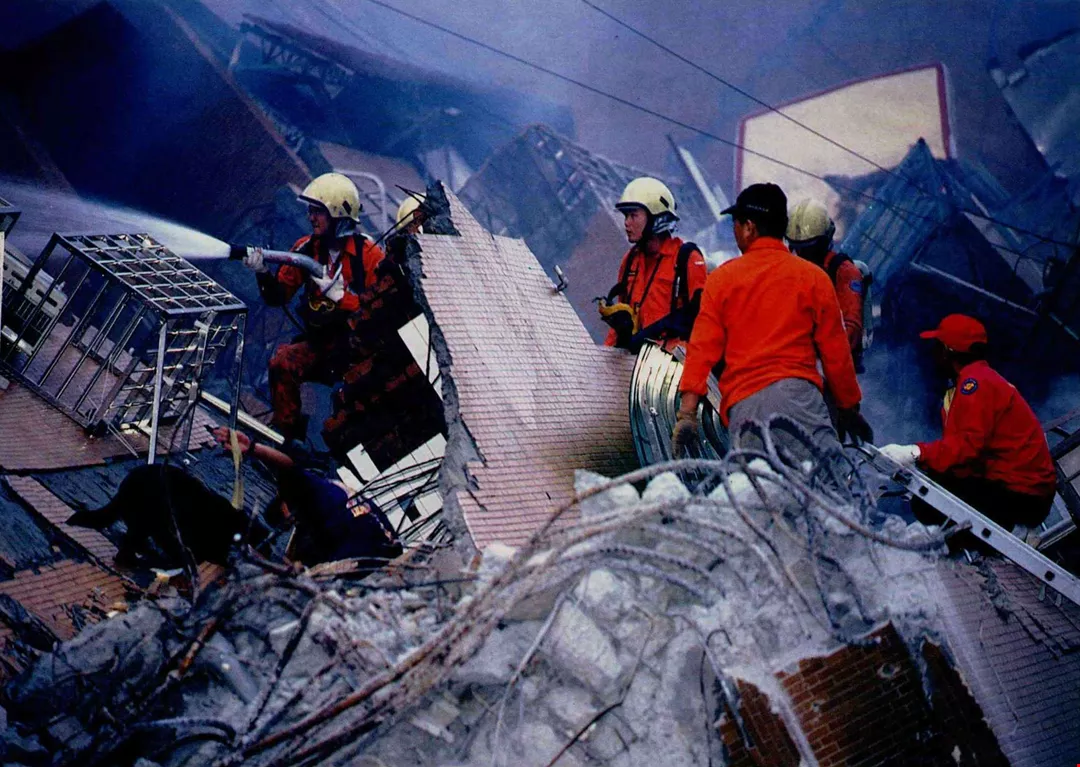
Professional rescue teams attempt to minimize injury and death by beginning rescue work as quickly as possible. Rescuers are shown here working to find survivors in Taipei's Tunghsing building. (photo by Diago Chiu)
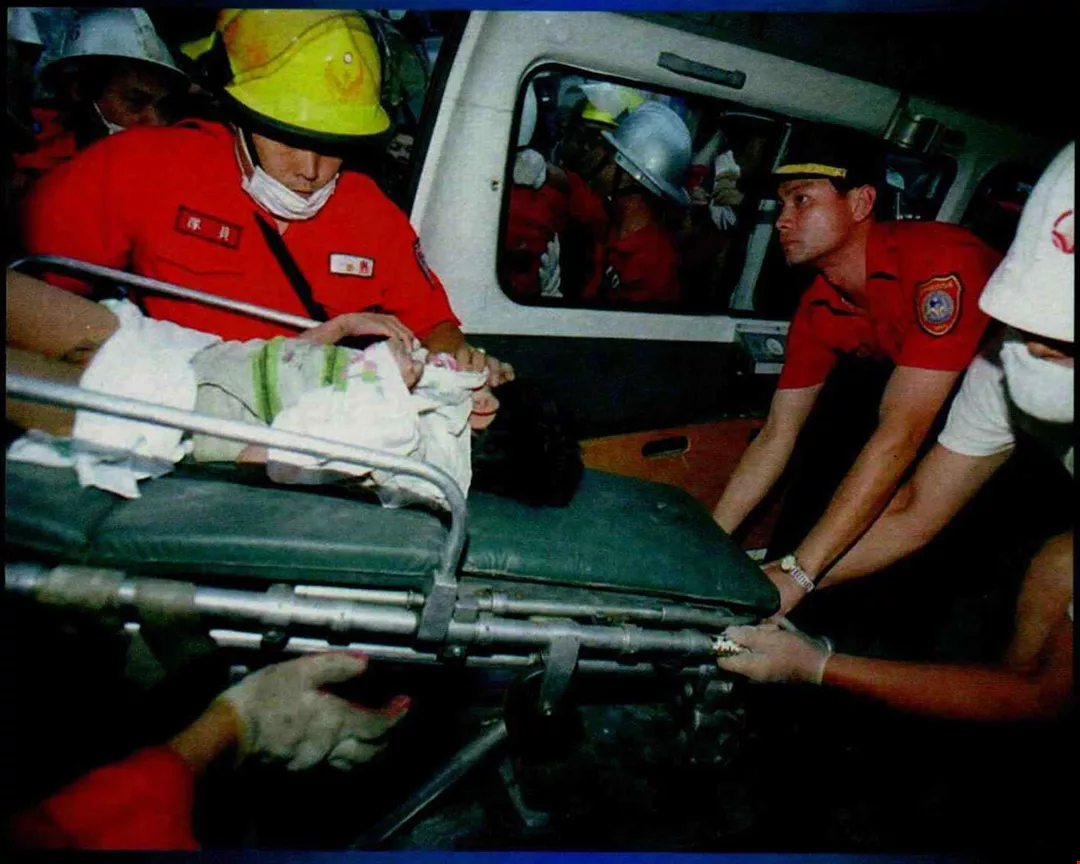
A Korean rescue team in Tali City, Taichung County, delivered good news on the evening of the Mid-Autumn Festival when they found little Chang Ching-hung alive after 87 hours under the rubble of the Golden Paris building. The success greatly boosted the morale of other rescue teams working around the island. (photo by Cheng Lu-chung, courtesy of China Times Information Center)
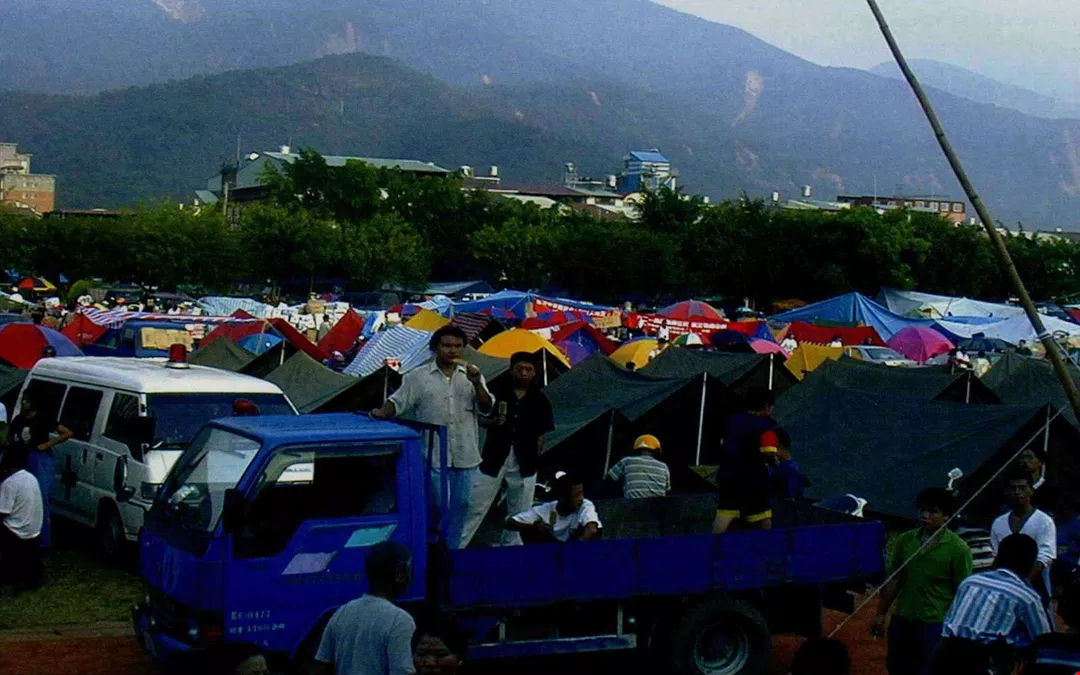
Many survivors have been living in donated tents since the earthquake and plan to stay there until their homes are rebuilt. Shown here is the temporary evacuation center at Hungjen Junior High School in Nantou. (photo by Chen Ying-tzu, United Daily News)
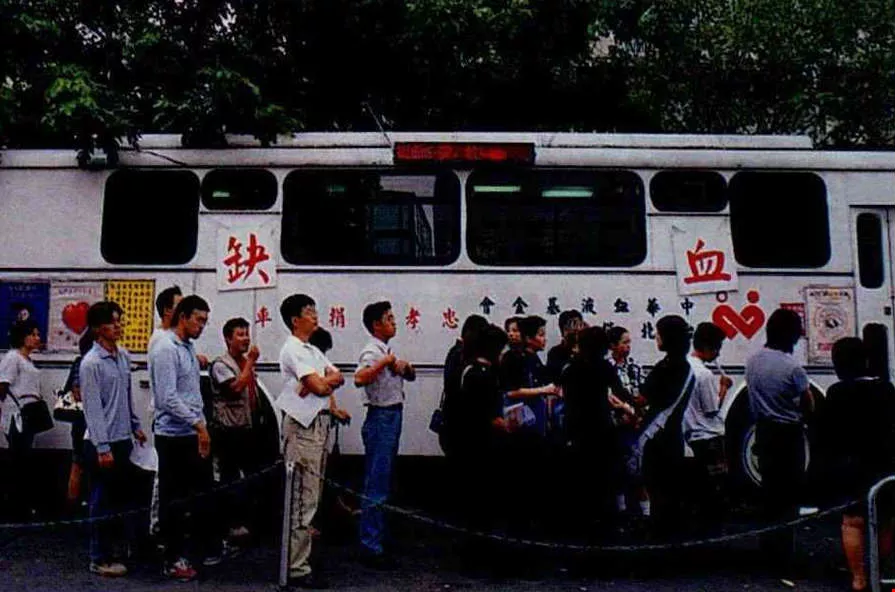
Citizens responded to the earthquake with generous donations. Even young children donated their pocket money to the relief effort (bottom), and articles bound for the disaster area were piled high in front of Taipei city hall (middle). A continuous stream of blood donors lined up outside the bloodmobile (top). (photo by Pu Hua-chih)
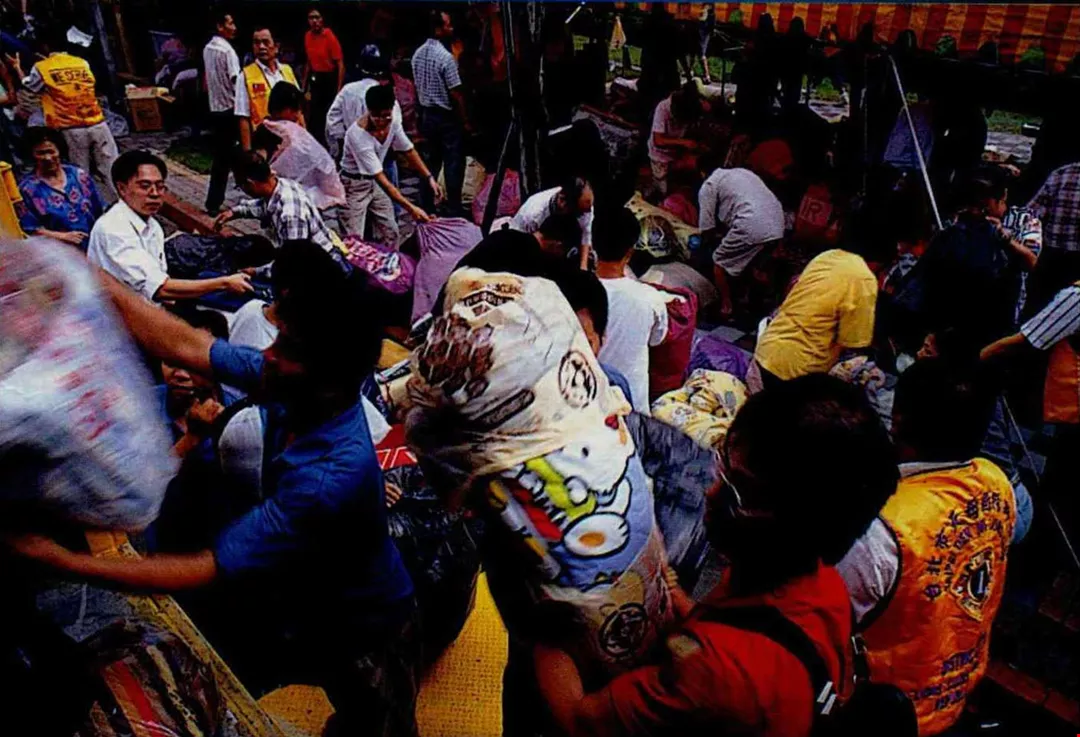
Citizens responded to the earthquake with generous donations. Even young children donated their pocket money to the relief effort (bottom), and articles bound for the disaster area were piled high in front of Taipei city hall (middle). A continuous stream of blood donors lined up outside the bloodmobile (top). (photo by Pu Hua-chih)
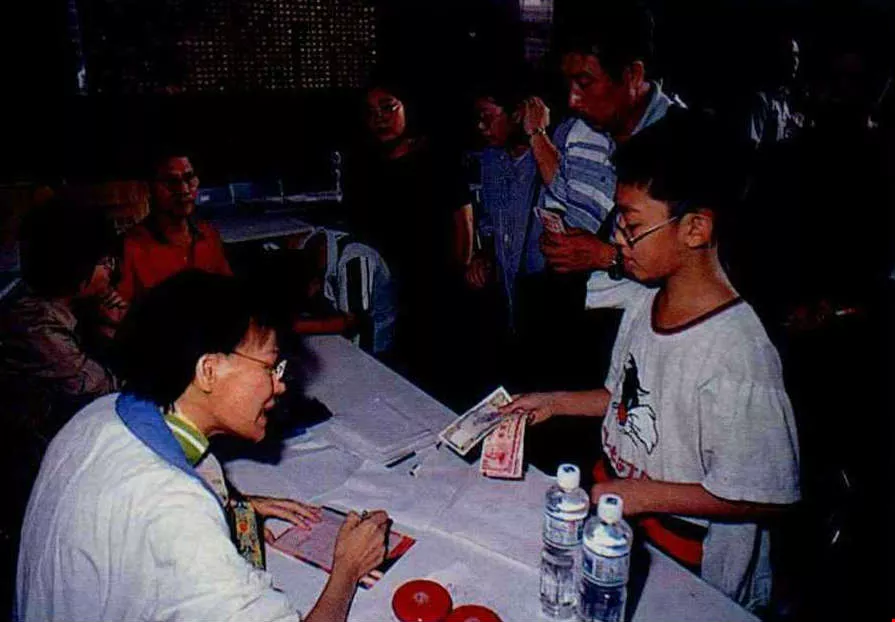
Citizens responded to the earthquake with generous donations. Even young children donated their pocket money to the relief effort (bottom), and articles bound for the disaster area were piled high in front of Taipei city hall (middle). A continuous stream of blood donors lined up outside the bloodmobile (top). (photo by Pu Hua-chih)


@List.jpg?w=522&h=410&mode=crop&format=webp&quality=80)


