

Neck-and-neck competition between the three leading candidates, and heightened tensions across the Taiwan Strait, caused worldwide attention to be focused on the 18 March elections for the 10th-term ROC presidency and vice-presidency. The results, announced on the evening of the poll, showed that DPP candidates Chen Shui-bian and Annette Lu had been elected with 39.3% of the vote, thus bringing to an end over 50 years of continuous KMT rule, and heralding the first peaceful transfer of power between political parties in ROC history.
Despite the tense situation in the run-up to the poll due to stern threats from Beijing and the intense competition between the candidates, the people of Taiwan displayed a high degree of democratic maturity, rationality and self-control, and peacefully chose a new national leader for the new century. This event can indeed be called a great victory for democratic politics.
The change in ruling party gives impetus to the overall development of national politics. Following the election, will cross-strait relations move towards detente? What kind of political challenges will confront President-elect Chen, who though full of bold plans for the future is in a politically weak position? What new moves will come from the losing KMT and James Soong camps? People are looking ahead to the next four years with bated breath.
The results of the presidential election were announced on the evening of polling day, 18 March. Democratic Progressive Party (DPP) candidates Chen Shui-bian and Annette Lu emerged as the people's choice to lead the country through the challenges of the coming four years. In this poll, in which 12,786,671 people-82.69% of the electorate-turned out to vote, Chen Shui-bian received 4,977,697 votes, giving him a "plurality" (relative majority) of 39.3%. Having failed to gain more than half of the popular vote, he thus becomes a "plurality president." The results for the other candidates were as follows: independent James Soong and his running-mate Chang Chao-hsiung took second place with 4,664,972 votes (36.84%); KMT candidates Lien Chan and Vincent Siew came third with 2,925,513 votes (23.1%); the remaining two tickets-independents Hsu Hsin-liang and Josephine Chu, and New Party candidates Li Ao and Elmer Feng-each garnered less than 1% of the vote.
As soon as Chen Shui-bian's victory was confirmed, he held a press conference at which he stated that the people of Taiwan had used their precious votes to resolutely express their determination to maintain democracy. The election, he said, had written a new page in our nation's democracy, created new opportunities for peace and democracy in the Asia-Pacific region, and set a concrete example for the global third wave of democratization. He was ready to enter into comprehensive, constructive communication and dialogue with Beijing, with the greatest goodwill and resolve.
In view of the heightened cross-strait tension following the sharp warnings from PRC premier Zhu Rongji, Chen especially stressed that as long as national security and the public interest were assured, he was willing to discuss with the PRC such topics as direct cross-strait transport, trade, and investment, the signing of a peace treaty, and military confidence-building mechanisms. He also extended a sincere invitation to mainland leaders such as President Jiang Zemin, Premier Zhu Rongji and top cross-strait negotiator Wang Daohan to visit Taiwan, and said that before taking office, he and Annette Lu were willing to go to mainland China on a journey of conciliation and dialogue. With regard to domestic policy, Chen declared his determination to drive criminality and corruption out of politics, and bring together the forces for clean government, in order to fulfil the heavy trust placed in him by the electorate.
Meanwhile, the Lien and Soong camps each made statements accepting their electoral defeat. James Soong, whose share of the vote was only 2.5 percentage points behind Chen Shui-bian's, called on the public to support the new government, and stated that he himself would not return to the KMT. On 20 March, the "New Taiwanese Service Team" of which he is the leader announced that it would be setting up a new political party, and on 24 March a founding meeting at which the new party was named the People First Party.
On the night of the poll, KMT candidate Lien Chan apologized to party members for his poor showing at the ballot boxes, and resigned as KMT vice-chairman. Voices were raised within the KMT calling for party chairman Lee Teng-hui to take responsibility for the electoral defeat by stepping down immediately. Many KMT members, including supporters of both Lien Chan and James Soong, gathered outside KMT party headquarters and protested continuously for several days, demanding thoroughgoing reform of the party. Reformist KMT public officials and academics, including Taipei City mayor Ma Ying-jeou, even initiated a signature campaign calling for Lee to resign immediately in accordance with popular wishes.
In response to such calls, at an emergency meeting of the KMT Central Standing Committee a reform committee was set up to accelerate internal party reforms, and party chairman Lee Teng-hui, secretary-general Huang Kun-hui and deputy secretary-general Huang Cheng-hsiung announced their resignations. Lien Chan took over as acting party chairman.
In marked contrast to the mainland's harsh tone before the election, PRC Taiwan affairs authorities responded to the poll's outcome with statements reiterating the one-China principle and again stressing opposition to Taiwanese independence; as for Taiwan's new leader, they would "judge him by his deeds as well as his words," and were awaiting the unveiling of the new government's cross-strait policy with interest.
The USA also sent envoys in the persons of former congressman Lee Hamilton and American Institute in Taiwan chairman and managing director Richard Bush, who arrived in Taiwan on 23 March to meet Chen Shui-bian and exchange views on issues related to cross-strait and Sino-US relations.
Chen Shui-bian's election has been described by some as a great victory for the forces for reform in Taiwanese society. But in the analysis of Professor You Yi-lung of Soochow University's politics department, on closer inspection the DPP victory was in large part due to the split in the KMT vote caused by James Soong's independent candidacy, in what was something of a replay of Taipei City's first direct mayoral elections. Professor You observes that in fact the voting ratio of 40% for the DPP and 60% for the KMT has not changed; rather, it was the split between Lien and Soong which opened the way to victory for Chen Shui-bian.
Other important factors in bringing about a change in ruling party in Taiwan in the millennium year were the public support Chen Shui-bian and Annette Lu received before the poll from figures such as Academia Sinica president Lee Yuan-tseh, who represents intellectuals opposed to corruption, and Hsu Wen-lung, a widely admired industrialist who is also a close personal friend of President Lee Teng-hui; the fact that following the National Assembly's decision to extend its term of office, assembly elections were not held at the same time as the presidential ballot, thus weakening the KMT's ability to mobilize voters at the grassroots level; dissatisfaction with the KMT government's response to last year's 21 September earthquake, which caused many voters in central Taiwan to shift their support to the Soong camp; and the damage done to James Soong's clean image by the Chung Hsing Bills scandal. PRC premier Zhu Rongji's saber-rattling speech on the eve of the election is also seen as having aroused resentment among Taiwan's electorate, and thus given Chen Shui-bian a last-minute boost.
The new president will be sworn into office on 20 May. As a "plurality" president, the first test facing Chen will be potential obstruction from a Legislative Yuan in which the KMT still holds the majority. Although the constitution does not require the president's choice of premier to be endorsed by the legislature, as the Legislative Yuan is the country's main legislative body and the organ which oversees the government's exercise of its executive powers, fears have been raised that strained relations between Chen Shui-bian and the Legislative Yuan could lead to a constitutional crisis in the form of a vote of no-confidence in the cabinet, or dissolution of the legislature. On this point, Chen Shui-bian has stated that he will not make use of his power to dissolve the legislature, but will seek every opportunity for cooperation. He also said that in the interests of stability within Taiwan, he would move quickly to invite representatives of all parties to form a "supra-party committee" to heal the divisions opened up by the election campaign.
The new political situation in Taiwan is still in a state of flux. In particular, it is possible that National Assembly elections will have to be held in the very near future, once again testing the strength of the three main political forces in the country. On 24 March the Council of Grand Justices, which had been asked to examine the constitutionality of the assembly's extension of its own term of office, ruled that the measure was invalid. Central Election Commission acting chairman Huang Shih-cheng has stated that if the Grand Justices' ruling is confirmed, elections to the National Assembly will be held immediately, and can be expected to be completed before the assembly's original mandate expires on 20 May.
The new president will have many tough challenges to face on Taiwan's behalf in the new century. Issues such as cross-strait relations and political corruption will be a test for the new administration. The new party-political landscape is not yet fully clear, and cross-strait issues will require an attitude of goodwill and conciliation on both sides. But we hope that the will of all our people to defend democratic development and social harmony will enable the ethnic and party conflicts stirred up during the campaign period to be quickly dispelled.
(Eric Lin)1977
November:
During Taoyuan County chief executive elections, suspected electoral fraud leads to the "Chungli Incident," seen as the beginning of the dangwai ("outside the party," i.e. non-KMT) opposition movement.1978
October:
At a dinner given by author Wang Tuo, legislator Huang Hsin-chieh announces the formation of the "Taiwan Dangwai Campaign Assistance Group."1979
August:
Formosa magazine is founded with Hsu Hsin-liang as publisher, Annette Lu as deputy publisher and Chang Chun-hung as editor-in-chief.
December:
A rally and march in Kaohsiung organized by Formosa magazine ends in clashes between police and demonstrators-the notorious Kaohsiung Incident. Almost all the leading lights of the dangwai movement are arrested.1980
December:
In supplementary elections, 12 non-KMT candidates are elected to the National Assembly and 13 to the Legislative Yuan. They include several family members of those arrested following the Kaohsiung Incident.1981
November:
Chen Ting-nan is elected chief executive of Ilan County-the first dangwai county chief.1983
December:
In supplementary Legislative Yuan elections, nine non-KMT candidates are elected.1985
November:
In elections for county and city chief executives and provincial and municipal assembly members, 23.04% of non-KMT candidates are elected.1986
September:
132 people attending a dangwai support meeting sign up to found a new party. The Democratic Progressive Party is formally established.
December:
23 DPP candidates are elected in Legislative Yuan and National Assembly elections. The party wins 24.78% of legislature votes, and 22.21% of assembly votes.1987
May:
The DPP organizes demonstrations marking the 38th anniversary of the imposition of the Emergency Decree (martial law), and demands the lifting of the decree.
July:
President Chiang Ching-kuo announces the lifting of martial law.1988
May:
A demonstration in Taipei by hundreds of farmers from Yunlin County ends in major clashes with police, in the notorious May 20 Incident.1989
December:
In elections for county and city chief executives, the Legislative Yuan and the provincial and municipal assemblies, the DPP garners 29.7% of the total vote.1990
March:
DPP delegates who go to the Presidential Palace to demand the dissolution of the first National Assembly, which has been in office since 1947, are forcibly dispersed by police. Several dozen university students begin a protest at Chiang Kai-shek Memorial Hall, marking the start of the "March Student Movement."1991
April:
The DPP calls on the public to march to Chungshan Hall in Yangmingshan to oppose constitutional amendments by veteran National Assembly members. Over 50,000 respond, setting a new record for Taiwan's largest ever demonstration.
December:
The DPP gains 22.78% of the vote in elections for the second National Assembly.1992
December:
In the second Legislative Yuan elections, the DPP's share of the vote grows substantially to 33.05%.1993
December:
The DPP gains 41.20% of the vote in county and city chief executive elections. Six DPP candidates are elected.1994
December:
In gubernatorial and mayoral elections, Chen Shui-bian becomes mayor of Taipei City.1995 In a two-stage primary process open to non-members, Peng Ming-min is chosen as DPP candidate for the first direct presidential election.1996
March:
The DPP gains 21.1% of the vote in the presidential election, and 29.9% in National Assembly elections.1997
November:
In county and city chief executive elections, 12 DPP candidates are elected and the party takes 43.03% of the vote.1998
June:
Lin I-hsiung is elected DPP party chairman in the first direct vote by the membership.
December:
In "three-in-one" elections, the DPP gains 70 seats in the Legislative Yuan and a total of 28 seats in the Taipei and Kaohsiung municipal assemblies. Frank Hsieh is elected mayor of Kaohsiung City, but Chen Shui-bian fails to gain reelection as mayor of Taipei City.2000 Chen Shui-bian is elected 10th-term president with 39.3% of the vote, bringing about the first peaceful transfer of power between parties, and the first DPP presidency.
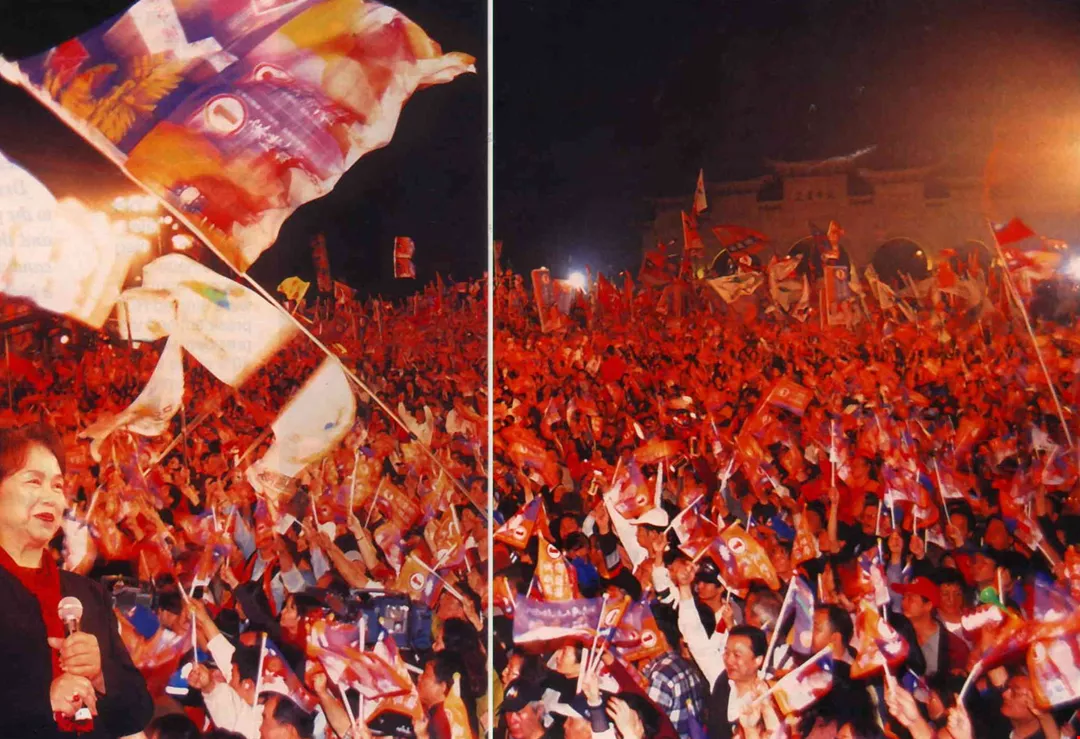
After James Soong finished less than three percentage points behind Chen Shui-bian in the presidential poll, supporters urged him to set up a new political party. Our picture shows an enthusiastic public at a James Soong campaign rally. (photo by Jimmy Lin)

@List.jpg?w=522&h=410&mode=crop&format=webp&quality=80)


@List.jpg?w=522&h=410&mode=crop&format=webp&quality=80)
@List.jpg?w=522&h=410&mode=crop&format=webp&quality=80)
