Gambling with the Gods--Weather Risk Management
Lin Hsin-ching / photos Jimmy Lin / tr. by Geof Aberhart
July 2007


Last winter, blizzards covered the central plains of the United States, while New York suffered a record lack of snowfall, receiving nary a flake through November and December for the first time in 130 years.
The Japan Meteorological Agency, meanwhile, made its first error in predicting when the nation's cherry trees would begin blossoming. The agency has long held a reputation for near supernatural accuracy with these predictions, but this year the first blossoms were over a week later than official predictions, resulting in profuse apologies to the public from officials.
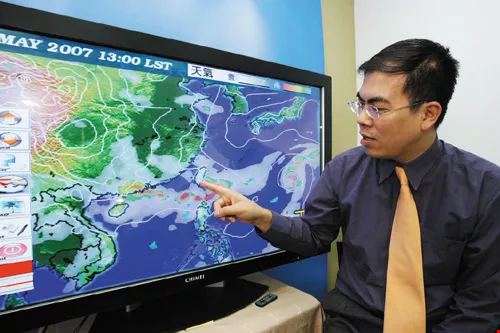
An old Chinese proverb states that "man's fortunes are as unpredictable as the weather," and the weather increasingly seems to be holding up its end of the arrangement. While weather forecasting technologies and techniques are still limited in their efficacy, there are still some who voluntarily rely on predicting the whims of the Heavens for their living; they try to take the pulse of the climate, offering people not only information on the weather, but also ways of linking business operations with weather variables, giving their clients what they need to adapt their decisions to the weather and providing suggestions to help avoid catastrophe. Such is the world of the so-called "weather industry."
Unlike the US, Europe, and Japan, where the industry is booming, Taiwan only began opening up the meteorological business to the private sector three years ago. Since then a range of value-added products has been developed, although the industry still lags behind other countries by some 20 years.
Nevertheless, Taiwan is now home to a wide range of weather-related services, from insurance to forecasting. Scholars and entrepreneurs alike predict a sunny future for Taiwan's weather industry.
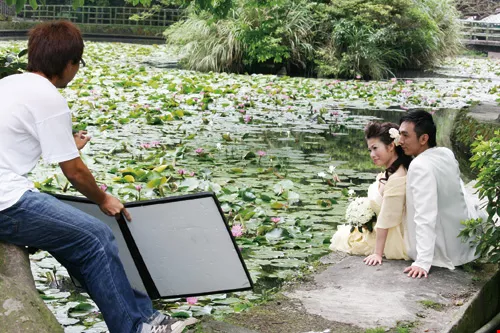
One early summer afternoon at the end of May, near a lotus-filled lake in Taipei's Yangmingshan Park, soon-to-be-married couples having their wedding photos taken were everywhere to be seen. The temperature that day had already gone over 30°C, but in the afternoon dark clouds closed in, filling the air with water droplets and making it look like it was about to rain and rain hard.
"Oh God, please don't let it rain!" exclaims a bride from Hong Kong, YoYo Yiu, as she stands in front of the budding lotuses and smiles for the camera. Faced by the threat of rain, though, her smile soon fades.
Groom Ho Wing Kwong notes that just for the flight to Taiwan, accommodation, and living expenses it had already cost them over NT$30,000, so if they had to change locations and do a reshoot because of rain, it would both be a hassle and cost them even more money. "If there were some kind of 'weather insurance,' and the rates and compensation levels were reasonable, I'd definitely consider it."
Weather insurance for weddings
Fortunately, after their interruption on Yangmingshan, Ho and Yiu had nothing but blue skies for their reshoot in Tanshui later, but theirs is a common situation. With Taiwan's fickle weather, most couples planning to have their weddings, wedding photos, and receptions in Taiwan are concerned by the potential for the heavens to open up and ruin the most special day of their lives.
Seeing the demand amongst such couples for weather information and risk management, well-known wedding planners FranceStar partnered up with Fubon Insurance and weather forecasters WeatherRisk Explore to create Taiwan's first wedding weather insurance policy.
Vice president of FranceStar Lee Shu-fen explains that weather insurance for weddings and wedding photos is primarily aimed at couples like YoYo Yiu and Ho Wing Kwong, who come to Taiwan from Hong Kong for their wedding photos. In the future, they hope to organize it so that couples will be able to pay an extra fee of NT$1800 when they sign their contracts with their wedding photographers and have coverage worth NT$10,000 in the event of 15 mm or more of rainfall. This policy is expected to go on sale in the middle of July this year.
"The losses couples from abroad incur if it rains and they have to reschedule their photo shoot are fair higher than those incurred by local couples," says Lee. "This is why we chose them as the targets for our initial sales. If there is enough demand, we will consider expanding our policies to cover Taiwanese couples as well."
A budding market
As early as March 2005, Central Insurance--now AIG General Insurance--began offering the first "rainfall insurance" policy to companies in Ilan running whale-watching operations.
In July that same year, Taiwan's professional baseball league took out their first rainfall insurance policy to cover the grand final being held in Kaohsiung. That policy stated that if 10 mm of rainfall was measured in a two-hour span on the day of the game, causing the game to be called off and requiring the organizers to refund tickets, the organizers would be entitled to compensation of up to NT$4 million. In the end there was no rain that day, and the league never had to file a claim.
Tokyo Marine Newa Insurance, a joint venture between Taiwan's Yulon Group and Japan's Tokyo Marine, began offering "typhoon insurance" two years ago. The company divides Taiwan into eight insurance zones based on information from the Central Weather Bureau on typhoon activity over the past four decades, and then based on each policyholder's historical turnover between the months of May and November they offer compensation of up to three days' "operating turnover" each time a typhoon hits their insurance zone, up to a total of three claims a year.
Yang Ching-jung, senior manager of the insurance products section at Fubon Insurance, explains that as long as the client is willing to provide historical annual income figures, then no matter what industry they're in, be it tourism, fashion, or drinks, Fubon can find data on relevant weather variables and tailor a policy and compensation system for each client based on factors like rainfall, temperature, or wind speed. Yang refers to it as "tailor-made insurance."
Good product, poor showing
The weather insurance market has been active in Taiwan for over two years now, but clients are few and far between. AIG, an industry pioneer, has gone over a year without anyone signing a new policy. Tokyo Marine Newa has been targeting its typhoon insurance at small and medium-sized enterprises, which have a lower risk tolerance. Fubon's "tailor-made" weather insurance has had no real success outside of the wedding industry.
Theme park Leofoo Village, which initially intended to take out weather insurance with Fubon for this past Chinese New Year, decided against it after finding out the premiums were too high. Peng Chi-ming, founder of WeatherRisk Explore and who worked on the Leofoo project, says Leofoo began looking for insurance close to the holiday period, when forecasts were out and indicated a high probability of rain, and naturally, not wanting to run at a loss, Fubon raised its premiums accordingly.
"The premium for the full nine days of the holiday was set at NT$5 million, and if Leofoo's local weather station had recorded over 20 mm of rainfall on any given day, they would have received NT$10 million in compensation. Granted, NT$5 million is a high premium, but as it turned out, it rained sufficiently on two of the nine days, so in retrospect, had Leofoo taken out coverage, they'd have actually profited from the deal," says Peng.
Leofoo Village public relations head Yuen Hsiang-chieh says that another reason no deal was made was a difference between the parties on the rainfall criteria. "The insurers would have taken their measurements from the Taoyuan weather station, which is local to Leofoo, but since most of our clientele is from Taipei City, if it rains there our turnover is impacted as much as if it rained here. Unless we could find criteria we both agreed on, Leofoo was quite willing to no forgo coverage."
Weather insurance, being the crapshoot it is, is an idea that sounds good but hasn't done so well in practice. Lin Chien-chih, chairman of National Cheng Chi University's Department of Risk Management and Insurance, says that Taiwan is lagging behind the booming weather derivatives and weather insurance markets in America, Europe, and Japan, and many Taiwanese companies still haven't come around to the concept of risk avoidance. "At present, weather insurance providers can only aim their policies at specific industries and can't offer broader policy terms; this has created a 'law of large numbers' economy, and so naturally premiums are relatively high."
Yang Ching-jung adds that, where ordinary accident insurance has a premium-to-payout ratio of approximately 8:10000, weather insurance's ratio is closer to 1:10 because of the higher payouts on claims. On top of that, most customers only take out insurance when bad weather is on the horizon, so of course premiums will be higher then, and potential customers may then think it's not a reasonable equation and become less willing to take out a policy.
Managing weather risk
While the weather insurance market in Taiwan may be stagnating, demand in the private sector for weather information is steadily increasing.
In 2004 the Central Weather Bureau (CWB) began granting permission to private-sector companies to provide forecasting and informational services, and so far 11 licenses have been issued. However, only two companies have invested in value-added weather products--Peng Chi-ming's WeatherRisk Explore and the Taiwanese branch of Japan-based Weathernews.
Peng, who received the first individual license in late 2004, holds a doctorate in meteorology from National Central University, and is known in the media as "Weatherman Supreme." In mid-2003, before anyone paid any heed to his ideas, he used NT$5 million to set up his own business, Taiwan's first specialist provider of added-value weather services, and today he is the operator of Taiwan's largest-scale local meteorology company.
During that first year of operation, the company made only a few hundred thousand NT dollars, but after much hard work this figure has grown. Last year, the company made NT$10 million, and is expected to make double that this year.
Bad weather means bad business
Two years ago the Hohaiyan Music Festival was delayed three times due to typhoons, with the organizers having to keep paying to rebuild the stages each time, as well as having to pay extra fees to the performers, both local and international, leading to a loss of over NT$10 million.
Peng Chi-ming explains that according to his company's records, closures and drops in customer numbers and turnover for the Taipei MRT system, Yingko Ceramics Museum, Leofoo Village Theme Park, and a well-known golf course over the past three years reveal how strong the influence of weather conditions can be.
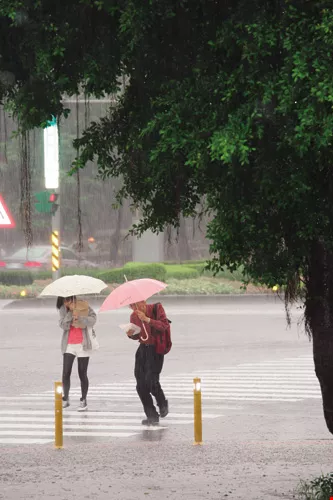
For amusement parks, for example, if there is as little as 5 mm of rainfall in a day (about equivalent to a light shower), turnover can drop by as much as 30% compared with a clear day. If the rainfall increases to 10 mm, the drop can increase to 60%.
Of the four industries covered by Peng's records, the only indoor activity center--the Yingko Ceramics Museum--is the only one to see an increase in business in the event of showers. If the rain is heavier, however, customer numbers there drop too.
Tailoring the weather report
However, the accuracy of weather forecasts is often doubted by the public, and even Wu Te-jung, head of meteorology for the CWB, has jokingly referred to himself as the "head of mistakeology." Can the private sector do any better?
"Our strength has nothing to do with whether we're more accurate than the official reports. It's more about how we can provide tailored weather information," says Peng. As an example, Peng explains how, when a front approaches, since the CWB serves the general public, they can't get any more specific in their forecasts than saying "overcast with some rain" for Taipei City, whereas in fact because of Taipei's geography, it won't necessarily rain in all districts of the city. If a company is planning to hold an outdoor PR event at a specific location in Taipei City, they can give WeatherRisk their details and get recommendations on whether they should postpone or relocate to an indoor location.
At present, Peng's company has over 80 corporate clients, each choosing plans between NT$1-200,000 or NT$1-2 million a year. Their client base is varied, including Farglory Land Development, the Family Mart convenience store chain, Team Ten, and even a top pigeon racer from southern Taiwan.
Lin Tsui-chuan, public relations manager for the Family Mart convenience store chain, says that the primary function of convenience stores is to give customers what they want, when they want it, and so if they can provide up-to-the-minute weather information, this will help tremendously in their sales of certain products. One Tuesday in April, for example, the temperature was only 20°C, but because of predictions the temperature would rise greatly by Thursday, the company began a special promotion of its cold noodles, increasing sales of those noodles tremendously as a result.
Farglory Land Development, which has major projects in the Taipei County towns of Sanhsia and Linkou, works with forecasts for each weekend to determine their level of advertising and media presence each week. Farglory's marketing team says that the numbers of people looking at property is larger in the weekends and holidays, with more deals closed then, and as such that is when they plan their major marketing activities. However, if there is a sudden downpour or cold snap, this could have a major impact on people's willingness to go out and look at property. "As a result, if we find out the weather is likely to be highly changeable in the weekend, we reduce our advertising level."
Pigeon racing team member Mr. Wang, who helped the team's boss get onto the weather information bandwagon, explains that most pigeon racing routes in Taiwan focus on the Taiwan Strait and the Bashi Channel, and that marine wind speed, wind direction, and swells can all have an influence on the pigeons' performance. "Because of that, we need to review weather forecasts to help us decide how much to feed our birds, how to train them, and even how much to put on the race."
A limited science
While weather information has been warmly welcomed, Peng Chi-ming admits that meteorological methods and technology are still fairly limited: most short-term forecasts provide data for two weeks, at the most. "For forecasts longer than that, such as a three to six months, the most we can offer is a rough statistical analysis like 'such-and-such percent chance of generally warm/cool weather.' Generally, the longer the time period, the more likely the forecast is off."
Even when forecasting a few days ahead there's the risk of mistakes. For example, in summer there are frequent thundershowers, but these are generally localized and develop very quickly, causing headaches for weather forecasters. As an example of the problems these can cause, Peng Chi-ming tells of a PR company that was subscribed to Peng's information service, but still ended up with ten out of around 60 events rained out. The company complained, but a one in six failure rate is fairly low by forecasting standards. Now that Peng and company are actively promoting their information service, they take great pains to explain the risk of inaccuracies in weather forecasts to their clients.
Gray skies are going to clear up
Although the weather industry in Taiwan is growing, according to a survey conducted by the CWB in November 2006, out of a valid sample of 1510 people, only 6.2% were willing to pay for weather information services. A further 7.3% said they would have to look at the services and fees before deciding. The other 86% had no interest in purchasing such services.
According to Yeh Tian-chiang, a section leader at the CWB, the weather information industry in Taiwan is still young, and the general public is still happy with a free general forecast, with entrepreneurs and businesspeople still not clear on the utility of paid services. "If the industry can tailor itself to specific demands and develop a wider range of products, I'm confident it will have a bright future."
Professor Lin Neng-hui of National Central University's Department of Atmospheric Sciences, a long-time observer of the weather industry both locally and internationally, predicts that as global competition continues to heat up and put pressure on both domestic and international businesses, having access to the most detailed, accurate information is going to be crucial to success in the marketplace.
"The weather industry is part of the broader knowledge economy, and to businesspeople the costs of getting weather information are relatively low, while the possible returns are huge. Companies abroad are already well aware of the importance of accurate weather data and risk management. Taiwanese companies will have to catch up," says Lin. "If we build it, the business opportunities will come."
With global warming and wild weather in the spotlight, perhaps Peng Chi-ming is right that "there are huge opportunities out there for the weather industry right now." But whether or not the market in Taiwan can really be so optimistic is an issue that, like the weather itself, can't be predicted with absolute certainty.
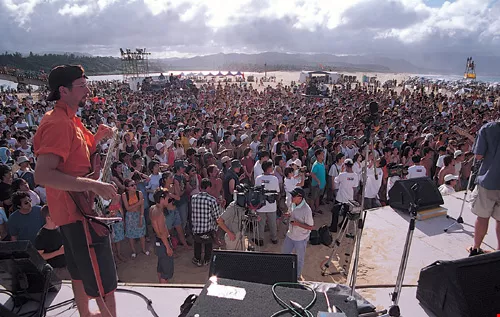
Sun, sand, cool music, and hot dancing usually characterize the Hohaiyan music festival, but two years ago the festival was postponed three times because of typhoons, costing the organizers over NT$10 million.
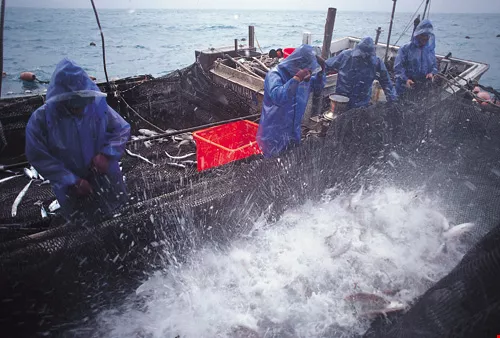
Fishermen make a living off the ocean, and even in poor weather they still have to set sail. Weather information can let them know wind direction, wind speed, and swell height, helping them plan the safest routes.