What Future for Technological and Vocational Education?
Chang Chiung-fang / photos Jimmy Lin / tr. by David Smith
April 2012


In order to achieve the goal of establishing 12-year public education, beginning in 2014, over 70% of junior-high graduates in Taiwan may be admitted to general high schools and vocational high schools without having to take entrance exams. How will this policy affect general and vocational high schools, which currently enroll roughly equal numbers of students? Will it bring a big change? And how are we to truly free students from the shackles of “examination hell,” so that each person can receive an education suited to his or her personal talents and aptitudes?
The following bit of ad copy speaks volumes about the job market: “You may not have connections, but you can’t be without professional qualifications.” How very true it is that who you know matters more than what you know. And in actual fact, if you’re looking to get ahead in your career, having professional qualifications is not as sure a path to success as winning an award in an international contest.
Students from Taiwan’s technological and vocational education (TVE) system have been big winners year after year in international contests. In 2009, for example, Johan Ku won first prize in the avant-garde design category at the Gen Art’s Styles International Design Competition in New York, and in 2010 Wu Pao-chun won the title of Master Baker at the Bakery Masters competition in France. Big wins like these have done much to raise the profile of TVE, and piqued increased interest in turning away from the academic rat race in favor of picking up a technical specialty.
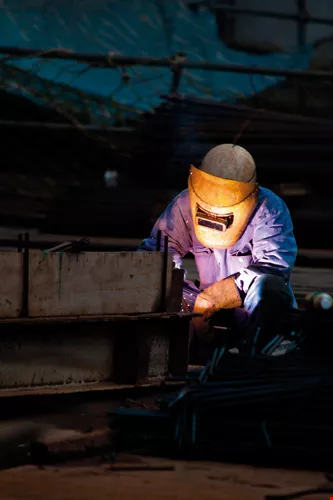
The TVE system suffers not from a shortage of students, but from an uneven distribution in their chosen specialties. Some departments that teach fundamental industrial job skills, such as welding, attract little interest.
In recent years, by producing graduates who’ve gone on to obtain patents and take part in international contests, Taiwan’s TVE system has successfully communicated the message that “there’s a future in the vocational path.”
The Ministry of Education (MOE) has long encouraged students to take part in international competitions, and toward that end began in the 2010 school year providing financial support to students from tech colleges to pay for international air fares to and from such events. And local students have been regular winners at overseas contests. Yeh Kuo-chen of Hung Kuang University’s Department of Hospitality Management, for example, won a “Gold with Distinction” prize at the 2011 Hong Kong International Culinary Classic. And Chen Junyu, a student at National Chin-Yi University of Technology, won a gold medal at the 2011 International Exhibition of Inventions in Geneva. Both of these students were among those who received recognition at the 2011 Awards for Heroes of Technological and Vocational Education.
Lee Yen-yi, director-general at the MOE’s Department of Technological and Vocational Education (TVE Department), points out that Taiwan ranked number one in the world in eight categories of the World Economic Forum’s Global Competitiveness Report 2011–2012, and one of those categories is “utility patents per million population,” an indication of just how important TVE is to national competitiveness.
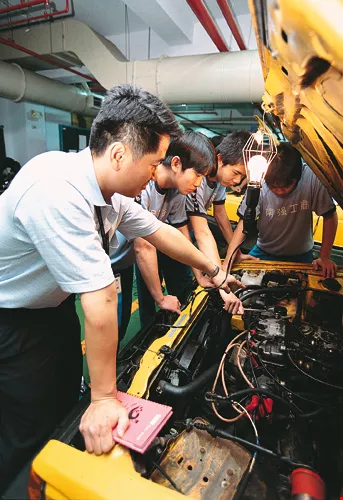
TVE must get back to its original focus on technology, and must evolve in step with the changing times. Shown here is an automotive class at Nan Chiang Vocational High School.
It is no exaggeration to describe TVE as the unsung hero behind the Taiwan economic miracle. The export-driven economy of the 1960s was characterized by rapidly growing small and medium enterprises, and vocational high schools did their part by preparing the needed basic skills. In the 1970s Taiwan’s economy shifted toward capital- and technology-intensive industries, then the 1980s saw the beginning of the rise of high-tech and petrochemicals, generating greater need for high-level skills. The ratio of TVE versus general senior high school enrollment hit an all-time high of 7:3.
TVE has been evolving in tandem with economic transition, and today Taiwan has a fully developed TVE system comprising 156 vocational high schools, 15 junior colleges, and 77 tech colleges. The ratio of TVE versus general senior high school enrollment now stands at roughly 1:1.
Ling Tung University vice president Hsu How-gao notes that prior to the April 10th Educational Reform March of 1994, education in Taiwan was all about “quantity control,” i.e. only a minority of students were able to go to general high school and university, while the rest were forced onto the TVE path and preparation for the work world. After educational reform, however, planned education was replaced by a model based on marketplace supply and demand. Everyone could now freely choose where they wanted to study, thus “the size of the system was determined by all of our choices.”
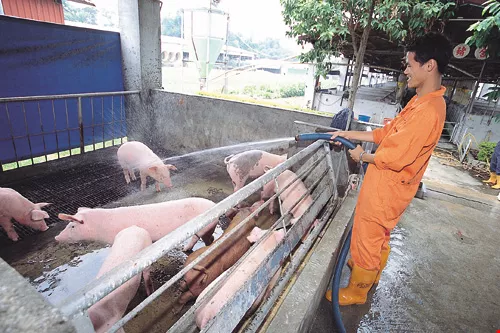
National Pingtung University of Science and Technology is internationally acclaimed in the field of agriculture. Its Department of Animal Science was established more than 30 years ago.
The plethora of options that TVE students now have for continuing their studies has brought a big change to the TVE environment in recent years. Statistics indicate that 79.6% of vocational high school graduates go on to enroll in two- and four-year tech colleges, while only 13% head directly into the job market.
And there is no longer an absolute separation between TVE and general education. Professor Cheng Ching-min, chairman of the Department of Mechatronic Technology at National Taiwan Normal University, is an excellent example of someone who made good by picking up strong mastery of a technical specialty. After graduating from junior high school, Cheng entered directly into the TVE system, studying in the sheet metal department at Daan Vocational High School. He established himself as the top sheet metal student in the nation and represented Taiwan at an international competition in Osaka, where he took a silver medal. He was awarded direct admission to NTNU, and went on from there to graduate school at NTNU. After finishing his military service he returned to NTNU as an instructor, and later earned a PhD from National Chiao Tung University. Today he holds the distinction of being the only sheet metal specialist from Taiwan to serve as a judge at international competitions.
The role of vocational high schools was formerly to prepare students for the job market, but now they prepare them to move on to higher education. In effect, they’ve become preparatory schools for tech universities and tech colleges.
Some private vocational schools have been working quite hard to get as many of their students as possible into higher education. Chih-Kuang Senior Commercial and Industrial Vocational High School (CKVS), located in Yonghe, New Taipei City, has established an intensive prep program to get students into national tech universities, and has hired cram school instructors to teach Chinese, English, and math to students in the evenings. According to school principal Lin Pusheng, the program has been an outstanding success. In the year prior to the program, 29 graduates tested into national tech universities, but the number shot up to 59 the following year.
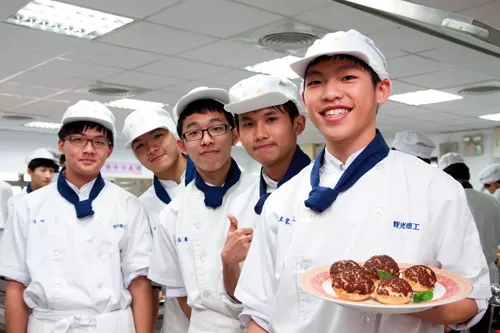
Food service programs are easy to get into, and offer students a feeling of accomplishment. Due to their popularity, schools have been quick to set up such programs. Second-year students in the food service department at Chih-Kuang Senior Commercial and Industrial Vocational High School are shown here beaming with delight as one of them holds up a plate of freshly baked cream puffs.
The focus on getting graduates into higher education is just one trend in TVE. Another is a tendency for certain departments to be far more popular than others.
The 85 subjects taught at vocational high schools fall into 15 disciplines: machinery; motor vehicles; electrical and electronic devices; chemical engineering; construction; business management; home economics; hospitality and tourism; agriculture; and so on. But because there is no system for managing the numbers of students studying one subject or another, schools tend to just service the latest fads, with the result that certain departments are overrun with students while others languish in obscurity. (See table, p. 51.)
Cheng notes excess enrollment in the disciplines of hospitality and tourism, business management, and electrical and electronic devices, while there are not enough students in such disciplines as fisheries, marine studies, and agriculture, even though expertise in these areas will be extremely important in dealing with problems having to do with food, energy, and marine resources.
Principal Lin at CKVS agrees that food service courses are too popular, and there is a danger that students may find themselves faced with a saturated job market. But the courses are fun and the immediately visible results make for a feeling of accomplishment, thus their popularity. CKVS is going to launch multimedia and tourism courses this year to meet market demand.
There are more than 120,000 first-year students in vocational high schools in Taiwan, of whom fully 21,851 are studying hospitality and tourism, which is second only to business management. This figure far exceeds the Council of Labor Affairs’ estimate of recruitment demand of 4569 people in the hospitality and tourism industry in the first quarter of 2012.
Fisheries and marine studies, in contrast, only have a few hundred students. Distaste for the hardship such jobs involve appears evident.
Ling Tung University vice president Hsu opines that allowing the market to determine the right mix of enrollments will naturally lead to such imbalances for a time, but once students realize a certain market is saturated they will naturally turn to something else. Early childhood education, for example, was all the rage 10 years ago, but the rage has subsided as the trend toward smaller families has gotten worse due to a low fertility rate.
Dearth of weldersThe trend in TVE to prepare students for higher education has got industry worried.
In his book Education Should be Different, former chairman of the Landis Taipei Hotel Stanley Yen wrote: “Taiwan society is moving toward an erosion of basic skills. The abilities needed by an aircraft maintenance technician, a plumber, or an electrician, for example, are disappearing as the result of a mistaken education policy that has prompted schools to compete with one another to get upgraded to universities.”
Commenting on the desire of most TVE students to get into university, NTNU’s Professor Cheng points out that social progress generates a need for more highly trained technical specialists. With lathe operators, for instance, the emphasis in the past was on finely honed manual skills, but today the use of computer numerical control (CNC) means that lathe operators must be able to write computer programs.
“The problem is that not all tasks can be done by machine. A lot of problems crop up that have to be resolved by a human.” Cheng recounts how a typhoon exposed Taiwan’s lack of skilled labor.
After the typhoon left a water reservoir badly silted, authorities needed to connect a big pipe to drain the turbid water, but the slow pace of work raised public ire. The bottleneck, it turns out, was insufficient numbers of welders qualified to work on the project. Welders were borrowed from China Shipbuilding, but there were still not enough.
If you wait until a pressing need arises before you start training for needed skills, you’re doomed to be a day late and a dollar short.
Says Cheng: “Taiwan has plenty of high-tech talent, but there’s a shortage of more basic skills in things like sheet metal work, welding, casting, and mold and die making.” He points out that society needs people with basic skills, and not every student is suited for study at a tech college.
Moreover, technological and vocational education isn’t finished upon graduation. Even after a person joins the work world, on-the-job training is still needed, and one must keep abreast of the latest changes.
Always “plan B”The MOE estimates that the total number of first-year junior high students, which stood at 310,000 this year, will drop by a whopping 26,000 persons next year, and by 15 years from now will be down to just 170,000. This will pose a big threat to general and vocational high schools alike.
But setting aside questions of what lies a decade and more down the road, the more pressing issue is how we are to prepare for the launch of 12-year public education, and for direct admission to general and vocational high schools without the taking of entrance exams.
Education must be suited to the individual, to be sure, but in a nation that favors book learning over technical expertise, few have ever gone the TVE route if they could have gone the other.
One mother repeatedly brushed aside her son’s requests to be allowed to go into the TVE system. She had long known of his distaste for theory and his love of working with his hands, but the boy got good grades. “If you’ve got the ability to take the academic route, why wouldn’t you do it?” was her thinking, so she encouraged him to take the standard path to success—general high school, and on from there to university.
That mother’s thinking is typical of the mindset of most people today: “Book learning is the true path to success; TVE is just plan B.”
The “plan B” status of TVE shows up not only in the abilities of the students, but also in the socio-economic position of their parents. Principal Lin of CKVS points out that the families of some 90% of all students at his school fall below the NT$1.14 million annual income cutoff for financial assistance.
In order to move back the age when a person has to decide between an academic and a vocational education, the MOE in 1996 began encouraging the establishment of bilateral (combined vocational and academic) high schools where students don’t take one path or the other until the second year. The number of vocational high schools has subsequently fallen, from 204 in 1997 to 156 today, while general high schools have increased from 228 to 335. Once entrance exams are dropped, will students opt in droves to attend general high schools? Will vocational high schools fade into history?
Professor Cheng points out that tech universities and colleges lack distinctiveness because 90% of their courses are the same as those offered at regular universities. And because of society’s emphasis on degrees, they are tripping over themselves to open up new master’s and PhD programs. “The increasing trend at tech schools toward convergence with the education offered at academic universities is prompting people to question the need for tech schools. On top of that, the Multiple Entrance Program for College-Bound Seniors makes it possible for students from general high schools to use the results of their Basic Achievement Test to apply for admission to tech universities, which leaves even fewer spots for vocational high school graduates.”
Industry-academia cooperationIn response to possible tough times ahead, the TVE system has been making inroads at the junior high level to help students to discover their aptitudes and develop accordingly. Huang Jingyi, a specialist at the MOE’s Central Region Office, states that most junior high school teachers are not graduates of the TVE system, and students know little about vocational high school. There is thus an urgent need for junior high schools to cooperate with vocational senior high schools in familiarizing students with TVE.
The TVE Department’s Lee Yen-yi explains that the initiative is being carried out in three phases in grades seven through nine. The first step is to familiarize students with the TVE option and what sort of careers it can lead to. The next step is to identify individual students’ aptitudes and expose them to hands-on learning experiences. Schools are setting up “junior-high TVE programs” under which interested students can go to vocational high schools to attend from three to 14 units of TVE courses per week. Ling Tung University vice president Hsu, who is involved in this initiative, states that the junior-high TVE programs have thus far attracted a total attendance of more than 50,000.
In order to keep to their TVE mandate, vocational senior high schools have established “applied skills programs,” “industry-education cooperative education programs,” and “programs in educational disciplines that develop specifically needed job skills.” Students who elect to enroll in one of these programs are offered tuition-free admission for three years.
To bolster the training of students in educational disciplines that develop specifically needed job skills, to prepare job market entrants in areas where there is a severe shortage of personnel (e.g. maritime navigation, machining), and to support government policy regarding development of the “six emerging industries” (such as green energy and tourism), the education community adopted a “three-in-one” approach in 2006 whereby vocational high schools, tech colleges, and industrial firms work together in providing student internships. For example, Municipal Kaohsiung Senior Vocational Industrial High School, National Kaohsiung University of Applied Sciences, and a local precision instruments maker have joined hands to establish an internship program in which students take turns shuttling back and forth between school and workplace. Students in the program are given a stipend.
Does TVE have a future?TVE and general education began evolving toward a two-track system after Taiwan’s first tech college—the National Taiwan Institute of Technology—was established in 1974. But when the tracks started converging in more recent years at the level of higher education, vocational high schools began finding it difficult to define their role within the larger education system.
At a meeting held in 2001 to review the state of education reform, some observers called for doing away with vocational high schools. Today, there are remotely located schools in central and southern Taiwan that can no longer recruit the minimum 600 students. The need for a “market exit mechanism,” so to speak, is an extremely difficult issue to tackle. There have been rumblings, but no one quite knows how a school is actually supposed to go about closing down.
The TVE Department’s Lee Yen-yi comments that the closing of a school has a bearing on the right of students to receive an education, and the right of teachers to employment. It’s a very nettlesome matter, and all the education authorities have been able to do is launch various programs designed to improve the quality of education at general and vocational high schools in hopes of improving the overall quality of education and helping students benefit more from their studies, while providing guidance to schools that are performing poorly.
NTNU’s Professor Cheng suggests that vocational high schools take advantage of this opportunity to totally remake themselves. “Since they’re not preparing students to go out directly into the job market anyway, there’s no need to split them into a lot of different finely divided disciplines.” He feels that a lot of students in vocational senior high school still haven’t clearly identified their interests, so it is sufficient to divide them into a few large categories. This approach makes it easier for students to pick something suitable for themselves. As for unpopular but important basic subjects, the national government needs to use policy as a tool to guide students in that direction.
So are vocational high schools headed for better things, or are they on their way out? Is there a future for the TVE system? The next few years will be a key test of the education authorities’ policymaking ability, schools’ mettle, the capability of parents to respond to a changing environment, and the ability of students to understand themselves.
Professor Cheng sums up his view of this critical juncture for the TVE system: “This is a crisis, but it’s also an opportunity for change!”


@List.jpg?w=522&h=410&mode=crop&format=webp&quality=80)

