Lunar New Year in Silicon Valley
Melinda Chiu / photos Melinda Chiu / tr. by David Mayer
February 2015
Ethnic Chinese living in California’s Silicon Valley are a lucky bunch. Not long after gathering with family to celebrate Thanksgiving in late November, it’s time soon for the happiness of Christmas and New Year’s, and the warmth of America’s biggest holiday season. Then, before you know it, the Chinese Lunar New Year rolls around, bringing the wonderful and uniquely Chinese way of ringing in the new. For people in our situation, the new year holidays are very long indeed!
Americans teach their children to be thankful. Kids here have to write verses to express thanks to their parents, teachers, and classmates. If you forget at Thanksgiving to thank someone or be grateful for something, there’s always a chance during Christmas to express your feelings. And if things go unspoken during Christmas, there’s always a chance at New Year’s. Then a few weeks go by and it’s the Lunar New Year, yet another opportunity to express gratitude for all sorts of things, including the company of good friends and loved ones. It’s also a time for the making of plans and wishes for the year to come.

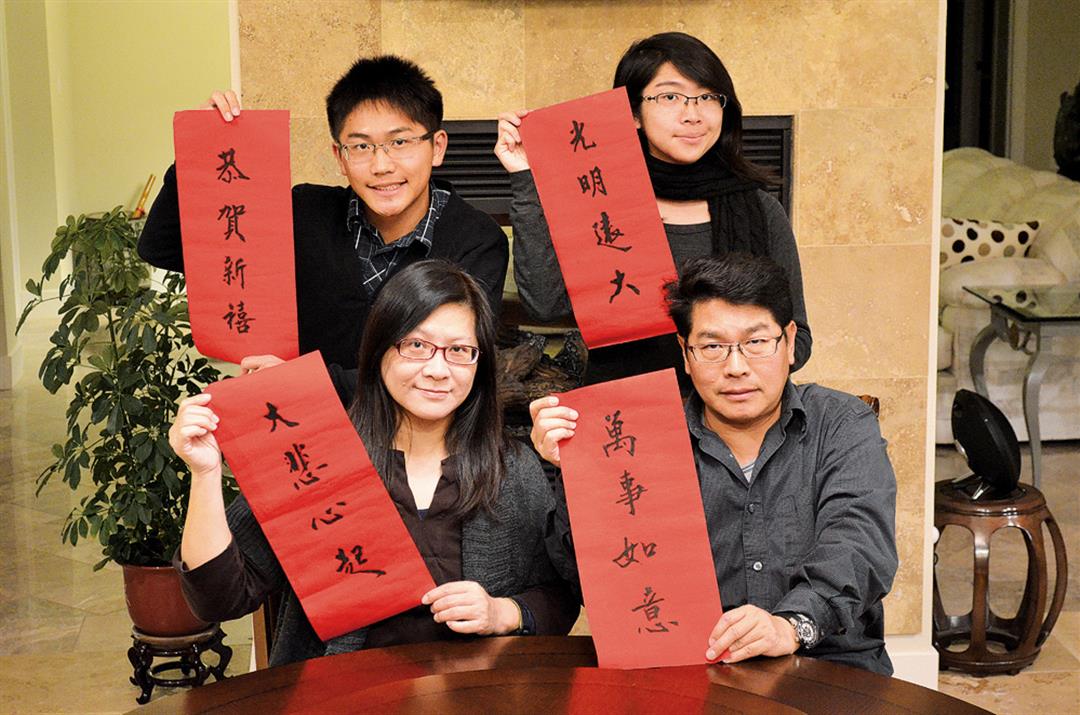
To take up a calligraphy brush and make a new year’s couplet is a time-honored tradition that adds a special festive note to the season. Melinda Chiu and her husband are shown here with their son and daughter.
Everyone is aware of the significance of Silicon Valley in the field of information technology, and we all know it attracts top talent from around the world. These factors have turned Silicon Valley into a collection of diverse cultures and customs that have mixed together here and recombined into something entirely new.
Countless Taiwanese choose to pursue their dreams in this foreign land and end up settling down here for good. We fuse into the pluralistic society of our adopted homeland, and attempt to understand its customs. At the same time, though, our own culture and its annual observances remain deeply imprinted on our consciousness.
Individual circumstances differ for each of us Taiwanese expatriates, and in the US there is no official holiday for the Lunar New Year, so the high-pressure life of high-tech professionals goes on as usual. These factors affect how we celebrate the Lunar New Year.
Calendars as printed in Silicon Valley never note the Lunar New Year, but there’s no way we expats could possibly be unaware of the holidays. The Chinese supermarkets here always remind us with their displays of traditional holiday foods, and play the Lunar New Year songs that we’ve heard all our lives. They may sound a bit cheesy, but they do indeed relieve homesick feelings.
Supermarkets set aside special areas just for the display of Lunar New Year foods (such as new year rice cakes and radish cakes), seasonal flowers (such as orchids), little kumquat bushes with their auspiciously decorative fruit, bright red new year couplets, and all sorts of snacks rarely if ever seen at any time other than the Lunar New Year.
We are so lucky that the high-tech hotbed of Silicon Valley is home to a society that still attaches importance to traditional family-centered values. For us, the Lunar New Year is a heartwarming time when families get together to renew the ties that bind. We always head off to the Chinese supermarket at this time of year, buy up enough Lunar New Year food to feed an army, and then gather around to gobble it up.

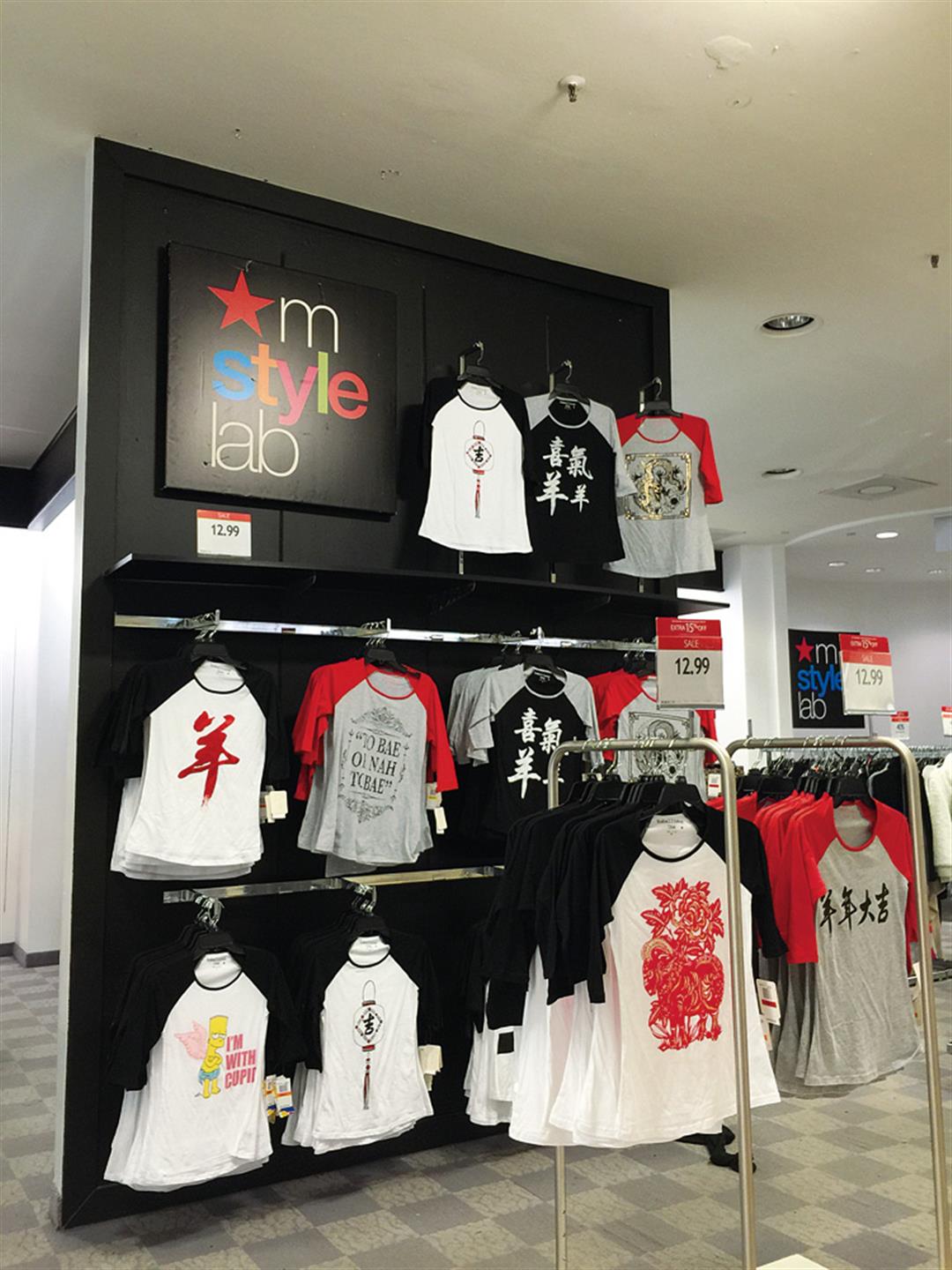
American department stores this year are selling clothing and accessories connected in some way with the Year of the Ram.
A lot of families have three generations living in Silicon Valley. What a happy picture they present to smaller families struggling along without any extended family in the area! For those with extended families, the Lunar New Year season feels much like the real McCoy; observances include the worshipping of Chinese gods, prayers to the Buddha, commemoration of ancestors, family reunions, and everyone staying up together until past midnight on the last evening of the old year. And, of course, there is the handing out of cash-filled new year’s envelopes to some very excited children.
Women may even wear bright red satin cheongsams for the family picture that is taken before everyone sits down to the new year’s feast, and some families will pile their children into the car on the weekend before the new year to visit the grandparents. The three generations will often go shopping together for their new year foods and take it all back home to observe the holiday together.
Most people whose relatives are all in Taiwan will eat a hotpot dinner at home, hand out cash envelopes to the kids, phone friends and relatives back home to deliver the season’s greetings, and then spend a quiet Lunar New Year’s Eve. In most years, after all, the first day of the Lunar New Year falls on a weekday, so people will have to go to work the next day.
Families with the time might take their kids over the weekend to browse a Chinese supermarket or walk around Chinatown so they can get a feel for the happy atmosphere and traditions of the Lunar New Year. And it is common for a family to get together with other families for a potluck dinner on a weekend soon after the Lunar New Year. The cornucopia of foods laid out on such an occasion plus the bustling vigor of the day always make for a good time, and the scene of people far from their homeland getting together for mutual support is quite moving.

For ethnic Chinese living in the US, the new year holiday season begins with Thanksgiving and continues through Christmas and the Western New Year, all the way to the Chinese Lunar New Year.
Of course there are always people who are just too busy with work to properly observe the Lunar New Year, and so mark the occasion simply by eating a special meal at home or perhaps a restaurant.
In fact, we spend the Lunar New Year in Silicon Valley pretty much the same way folks do it in Taiwan. The only real difference is that individual families over here have evolved certain ways of doing things to suit their own particular circumstances. The core values remain the same.
Almost all Taiwanese parents in Silicon Valley have their children start attending weekend Chinese classes when they reach school age so that they can learn about their family’s cultural roots, which spurs better communication between parents and children. Such classes combine the best aspects of Eastern and Western education, and the acquisition of a second language sharpens the children’s future competitiveness.
That’s why Chinese schools mark each lunar year by holding festivities where the students give performances, and cash envelopes are handed out to all the children. Some schools will hold a school fair where children learn to write new year’s couplets and draw traditional new year’s pictures, and traditional Taiwanese eats are served.
Such activities may not seem to have much immediate impact on a generation that is growing up in America, but the children do come away with a better understanding of their roots, and some sense of connection to the land where their parents are from.
Universities in the Silicon Valley region all have a Taiwanese student association or a Taiwanese American association that holds events from time to time where Taiwanese students can find some relief from homesickness and find mutual support among others of similar background. Such organizations always sponsor Lunar New Year performances and hold banquets on Lunar New Year’s Eve so that students stuck far from Taiwan during the holidays can feel the warmth of the season and not suffer too badly from their longing for home.
Dragons, lions, and firecrackersSan Francisco’s Chinatown is always festooned during the Lunar New Year with lanterns and other traditional ornamentation, and shops decorate in brilliant red color schemes to attract the business of Chinatown visitors. There you can shop for Lunar New Year items at old dry goods stores very reminiscent of the sort seen everywhere in Taiwan decades ago.
In addition to Chinatown, cities with a big ethnic Chinese community can be counted on to organize fairs, parades and other such events around the time of the new year. At a fair you will find booths with goods and eats peculiar to different cultures, and lots of fascinating street artists who make caramel art, edible dough figurines, and more. Parades, meanwhile, attract enthusiastic participation by local school bands, places of business, martial arts troupes, community service organizations, and the like. Even big department stores have begun this year selling clothing and accessories connected in some way with the Year of the Ram.
And some business establishments mark the first business day after the Lunar New Year by hiring a martial arts troupe to do a lion dance or a dragon dance in front of the store, and they may set off huge strings of firecrackers. In traditional Chinese culture, all of this is intended to ensure a prosperous year to come and attract customers. In America, of course, such things are a rare sight.
If you restrict your focus to Silicon Valley’s ethnic Chinese community, the Lunar New Year does indeed have a festive feel, but it’s not an American holiday, after all, so in the larger community, our celebrations are pretty much drowned out by the hubbub of the workaday routine. We just have to rely on our commitment to the culture of our birth if we are to maintain our heritage as a source of pride in the adopted homeland.
I do hope the innovative, hardworking spirit of a Silicon Valley high-tech professional will enable me to lead my life each day as though it were New Year’s Day. I hope I can overcome the obstacles that have held me back in the past. I hope I can take a new mental approach to the new year, and look upon life in all its breadth, height, and depth. Happy New Year!