Interview: Su Chin-chiang, Taiwan Solidarity Union
interview by Laura Li / tr. by Jonathan Barnard
December 2001


The Taiwan Solidarity Union, a political party formed just three months ago, has the support of former ROC president Lee Teng-hui. Nevertheless, it faces an uphill battle to achieve much in the end-of-year elections. TSU Secretary General Su Chin-chiang, known as the "soul of the party," spent his adolescence in military schools and then went on to serve as an expert in national defense strategy. Under the penname Lu Chiang, he has also written several award-winning books. How does he see the party's chances in the coming elections? And what future does he see for the party?
Q: There are many political parties in Taiwan. Why has former president Lee Teng-hui established the TSU? What do you think of the party's chances?
A: The TSU was established in response to economic problems. Over a year ago, when KMT legislators forced through the 84-hours-per-two-weeks working hours bill, many small and medium-sized businesses could no longer afford the high costs of labor. This has resulted in economic difficulties and a rising unemployment rate. Lee had already grown concerned about the political scene. When he then talked to people in labor, they immediately found common cause. If Lee, who is 80 years old, is willing to give his all for the nation, how can we in the younger generation refuse? And so we formed a political group with the stated goals of "political stability and economic revival." After the party was established, we came up with our own slate of candidates for the elections. Huang Tzung-yuan, president of the Manufacturers' Association and our candidate for at-large legislator, is leading in the polls. Huang is the leading voice of traditional industry.
Q: But this is rarely the angle that outsiders take on the TSU, is it?
A: True, everyone is trying to explain TSU through the lens of the relationship between Lee, Lien Chan, and Chen Shui-bian, but this is a mistake. What the TSU is really about is supporting the majority of workers and allowing traditional industries to put down roots in Taiwan, so that the economy can continue to grow and unemployment can be reduced. We're paying attention to industry's structural problems, rather than problems of a political nature.
Q: You have proposed that the number of legislators should be cut in half and that the salaries of those who remain should be cut in half. You propose to use the savings to support families with unemployed bread winners. But it seems that these positions aren't helping you in the elections.
A: The TSU wants to support families hit by unemployment because unemployment is a big problem for families and society. The elderly and young children are particularly at risk, and so we advocate providing nutritious lunches and tuition relief for the children of the unemployed. I'm delighted that Huang Tsung-yuan represented the TSU at the Economic Development Advisory Conference, where he suggested that the working hours law be revised. As expected, his suggestion met with general approval, and the number of permitted working hours was revised to a range between 40 and 48. Labor and industry can negotiate the exact amount as is appropriate to the situation. We hope that industry and labor can quickly reach consensus.
Many are wondering where the TSU voters are coming from. Some say that they are Taiwanese voters who are disappointed with the DPP or the nativist KMT, or that they are the votes of those who support independence. We welcome all these voters, but there is a group that no one mentions-the workers from traditional industries!
Q: The "three links" (direct mail, telecommunications and shipping between Taiwan and the mainland) would have a direct impact on the economy. The TSU has adopted the "no haste, be patient" tack of former president Lee. How do we move ahead on this front?
A: When you talk about the three direct links, the first thing you've got to do is to untie the political knot. The mainland has got to first set aside the issue of unification and talk directly about the three links. In this way, there won't be a problem about the relative status of the ROC and PRC. Secondly, there have to be some rules for the game. The TSU supports a gradual step-by-step implementation of the three links, and not a sudden total opening. With the two sides so distrustful of each other, proceeding in this manner will reduce the social impact and political risks. Getting together with the PRC and discussing the three links within the structure of the WTO is also something that hasn't been fully explored.
Q: Many people believe that the TSU is a pro-independence party. How do you see it?
A: I believe that Taiwan isn't deciding between independence or unification. The problem is whether to accept the authority of the PRC-because down to the present day the core issues needing resolution are the differences in the political systems and lifestyles.
I personally believe that if the two sides both acknowledged that the people of the ROC and PRC are both Chinese, then you would avoid a lot of unnecessary problems. When you look back over what major figures have said about this issue-whether Jiang Zemin's eight points, Lee Teng-hui's six articles or Chen Shui-bian's seven items-all of them share an essential point: that Chinese shouldn't war with other Chinese; they should help other Chinese.
But there are two preconditions for this: first, we've got to get the Communists in Beijing to put the emphasis on the phrase "Chinese people," without having this be a synonym for "people in the PRC." If they can do that, people in Taiwan won't reject it. Secondly, Beijing should be asked if they consider Taiwanese to be "Chinese people." If the answer is yes, then they should be asked to forsake the military option, and stop terrorizing Taiwan with the threat of force-because Taiwan won't regard an invasion by the PRC as civil war, but rather as an occupation by a foreign army.
When you look back in history, it was the PRC, not us, that initiated the concept of "two Chinas." To take a step back, the concept of the "Chinese people" involves culture and blood. Moreover the Chinese can be divided into many different families. Who says that the Chinese must be regarded as members of the same family? Hence, it is my belief that the two sides can start to make progress by discussing this concept of "the Chinese people." We should take it slow, so that there is a natural course of development. Otherwise there will be no understanding.
Q: The TSU's catchword is "solidarity," but the ranks of the pan-green forces (the DPP and TSU) appear fractured. Could you tell me what kind of relationship you have with the DPP right now?
A: The TSU is a political party, and it operates independently. It is in no way, shape or form a faction of the DPP. If there is an attempt to "bring stability to politics," that will have to happen after the election, not before it.
With regard to the DPP suggesting they would be willing to work with any party, to the contrary they have been trying to belittle the TSU and marginalize it. We understand what's going on, but we're not going to let it bother us.
There are various academics who very much hope that Lee Teng-hui and Chen Shui-bian will work together in the spirit of a "pan-green" alliance. There have been and will be many opportunities for Lee and Chen to cooperate, but they needn't cooperate during the election. The DPP naturally don't want us to take away their votes, and we also would be uncomfortable with Lee asking TSU voters to cast their ballots for the DPP. The fact that the TSU is not nominating candidates for county and city elections is already a gesture of goodwill to the DPP. For the elections to the Legislative Yuan, it's each party for itself.
Q: What are your predictions about the elections?
A: Of course, we are hoping for more than 10%. You can see that Lee is drawing huge crowds wherever he goes, and that a lot of people are saying they want to "cast their ballots for Lee." Of course, the party is riding Lee's coattails this time around. Next time, we'll have to stand on our own. Hence, the end-of-year elections for the Legislative Yuan will be key. If the TSU has seats in the Legislative Yuan and thus can speak there, then this will be very supportive for the development of the party. In any case, the four guiding principles of the TSU-stable politics, economic revival, security for Taiwan and consolidation of democracy-are not going to change.
p.039
Su Chin-chiang, a military strategist who describes himself as a "student proctor in the Lee Teng-hui school," has assumed the role of spokesperson for the TSU. He has done a lot to help the party.
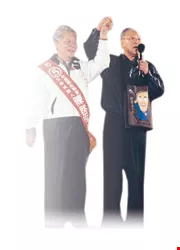
(photo by Hau Chen-tai)


@List.jpg?w=522&h=410&mode=crop&format=webp&quality=80)
