The e-Paper ChaseElectronic Newspaper Publishing Gains Ground
Eric Lin / photos Pu Hua-chih / tr. by Phil Newell
June 2002


Two years ago, the Internet industry was like a global example of the "Portuguese egg tart phenomenon" in Taiwan: In a very short period of time it attracted huge numbers of people and large amounts of investment, and in an equally short time the bubble burst. Today dotcom management has returned to basics, and entrepreneurs have steadily moved away from the past idea of passively attracting traffic to their websites. Electronic newspapers-e-papers-have become one new focal point of Internet operations, thanks to special characteristics of their own: they are "active" (they are sent out to mailboxes, not just waiting around to be found and read) and have clearly defined readerships with a high level of loyalty.
The e-paper idea is spreading fast, and the personal e-paper is already up and running on a large scale. Last year many candidates in the legislative elections turned to e-papers instead of traditional flyers, with the most obvious approach being to establish a personal campaign website. Internet entrepreneurs and companies are now back in business with such services as providing "platforms" for issuing e-papers, combining "virtual" and "real" media, collecting subscriber fees, and assisting individuals with personal e-paper "information-based entrepreneurship."
You are entering the office of a stock analyst named Miss Wu, located on Chunghsiao East Road. She turns on her computer with the same attitude she might have when opening her makeup case to share her experience of cosmetics with her friends, and excitedly shows her visitors the e-papers to which she subscribes.
Her email in-box is filled with e-papers that just arrived that day. These include her daily horoscope; winning lottery numbers; reports on finance, the economy, investment, money management, and various industries; English-language study materials; columns on gender relations, dining out, books, and travel; and essays by famous writers. There have got to be at least 20 of the things.
"These cover virtually every aspect of my life," says Miss Wu. The first thing she does every day upon arriving at the office is open her in-box to check her horoscope to see if she will have a lucky day, before she buckles down and gets to work.
"These are all free subscriptions, and I'm using the company's T1 line, so the speed is super fast." She praises e-papers for the convenience they bring to her life.

Most of the staff at PChome's e-paper platform are in their early 20s. Their creativity and abundance of ideas have helped them create many firsts in the local e-paper industry.
The forwarding effect
Like Miss Wu, most Internet users in Taiwan subscribe to e-papers. According to statistics collected last year by SmartNet, 93% of Internet users in Taiwan subscribe to e-papers, with 54% subscribing to five or more. The most frequently subscribed categories are lifestyle and recreation, or technology and the information industry. The main reasons people read them are because the contents are interesting, the papers are free, and it seems to be the current faddish thing to do.
Nica Chou, who has served as director of marketing for a number of Internet companies including iHome.com and AboutCase.com, explains the commercial potential. Ordinarily, email marketing techniques can be divided into electronic direct mail (eDM) and newsletters. Although generally speaking most e-papers fall under the latter heading, because the newsletter platform has a subscriber name list, and subscribers have a high degree of trust in the source, if you run an e-paper, you can also send out targeted eDM, multiplying the possibilities for profit. Thus, after the bubble burst on entrepreneurs who in the past used "free mailboxes" and "free e-papers" to attract Internet flow to their websites, profit-seekers have turned to expanding e-paper operations, which have a hidden commercial potential.
Vicky Tseng, assistant manager for public relations in the department of marketing at the PChome group, explains: "E-paper readers 'stick,' which is to say they are very loyal once they find something they like. So long as the content has broad appeal, moreover, there's a high frequency of newsletters being forwarded to other readers. On average, the ripple effect of a single e-paper can last as long as a week." The impact of an e-paper is therefore not limited to the subscribers, but also includes the people to whom it could be forwarded, who themselves become potential new subscribers.

Maillist, having survived the collapse of the dotcom bubble, has moved to a small office with most staff working from home in order to reduce costs; it has become one of the most profitable firms in the business. The photo shows CEO Sean Fu hanging out the shingle for their new office.
Shakeout.com
When the Internet industry was at its peak in early 2000, there were nearly 20 e-paper publishing platforms of significant scale operating in Taiwan. However, with the collapse of the industry, there are only five or six now in operation, including URL, Maillist, herefrom, Taconet, and PChome's "epaper." Although the number of platforms has declined, after a number of shakeouts, readers have concentrated on the small number of "surviving" platforms, so that those businesses in operation have a more concentrated command of the market.
Currently most e-papers operate through such platforms. Platform operators sign contracts with newsletter agencies or individuals and publish their materials for them online. The platform businesses only need to come up with minimum hardware, and a small amount of manpower, and provide advertising and marketing services through the platform. The platform system greatly reduces the costs associated with e-papers, and increases the scope for profit. Moreover, because of the special flexible nature of the Internet, with great room for imagination, each platform has adopted somewhat different operating methods to seek the strongest profit base.
Currently the largest publishing platform in Taiwan is "epaper," under the PChome group. Supervisor Steve Hsu says that "epaper" is one of the more profitable departments in the PChome business empire.
PChome issues a total of 151 e-papers, with total "circulation" exceeding ten million. They have more than ten categories of e-papers, including politics, finance, and the economy; education and learning; investment and money management; online shopping; lifestyle; and entertainment and hobbies.
Steve Hsu explains: "Currently the main sources of income for the platform can be divided into advertising, commercial newsletters, and paid-subscription e-papers." In order to differentiate specific target markets, the platform divides e-papers into five basic categories: women's, information techno-logy, politics and economics, recreation and entertainment, and online learning. This makes it easier for advertisers to target their ads, and the platform itself can utilize these breakdowns to run revenue-generating clubs and activities.
While advertising is a rather traditional form of revenue, commercial newsletters and paid-subscription e-papers can be considered revolutionary. Commercial newsletters are e-papers paid for entirely by their parent companies. Paid-subscription e-papers, meanwhile, mainly fall into the categories of language learning, information about various economic sectors, investment and money management, and personal columns. In the year since it began operations last March, PChome has handled 31 paid-subscription e-papers, with a total of 30,000 subscribers. If growth remains stable, this year the latter figure could reach 50,000. Based on prices of NT$150 to NT$2500 per head, PChome's operating revenue from issuing paid-subscriber e-papers could exceed NT$20 million.
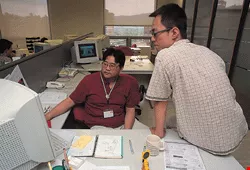
URL's e-paper portal is handled by assistant editor Ricardo Hu (left) and executive editor Ian Wu (right), keeping personnel costs to a minimum.
Image
Another major platform, URL, which currently issues 127 newsletters, is much more conservative in handling e-papers, because it is a subsidiary of Accton, and therefore must take the parent corporate image into account.
Associate editor Ricardo Hu, who is responsible for handling URL's e-paper business, states that income in this line mainly comes from advertisements. Estimated revenue for this year is NT$12 million. Though this remains some distance from breaking even, URL for the time being is not considering collecting fees from readers.
"There is no established tradition of readers paying fees, so if we institute fees rashly, there could be a loss of subscribers. Most personal e-papers also do not want to collect fees for the same reasons," says Ricardo Hu. The "publisher pays" model is more feasible. Of course, says Hu, it is inevitable that there will be a heavy advertising content in e-papers produced by corporations and for which the publishers must pay. But rather than try to disguise this fact, it would be better just to plan properly and create some activities that are of benefit to readers. This would be a win-win situation for both publishers and subscribers.
Currently URL issues 30-plus corporate newsletters, with the other 90 or so clients being personal e-papers. In order to maintain standards, URL is very strict about accepting personal newsletters. Publishers must provide comprehensive plans and samples, and only receive approval to use the platform after a thorough review. URL also publishes two of its own e-papers, URL Digest and URL Music Weekly, which include selected articles from other newsletters, and thus help newsletter owners to spread the word.
"Operating an e-paper doesn't necessarily mean just doing e-papers and nothing else. Currently we are trying out the idea of promoting 'paid mailboxes,'" says Recardo Hu. The paid mailboxes are divided into three different categories with different prices, for individual, group, and corporate use. Users can produce their own e-paper. "We're moving in the direction of the concept of platform rental."
The attraction of e-papers
In contrast to the e-paper platforms operated as a sideline by major dotcoms, which strictly control the quality of their e-papers, Maillist, which was founded in October of 1999 as the first commercial e-paper platform in Taiwan, turns virtually no one away.
Maillist understands the desire of modern people to express themselves, and it sets virtually no restrictions, so has attracted a large number of e-paper creators and has become the platform in Taiwan boasting the largest variety of e-papers. So far, Maillist has published online more than 24,000 varieties of e-paper. Most are individual e-papers, in which the authors simply write about their feelings or what is happening in their lives.
"Personal e-papers cover everything. It's hard to imagine sometimes, but there are the minimum number of subscribers for all kinds of bizarre stuff," says Sean Fu, CEO of the Internet Research Company, Maillist's parent firm. For example, Maillist has even attracted more than 100 web users from mainland China to set up e-papers, some of which are devoted exclusively to attacking the idea of Taiwan independence, and even these are able to maintain the basic level of a hundred or more subscribers.
Sean Fu says: "Maillist, like others in this business, also went through the rise and collapse of the dotcom bubble. But, after streamlining personnel and expenses, and with the number of subscribers continually increasing, this year they expect a profit of more than NT$5 million." Given that their full-time staff consists of only five persons, you could say that this is a business with an extremely high profit ratio.
The main profit sources for Maillist are advertising and corporate newsletters. Advertisements come directly from Internet advertising companies, who directly bid for contracts themselves, so Maillist does not need a sales department. Income from corporations is divided into two categories: sales of publishing software and renting of the platform.
Knowledge-based entrepreneurship
Maillist is the classic example of tech people founding their own business. Meanwhile, many of those who utilize the platform are also optimistic about the potential impact of e-papers, and are attempting to build up their status and name recognition online to develop "knowledge-based entrepreneurship." An example is food critic and writer Yeh Yilan, whose e-paper operates through the PChome and URL platforms. Her personal e-paper already has more than 50,000 subscribers, surpassing many print media outlets. As a result, Yeh is establishing herself as someone with a great deal of influence in the consumer criticism community.
"herefrom," which is under the United Daily News banner, is placing its bets on individual entrepreneurship, and is positioning itself as the "entree website for individual entrepreneurship." It is trying to get doctors, professional managers, artists, and others from various professional fields to start up e-papers. It is attempting to follow the path of creating "knowledge-based industry" that will be a win-win situation for both the platform and the individual e-paper creator.
Nonetheless, no matter what kind of model they operate by, at present all the various e-paper platforms in Taiwan still get most of their income from that old standby, advertising. In order to balance revenues with costs, last year there was a trend in the e-paper platform business in Taiwan to begin charging fees to readers. Leading the way in promoting fee-based e-papers was PChome's platform, "epaper."
Paid-for e-papers
Collecting fees was something of a revolution in the Internet industry. However, in attempting to apply this to e-papers, there are a number of complex problems. First are technical problems of how to prevent forwarding, and how to collect fees. Second is deciding which e-papers are really marketable. Third there is the question of whether those who run the newspapers even want to charge, accepting a very small amount of subscriber fees on the one hand but perhaps losing a broad accumulated audience on the other.
PChome currently publishes 31 paid-subscription newsletters. Steve Hsu admits that if you add anti-forwarding and anti-cut-and-paste functions, the costs become exorbitant. That is why the e-papers are adopting various added-value measures, such as pictures, discount coupons, and the like, to encourage subscriptions.
"E-papers that wish to collect subscriber fees have to be both unique and in demand. If it is easy to find a free e-paper that is similar, or if the readers don't really need the content, it is difficult to achieve the level of appeal required to collect fees," says Hsu. But it can be done. Currently, e-papers at PChome that do the best with subscriber fees are for language learning and industrial reports. The publication with the most subscribers is iThome, a computer report, with about 10,000. Indeed, argues Hsu, even for language learning companies, specialized paid-subscription e-papers are still a better bet than establishing a company's own website.
Nevertheless, the total of 30,000 paying subscribers at PChome is a drop in the ocean compared to the 10 million copies of e-papers sent out, so that it is difficult to be optimistic about this market. But that doesn't stop Maillist's Sean Fu from being upbeat. He says that e-papers by their nature target small niche audiences, so there's no need to expect any single paper to have startling circulation figures. But given the streamlining of personnel at various e-paper platforms right now, even if only 10% of circulation is accounted for by paid-subscription e-papers, there's still quite a clear profit to be made.
"Take for example the most popular paper at Maillist, Some Magazine. The creator of the paper, which focuses on scandals and gossip, has a very unique approach, ranking and scoring the various stories. Although there are currently only a hundred or so subscribers, they have a high degree of loyalty, and the number has been steadily increasing." Sean Fu points out that so long as operators of e-papers do not get antsy, and take the long view, there's considerable room for growth in the paid-subscription field.
Virtual and real combined
Yet, "distant water cannot put out a nearby fire." What can e-papers do to make profits now?
News.chinatimes.com, the largest news-oriented e-paper in Taiwan, went through a loss of balance in revenues and costs after excessively rapid expansion. Currently it is focusing on diversified development to increase revenues.
"The approach adopted now at chinatimes.com is to integrate a number of e-papers and mail these out to members. Although no fees are collected from members, the profit lies in the hidden vertical-depth e-commerce represented by each member," says Michael Chang, chief operations officer. By working with businesses, treating the e-paper platform as a giant shopping center, and using integrated operations, not only can a news-oriented e-paper survive, its professional reputation can be a guarantee of reliability to consumers.
The iThome e-paper, which is likewise an integrated venture with news-oriented media, is operating against the flow, moving from the Internet into print, searching for immediate profits through "integration of the virtual and the real."
iThome was founded in 1997, under the PChome group, focusing mainly on information about the IT industry. The content was produced by full-time staff reporters, and they did not charge reader fees. At its peak, it had 122 reporters. But after the Internet bubble burst, PChome, which was reeling from the impact of the collapse of another of its free e-papers, TTimes, adjusted the operation strategy at iThome. Beginning last June, it began a wave of structural adjustments, entering the print media market, with the weekly iThome founding print issue coming out in September of 2001.
"Many people think we're going backwards. Everyone's jumping into the Internet because costs are lower than in the print media, so why would someone move toward higher costs?" In response to her own question, iThome's director Amy Ho explains that although there's vast room for creativity online, it is indisputable that currently the virtual market is not mature.
"Generally speaking, advertising clients still prefer the effectiveness of printed ads, and when account executives are giving their spiels to clients, they explain things using print media, because it is easier for clients to grasp," says Amy Ho. In fact, the content comes from the same reporters; it's just that the editors at the e-papers are different from the print media.
Though it has added printing costs to its ledger, by getting greater advertising impact iThome has for the moment gotten out of the red. This dual approach, which requires only one person at the Internet version for every two at the print version, puts iThome in an ideal position. The Internet platform gains reputability from the print version, and the print version can absorb the original Internet audience, creating a positive situation in which each version can feed off the other. Currently the e-version has nearly 10,000 paid subscribers, with about 30,000 for the print version.
The Taiwan experience
Much of what we see in Taiwan, including the appearance of large platforms and news-oriented e-papers, is uniquely part of the Taiwan experience. "Right now Japan's i-mode for mobile phones is the only thing that even comes close to Taiwan's e-paper platforms in diversity of content and operations," says PChome's Vicky Tseng.
But already the platform example is being exported. Beginning last year Maillist set up "offshore" platforms in Beijing, Shanghai, and Guangzhou, with Xi'an being the next target.
"The situation in mainland China today is similar to what it was in Taiwan in 2000: it's the ground floor. For example, we have been in Beijing only one year and already are issuing 3000 e-papers," says Sean Fu. As they build up their reputations, those e-paper platforms that have survived the unfavorable dotcom environment in Taiwan will look even better given the mainland's online population.
Ideas about the Internet are constantly changing. Perhaps the e-paper will not immediately bring in large profits to dotcoms, but it certainly does point to unlimited possibilities, so that high expectations for the future of Internet business may not be misplaced.


@List.jpg?w=522&h=410&mode=crop&format=webp&quality=80)


