Motech Industries--Powered by the Sun
Kaya Huang / photos Chuang Kung-ju / tr. by Minn Song
December 2006


Transforming a business is easier said than done. Not only is the right strategic direction required, but so is a painstaking and unrelenting execution of the chosen strategy. From 1999 to 2006, Motech Industries--Taiwan's largest solar-energy-industry vendor--has demonstrated its ability to successfully transform its business, as seen through its technology breakthroughs and growth in global market share.
On a 1980s weekend, as thousands of people crowd into the historic streets of Taipei County's Shenkeng, a production line in a busy factory on nearby Peishen Road rolls out an orderly stream of numerical gauges for test equipment. The scene records the vitality of Taiwan's SMEs at that time.
Shift to 2002, and the Tainan Science Park (TSP--the Tainan campus of the Southern Taiwan Science Park, STSP) situated where Tainan County's Hsinshih, Shanhua, and Anting Townships meet. It is just a dusty piece of land at the time, with only the occasional heap of earth and cranes that has not yet been moved away. In a neighboring lot, a field of sugarcane standing tall as a man has been cut down, and the smell of dirt wafts through the air. Driving along the main road, Siraya Boulevard, Nanke Elementary School (now part of National Nanke International Experimental High School) comes into view. To the right, on Tashun 9th Street, sits an inconspicuous factory. Mounted high on its roof is a gleaming seven-foot-square solar panel. A foreign businessperson in a crisp suit rides in a car rushing to the TSP factory of the world's largest contract manufacturer of semiconductor chips, Taiwan Semiconductor Manufacturing Company. The cold lines of his face seem to set themselves off in stark contrast to the warm panel that is absorbing heat from the sun. But at that time, neither he nor any of the many people at work in the TSP could predict that two years thence the company that owns the factory will have become one of the world's top ten solar energy vendors, and one of the new generation of top-performing stocks.
In late September 2006, Chou Wen-yan, secretary to Motech's president, and Shen Hsuan-cheng, just returned from the US to work in Taiwan, are busy packing up the items on their desks in preparation for a move to Fab 2, the company's second TSP factory, on Tashun 9th Street. The newly leased plot covers 1.34 hectares, and each person's new work area is fully double the size of the one before, providing a sense of personal space on the job. Production capacity at the inconspicuous factory building has long been fully booked, and Fab 2 was completed within one year after construction work began in May 2005.
In addition to the managerial departments moving in, a yoga classroom and nursing room are provided beside the 1,650-square-meter employee restaurant on the first floor of the new factory, as well as an exercise and recreation area. A company that nobody had thought twice about before has now become one whose business everyone seeks. While many companies followed Motech in entering this promising sector, Motech itself long ago left them well behind, achieving concrete results in the next phase of development.
Taipei County's Shenkeng, and Fabs 1 and 2 in the TSP--these three locations represent three different phases in the development of a company whose name they share--Motech Industries.
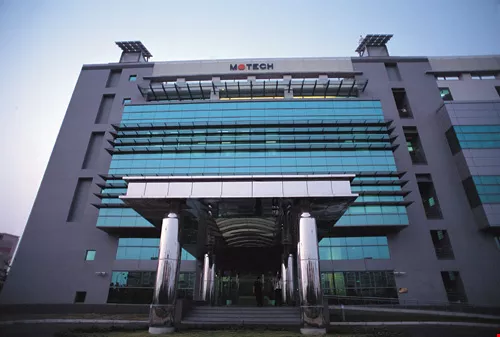
Motech's three factories--its original plant in Shenkeng, Taipei County, and its Fabs 1 and 2 in the Tainan Science Park--together present a record of the company's sustained growth and continual change. Picture here is the main entrance to Fab 2, which opened in September 2006.
Internal startups
--An industry for the times
When a company faces a transformation that could decide its ultimate survival, it's essential that it chooses the correct path. Established in 1981, Motech initially focused on producing and selling digital gauges. Subsequently it moved into technologically more sophisticated test and measuring equipment, including products such as programmable digital electronic loads, and digital power analysis clamp meters, which provided steady earnings. However, while test and measuring equipment yielded high profits, the business was restricted to a niche market. Though the company had been in business for nearly 20 years, its annual revenues were stuck at around NT$200 million. Transforming a company was an extremely involved process, and breaking through old limits and discovering a driver for a new phase for growth was difficult. These issues occupied the thoughts of Motech chairman Leo Cheng at the time.
Serendipitously, a hike in the mountains became the key to resolving the dilemma. On a trip back from America, where he had been researching and promoting renewable energy sources for the US Department of Energy, Cheng's university classmate Simon Tsuo invited Cheng to hike a mountain near Taipei. As they chatted, Tsuo described his research work in the States, mentioning a solar cell technology whose commercialization had been hindered, but that was slated to enter mass production, and whose market potential was virtually unlimited.
The information that his long-time friend revealed so casually prompted Cheng to start thinking along those lines. To understand whether solar cells were worth investing in, he made a special trip to the Industrial Technology Research Institute (ITRI) to find out about all the production workflows from a research team that had been doing studies in the field for more than ten years. Cheng spent a year and a half learning more about solar cells, traveling to Europe, the US and Japan to hear the perspectives of more than 50 experts. He was surprised to learn that over the previous decade, aided by the support of the German and Japanese governments, the global solar cell industry had grown by more than 30% annually. Moreover, the key component in solar cells was semiconductor silicon crystals, which were plentifully supplied by Taiwanese vendors.
Things came together quickly, and in 1999 Tsuo brought the 20 years of experience he had accumulated in the field and jointly founded Motech Solar with Cheng. Production of solar cells and components commenced. However, the initial stages of establishing a new business are arduous. "Don't be foolish. Just stick with the instrumentation business," Cheng was told. Tsuo heard admonitions such as, "You have no business or manufacturing experience, and the cost of commercializing solar energy products is high too. Just having the technology is not enough!" Faced with skepticism and ridicule from their friends and family and from others in the business, in the warm sunshine of southern Taiwan Motech's "transformers" silently built up the capabilities that would prove their doubters wrong.
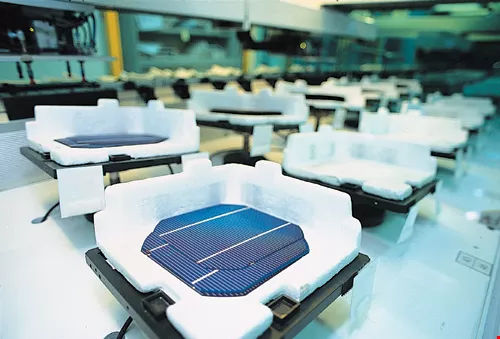
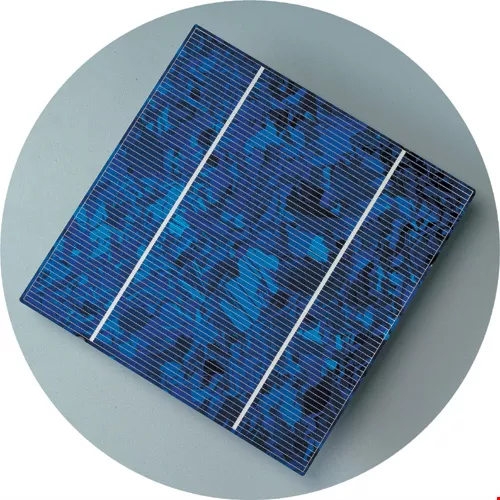
Most solar panels are composed of many individual solar cells. Motech is Taiwan's first vendor to concentrate on the production of solar cells. Its main products are high-performance solar cells made from polycrystalline silicon and monocrystalline silicon.
Running a company
--Tech and business smarts needed
Although solar energy is called an "emerging industry," 17 years ago Taiwan already had vendors like Sinonar involved in the area. Subsequently, environmentally conscious companies including Photonic Energy Semiconductor, EverBright, and E-Ton Solar Tech, which was strongly supported by ITRI, entered this clean-energy industry. Sinonar has focused from the beginning on developing non-crystalline-silicon-film-based solar panels, and thus was less affected by shortages of silicon, even managing to become the world's largest vendor in 1994. However, Sinonar entered the market too early. The path from development and production to real-world applications was too lengthy, making business difficult.
Entering the market early was less desirable than entering just in time. Although Motech was not Taiwan's first solar energy company, it entered the market at a propitious time, and had a solid grasp on future directions in the industry. It was thus able to spearhead renewed development in the sector.
However, even if its timing is right, a company that doesn't have the requisite supporting technical capabilities is still vulnerable to being overwhelmed in the subsequent crush of new rivals. "Though Motech had just a few years of experience with solar cells, Dr. Tsuo had been at the cutting edge of the field for 25 years!" says R&D manager Tang Ching-yao, who came to Motech in 1999 when it built its solar cell factory, in response to skepticism about Motech's technological capabilities.
When 25 years of accumulated resources finally reached fruition, the effect was electrifying. After graduating with a degree in physics from Fu Jen Catholic University in 1972, Tsuo went to Yeshiva University in New York to continue his physics studies. After obtaining his PhD, he worked at NASA performing research on infrared sensing technology for satellites. He subsequently went to the US Department of Energy (DOE). This background gave him a valuable head start in leading Motech Solar. Tsuo and the entire team spent more than one year studying how to convert sunlight into the maximum amount of electrical energy, while also ensuring the stability of the power generation system. This was necessary because "if just one palm-sized cell in a solar panel made up of hundreds of cells is blocked, the entire panel won't produce any electricity," notes Tsuo.
Expanding your business is one thing, but product quality is something else entirely," explains Tsuo, explaining the key to Motech's success. The entire solar energy industry begins upstream, with chip vendors turning the raw silicon into silicon ingots. These are cut into silicon chips, which cell manufacturers turn into cells. Module vendors turn the cells into panels, which finally go to system vendors for installation. A seven-foot-square solar panel consists of over 100 cells soldered together, and these cells are Motech's main product.
Motech's initial strategy was to take on the technologically challenging area of designing solar energy cell chips and performing system integration, while outsourcing the work of solar module assembly, with its lower profit margins, to local vendors. Over a short six years, the solar energy cells developed by Motech performed well in the World Solar Challenge solar-powered boat competition and the American Solar Challenge solar-powered auto race. While the top seven finishers in the latter competition used the type of solar cells normally used for aerospace applications, which are made from rare, costly materials, the cells supplied by Motech were those found in land-based installations. But the race team they worked with ranked second among teams using this type of cell, making it evident that Motech's solar cells are technologically on a par with other products internationally.
Because no clear direction for energy policy has been set in Taiwan, the domestic demand for solar energy cells is limited. Motech has thus been forced to turn to the international market. Motech has entered strategic alliances with raw materials and module vendors such as Norway's Scanwafer and Germany's polycrystalline silicon wafer giant SolarWorld AG. Using cross-investment and joint investments, Motech has turned these foreign companies into its European bases, while Motech itself plays the role of its partners' operational centers in Asia. Through its partnerships, Motech has thus been able to enter international markets.
Once Motech had established a mutually beneficial approach to partnerships, it successfully won numerous solar energy generation system contracts in Germany and Japan. Motech used each contract it won as a springboard to another in the international market, rapidly accumulating extensive experience in solar photovoltaic system design. It then assisted in the building of solar power generation systems in Taiwan.
For example, in 2003 Motech helped the Fubon Group construct an environment-friendly building near Taipei's Jen-ai traffic circle, including the highest-capacity solar panel in all of Taiwan. At the same time, Motech has supplied solar panel-based power supply systems for use in remote areas such as mountainous regions, offering a means of providing emergency lighting and communications in the event of landslides or road collapses. In the Central Mountain Range, where peaks top 3000 meters, some mountain shelters include Motech's solar power modules for mountaineers to use in emergency situations. In this way, Motech is demonstrating the practical utility of its products to stimulate market demand.
Having endured a painful period of transition, Motech's reputation has grown immensely. However, the hectic growth that has followed the establishment of the business and development of markets through global alliances has forced Tsuo to confront changes in the company's strategic direction and deployment of its resources. For the sake of long-term business, it is essential to establish a strong organizational infrastructure and attract international talent.
"Helping Dr. Tsuo establish a systematic workflow is currently my main job responsibility," asserts chief operating officer Paul Cheng, who just returned to live in Taiwan in March 2006 after working in the US for 35 years. He chose to come to Motech in his quest for new beginnings.
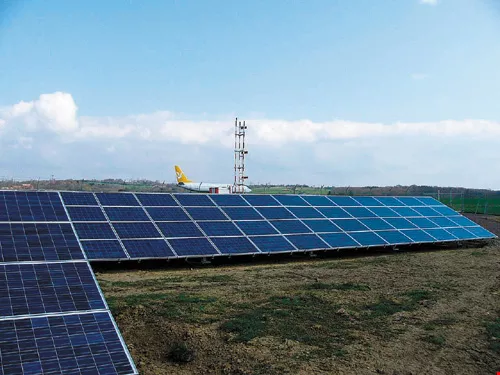
Ten years ago, most people believed that solar power was merely fodder for laboratory experiments. Today, the use of solar power is visible in solar-powered model cars, on bus shelters and rooftops, and even solar-powered boats.
The next decade
--Spreading innovation
Just how big is the business opportunity for the solar energy industry? The golden number most frequently invoked by market analysts is the one that emerges from the statistical data of the Industrial Economics and Knowledge Center (IEK) of the Department of Industrial Technology at the Ministry of Economic Affairs: until 2010, the worldwide annual growth rate should reach between 30 and 35%. The European Photovoltaic Industry Association (EPIA) projects that in 2010, 3600 megawatts will be generated globally through solar power. Based on current prices for solar cells, that represents more than NT$300 billion in sales. If declining prices made possible by mass production are factored in, it is projected that in 2010 the overall market will surpass 2.5 billion (about NT$100 billion). Meanwhile, Motech forecasts that when production at its second plant comes online at the end of 2006 its annual production capacity will reach 200 megawatts of solar cells. Based on current unit prices, NT$20 billion in operating revenues will be possible.
Peng Yu-min, deputy general director of the Materials Research Laboratories at ITRI, points out that over the past ten years, the global market for solar energy has already expanded 22-fold, and it is projected to grow large enough for the industry to achieve economies of scale by 2015. Looking at the situation domestically, the production value of solar cells has been growing exponentially in the past three years, from NT$1 billion to NT$5.5 billion, and is projected to grow to NT$10.6 billion in 2006 and NT$40 billion by 2010. Able to draw on its advantages in semiconductor manufacturing, Taiwan has great potential in the solar energy sector. It is possible that solar energy may follow semiconductors and LCD panels to become Taiwan's third trillion-NT-dollar industry.
However, looking at matters from the most basic imperatives of supply and demand, one must admit that solar energy is not a household necessity. To stimulate market demand, national incentives must be put in place.
Germany, which has the strongest government environmental subsidies to promote solar energy, passed legislation in 2001 which required utility companies to purchase unused electrical power from members of the public who installed solar-based power generation equipment at prices four times higher than the general market, with purchase guarantees extending for 20 years. The result was that the income earned by regular German families from selling electricity generated through solar power back to utilities considerably exceeded the bills they owed, while installation charges for the equipment can be paid back over a period of 30 years. The program was thus able to win an enthusiastic response from the public, and solar energy now accounts for 12.5% of Germany's total electricity consumption.
In contrast, Taiwan does not have a coordinated policy to encourage the development of a renewable energy industry. The passage of an energy bill has been held up in the legislature now for six years. Less than a tenth of Motech's orders originate from the domestic market. Unconcerned about the impact on his personal interests, Tsuo expresses worry about Taiwan's energy efficiency and the competitiveness of future renewable energy industries.
In addition, once technology is mature and markets have taken shape, production scale and price will be the ultimate keys to success. Companies that can raise conversion efficiencies, lower prices, and increase scale will put themselves in a strong position. Only then will the true challenge begin.
Faced with the question of how to sustain the company's development, Tsuo's answer is to take things step by step. He says, "After all, Motech is still far behind the world leaders, like Sharp and BP." He adds earnestly, "Our long-term objective is to improve our ranking in solar cell production volume from last year's #9 to one of the world's top three in the next six years."
"There are contenders, and there are pretenders," quotes Tsuo, expressing his view that Motech is a company that is moving pragmatically to sustain its business, and not playing the part of a speculative enterprise designed to cash in on a ephemeral trend. This quote is also one that Tsuo uses as a cautionary statement to new employees at each employee orientation. Stemming from the attitude expressed by the quote, while 20 years ago Motech was but one of Taiwan's multitude of small enterprises growing steadily but unspectacularly, it is now one local company from a traditional industry that has dared to transform itself. It has reached out beyond Taiwan, and like one of the solar panels on its roof, is rapidly accumulating power, shining forth as one the hottest players on the global stage.
Established June 3, 1981
Headquartered in Shenkeng, Taipei County
Production sites: Tainan Science Park; Shenkeng, Taipei County
Core businesses and their shares of total revenues: Solar cells (97.41%), test equipment (1.25%), solar photovoltaic systems (0.68%), third-party products (0.29%)
Workforce: More than 800
2005 revenues: NT$4.627 billion
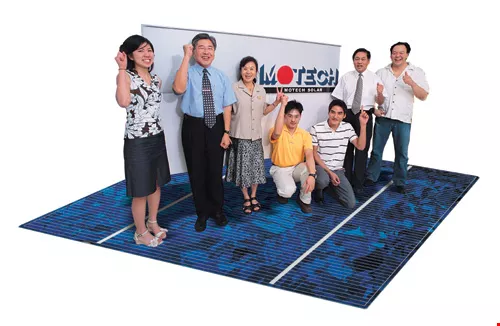
Under the leadership of CEO Simon Tsuo (second from left), Motech has drawn many overseas Chinese to work in Taiwan. Some have done so to rejuvenate their careers, while others seek to broaden the stage on which they will be able demonstrate their abilities. Although their motives may be different, all have made their contributions to Motech's development.
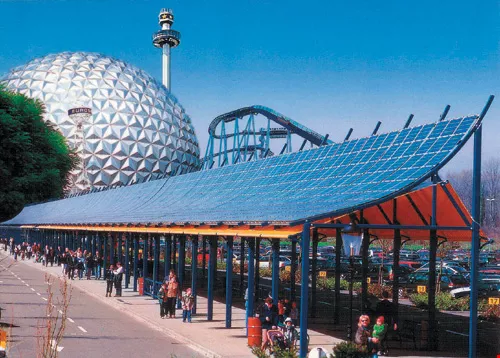
Ten years ago, most people believed that solar power was merely fodder for laboratory experiments. Today, the use of solar power is visible in solar-powered model cars, on bus shelters and rooftops, and even solar-powered boats.
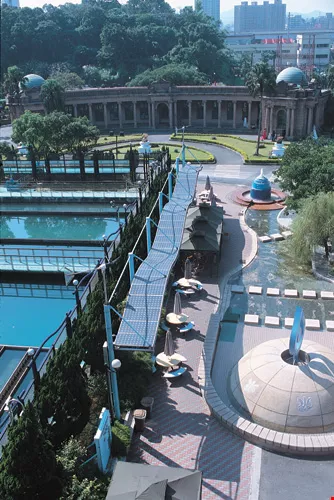
Inside the Taipei Water Park is an electricity generating facility that is the first in Taiwan to draw on both wind and solar power. The facility comprises two wind turbines and more than ten solar panels. When operating at full capacity, it can produce 8.3 kilowatts of electric power to run the park's fountains and lighting equipment. The solar panels seen here were manufactured and donated by Motech.
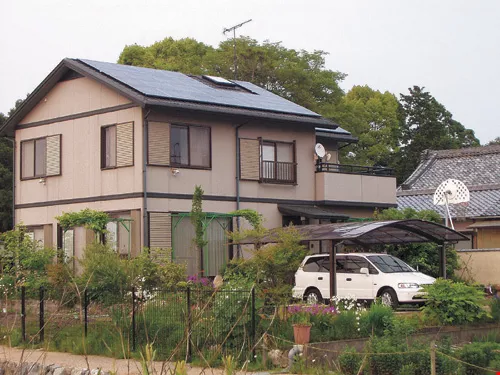
Ten years ago, most people believed that solar power was merely fodder for laboratory experiments. Today, the use of solar power is visible in solar-powered model cars, on bus shelters and rooftops, and even solar-powered boats.
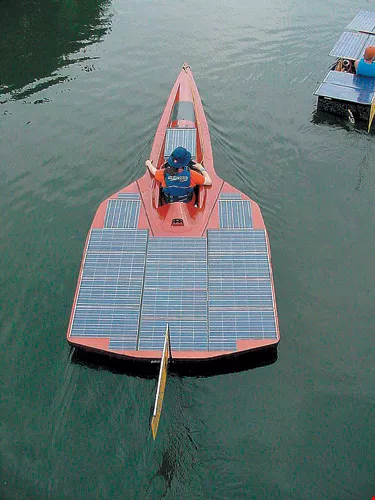
Ten years ago, most people believed that solar power was merely fodder for laboratory experiments. Today, the use of solar power is visible in solar-powered model cars, on bus shelters and rooftops, and even solar-powered boats.
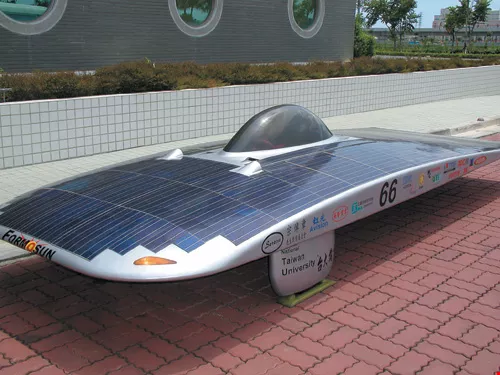
Ten years ago, most people believed that solar power was merely fodder for laboratory experiments. Today, the use of solar power is visible in solar-powered model cars, on bus shelters and rooftops, and even solar-powered boats.


