

Lo Chai-chun is one of the most famous woman columnists in the Republic of China, writing under her pen name of Madame Wei-wei in the mass-circulation United Daily News. Since she came from the China mainland province of Anhwei at the age of 18 with her younger sister, what has been the basis of her spiritual strength, particularly in view of her lack of a strong family background? Curious to know the answer, I recently visited Madame Wei-wei in Taipei.
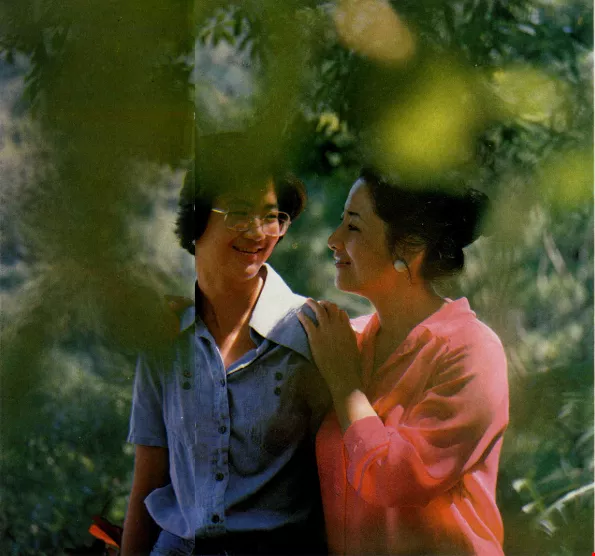
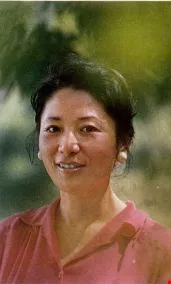
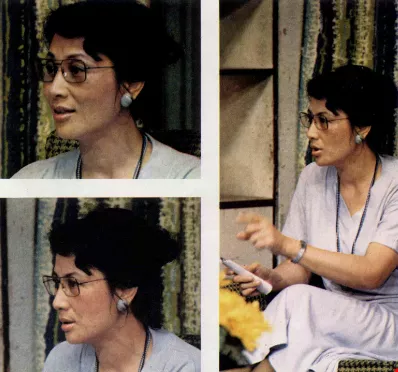
When I first arrived at her house one bright Sunday morning in the residential area known as the "New Garden City," I was first attracted by some 100 flower pots lining the approach to her door. As Madame Wei-wei, wearing a green dress and her hair in a bun, approached me, I noticed her dark eyes were shining, and that she looked young and beautiful despite her 47 years and the fact she was wearing no make-up.
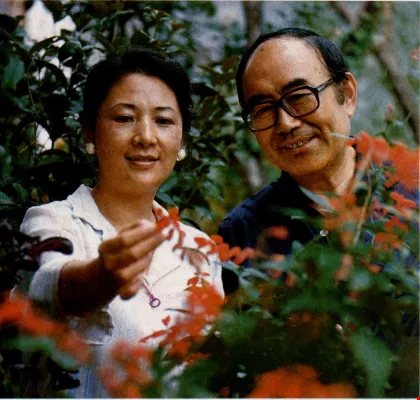
She explained, to my surprise, that the flowers I admired so much were grown by her husband. Before I learned about his prowess as an amateur gardener, I had only known Mr. Chou Cheng as an accomplished scholar who taught Chinese history at the Fujen University in Taipei.
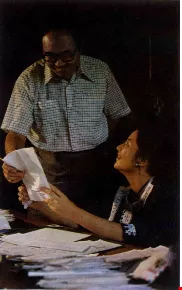
As I walked with Madame Wei-wei into the parlor, we met Mr. Chou, a tall and handsome man from Shantung, who is often described by his wife as an essential support for her writing. With his two wise eyes glinting behind owlish glasses, he seemed to be a sincere and principled man.
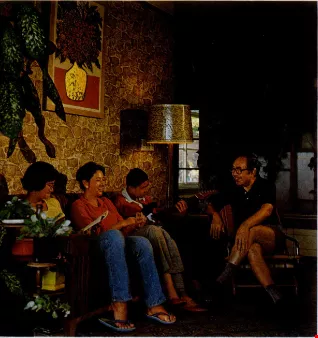
After Mr. Chou had returned to his study, and Madame Wei-wei had gone into the kitchen to prepare a drink for me, I took the liberty of looking around the decorations and furniture in the parlor. I noticed the attractive flower paintings by contemporary artists, and the comfortable appearance of the room, even though it had no air conditioner, carpet or large sofa.
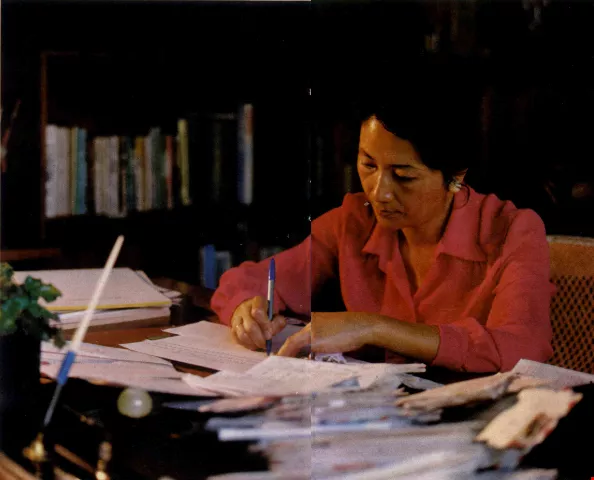
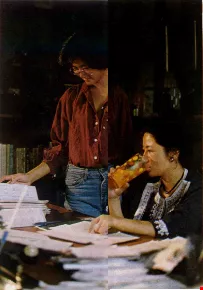
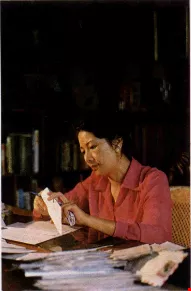
Since one of Madame Wei-wei's most common exhortations is "to substitute the bookcase for the wine cupboard" when buying furniture, I was particularly interested in seeing her own book collection. My opportunity came when she took me into the study to drink the orange juice she had prepared. Even though the oblong room was barely large enough to accommodate a desk and a chair, it was filled with books, clippings, periodicals and letters. Volumes on psychology, medicine, children's education and law made up the bulk of the collection.
To obtain the latest information, she subscribes to four newspapers, and almost all the periodicals on psychology, medicine and law.
Madame Wei-wei explained to me that she had been interested in writing since she was young. Her articles first appeared in newspapers and magazines in 1964, the most popular ones at that time being "The Small Family Comedy," which appeared in the United Daily News each week, and was a commentary on her own family life. Because of the popularity of this column, the United Daily News asked Mrs. Chou to start an advice column in 1965, and thus Madame Wei-wei was born.
Many of her pieces written in the past 13 years have fought against the injustice in the laws as they relate to women. For example, a married woman could not retrieve her personal property in the event of a divorce, although a man could. As a result of her pointing to these injustices, the Government has recently decided to amend the laws in question. In her column also, Madame Wei-wei has commented on speeches by prominent people, concerts, dance performances, books and movies, in an effort to persuade housewives to take up new hobbies, cultivate their spiritual growth and enlarge their horizons.
She stops short, however, of the extreme feminism which holds that the woman should necessarily leave the kitchen and compete with men in careers. But she thinks that the housewife should try to be independent and open-minded instead of becoming too reliant on her husband. When some housewives write to her to complain that their husbands are not faithful and neglect the family responsibility, she advises them to examine themselves first, because the husband is not always at fault. In particular, she warned women to take care of their physical appearance, since many of them age too quickly, both mentally and physically, after marriage. But in the case of husbands who are truly irresponsible and impossible to reform, she urges no tolerance and a quick solution.
At present, she receives about 300 letters from readers each month, dealing with such diverse subjects as marriage, family life, the generation gap, medical and psychological problems. When I asked if she had much difficulty in answering the questions, she smiled and said: "At first I did not know how to answer many of those which were outside my experience. But now I adopt the policy of only answering questions on affairs of the heart and marriage myself, and seek the advice of experts on more specialized questions.
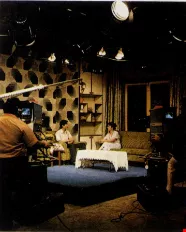
The old Chinese saying that even a wise judge cannot solve family problems does not deter Madame Wei-wei from trying to help her readers. Besides writing her column, Madame Wei-wei also contributes to the Mandarin News and the World Journal, and produces and commeres a TV program called "Today," screened by the China Television service.
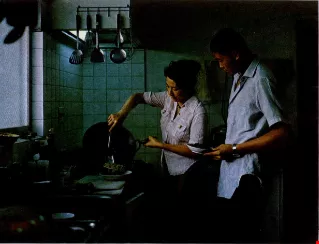
Asked how she manages to do the housework while coping with her various jobs, Madame Wei-wei explained that she finds housework to be a form of mental relaxation when she cannot think clearly. In addition to her two "silent servants" in the kitchen, the refrigerator and the washing machine, Madame Wei-wei is helped by her two sons and one daughter, all of whom are still in school.
"I tell my children that housework is everyone's job, and not only mother's. Even housewives who have no other job need someone to relieve them from the monotony," she said. Another important point is that children who are not told to do housework are often less independent.
In educating children, it is more important that they be prepared for a happy life ahead than that they come top of the class. Instead of forcing children to concentrate wholly on school textbooks, they should be encouraged to do outside reading, she said.
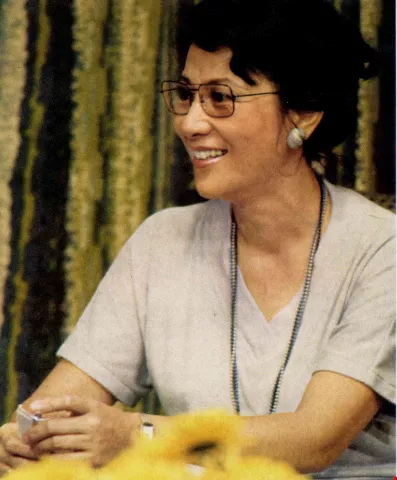
As I left Madame Wei-wei's house after enjoying lunch with her on her balcony with a beautiful mountain view, I remembered one of the main points of her philosophy: "To be active in achieving something meaningful is the best way to remain fresh, vital and young." I realized that this was truly advice coming from her personal experience.


@List.jpg?w=522&h=410&mode=crop&format=webp&quality=80)


