The Chinese Road to Riches--Rotating Credit Associations
Elaine Chen / photos Vivian Liu / tr. by Robert Taylor
August 1993
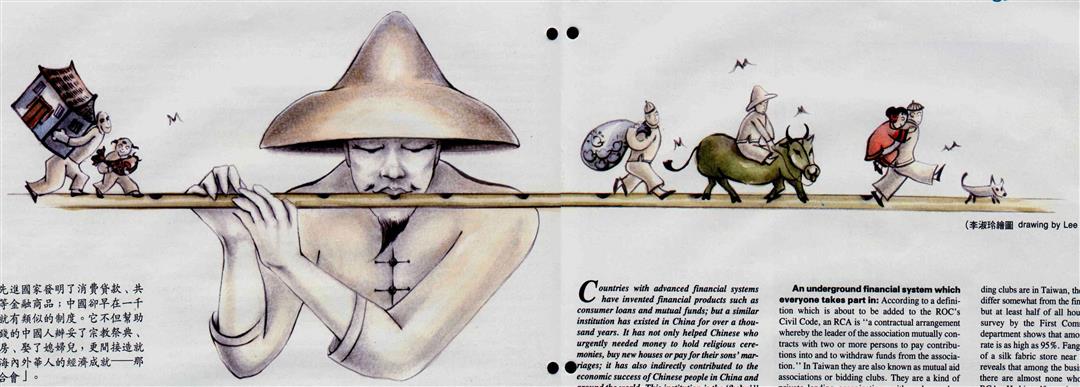
Countries with advanced financial systems have invented financial products such as consumer loans and mutual funds; but a similar institution has existed in China for over a thousand years. It has not only helped Chinese who urgently needed money to hold religious ceremonies, buy new houses or pay for their sons' marriages; it has also indirectly contributed to the economic success of Chinese people in China and around the world. This institution is the "hehui" or rotating credit association.
Legislator Huang Huang-hsiung has three well behaved daughters, who like many young people nowadays go out to work in their spare time. But they don't spend the money they earn on clothes or trips abroad; they give it to their mother to pay into a rotating credit association (RCA). Every year even the oldest daughter, who is now studying at university, just like her two younger sisters, hands over the money presents she gets at Chinese New Year to her mother to pay into an RCA.
"At the first Chinese New Year after she was born, our eldest got NT$2000 in New Year money. I thought we should save it to pay for her education, and so I started paying into a NT$300-a-month club," says Huang's wife Wu Yue-e. Smiling, she explains that she and Huang Huang-hsiung had no family property to inherit. They were on their own and had to make their own provision for a rainy day. For over 20 years, without digging into her housekeeping money, and without letting her husband or children know, she joined one RCA after another, using the money from one to finance the next. Adding in the children's New Year money each year, and their job earnings, her investment in the RCAs has grown until it is now NT$20,000 a month, and when her eldest daughter graduates from Taiwan University's Department of Social Sciences next year, the money she will need to go and study abroad will be assured.
These are typical Chinese parents, with a typically Chinese way of managing money.

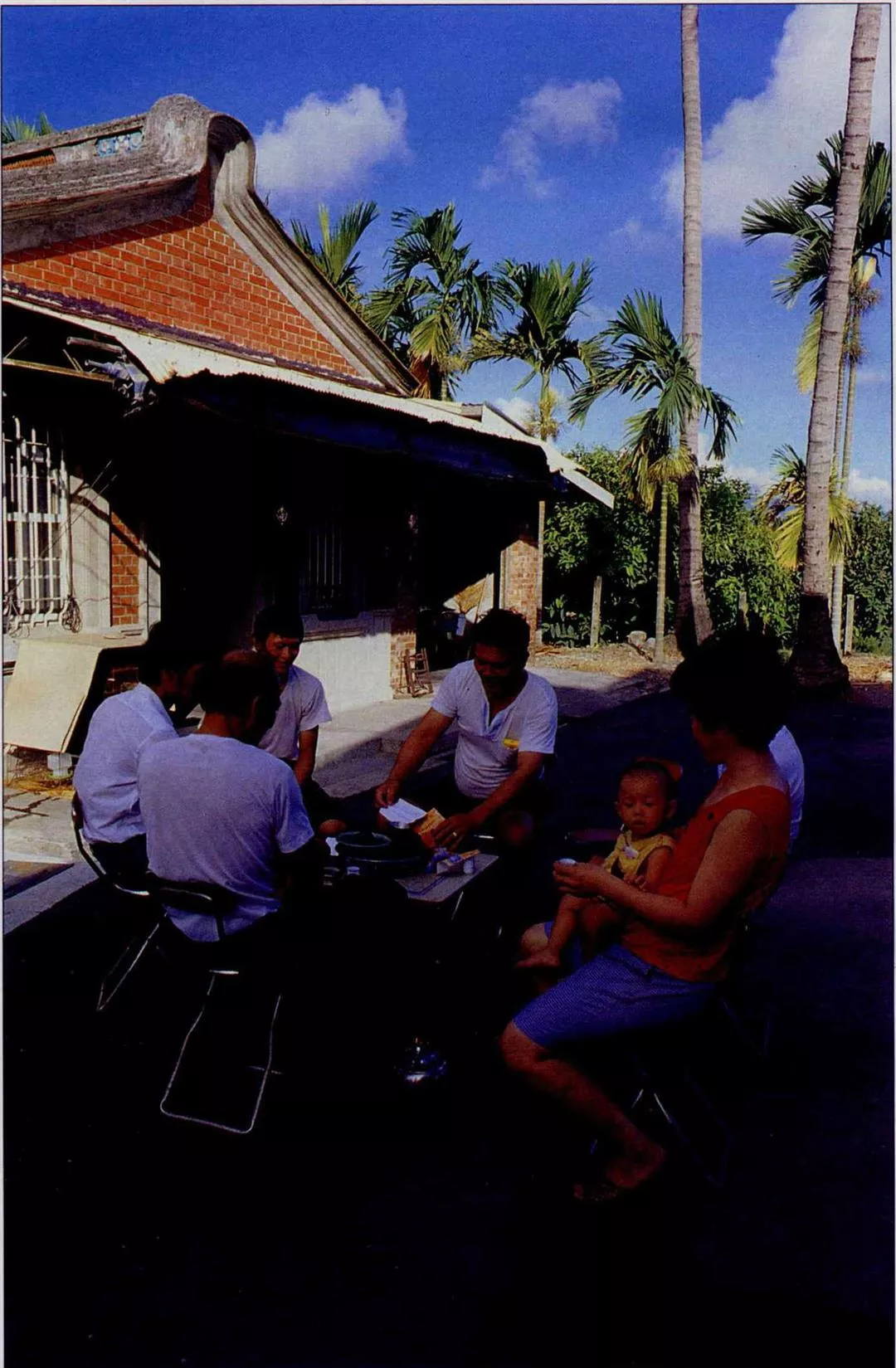
In the countryside of Pingtung County, one can still find "rice clubs," rotating credit associations which use grain instead of money. (photo by Cheng Yuan-ching)
An underground financial system which everyone takes part in:
According to a definition which is about to be added to the ROC's Civil Code, an RCA is "a contractual arrangement whereby the leader of the association mutually contracts with two or more persons to pay contributions into and to withdraw funds from the association. " In Taiwan they are also known as mutual aid associations or bidding clubs. They are a kind of private lending organization, with each member paying a fixed amount to the leader each month, and with members who wish to withdraw money drawing lots or withdrawing in rotation according to the rate of interest which they bid.
In the past the law did not regulate RCAs in any way, and most people who have not participated in them think that it is probably only people in the countryside or with no education who take part in this type of "underground financial activity," which lacks any legal guarantee. But this really underestimates the RCAs.
According to a general survey of family savings made in 1989 by the Taiwan Provincial Government's Department of Budget, Accounting and Statistics, there is not much correlation between participation in RCAs and the degree of urbanization of the area where participants live. It is only in Eastern Taiwan, for instance in Hualien and Taitung Counties, that participation is markedly lower. The likelihood of a family being in an RCA increases with family income and the level of education of the head of the household: the highest rate of participation is among families in the high income band over NT$540,000 per year, with a university education.
Looking more closely, its not that highly educated people find RCAs particularly attractive. Its just that such people have relatively high earning power and have surplus money available to invest in the RCAs. The same survey revealed that among the reasons given by people who were not in RCAs, "no money to spare" accounted for a large proportion. As to just how widespread bidding clubs are in Taiwan, the department's statistics differ somewhat from the findings of other scholars, but at least half of all households participate. A survey by the First Commercial Bank's credit department shows that among business people the rate is as high as 95%. Fang Han-chang, the owner of a silk fabric store near Taipei's Tihua Street, reveals that among the business people he knows, there are almost none who are not members of RCAs. He himself pays in over NT$400,000 every month. It is so much that he cannot keep track of it, and depends on the RCA leaders phoning him to tell him it is time to pay up, whereupon he scrapes the money together ready for them to come and collect.
"Sometimes I really can't drum up the cash, and I have to borrow money from one club to pay into another," says Fang Han-chang.

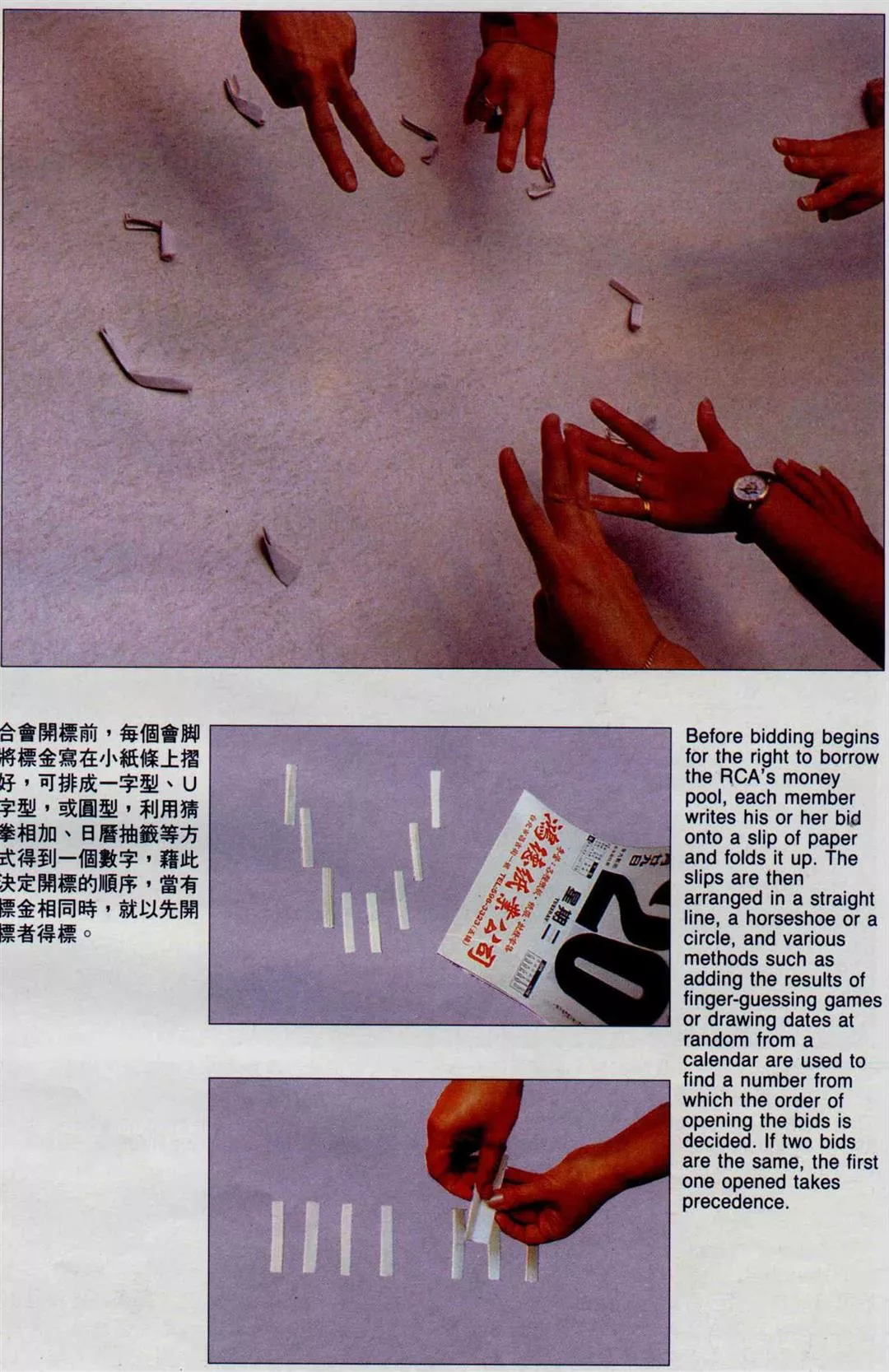
Before bidding begins for the right to borrow the RCA's money pool, each member writes his or her bid onto a slip of paper and folds it up. The slips are then arranged in a straight line, a horseshoe or a circle, and various methods such as adding the results of finger-guessing games or drawing dates at random from a calendar are used to find a number from which the order of opening the bids is decided. If two bids are the same, the first one opened takes precedence.
A fine economic institution:
It is not only housewives, office workers and business people who participate in bidding clubs: many celebrities' way of managing money is to invest in an RCA.
Singing star Fei Yu-ching, who has recently made a comeback, is known in entertainment circles as a "rich miser. " His friends reveal that whenever Fei Yu-ching receives, say, NT$200,000 in performing fees, he is sure to pay it into an RCA, with the aim of raising enough money for the down payment on a house. Today he even owns real estate overseas in such places as Singapore and Canada.
RCAs are not only an important instrument by which people in Taiwan manage their finances; they have also played an important role in enabling Chinese people to establish themselves economically overseas. In a book about the Chinese in New York's Queens district, Chen Hsiang-shui, an associate professor at Tsing Hua University, notes that in traditional overseas Chinese communities, RCAs are a very important means of accumulating capital. Many overseas Chinese agree that this special facet of Chinese culture was what enabled them to establish themselves abroad. Lu Nianhua, owner of the Ruby Chinese Restaurant in Paris, left Mainland China and went to work in France at the age of twenty, and only three years later became a restaurant owner. But he says that he didn't have any special secret at all for getting rich quick --it was all thanks to Wenzhou people's "magic flute" for whistling up mutual prosperity: the "monthly club."
"We Wenzhou people are like this. You work for me for a while, and I'll help you set up on your own. When you've worked a few years and got a bit of money together, as long as you're honest and hardworking, than Wenzhou folk will support you to start a "monthly club," and in a few days you can have a loan of a few hundred thousand francs, interest-free, to start up in business. When French people borrow money from a bank they have to pay at least 12% interest, and that's where we have the edge." In a personal interview, Lu Nianhua observed that French economists regard Chinese monthly clubs as a fine economic institution.
Western economists may be full of admiration for mutual aid associations, but anthropologists take a different view.

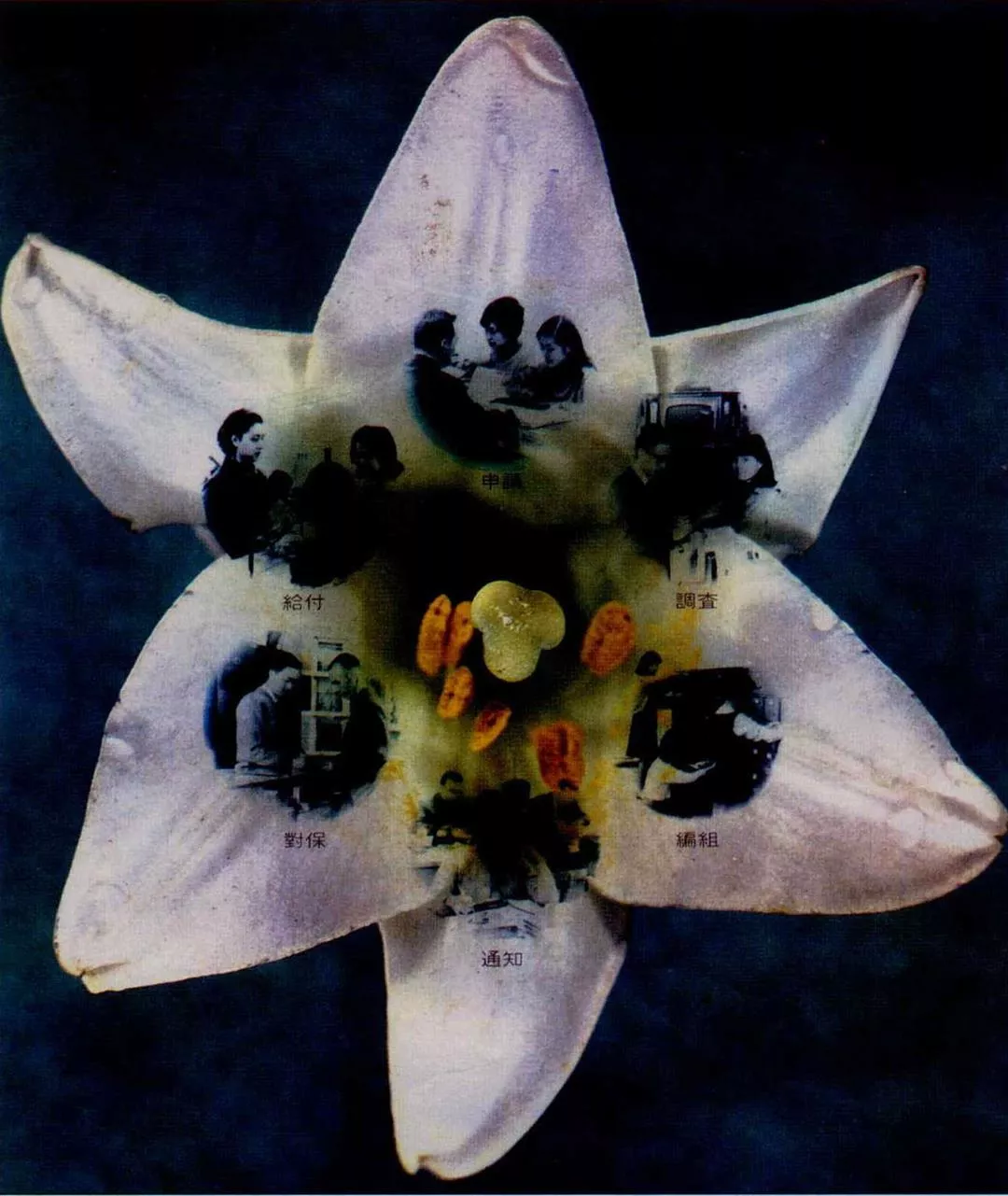
This unusual poster was made by the Taipei Mutual Loan Company before it became a bank. It shows all the stages, from application to payment, involved in joining a rotating credit association run as a formal business.
Symbolic of "underdevelopment"?
The paleoanthropologist Shirley Ardener has found that not only Oriental peoples such as the Chinese and Japanese have RCAs. There are also similar rotating credit systems in Africa. By contrast, they do not exist in advanced Western countries. This leads her to conclude that the RCA is a financial institution which basically only exists in developing countries which have not yet evolved a fully-fledged financial system, and that it represents a process of training in the transition from a traditional agricultural society to a modern society.
Looking at Japan as an example, there would appear to be some truth in her assertion.
After the Meiji Restoration in Japan, wealth was concentrated in the hands of the nobility, among whom the practice of keeping armed retainers was widespread. To provide for their followers in peacetime, they organized RCAs with themselves as leaders. As the nobles' credit was beyond doubt, the RCAs rapidly expanded, at which point several leaders would join together to form a company.
Later, in 1905, in order to tap the potential of this stock of capital, the Japanese government passed a law creating "joint-stock mutual loan companies" and later also encouraged these small companies to increase their capitalization, merge and become "mutual financing banks. " In 1989, these again changed into ordinary commercial banks, and their traditional mutual loan business gradually declined.
Taiwan has also made continuous efforts to follow the same path as Japan. The several "small and medium business banks" now in existence grew out of mutual loan companies. After the new banking law enacted in 1975 came into force, these companies were permitted to become banks, and in recent years the Ministry of Finance has not permitted those with international departments to continue taking on new mutual loan business. Nonetheless, RCAs continue to abound among the general public.
If as Shirley Ardener suggests, RCAs are part of a process of transition to a modern society, can China really have been undergoing this process for more than a thousand years without completing it? RCAs are not only widespread in Taiwan, they are said still to exist in Peking too. And even if the financial systems on both sides of the Taiwan Strait are not yet modern enough, "what about Singapore?" Kuo Ping-hsin, an assistant research fellow at Academia Sinica's Institute of Economics, states that some people predict that the liberalization of Taiwan's financial system will lead to the gradual disappearance of the RCAs; but looking at the example of Singapore and Hong Kong, "it's really not very likely; at most their share of the market may decline somewhat."

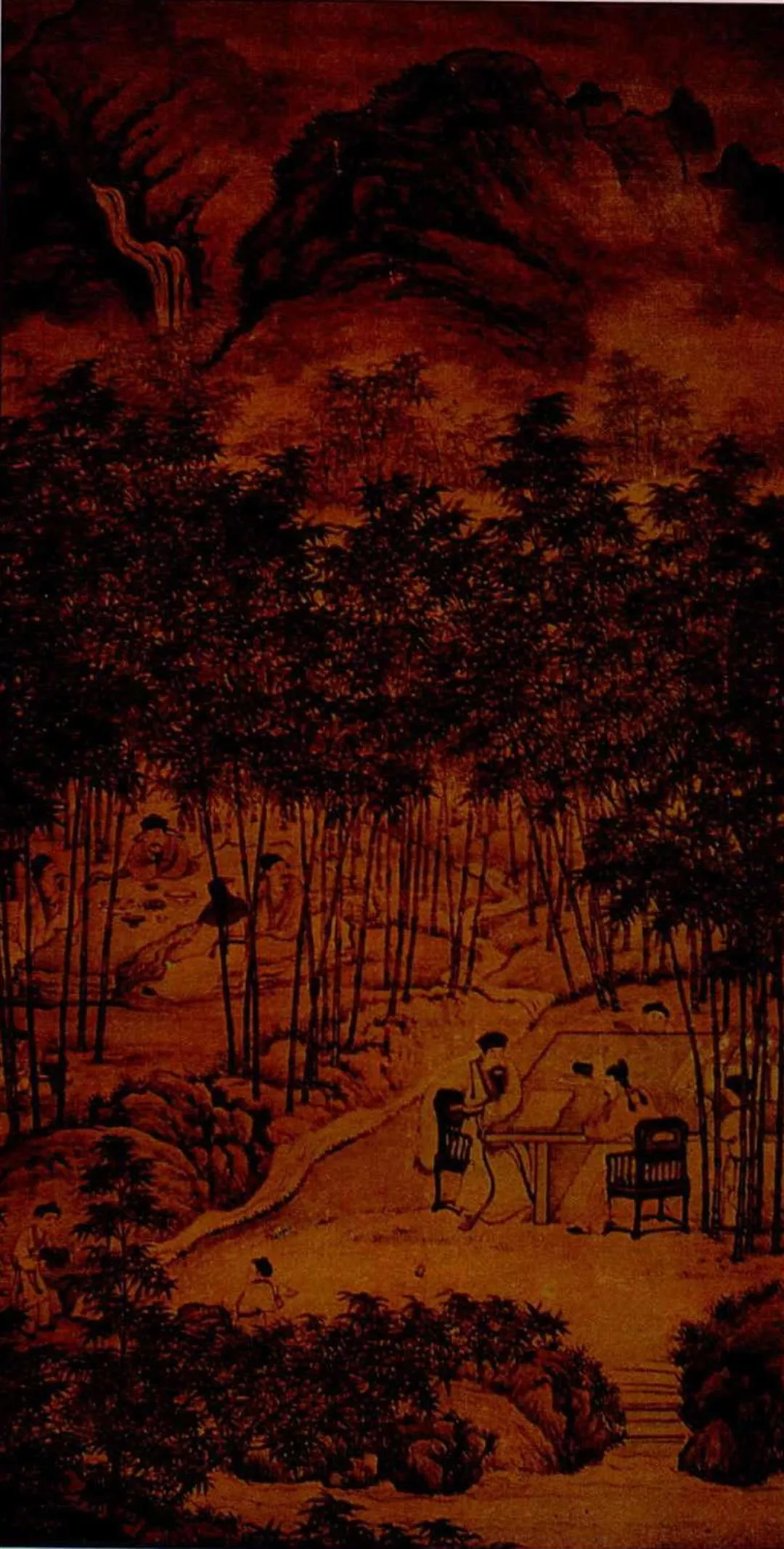
One of the legends concerning the origin of RCAs is that they were created in the Chin dynasty by the reclusive "Seven Worthies of the Bamboo Grove.".
Invented or copied?
Although the function of RCAs in Chinese society has been developed to the fullest extent possible, when one tries to trace their origins it is impossible to confirm with any certainty whether they were a Chinese invention.
Perhaps because Chinese scholars of past ages disdained to write of money and profit, China's historical records do not describe RCAs. For the time being we can only infer a few possibilities from very limited documentary materials.
According to the Cantonese, RCAs were invented by Lord Pang Teh (d. 219 AD) of the Eastern Han dynasty. Traditional Cantonese RCA rules include the phrase: "It is said that aid associations began with Lord Pang. " But there is no record of how Lord Pang came to create the associations. On the other hand, because seven-member RCAs known as "seven worthies' associations" are popular in Jiangsu and Anhui Provinces, people there believe the RCA system has been handed down from the "Seven Worthies of the Bamboo Grove" of the Chin dynasty (265-420 AD).
In his History of the Chinese Economy, Professor Chou Chin-sheng ascribes their origin to the Sui dynasty (581-618 AD). He points out that the form and rules of Chinese RCAs are often modelled on those of Sui dynasty "Hsin An clubs." His research indicates that this "Hsin An" is Hsin An Prefecture, first created in Anhui Province in the Sui dynasty.
Chinese history lacks clear records concerning RCAs, but in view of Indian Buddhist temples' "endless money" loan system and the legal regulations for mutual aid associations, credit bidding clubs and other clubs similar to the Chinese RCAs, which were once common among the people of India, some people believe that RCAs were brought to China with the eastward spread of Buddhism in the Tang (618-907 AD) and Sung (960-1279 AD) dynasties, and that they reached Japan, where they are known as "endless associations" (mujinko), in the Kamakura period (1185-1333 AD).
However, when we sought confirmation from Li Hsi-tao, current secretary of the Buddhist Association of the ROC, and from the Fokuangshan Temple in Kaohsiung County, both said they had never heard this theory, and that no such practice now exists in Buddhist circles either in Taiwan or in Mainland China.

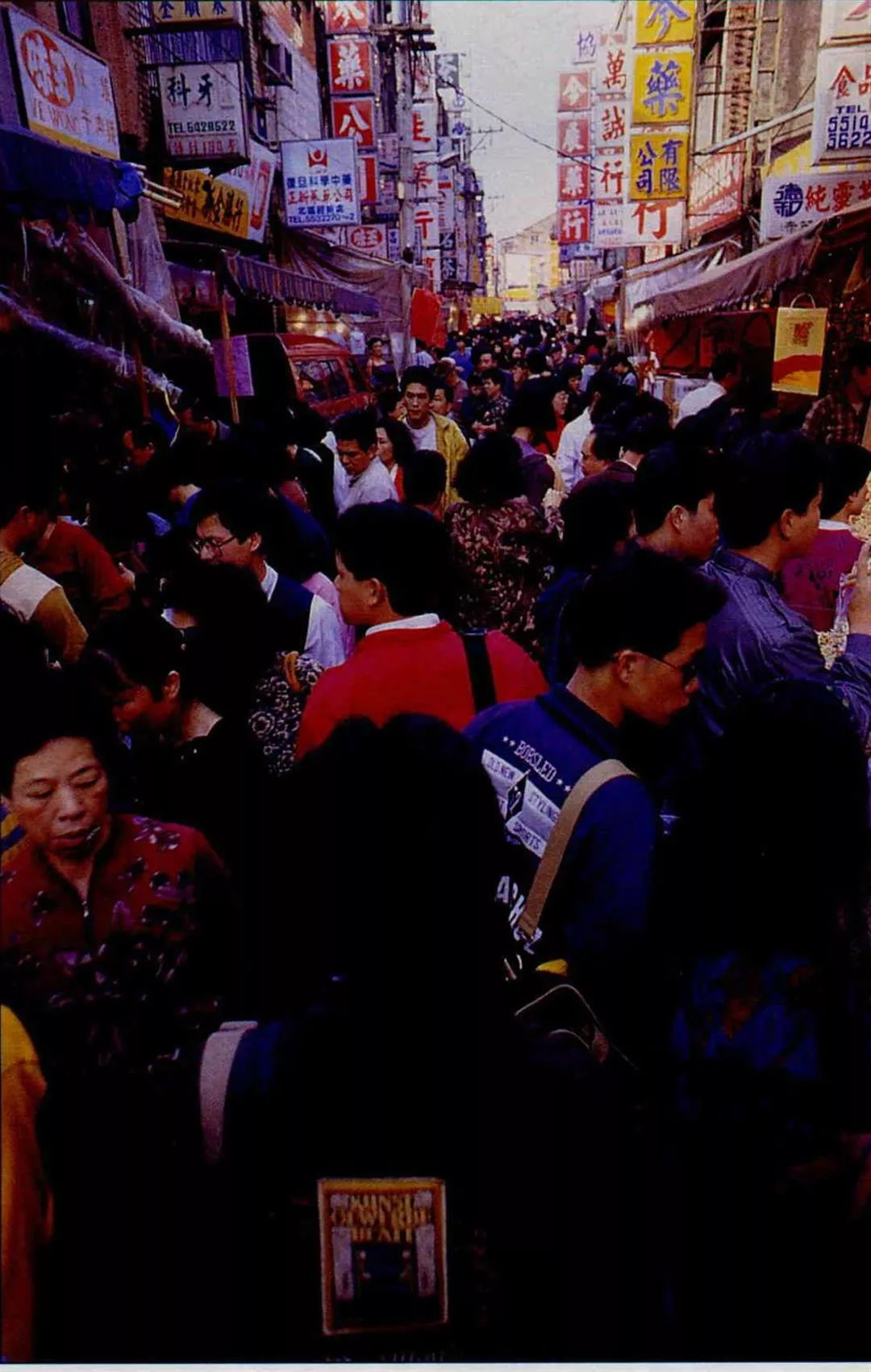
Tihua Street is a center of Taiwan's underground financial system. Many business people are still members of mutual aid associations.
The bidding clubs have lost the scent of rice:
Whatever the origins of RCAs, one thing we can be certain of is that they have been widespread in China for over a thousand years. Originally they paid out money in rotation to family members who needed it for sacrificial rites, marriages, funerals and the like, with any disputes over precedence being arbitrated by the local elders; later people felt this method was not objective enough, so they drew lots to let the spirits decide; later still, a bidding system developed whereby the money pool goes to the person bidding the highest rate of interest. At this point the allocation of capital reached its most efficient.
Different areas have different names for rotating credit associations, depending on their form. The names include invitation clubs, lottery clubs (decided by drawing lots), bidding clubs (decided by the rate of interest bid), credit clubs, mutual aid associations, and monthly clubs; and in Taiwan, clubs, writing clubs, silver clubs and so on. They may take the form of cash clubs, which ordinary people usually choose, or the cheque clubs more often found among business people.
Farmers' bidding clubs have a style of their own. Apart from ordinary cash bidding clubs, there are also clubs where payment is made in kind, most often with rice.
Cake shop owner Chen Chen-chiang from Tali Rural Township in Taichung County farmed the land as a young man, and has participated in "rice clubs" amongst his relatives.
He describes how in agricultural society everyone was short of cash, and so they would organize bidding clubs after each harvest. The payments and interest would all be calculated according to the price of rice grain. For instance, if each person's payment per session was NT$3000, the leader would calculate the equivalent amount of rice, and after collecting it would hand it over to the bid winner, or else would use the rice mill as an intermediary, with the winner collecting the rice from the mill. With only two harvests a year, only about 12 to 16 people would take part, but even so it would take six to eight years to go the full round.
"In those days the people in the club were all relatives and neighbors, along with a few distant relatives such as husbands of aunts. Once the rice harvest was in we would 'eat on the club, ' with the leader setting up tables and laying on food for the guests, who would put in their bids, " Chen Chen-chiang recalls. He laments the fact that today human relationships and principles have become weaker, and not only do tricksters make off with club money, it is also very difficult to recruit members for a club with a life as long as six or eight years.
Civil servants were "off limits":
The risk of fraud is the reason why people's attraction to RCAs is tinged with fear. Around 1980 especially, Taiwan was rocked by a succession of RCA fraud scandals. Lin Kuang-yu, formerly of the First Commercial Bank's credit department, has calculated that in a period of little over two months from August to October 1979, over 10,000 people lost money in RCA frauds, with the sums involved totalling over NT$1 billion. In places such as Yunlin and the Chienchen district of Kaohsiung there were even whole series of domino-style failures.
"Later there was even a case with an enormous bidding club organization where the leader drove a Mercedes up and down the island collecting money, and eventually made off with several billion dollars. That case sent shockwaves through society for a long time," recalls Lin Wei-ke, General Manager of Taipei Business Bank's Secretariat Department.
In that jittery period, government agencies worried that it would damage their image if civil servants were involved in bidding clubs, and so some departments sent down orders forbidding civil servants to take part in RCAs. In recent years the number of defaults has gradually dropped off, and RCAs have been replaced as the "stars" of the underground financial system by underground investment companies and futures companies, which attract even greater sums of money, so that the ban has finally been dropped.
Supreme Court President Wang Chia-yi, who claims not to know the first thing about managing money, agrees to his wife putting their spare cash into mutual aid associations, but only on condition that if ever an association should collapse, she should on no account try to recover the money through the courts. This is because with his position in the judicial system, if she won people would say he had a hand in it, and if she lost people would make fun of him, saying he was ineffectual. With the prospect of losing either way, it is better simply not to fight such a case.
Because bidding clubs are not regulated or guaranteed by the government, for many young people with a modern education, who like to do everything by contract and written agreement, RCAs are an archaic way of managing money, and they prefer newer financial instruments such as shares, futures, mutual funds and annuities. One doctor of chemistry working at the Industrial Technology Research institute told his newlywed wife: "Don't talk to me about bidding clubs: I don't understand them and I don't trust them."
The survey by the Provincial Government's Department of Budget, Accounting and Statistics also showed that compared to a survey five years previously, although RCAs are still a major form of savings, with the sums invested second only to deposits with formal financial institutions, their share of the market has fallen slightly. This fall corresponds to a rise in the number of people who say they are "worried by the possibility of fraud."
A choice of gain and risk:
If people are aware of the risks, why are they still willing to take them?
One housewife says that since she does not go out to work, she has no concrete income to contribute to the family purse, and so has no sense of achievement. Saving some of the housekeeping money to put into an RCA and earn a profit is the only chance she has to build up any savings.
A taxi driver sees joining an RCA as a way of forcing himself to save. By putting in a little every month, after a time he will have a tidy sum; "otherwise I'd just spend it without thinking," he says.
"If you need some money you don't have to explain to anyone or win their approval," explains Fang Han-chang. People in business are often in need of some ready cash, but to borrow from a bank one has to meet all kinds of conditions and put up security, and the procedure is time-consuming and troublesome. If one tries to borrow privately, underground loan sharks' interest is too high, and ordinary individuals are not that trusting. But by joining an RCA, when one does not need the money one can save it, and when needs money one can bid for it. Everyone is happy, and it is very convenient. And if you want to avoid being tricked, all you have to do is be careful when choosing a club leader.
In fact, although RCAs create a loophole in Taiwan's financial management system, and people who become the victims of fraud may suffer severe financial loss, nonetheless healthy RCAs have undoubtedly made a great contribution to financing Taiwan's small and medium-sized businesses. It is not going too far to call them unsung heroes of Taiwan's economic miracle. Because the interest they pay is much higher (generally by two or three times) than the financial institutions, most housewives are willing to run the risk of being defrauded and invest their saved housekeeping money little by little in a mutual aid association. And small and medium businesses whose credit standing cannot match that of large companies and which therefore find it difficult to borrow from financial institutions, can use this channel to obtain funds to enable the business to operate and to grow.
Staying alive:
As a traditional Chinese financial institution, RCAs' existence has its value. The government's attitude has changed from a negative one to a positive one, and it has decided to amend the law in order to protect the interests of participants. The articles of the Civil Code regulating debt will now include provisions explicitly setting out the rights and duties of RCA leaders and members. The bill is currently in its second reading and once it becomes law, it will give RCAs a new modern face, enabling this Chinese "magic flute" to continue bringing mutual prosperity.
[Picture Caption]
p.38
In the countryside of Pingtung County, one can still find "rice clubs," rotating credit associations which use grain instead of money. (photo by Cheng Yuan-ching)
p.39
Before bidding begins for the right to borrow the RCA's money pool, each member writes his or her bid onto a slip of paper and folds it up. The slips are then arranged in a straight line, a horseshoe or a circle, and various methods such as adding the results of finger-guessing games or drawing dates at random from a calendar are used to find a number from which the order of opening the bids is decided. If two bids are the same, the first one opened takes precedence.
p.40
This unusual poster was made by the Taipei Mutual Loan Company before it became a bank. It shows all the stages, from application to payment, involved in joining a rotating credit association run as a formal business.
p.41
One of the legends concerning the origin of RCAs is that they were created in the Chin dynasty by the reclusive "Seven Worthies of the Bamboo Grove."
p.42
Tihua Street is a center of Taiwan's underground financial system. Many business people are still members of mutual aid associations.
p.43
That Chinese people have been able to establish themselves economically overseas has in no small part been thanks to the capital accumulated by RCAs.(photo by Cheng Yuan-ching)