

Sitting to the north of Changhua City is the township of Huatan. Unlike its bigger brother to the south, though, Huatan is not really a major destination for train travelers. If the town has made any sort of impression on the average Taiwanese, it's probably for its role in a commercial for a brand of tea, featuring a bunch of young people frolicking around a century-old autumn maple. Yes, that is Huatan in the advert-more specifically, the famous Sanchun Tree. And that's probably about the extent of most people's familiarity with the place.
This town of just 40,000 isn't placed particularly well for agriculture, with the characteristic red clay at the base of Mt. Pakua lacking fertility. It's not exactly the easiest place to make a living in either, but the locals get by-mostly working firing red bricks. Huatan is also known as the "Town of Jasmine," on account of its being home to the largest jasmine gardens in Taiwan.
Alongside a small road, running by the Changhua highway and nestled in the hills, is a stretch of fields of jasmine. At dusk each day during summer, the jasmine flowers that the farmers didn't manage to harvest during the preceding day slowly start to open up, their light scent slowly filling the air. Then, in the dark of night, the delicate white flowers open fully, completely saturating the night air with the scent of jasmine.

A Brief Guide to Huatan
Intoxicating beauty
"Back in the 60s and 70s, there were about 60 or 70 hectares of jasmine growing here, but with costs lower and gardens larger in China, and fewer and fewer people in floriculture here in Taiwan, that's dropped down to around 40 hectares," says Li Chih-che of the Huatan Farmers' Association, with an obvious hint of sadness.
The jasmine flowers start to open at dusk, so harvesters have to rush about the fields in the bright afternoon sunshine to collect as many buds as possible before night falls.
The harvested buds are put into storage by the production team and then sent off for processing into scented tea. Time is of the essence in making this tea, as the producers need to be quick to use the flowers while their fragrance is at its strongest. The flowers are mixed with coumarin and dried to make a scented tea known as Yin Hao.
At midday, several people busily work the fields, mesh bags at their waists and coolie hats on their heads, seemingly not worried by the intense noonday heat. They dart from flower to flower, expertly plucking the buds and placing them into their bags; all of them are old hands. With the production period drawing to a close, the farmers are afraid they might not be able to make the most of the harvest by working normal hours, so they have taken to the fields earlier in the day. Their families have dropped off lunch for them, putting it under the shade of nearby trees, where it sits untouched.
For nearly 30 years Mrs. Chen, one of these farmers, has worked her family plot, a hectare of land that was converted to jasmine growing in 1976. She can pick over a catty (600 grams) of buds in an hour; if the buds have grown quite large, she can get as high as two catties per hour. An average day's work usually sees her pick a total of over 20 catties. "Jasmine farming's not that hard! Harvesting ends in September, then the garden's more or less left alone until the following April, when all the flowers start popping back up. We're only really busy for about three months each year, so it's not too bad," smiles Mrs. Chen.
Despite the delicacy and precision required in growing and harvesting jasmine, the income it generates isn't great. One catty of buds brings in about NT$80, and half of that goes to wages for the harvesters; a year's work will probably make the farmer no more than NT$70-80,000-pocket change.
Li Chih-che says that although the bulk of Taiwan's domestic scented tea production seems to be based in Huatan, every summer the local tea-makers have to get tealeaves shipped down for preparation before the jasmine buds can be fully processed. Making high-quality tea like Yin Hao is a complex process-petals need to be added into the mixture every hour or two, for a total of six times, about two or three times more than the average mid-range tea requires. The mixture also needs to be turned continuously throughout the process in order to produce a full-flavored tea suitable for even the most discerning palate.
To complement their tea-making, the people of Huatan have also started researching the production of jasmine-based soaps, shampoos, bath and shower gels, perfumes, and other cosmetic products, which might be just the makeover this small town needs.
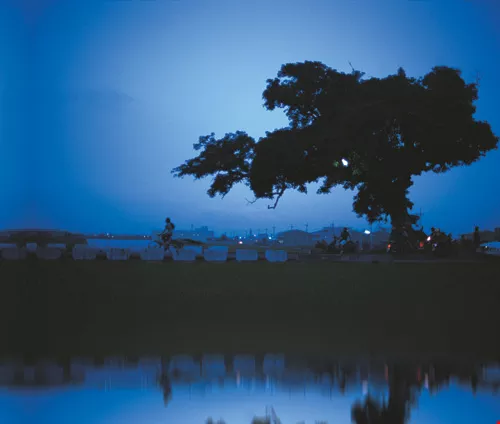
This century-old autumn maple, known as the Sanchun Tree, is one of the first things people recognize from Huatan.
Taiwan's aquacultural heart
Huatan's fish farms, many over 200 years old, are another of the distinctive features of the town. The area was once central Taiwan's main aquacultural center, with all kinds of fish being raised there. Traders would come from around the island to strike deals with the local farmers, who did double duty as their own wholesalers. For a while, trade was brisk, but over recent decades the industry has been on the decline, and is now of little real note. Already it seems like people are forgetting this important part of Taiwan's history.
The growth of this particular style of aquaculture can be traced back to the Qing dynasty-the mid 1800s, to be more specific. This was Taiwan's first really prosperous time, and cross-strait trade was commonplace. Traders from Chaozhou and Shantou on the mainland would often travel to Taiwan to buy rice and tea, bringing along with them fish from their home areas.
These trading ships would head to Lukang to do their business, and the merchants aboard started to seek out places in the area with similar water quality to their mainland homes so they could start raising fish there. Eventually they hit upon the nutrient-rich natural springs at the base of Mt. Pakua-at the village of Huatan, more exactly-and it was here they chose to start their aquacultural business.
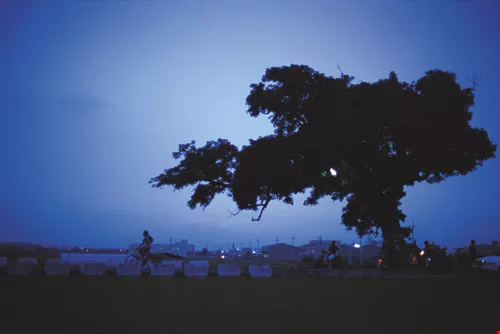
This century-old autumn maple, known as the Sanchun Tree, is one of the first things people recognize from Huatan.
Turtle power
At the peak of the aquaculture business, most Taiwanese were fairly strapped for cash, so the farmers would mostly raise cheap fish like grass carp and silver carp to sell as food. Once people started to get a bit more disposable income, their tastes in food and drink grew richer too, and other higher-priced fish like milkfish and rockfish became the norm. More fish farms started popping up, eventually driving the industry into decline.
At its largest, the industry was made up of about two dozen farms, but of those only seven or eight remain, most of which raise purely ornamental fish and sell them to stallholders in night markets. These fish don't fetch a particularly high price, and so once again the industry is facing the need for reform. Martin Chiang, head of the Mt. Pakua Cultural Association, believes that the industry's best bet for survival is tourism.
The ponds in these fish farms have been handed down from parent to child, with many having gone through four or five generations. Li Yi-shui and his wife run one farm, still following the classical methods of farming, which still turns a decent profit. Mrs. Li, who is now in her 50s or 60s, is in charge of the farm; she rears both ornamental fish and edible fish, but her biggest seller is turtles.
Turtle rearing has gone on in Taiwan since the Japanese occupation, and the techniques used are amongst the most refined in the world. The Li family have set aside a special turtle-rearing room in their farm, and on top of this one of Mrs. Li's daily duties is heading out to neighboring towns and villages to buy turtle eggs, some of which get shipped on to mainland China.
Turtle eggs aren't cheap-last year the market price for a single egg was NT$9, far more expensive than hen's eggs. This year, the price has risen another NT$3 or 4. There are a wide range of turtle-based products, says Chiang-turtle blood and eggshells can be ground into a powder and made into chewable calcium; and pickling turtle eggs in kaoliang liquor results in a traditional medicinal drink reputed to be quite potent. Some Chinese merchants will buy turtle eggs specifically to make that liquor, and then sell it on to the Japanese, who are big fans of the drink. Mrs. Li started brewing the drink herself about two years ago, and is hoping to build up a good trade in it once she gets the packaging all sorted out.
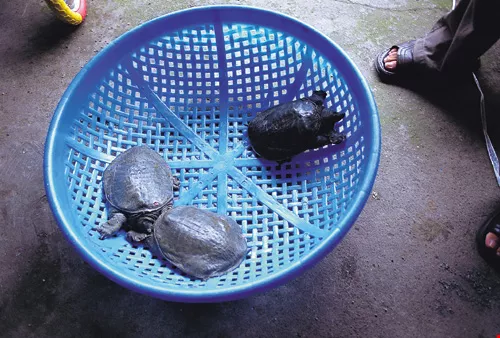
Taiwan is a world leader in raising turtles, which are becoming a new favorite food for their purported health benefits.
Avian paradise
Thanks to the tourist trade being encouraged by the Mt. Pakua Cultural Association-set up by Martin Chiang-the aquaculture industry of Huatan has been given a new lease on life. Many local figures have lent their support to this effort, not least 87-year-old Chen Chin-chiang.
Mr. Chen has lived in Huatan all his life, so aquaculture was always going to be part of his life. Seeing the industry on the decline hurt him deeply, and when he heard about the Cultural Association's plan to try and revive it, he leapt straight in, despite not quite getting the idea himself. After reflecting on the current situation-all his children and grandchildren had moved elsewhere to work in other industries, so there would be no-one to carry on the tradition-he decided to devote himself to trying to help rebuild the old farms and give them a second shot at life.
When they were just getting things going, they realized that the old fish farms didn't necessarily have to be used just for fish rearing. Many of the old ponds had fallen into disrepair and been overrun by water hyacinths, which had the unexpected bonus of making the farms havens for all kinds of birds. As Chiang says, most fish farms have about 20 to 30 ponds all linked together, which made these old ponds the largest inland marshes in Taiwan. Be it dawn or dusk, there is a huge range of birds to be seen in these old farms, including kingfishers, black-crowned night-herons, pheasant-tailed jacanas, white wagtails, ruddy kingfishers, and sandpipers. These birds have brought life back to these once-dead farms. All that remains now is for Chiang and company to successfully integrate this with the rest of the tourism industry in the area.
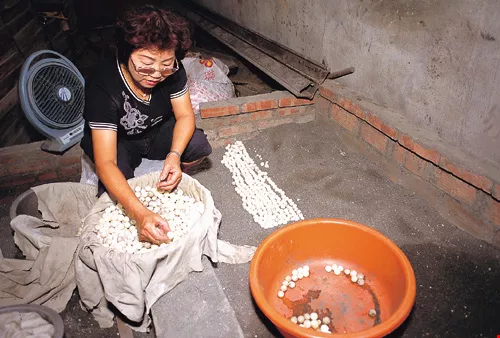
Turtle eggs fetch an excellent price, and have become the main product of Huatan's fish farms in recent years.
The red clay of Mt. Pakua
The story of these fish farms is like a microcosm of Huatan itself. But the town's story doesn't stop here; looking into the distance, you can see chimney after chimney around Huatan. Each chimney is from a kiln, and each is one of the last traces of a once bustling brick-firing industry.
Two requirements for a good brick are that it looks good and is rock-solid; Mt. Pakua's clay has the necessary level of cohesiveness and has few impurities, making it perfect for brickmaking. High iron levels in the clay give the bricks a beautiful reddish color while adding to their overall hardness.
In the early days of the building industry in Taiwan, discriminating builders would ask for Huatan brick specifically. But with the advent of reinforced concrete, the demand for bricks dropped off. This was exacerbated by the growth in interest in environmental conservation, and to protect the area's soil and water resources, excavation at Mt. Pakua was scaled back, forcing kiln after kiln to shut its doors.
Chiaotou Village in Huatan is a perfect illustration of this decline: at the industry's peak, Chiaotou was home to 30 or 40 kilns. Gradually this dropped to 17, and now there are no more than five kilns still in business there.
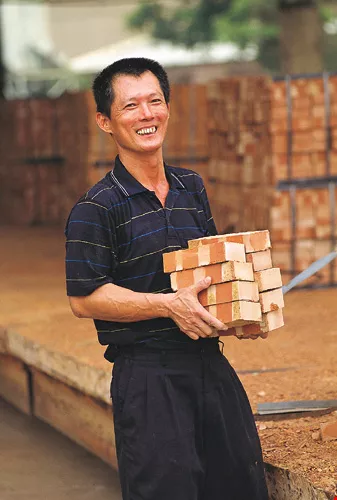
The town of Huatan is bringing together the local people and transforming their traditional brick kilns to focus on more artistic and cultural production. This photo shows Chang Cheng-yuen, owner of the Shun-ta kiln.
Brickmaking makes a comeback
Liao Chang-o is a second-generation brickmaker, and the Liao family kiln and factory cover a total of two hectares. In the tunnel-like building, tracks are laid out to help move around the masses of bricks produced there. In its day, the Liao kiln would produce over 200,000 bricks a day, selling consistently at just under NT$1.5 per brick for years. Each year, production numbers have dropped, and it concerns Liao to see such a big kiln sitting largely empty.
Four years ago, the Changhua County Cultural Affairs Bureau proposed a plan to revitalize the industry, hoping to revive the area's old brickmaking culture. They sought out Liao's help with the plan, and she threw herself into it completely, converting the old factory to focus more on artistic and cultural creations than simple utilitarian bricks. She started working with local schools, taking groups of students through on tours to teach them about the cultural importance of brickmaking, and now, after several years of hard work, they're finally managing to bring in over 1000 visitors a year.
Liao couldn't quite believe it when the Cultural Affairs Bureau first laid out their plan; she'd never really thought of brickmaking as "cultural," let alone artistic. So to help her get a better idea of what she needed to do, she visited artistic brickwork studios throughout central Taiwan, and found that brickwork as an art form actually has a long history. In the old days, the wealthy regarded artistic brickwork, and wood and stone carvings, as ways to decorate their houses and flaunt their wealth. The last two have stayed as large parts of local culture, but brickwork somehow fell out of favor, and so Liao set herself to reviving brickworking as a living part of the culture.
As far as Liao is concerned, bricks are a very fundamental part of the culture-when the terracotta warriors and horses were discovered in the tombs in Xi'an, the bases were found to have been made of brick, indicating that brickmaking was already fully fledged as far back as the Qin dynasty. In Taiwan, other examples of traditional brickwork can be found in the Presidential Palace and several ancient temple sites around the country, many of which are entirely built of brick. Although bricks have been used in a broad variety of places and ways, most people have at best a patchy understanding of them. Now, through educational tours and hands-on demonstrations, more and more people are learning about the art of making ornamental bricks and bringing new innovation to it, as well as opening new lines for passing down the traditions. Both of these are major achievements.
The Huatan Township Office has worked hard to promote traditional industries in the township, and chief secretary Lu Chien-san believes this could have extra benefits beyond the obvious continuation of tradition. Local parks, sidewalks, walls and fences, and building facades could all benefit from the aesthetic appeal of specially created bricks, while also giving the whole town a more modern air. This is part of the reason that Liao's husband Chang Cheng-yuen decided to get involved in the brickmaking industry, even though he never had any contact with it as a child. In fact, Chang has developed a repertoire of over 70 different styles of brick, and his exquisite workmanship has even attracted clients like McDonald's, who contracted him to build the local outlet a pond and a set of brickwork golden arches. Having such a major company recognise their work has encouraged Liao and Chang immensely.
Things are looking bright for the future of Huatan. Whether it's developing new jasmine-based products, the revival of the aquaculture industry, or the local brickmaking industry's comeback, the traditional industries of Huatan, that were once in such dire straits, are looking at a wonderful future.
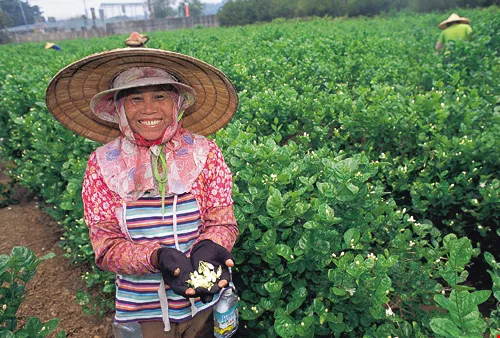
The so-called "June snow"-a sea of jasmine flowers.
A Brief Guide to Huatan
The township of Huatan was originally known as Qiedongjiao, or "autumn maple village," after the stand of trees by the original settlement. It kept this name until the Japanese occupation of Taiwan, when a Japanese prince stopped at the town on a tour. When the train pulled in and he heard the name of the town announced, he misheard the Japanese pronunciation of the name, Kadankyaku, as kadoukyaku, or "low-class passenger." Displeased, he declared that the name was to be shortened to Kadan, and written with different characters. The new name translated to "flowerbed"-huatan in Chinese.
The town itself covers an area of 36.3 square kilometers, and has a population of over 40,000. Its main products are red bricks, plastic products, and leather goods. The fish farms of nearby Paishakang were once the center for aquaculture in central Taiwan. Huatan also has a reputation as a "jasmine paradise," and is home to the largest jasmine gardens in Taiwan.
Until recently, the town's main industries had been in decline, but under the leadership of current mayor Tseng Wen-hsun, they have been undergoing a revival, becoming the centerpiece of the town's efforts to encourage tourism, and also firing up a brilliant creative industry in the form of the town's artistic bricks.
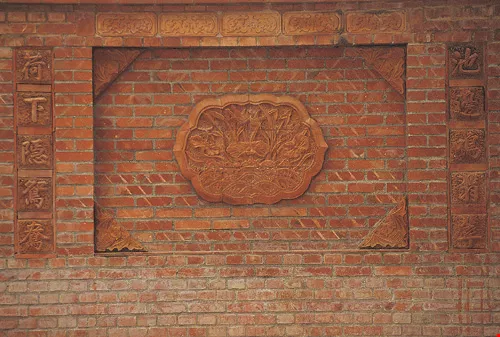
Huatan's bricks are known far and wide, and the new spin on their production has given the industry new hope.
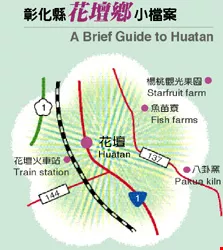
A Brief Guide to Huatan
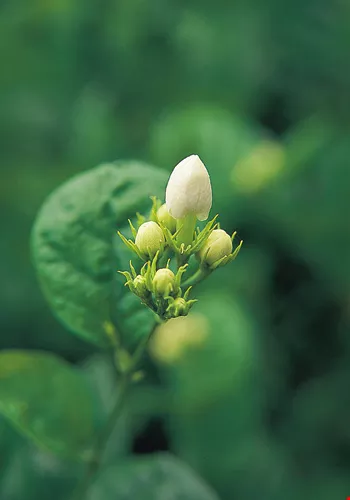
Huatan has the world's largest jasmine gardens. The buds from the flowers are used in the making of scented tea.
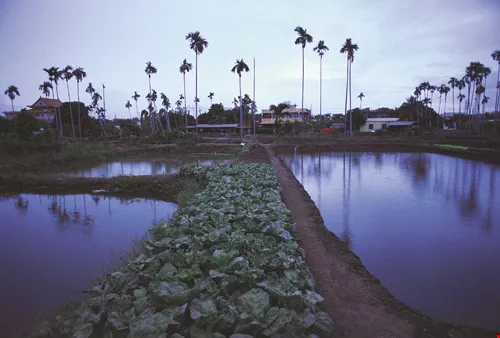
Huatan's unassuming exterior belies the new vitality of its industries.


@List.jpg?w=522&h=410&mode=crop&format=webp&quality=80)


