Travel with a Purpose: Young Taiwanese Seek to Meet 100 World Leaders
Polly Peng / photos courtesy of W.island / tr. by Robert Taylor
January 2015
“If I had the opportunity to interview Jamie Oliver,” says 20-year-old Wu Chen-yu, a third-year undergraduate student in the School of Pharmacy at China Medical University, she would ask this world-class chef: “Do you like the taste of mango?” Then Wu would present Oliver with the following menu: “Beginning of Spring, Rain Water, Waking of Insects, Vernal Equinox, Pure Brightness, Grain Rain, Beginning of Summer, Grain Full, Grain in Ear, Summer Solstice, Slight Heat, Great Heat, Beginning of Autumn, Limit of Heat, White Dew, Autumnal Equinox, Cold Dew, Frost’s Descent, Beginning of Winter, Slight Snow, Great Snow, Winter Solstice, Slight Cold, Great Cold.” She hopes to share with Jamie Oliver the tastes of Taiwanese foods corresponding to each of the 24 “Solar Terms” of the traditional Chinese calendar.
These words of Wu’s were what persuaded the judges to choose her, from among many contestants, to have the opportunity to interview Jamie Oliver in the 2014 edition of the “Travel with a Purpose” program, organized by W.island.
W.island is an organization whose core aim is to enable the people of Taiwan to become “citizens of the world.” W.island’s “Travel with a Purpose” program attempts to loosen the structural bonds created by Taiwan’s education, media and political systems. Each year W.island announces a theme, and selects young travelers aged 20–26 to complete a mission in accordance with that year’s theme. Travel with a Purpose was set up by W.island chairman Sean Lu and a group of like-minded people, including Shih Chin-tay, who is Morris Chang Chair Professor at National Tsing Hua University; Johnsee Lee, then chairman of the Development Center for Biotechnology; Wu Yan-hwa, president of National Chiao Tung University; and Tsay Ching-yen, chairman of the Industrial Technology Research Institute. Lu explains that the core idea behind the program is that “at age 20, a person should have the ability to travel alone anywhere in the world; at 30, they should be equipped to seek employment in any country in the world; and at 40, they need to be able to understand world trends, to take advantage of them, and even to shape them.” They conceived the program as the most direct method of educating young people to have a global perspective.
In 2011, the first year of the program, 1000 students from 104 institutes of higher education each presented a travel plan, and finally ten young travelers were selected to each receive the cost of a return air ticket to enable them to visit their chosen location anywhere in the world. “This was the beginning of these kids’ encounter with the world. You could call it a coming-of-age present,” says Sean Lu. He explains that apart from the return airfares, the young travelers had to find their own funds to cover their expenses at their destinations, and had to organize all the details of their trips, including accommodation and food, for themselves. Most importantly, each of them had to complete the mission that they had originally stated in their travel plans. In this way they would learn to take responsibility, and to keep their promises.
In the second event, in 2012, W.island sent out 129 travelers to the countries allowing visa-free entry for tourist visitors from Taiwan. During their trips, whenever they got the time and the opportunity these young travelers would send back photographs and descriptions of what they had experienced on their travels. On seeing the photos sent back by Taiwanese kids from places such as Sweden, Finland, the Faroe Islands, the Seychelles, Mozambique, the Gambia, Fiji, or Brazil, Sean Lu recounts, “many people were thrilled to their very souls, and they asked me whether Taiwanese kids really had gone to every one of these 129 countries.” The answer was yes: not only had they gone to all of them, but they had all come back again, “to tell their friends about the stimulation and excitement they had experienced in different parts of the world.”

W.island’s fourth “Travel with a Purpose” program comprises ten themes, including “emergence” and “education.”
Starting in the third year of the program, W.island arranged for each traveler, after completing their mission, to return to the senior high school from which they had graduated and use the weekly school assembly to share the experience of their journey with all of the school’s students. W.island also invited director Lin Cheng-sheng to put together a film crew that followed ten of the travelers to make a documentary film, provisionally titled W.island: Travel with a Purpose. “This is Taiwan’s first documentary film to be shot in ten countries,” says Lin. “This journey was an epic story of young travelers going out into the world, and our record of it is also a new departure in Taiwanese documentary film.” He reports that with shooting complete, the film is currently in postproduction, and should reach screens by the autumn of 2015.
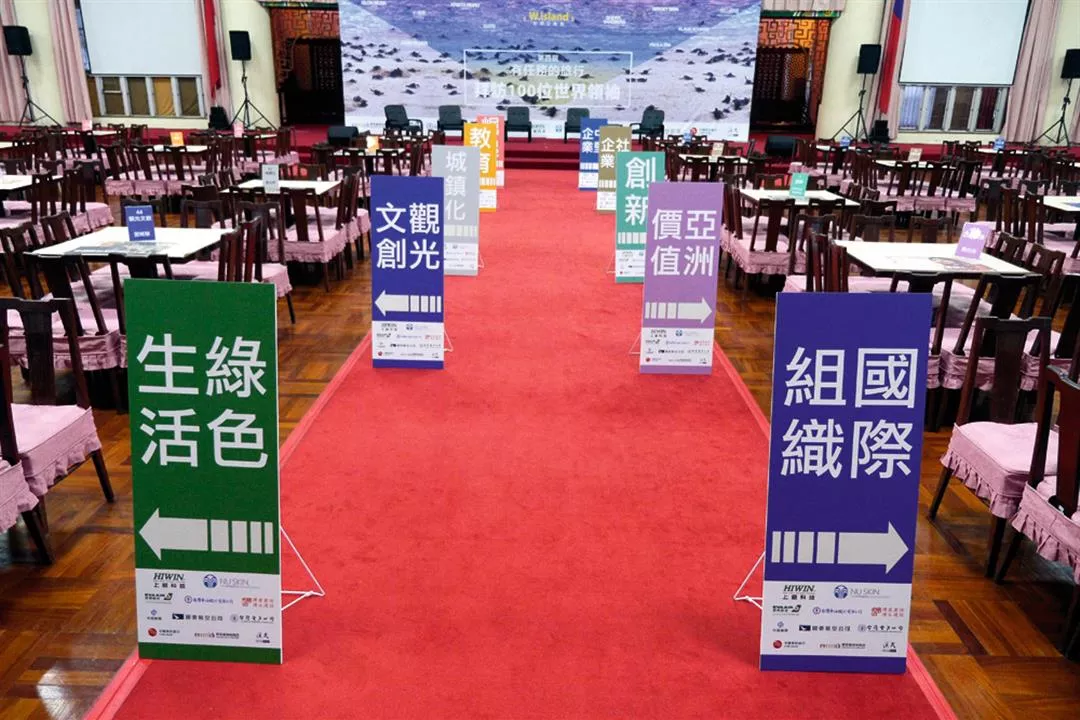
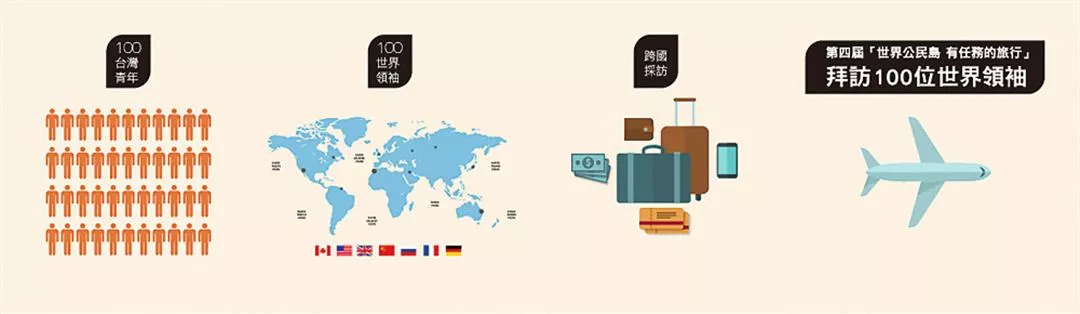
In 2014, the fourth year of Travel with a Purpose, the bar was set even higher: the challenge set for the selected travelers was to visit 100 individuals who are world leaders in their fields. The personalities to be visited were categorized into ten fields: “emergence,” “innovation,” “education and human resources,” “social enterprises,” “Mittelstand enterprises,” “tourism and the creative and cultural industries,” “Asian values,” “international organizations,” “green living,” and “urbanization.” These leaders include—in addition to Jamie Oliver—South Korean president Park Geun-hye; Japanese animated film director Hayao Miyazaki; Burmese democracy leader Aung San Suu Kyi; Alibaba Group executive chairman Jack Ma; 2014 Nobel Peace Prize laureate Malala Yousafzai; Radiohead lead singer Thom Yorke; Google founder Sergey Brin; Simone Peter, co-chair of the German political party Alliance ’90/The Greens; Wadah Khanfar, former director general of the Al Jazeera Media Network; Huffington Post founder Arianna Huffington; Amancio Ortega, founder of the Inditex fashion group, which includes the Zara retail chain; Hollywood director Steven Spielberg, and so on—100 names including some who are so reclusive or unapproachable that many regard the task as “mission impossible.” “Why impossible?” counters Sean Lu: “Whatever you have the courage to imagine, it is possible to achieve.”

Taiwan’s largest ever program of visits to world leaders is about to get underway.
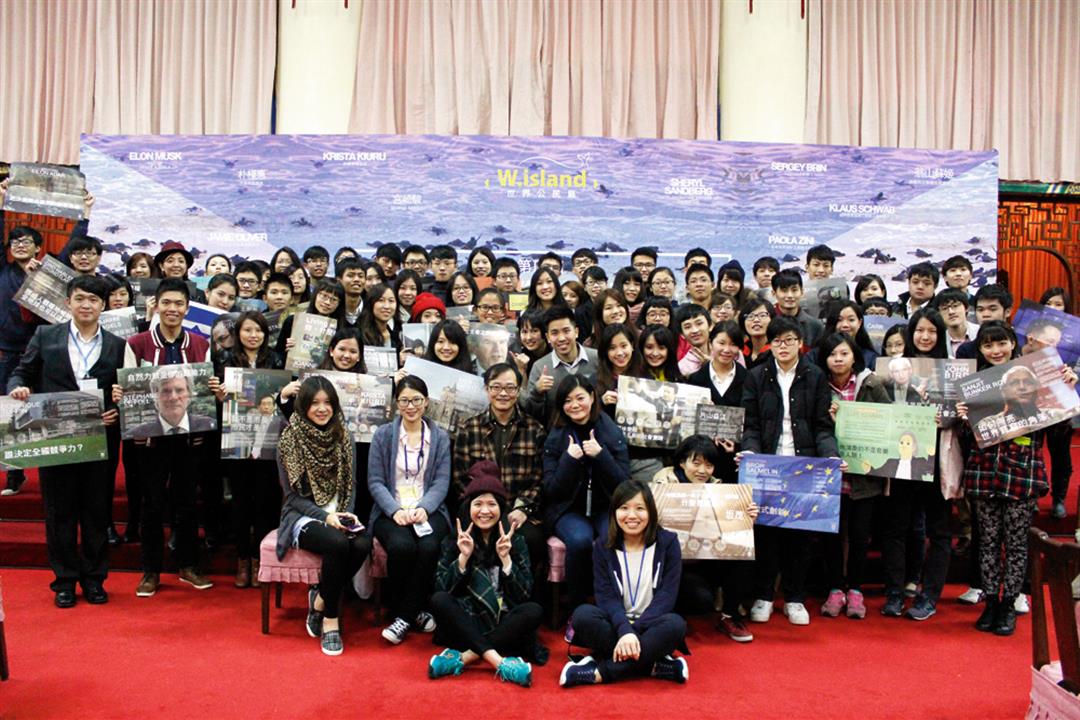
Following the initial selection, more than 400 competitors entered the elimination round, held on 21 December 2014. W.island invited scholars and experts from around Taiwan to act as “guides.” Young people wanting to visit a particular world leader, whether as an individual or as a group, submitted a travel plan to the guides responsible for the relevant field of endeavor, and at the competition venue each person or group was given seven minutes to describe their travel plans. After the scores were calculated, 62 young travelers were selected.
Having a list of world leaders to visit does not mean that things will necessarily go as one wishes. After all, if these people deserve to be called world leaders, they are sure to have a very full schedule. Without a good enough reason, why would they agree to be interviewed by a young person from Taiwan? On this point, Sean Lu explains that on the one hand the travel plans that the travelers put forward need to be highly appealing, and on the other they need to use “contacts” to best effect. Among the many Taiwanese located in places all over the world, some may have connections with a world leader in their particular location. If they are willing to help out, in a spirit of generosity, then there is a chance that by following the threads of these many interpersonal relationships, the young people may succeed in making their visits. Sean Lu describes this “networking” as a process of “gathering strength for Taiwan.”
We live increasingly in a “small world,” a phenomenon investigated by scholars such as Harvard psychology professor Stanley Milgram. Every person is like a node in a spider’s web, with each node connected to the nodes around it, finally forming a world network of personal contacts. This notion has gained currency in the concept of “six degrees of separation,” which suggests that every person in the world is connected to every other through a chain of no more than six personal acquaintances. That is to say, one needs to go through no more than six people to get into contact with any other person in the world. In 2008, a researcher used Facebook traffic data to show that the average separation between any two users was 5.73 degrees; three years later, the average separation between two Facebook users anywhere in the world had fallen to 4.74 degrees. One might say that these findings give some degree of support to W.island’s plan for young people to interview 100 world leaders. Sean Lu first invited the 100 Taiwanese academics and experts who are acting as guides, to each provide the names of five international personalities in various fields whom they are able to contact. From among them, the W.island team can then identify those who may have connections to the 100 targeted world leaders. In this way they will cast their first net in the search for contacts. “Then we repeat the process. You know A, A knows B…, and in the end you will find the opportunity to contact a key person who will enable your visit to a world leader to become a reality.” The young travelers themselves are also required to propose their own plans for contacting the persons concerned.
Stepping out of one’s comfort zoneOf course, this process requires boundless zeal and patience. Shih Chin-tay says that both when he was growing up, and in the course of his career, he has met many life mentors, without whose selfless contributions he would have been most unlikely to have got where he is today. Now he wants to pay it forward, so he is willing to do his utmost to create opportunities for young Taiwanese that will help them grow. “I’ve watched Travel with a Purpose through its first three years, and I want to say that when these youngsters come back from their journeys, they really have changed completely. So I want to tell young people: Go out into the world and take a look around. It will broaden your mind and you will come back with a different perspective.”
The plans for visiting world leaders put forward by the winning young travelers are indeed highly creative. For example, Zeng Bozhang, a student in his seventh year of study at Kaohsiung Medical University, currently doing his hospital internship, wishes to visit Aung San Suu Kyi. He forms a “hyperlink” between the space in which Aung San Suu Kyi was confined for 15 years under house arrest, and the hospitals in which he will practice medicine in the future, “because a place of imprisonment and a hospital ward are two places where human character is laid most bare.” Xu Ruifu, a student in the Department of Electrical Engineering at National Taiwan University, and some of his classmates, have formed a group to visit Sergey Brin. For his generation, he says, Google seems as omniscient as a god. “We will put together ten questions that even Google cannot answer, to interview Sergey Brin.”
“Just imagine the scene of young Taiwanese scholars in dialogue with Aung San Suu Kyi about democracy, or with Steven Spielberg about creativity!” Sean Lu is enthused by the prospect. Of course, many challenges undoubtedly lie ahead, from the large ones, such as how to persuade these world leaders to accept visits from young Taiwanese, down to the small ones, such as dealing with the details of life while traveling, and how to raise enough funds for the journey. One of the guides for this year’s journeys, Professor Lin Chung-i of the philosophy department at National Chengchi University, offered these words of encouragement to the selected young travelers: “When it comes down to it, travel is a process of taking yourself out of your comfort zone.” Another guide, the famous social trend observer Chan Wei-hsiung, said: “Just go! Because the biggest freedom in this world comes when you find the courage to visit the places that you fear, and you return renewed by the difficulties you have overcome.”