Addressing Social Problems with Architecture: Pai Hsi-min
Andre Huang / photos Wang Meng-hsiao / tr. by Phil Newell
February 2008


When Tunghai University was es-tablished in the 1950s it was as prestigious as National Taiwan University, and most of its students, like those of NTU, went abroad for further education after they graduated. In those days, when most people in Taiwan had to struggle just to make ends meet, architecture, requiring large investments of capital, had little room for development.
In the 1970s when the economy took off, there were a series of speculative booms in the construction industry, but sadly, most of the work was as crudely done as before. The new houses and buildings all looked exactly the same; to maximize profits, open public spaces and facilities were cut out; the quality of construction work and materials remained poor; and interior designs were awkward and poorly conceived. The quality of life was sacrificed to speculative gain.
Faced with this situation, a "Tunghai Architecture Gang," led by Pai Hsi-min, decided to take what they had learned and make a difference in society.
Birth of the Tunghai Gang
Pai Hsi-min, now 56, graduated from the Tunghai Department of Architecture in 1977, at a time when the entire school only had some 2000 students. Pai recalls: "The whole program at Tunghai was very strong, but what influenced me most was Professor Han Pao-teh. I will always remember what he told us: You have to seek out the problems in society, analyze them to get to their basic nature, and then use architecture to provide solutions and lead the way toward a more progressive situation." Under Han's influence, graduates back then often did their graduation projects on reconstruction of farming or fishing communities, or on designing living space for disadvantaged persons such as the deaf.
Pai, nicknamed "the Chairman," gathered together a group of classmates and they made an analysis of the shambles that was Taichung's real estate market, drawing attention to the fact that the slipshod construction culture created by speculative building, which put a premium on speed, was actually causing people to feel more and more estranged from each other. They even drew on the rural construction concepts of Y.C. (James) Yen, a leader in the movement to offer education to ordinary and poor people in the early Republican era. Their goal was to recreate a sense of community and rebuild neighborly relationships through architecture. At the same time, based on their experience working in the real estate industry, they set their sights on the newly rising middle class, which was more open to new ideas.
When Tunghai University was es-tablished in the 1950s it was as prestigious as National Taiwan University, and most of its students, like those of NTU, went abroad for further education after they graduated. In those days, when most people in Taiwan had to struggle just to make ends meet, architecture, requiring large investments of capital, had little room for development.
In the 1970s when the economy took off, there were a series of speculative booms in the construction industry, but sadly, most of the work was as crudely done as before. The new houses and buildings all looked exactly the same; to maximize profits, open public spaces and facilities were cut out; the quality of construction work and materials remained poor; and interior designs were awkward and poorly conceived. The quality of life was sacrificed to speculative gain.
Faced with this situation, a "Tunghai Architecture Gang," led by Pai Hsi-min, decided to take what they had learned and make a difference in society.
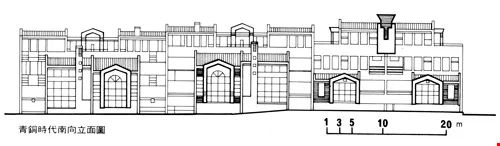
Guided by their ideals, they completed a number of construction plans, one of which was "Tang Village." It was an intriguing challenge for them to adopt the spatial layout of a core element of traditional Chinese culture, the "Tang village." Chen Yung-sung, who took part in the project, recalls that given the rectangular shape of the land where Tang Village was to be built, the usual design would have been two parallel rows of long, narrow structures set back-to-back, divided by only a narrow lane. But that would have generated little natural interaction between residents, so they arranged for the homes to intersect spatially. They came up with the idea to make irregular buildings that surround connected squares of public space, thereby creating community commons. Moreover, each neighborhood included units of widely varying price ranges, symbolizing the ideal of the integration of different social strata.
These landmarks of Taichung architecture in the 1980s not only sold very well, they were among the very few designs combining commercial and residential space to be honored with a prize from Taiwan Architect Magazine.
Building Utopia
Another example is the "Utopia" community of Mt. Tatu, also considered a classic of early community redevelopment in Taiwan. The site was originally just wasteland, but during the building rush of the 1970s thousands of densely packed residential units were erected there. However, because of the poor quality of the construction, many units went unsold and many others were eventually abandoned by their owners, leaving the site with little but derelict concrete shells. Faced with this situation, Pai Hsi-min declared, "If all of us here with our knowledge and training can't rescue even this one community, then how can we talk about reforming the whole society?"
There's nothing more difficult in a project than getting the ball rolling, and the founders of the Tunghai Architecture Gang had to handle every aspect on their own. In addition to basic planning, design, and construction, they had to manage the buying and selling of land, installation of hardware and software for the whole community, sales of units, advertising and marketing, and so on. Their success is testimony to the effectiveness of their many years of multi-disciplinary training.
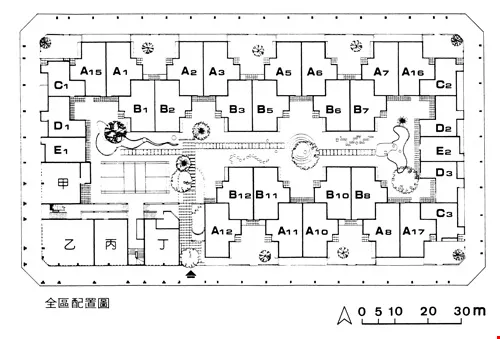
Abandoning the tradition of two parallel rows of back-to-back structures and instead using communal park space to encourage interaction among neighbors, "Tang Village," completed in 1984, was a bold experiment that has had a far-reaching effect on community redevelopment in Taiwan.
Birth of the Tunghai Gang
Pai Hsi-min, now 56, graduated from the Tunghai Department of Architecture in 1977, at a time when the entire school only had some 2000 students. Pai recalls: "The whole program at Tunghai was very strong, but what influenced me most was Professor Han Pao-teh. I will always remember what he told us: You have to seek out the problems in society, analyze them to get to their basic nature, and then use architecture to provide solutions and lead the way toward a more progressive situation." Under Han's influence, graduates back then often did their graduation projects on reconstruction of farming or fishing communities, or on designing living space for disadvantaged persons such as the deaf.
Pai, nicknamed "the Chairman," gathered together a group of classmates and they made an analysis of the shambles that was Taichung's real estate market, drawing attention to the fact that the slipshod construction culture created by speculative building, which put a premium on speed, was actually causing people to feel more and more estranged from each other. They even drew on the rural construction concepts of Y.C. (James) Yen, a leader in the movement to offer education to ordinary and poor people in the early Republican era. Their goal was to recreate a sense of community and rebuild neighborly relationships through architecture. At the same time, based on their experience working in the real estate industry, they set their sights on the newly rising middle class, which was more open to new ideas.
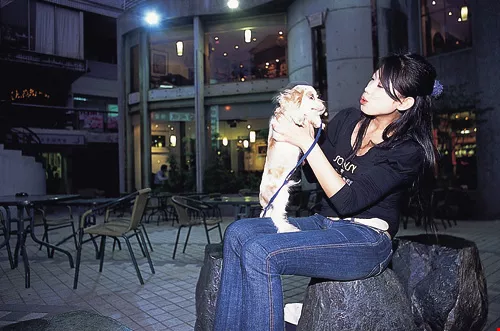
The Utopia community, created out of the derelict abandoned concrete shells of a failed earlier development, has become one of the best-known spots in Taichung for its art shops. The photo at left shows part of Corbusier Square in the community.
In the process, they pioneered the then little-known approach of "total community redevelopment." This included everything from planning for the routine needs of daily life to forming a street of shops devoted to arts and culture, to the "community celebration" that would require the collective labor of all the residents. They successfully transformed this declining area into an organic whole with a superior living environment, a strong degree of collective identification among residents, and a certain degree of economic self-sufficiency, and it was named by the Council for Cultural Affairs in 1996 as a model of redevelopment. Although Pai's team gradually withdrew from the project because of lack of funding, the community was by then able to function on its own, and it remains a major draw for visitors who want to browse the shops or just experience the neighborhood.
This attempt to integrate economic and cultural power through spatial design and community organization was an idealistic experiment far ahead of its time in 1980s Taiwan. The fact that community redevelopment has become a catchphrase all over Taiwan since then is evidence of the genuinely creative character of that generation of Tunghai architects.
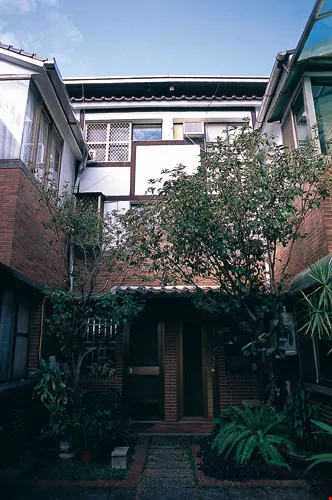
Abandoning the tradition of two parallel rows of back-to-back structures and instead using communal park space to encourage interaction among neighbors, "Tang Village," completed in 1984, was a bold experiment that has had a far-reaching effect on community redevelopment in Taiwan.
Guided by their ideals, they completed a number of construction plans, one of which was "Tang Village." It was an intriguing challenge for them to adopt the spatial layout of a core element of traditional Chinese culture, the "Tang village." Chen Yung-sung, who took part in the project, recalls that given the rectangular shape of the land where Tang Village was to be built, the usual design would have been two parallel rows of long, narrow structures set back-to-back, divided by only a narrow lane. But that would have generated little natural interaction between residents, so they arranged for the homes to intersect spatially. They came up with the idea to make irregular buildings that surround connected squares of public space, thereby creating community commons. Moreover, each neighborhood included units of widely varying price ranges, symbolizing the ideal of the integration of different social strata.
These landmarks of Taichung architecture in the 1980s not only sold very well, they were among the very few designs combining commercial and residential space to be honored with a prize from Taiwan Architect Magazine.
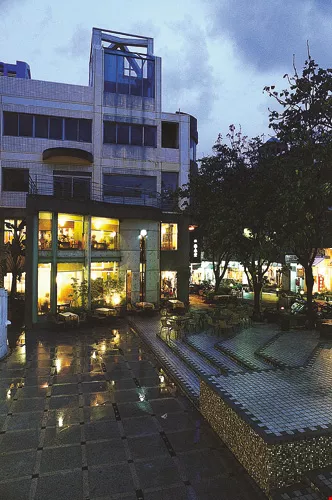
The Utopia community, created out of the derelict abandoned concrete shells of a failed earlier development, has become one of the best-known spots in Taichung for its art shops. The photo at left shows part of Corbusier Square in the community.
Pai-Hsi-min
Graduated from the Department of Architecture at Tunghai University in 1977; best-known for bringing architectural concepts into community redevelopment in Taiwan. Representative works include Jung (Banyan) Village, Tang Village, and the Utopia community (all in Taichung), as well as Fukuei Village and the Changweiliao community (both in Nantou). Awards include an Architecture Magazine award and a prize from the Council for Economic Planning and Development for community redevelopment.
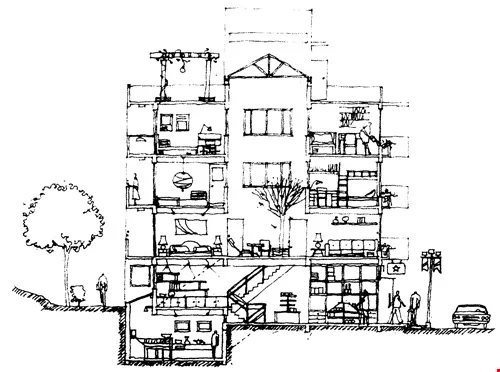
Abandoning the tradition of two parallel rows of back-to-back structures and instead using communal park space to encourage interaction among neighbors, "Tang Village," completed in 1984, was a bold experiment that has had a far-reaching effect on community redevelopment in Taiwan.
Building Utopia
Another example is the "Utopia" community of Mt. Tatu, also considered a classic of early community redevelopment in Taiwan. The site was originally just wasteland, but during the building rush of the 1970s thousands of densely packed residential units were erected there. However, because of the poor quality of the construction, many units went unsold and many others were eventually abandoned by their owners, leaving the site with little but derelict concrete shells. Faced with this situation, Pai Hsi-min declared, "If all of us here with our knowledge and training can't rescue even this one community, then how can we talk about reforming the whole society?"
There's nothing more difficult in a project than getting the ball rolling, and the founders of the Tunghai Architecture Gang had to handle every aspect on their own. In addition to basic planning, design, and construction, they had to manage the buying and selling of land, installation of hardware and software for the whole community, sales of units, advertising and marketing, and so on. Their success is testimony to the effectiveness of their many years of multi-disciplinary training.
In the process, they pioneered the then little-known approach of "total community redevelopment." This included everything from planning for the routine needs of daily life to forming a street of shops devoted to arts and culture, to the "community celebration" that would require the collective labor of all the residents. They successfully transformed this declining area into an organic whole with a superior living environment, a strong degree of collective identification among residents, and a certain degree of economic self-sufficiency, and it was named by the Council for Cultural Affairs in 1996 as a model of redevelopment. Although Pai's team gradually withdrew from the project because of lack of funding, the community was by then able to function on its own, and it remains a major draw for visitors who want to browse the shops or just experience the neighborhood.
This attempt to integrate economic and cultural power through spatial design and community organization was an idealistic experiment far ahead of its time in 1980s Taiwan. The fact that community redevelopment has become a catchphrase all over Taiwan since then is evidence of the genuinely creative character of that generation of Tunghai architects.

@List.jpg?w=522&h=410&mode=crop&format=webp&quality=80)


