

Ang Lee is back! The director returned to Taiwan on the eve of Mother’s Day, shortly after winning his second Oscar, this one for his direction of Life of Pi. Here to celebrate his mother’s 88th birthday, he was also honored by President Ma Ying-jeou with an Order of the Brilliant Star, first class.
Welcomed everywhere by film fans and the media, the amiable and accommodating Lee also took part in an international press conference and two symposia while he was here. A shy man, Lee speaks from the heart, his words bringing a warm, positive energy to Taiwan.
Lee’s dramatic career turnaround from struggling to celebrated artist makes for an exceptionally uplifting tale. The young Lee twice failed the university entrance exams and his father, a school principal, disapproved of his decision to study theater. A university student at one of the symposia touched on this history, mentioned that he too was struggling with apparent failure, and asked Lee’s advice on how to cope.
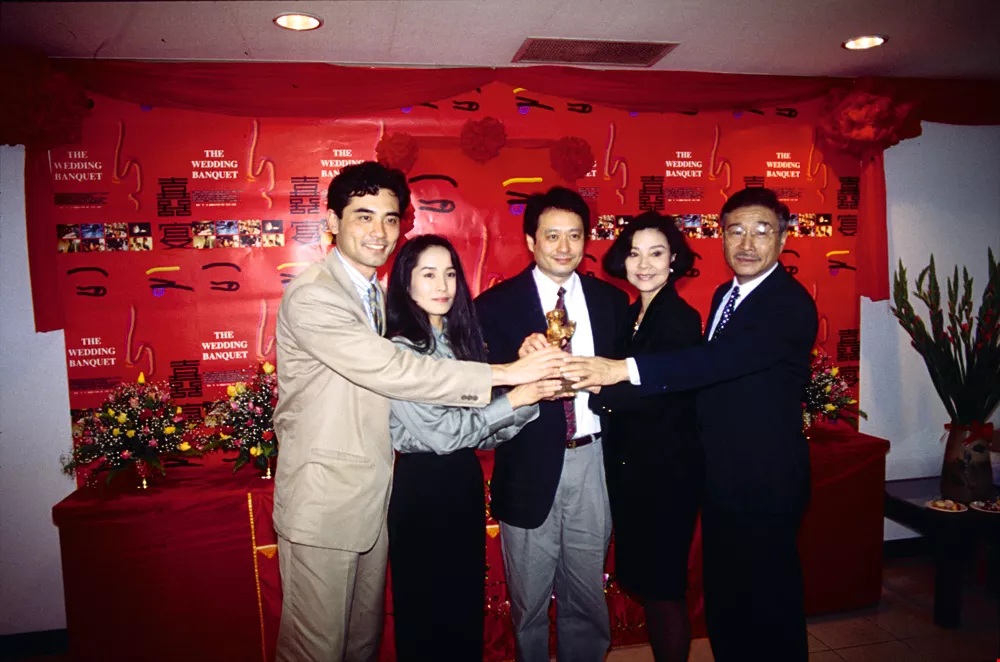
Lee smiles with his actors at a banquet welcoming them back to Taiwan after The Wedding Banquet (1993) earned a Golden Bear in Berlin.
Don’t let failure build momentum
“Frustration and failure can hone your character, but you don’t want too much. If you experience too much failure, it can become habitual and create a kind of [negative] momentum. Changing your fate comes down to the decisions you make at critical moments.”
Lee encouraged the youngster to figure out a way to overcome his sense of failure, and suggested that when he was feeling down, he should think about how to reorient himself towards success. Lee stressed the importance of making rational decisions at crucial moments, citing his decision to work with James Schamus, an independent New York producer, on his first film, Pushing Hands, as a case in point. Schamus’ help with the budget enabled Lee to get the film made for just US$400,000.
Lee’s father was born into a wealthy family in mainland China’s Jiangxi Province. An educator, he was principal of two renowned Tainan high schools and had high hopes for his son. Lee felt the burden of those expectations, but also saw his father as a role model in all things.
“If you look at the relationship from a Freudian perspective,” Lee told his audience, “the father has to fall for the son to rise. But I didn’t want my father to fall. Because I was afraid and I didn’t want to fight with him, I hid myself by moving far, far away.”
Leaving Taiwan freed Lee’s personality from its repression, and provided an outlet for his adventurous spirit.
Following the completion of his Chinese-language “father knows best” trilogy, Lee directed an adaptation of Jane Austen’s Victorian classic Sense and Sensibility, then Brokeback Mountain, a gay love story set in the American West of the 1960s. Intrigued by this diversity, a member of the international media asked why someone so steeped in the Confucian culture of East Asia would explore such a broad range of cultures in his films.
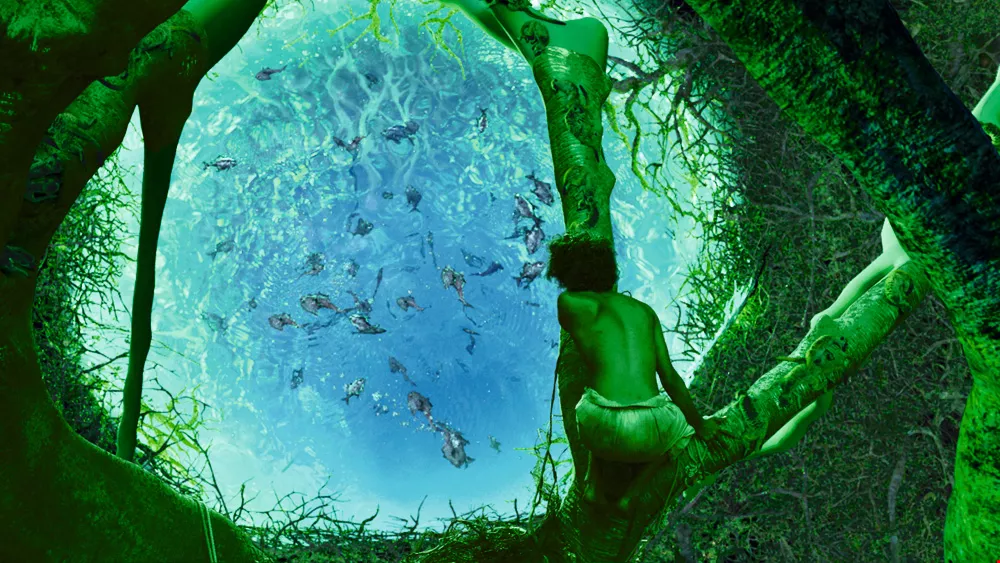
Lee had long wanted to shoot an art-house movie in 3D. His dream came true when he made much of Life of Pi in Taiwan. The film’s fantasy scenes have deep philosophical roots and helped generate box-office revenues that rank among the top 100 in film history.
Cultural transcendence
“It’s easy to film other cultures because you are so far removed from them,” answered Lee. “Lust, Caution was a killer because it pulled up and examined knotty [Chinese] cultural issues. It was an extremely uncomfortable film to make.”
Lee excels at blending Eastern and Western cultures, a skill he attributes to growing up in Taiwan, which has been subject to outside cultural influences for centuries. His childhood here, along with his early love of both Hollywood and Hong Kong movies, made cultural conflicts an integral part of his thought processes.
Lee added that he’s been an outsider living in the midst of cultural conflict all his life, noting that in Taiwan he’s a second-generation waisheng ren (waisheng ren are the mainland Chinese who immigrated to Taiwan after 1945), in the US he’s a foreigner, and in mainland China he’s a “Taiwanese compatriot.”
He also admits to having had to learn much while filming his English-language films. His English still wasn’t very good when he shot Sense and Sensibility. Faced with a cast that included the likes of Emma Thompson and Hugh Grant, his desire to do Taiwan and Asia proud became an almost unbearable burden.
He ended up asking the actors to draw their inspiration from nature, which resulted in wonderful, almost poetic scenes. The film ultimately won a Golden Bear at the Berlin International Film Festival and was lauded by the British Academy of Film and Television as one of the best examples of an Asian adaptation of Western material in the history of film.
Lee’s success with the film led to a string of movies in the West, culminating in his ninth picture, 2006’s Brokeback Mountain. It was only after the film earned him an Academy Award for best director that he acknowledged his own success and accepted he’d been meant to work in the movie industry.
But on returning to a more familiar cultural sphere in order to take on more difficult challenges, his anxiety returned.
“Lust, Caution touches on something that I was afraid to talk about, a sort of shared historical trauma. Though it didn’t feel right to tell this story, I felt that I had to. The film gave young people an opportunity to experience the atmosphere of those times, one that they wouldn’t otherwise have had.”
Lee has directed a wide variety of films over the course of his 22-year career, from art house to science fiction to martial arts. How does he balance the demands of art and commerce?
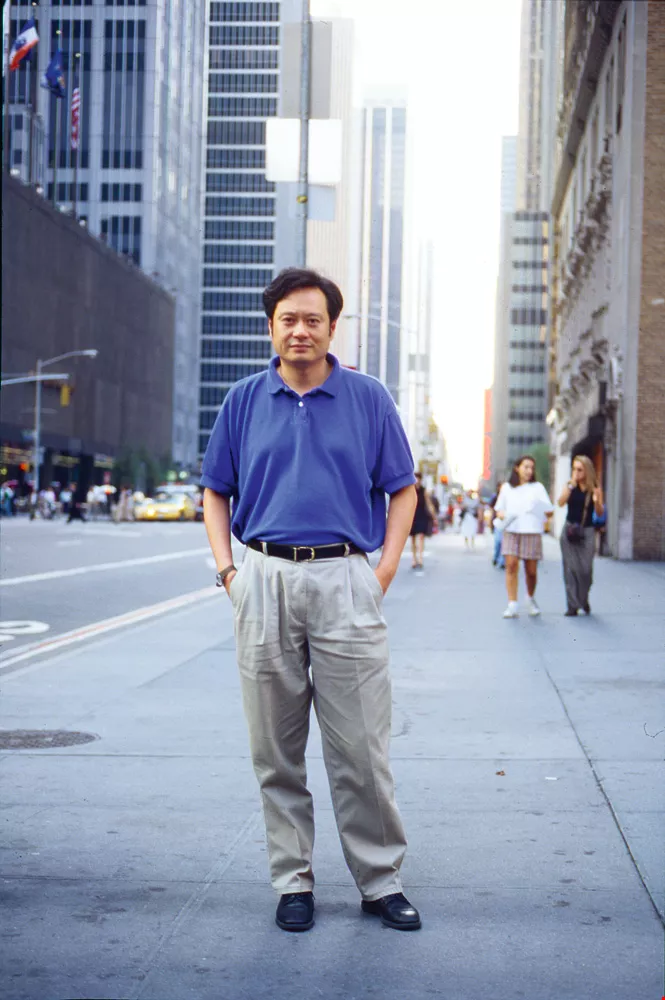
A long-term resident of the United States, Lee enjoys New York’s creative environment. The photo was taken in New York following the completion of The Ice Storm.
No formula
“I don’t have an answer to that. If there were a formula for making films, they’d never lose money.”
Lee notes that art and commerce are usually at opposite ends of the spectrum, and suggests that perhaps he’s just been lucky to make films that get good reviews and fill seats. But he also notes that not all of his films have made money.
Lee has had a number of films perform well at the box office, but neither Ride with the Devil nor Hulk sold many tickets. Fans who enjoyed Ride with the Devil sometimes ask why he developed the story from the standpoint of the Confederate army, the losing side in America’s Civil War.
“I identify with and feel great sympathy for losers,” says Lee. “Taiwan’s position in the international area is extremely tenuous, and I was disadvantaged when I went to the US.”
Lee explains that the American Civil War was a complex affair that involved more than the freeing of slaves. Ride with the Devil, which was adapted from a novel, uses a young man’s coming of age to examine the American expansion into the western half of the continent, in particular how that pioneering spirit transformed the American South and even the world.
When the film was released, many viewers were critical of the characters’ awkward English and odd accents. Lee says he and his team researched the Civil War for the film and he defends their language choices. He points out that Missouri, where the film was set, was a border region in those days, and home to many European immigrants. This immigrant population influenced the accent, which was a complex amalgam containing elements of German and Irish. He says his mistake was in failing to anticipate how unfamiliar it would be to modern American ears.
Lee jokes: “I’m a foreigner, so I understand very well why it failed at the box office: I’d told the story too well and Americans just couldn’t accept the truth. In 10 years or so, they may change their minds and decide it’s a good film after all.”
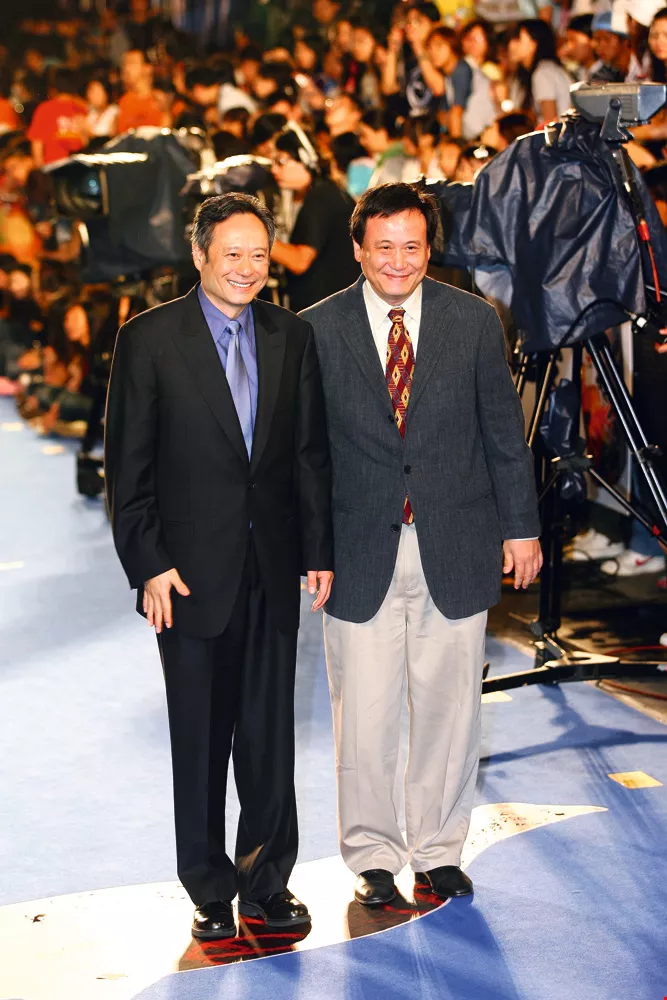
A frequent honored guest at the Golden Horse Film Awards, Lee attended the 42nd in the company of his younger brother Lee Gang.
Building a foundation
“Culture needs roots and it needs vision. It isn’t just an excuse for grandstanding. The biggest problem facing Taiwan’s film industry is the lack of a long-term strategy. [Right now] everyone’s battling on their own.”
Every time Lee returns to Taiwan, he’s asked how to get Taiwan’s film industry going, and how to attract foreign investment.
He argues that because films are a high-risk endeavor, you have to reassure investors. From that standpoint, tax breaks can function as an incentive. He offers Brokeback Mountain as an example. The film is set in Wyoming, but the production team chose to shoot it in Canada because the Canadian government offered tax credits and the scenery was similar enough to work.
New York similarly announced tax credits of 30% on film production costs incurred in the state before Lee began shooting Taking Woodstock. The incentive led to an explosion of filmmaking in the state. Lee argues that if Taiwan were to offer similar credits, many productions that might otherwise go to Japan would be shot in Taiwan instead.
Citing Life of Pi, Lee notes further that the film industry has long been global in nature. He explains that he’d decided to shoot the film in 3D even before Avatar was completed. Since Hollywood didn’t have the requisite experience, he chose to get the 3D ball rolling in Taiwan instead.
Lee was anxious that the 150 top-tier technical personnel he brought with him to Taiwan have a positive experience in his homeland. The crew ultimately worked here for nine months, finding or building 80% of the sets and boat-related props over the course of that time. Lee’s hope is that the endeavor has laid the foundations for a resurgence in the local film industry.
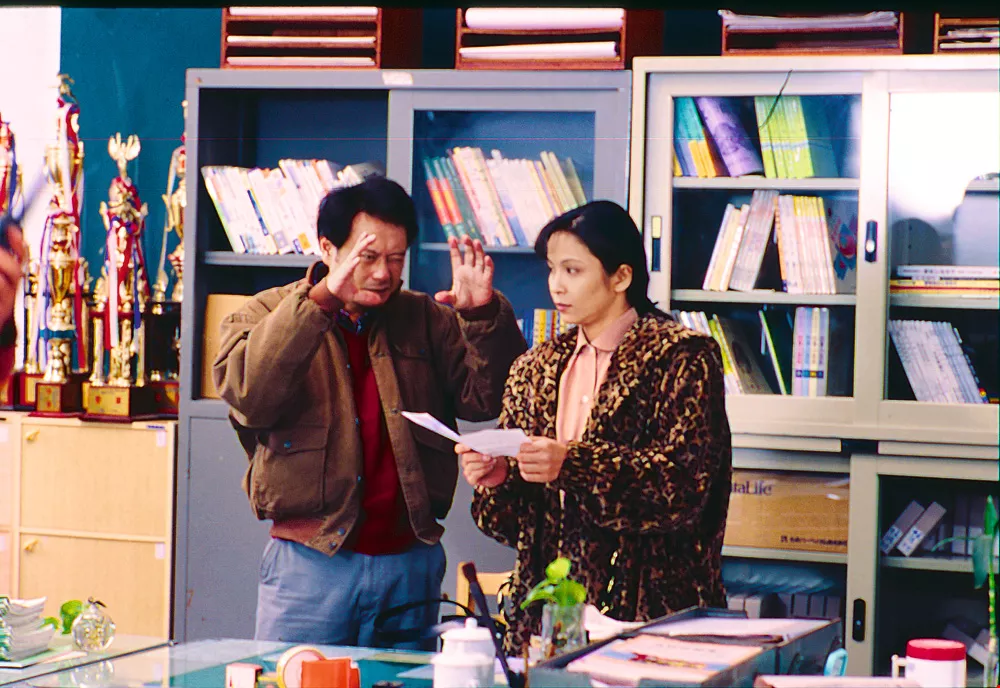
Lee returned to Taiwan in 1993 to shoot Eat, Drink, Man, Woman. Here he gives direction to Yang Kuei-mei, who plays a teacher in the film.
An unknown power
“I have to believe that there’s another power, that fate has decreed I do this work. I sense something unknown and unknowable, an illusory conviction, a kind of otherworldly aid. I believe I am a servant to the arts.”
Having won two Oscars for directing, two Golden Bears, and two Golden Lions (from the Venice Film Festival), Lee has already earned his place in film history.
“I have a hard time explaining why I feel stressed about winning awards. When an award is announced and I see the audience standing up and applauding me, I can feel the waves of goodwill radiating from everyone. It truly makes me very happy.”
Going home, on the other hand, is always an emotional experience. He is warmly received every time he comes back, but the crowds who are so eager to meet him make him uncomfortable.
When Lee, who sees his creative powers as a gift from the heavens, gave his acceptance speech at the Oscars, he made a point of first thanking the “movie god.”
He says he is surrounded by people far smarter than he is, but who haven’t made nearly so many films. He adds that when he fully commits to a project, he feels fearless and empowered. With the people around him also doing their utmost to assist him, it’s almost as if the heavens themselves are lending a hand.
A born filmmaker and a true artist who never repeats himself, Lee has been embraced by Taiwan for his sincerity and genuineness. He is sure to respond with even greater achievements.

Lee had long wanted to shoot an art-house movie in 3D. His dream came true when he made much of Life of Pi in Taiwan. The film’s fantasy scenes have deep philosophical roots and helped generate box-office revenues that rank among the top 100 in film history.


@List.jpg?w=522&h=410&mode=crop&format=webp&quality=80)

